
Types of Borderline Personality Disorder (BPD): The 4 Types, 9 Traits & DSM-5 Reality

Borderline Personality Disorder (BPD) is perhaps the most misunderstood diagnosis in the mental health landscape. Often portrayed in media as a monolith of “instability,” the clinical reality is far more nuanced. Many individuals who struggle with this condition find that their experiences don’t always align with the “classic” stereotypes. This has led to a surge of interest in the different types of borderline personality disorder, as people look for a more precise language to describe their internal world.
If you have ever wondered what are the types of borderline personality disorder, or why some people “act out” while others “act in,” you are essentially looking at the diverse ways emotional dysregulation manifests. In this guide, we will break down the official DSM-5 criteria, explore the commonly referenced clinical subtypes, and provide a clear roadmap for understanding the 4 types of borderline personality disorder.
What Is Borderline Personality Disorder?
At its core, borderline personality disorder is a disorder of the emotional regulation system. It is characterized by a pervasive pattern of instability in relationships, self-image, and emotions, alongside marked impulsivity.
Individuals with borderline disorder often experience emotions with an intensity that feels physically painful. Marsha Linehan, the creator of DBT, famously described people with BPD as having “third-degree emotional burns,” lacking the emotional “skin” to protect them from even minor social slights or changes.
It is important to distinguish borderline personality from mood disorders like Bipolar Disorder. While Bipolar Disorder involves biological cycles of mania and depression that can last weeks, BPD involves “mood reactivity”—rapid shifts in emotion that are usually triggered by interpersonal events (like a text message not being returned) and last only a few hours.
Do Official “Types” of BPD Exist in the DSM-5?
When researching types of borderline personality disorder dsm-5, many are surprised to find that the official manual does not list any subtypes. In the eyes of the American Psychiatric Association, BPD is a singular diagnosis.
To be diagnosed, a person must meet at least 5 of the 9 specific criteria. This means there are technically 256 different combinations of symptoms that can result in a BPD diagnosis. Because of this high variability, clinicians and researchers began to look for patterns in how these traits cluster.
So, are there different types of borderline personality disorder? Clinically, yes; officially, no. The “types” we discuss today—like Petulant or Quiet BPD—are descriptive clinical patterns used to help therapists understand a patient’s unique “flavor” of BPD, but you will not find them on an insurance claim form.
Why Do People Talk About 4, 5, or 9 Types of BPD?
The confusion surrounding how many types of borderline personality disorder are there usually stems from different psychological theories.
- The 4 Types: This is the most famous model, developed by psychologist Theodore Millon. He categorized BPD into four subtypes based on how the personality interacts with the environment.
- The 5 Types: Some clinicians add “Quiet BPD” as a separate fifth category, although it is usually considered a variation of the Discouraged type.
- The 9 Types: This is often a misunderstanding of the 9 types of borderline personality disorder traits. There aren’t nine types; there are nine criteria.
Most modern discourse focuses on Millon’s four types of borderline personality disorder, as they provide a helpful framework for understanding whether a person externalizes their pain (Impulsive/Petulant) or internalizes it (Discouraged/Self-Destructive).
The 4 Most Commonly Referenced Types of Borderline Personality Disorder
Understanding the 4 different types of borderline personality disorder helps bridge the gap between a checklist of symptoms and the actual lived experience of the disorder.
1. Impulsive BPD (The Externalizing Type)
Individuals with the impulsive subtype often struggle most with the behavioral aspects of the disorder. Their emotional pain is pushed outward into immediate action.
- Key Traits: Frequent emotional outbursts, a “live for the moment” attitude that ignores consequences, and high-risk behaviors.
- Examples: Impulsive spending, substance misuse, reckless driving, or sudden, intense sexual encounters.
- The Goal: The impulsivity usually serves as a “distraction” from deep-seated feelings of emptiness or pain.
2. Petulant Borderline Personality Disorder
The petulant borderline personality disorder subtype is defined by a sense of resentment and disappointment. These individuals often feel that the world has “cheated” them or that they are never truly understood by others.
- Key Traits: Passive-aggressive behavior, persistent irritability, and a “push-pull” relationship dynamic.
- Interpersonal Style: They may become sullen or stubborn when they feel their needs aren’t being met, yet they are terrified of being abandoned. They often “test” people to see if they will stay.
3. Discouraged Borderline Personality Disorder
Commonly referred to as “Quiet BPD,” the discouraged borderline personality disorder subtype is defined by internalized distress. Instead of acting out against others, they act in against themselves.
- Key Traits: Extreme dependency on a “Favorite Person” (FP), internalized shame, and intense feelings of inadequacy.
- Attachment Style: They often present with avoidant attachment patterns or anxious-avoidant styles, appearing “clingy” yet terrified of intimacy because of the potential for rejection.
4. Self-Destructive Borderline Personality Disorder
This type is characterized by a pervasive sense of self-hatred. In the self-destructive borderline personality disorder subtype, the individual’s anger is turned almost entirely inward.
- Key Traits: Chronic suicidal ideation, frequent self-harm, and the “sabotage” of good things in their life.
- The Logic: If they feel a relationship is going too well, they may destroy it themselves to “get it over with” before the other person can leave them.
Quiet Borderline Personality Disorder (High-Functioning / Internalizing)

The term quiet borderline personality disorder has gained massive popularity on social media and in forums because it describes a group that feels “invisible” in the clinical community. Many people with this type are considered high functioning borderline personality disorder cases.
In Quiet BPD, the “rage” and “splitting” (viewing people as all good or all bad) happen entirely within the person’s mind. To the outside world, they may seem calm, successful, or even “perfect.” However, inside, they are experiencing:
- Severe Masking: Putting on a “normal” face while feeling a level-10 emotional crisis.
- Misdiagnosis Risk: Because they don’t have the “angry outbursts” associated with BPD, they are often misdiagnosed with simple depression or social anxiety for years.
- Internal Splitting: Instead of hating the person who hurt them, they turn the “hate” on themselves for being “too sensitive” or “broken.”
Are There 5 Types or 9 Types of Borderline Personality Disorder?
As mentioned, when you see references to 5 types of borderline personality disorder or 9 types of borderline personality disorder, it is usually a conflation of Millon’s subtypes with the DSM traits.
There are no official “9 types.” However, some researchers use “trait-specified” models where they look at which of the 9 traits is most dominant. For example, some might call someone an “Aggressive-type” if their dominant trait is intense anger, or an “Empty-type” if their dominant trait is chronic emptiness. These are not diagnostic categories but ways to describe the unique suffering of the individual.
What Are the 9 Core Traits of Borderline Personality Disorder?
While the 4 types of borderline personality disorder help categorize behaviors, clinicians always return to the foundational 9 traits of BPD listed in the DSM-5. These criteria act as the building blocks for every subtype. To receive a diagnosis, an individual must persistently display at least five of these:
- Frantic Efforts to Avoid Abandonment: Real or imagined rejection triggers extreme panic.
- Unstable Interpersonal Relationships: A cycle of “splitting”—alternating between extreme idealization (“You’re my hero”) and devaluation (“You’re a monster”).
- Identity Disturbance: A markedly unstable self-image; feeling like you have no “solid” personality or core.
- Impulsivity: Engaging in at least two potentially self-damaging behaviors (e.g., overspending, unsafe sex, substance use, reckless driving).
- Recurrent Suicidal Behavior or Self-Mutilation: Using self-harm or threats as a way to communicate pain or regulate overwhelming emotions.
- Affective Instability: Intense “mood reactivity” where moods change rapidly in response to environmental stressors.
- Chronic Feelings of Emptiness: Described as a physical ache or a “void” that cannot be filled.
- Inappropriate, Intense Anger: Difficulty controlling “borderline rage,” often followed by deep shame.
- Stress-Related Paranoia or Dissociation: Feeling “spaced out,” numb, or irrationally suspicious when under pressure.
Do People With BPD Know They Have It?
One of the most common questions from loved ones is: “Do people with BPD know they have it?” The answer is complex and involves insight variability.
- The Egodystonic Struggle: Many people with BPD are acutely aware that they are “different” or that their emotions are more painful than those of others. They often hate their own reactions, a state called being egodystonic.
- Defense Mechanisms: To survive the agony of their emotions, the BPD brain uses primitive defense mechanisms like denial, projection, and splitting. In the heat of a “trigger,” they may truly believe the other person is the “bad guy” to protect their own fragile sense of self.
- The “Victim” Narrative: Because BPD often stems from childhood trauma or invalidation, an individual may lack the insight to see how their reactive behaviors contribute to their relationship chaos. They feel like they are perpetually being attacked, so their “rage” feels like self-defense.
Insight typically grows through specialized therapy, where patients learn to bridge the gap between their feelings and their actions.
What Happens If Borderline Personality Disorder Is Untreated?
BPD is not a condition that typically “goes away” on its own without intervention. What happens if BPD is untreated? The consequences can ripple through every area of a person’s life:
- “The Wreckage” of Relationships: Chronic instability often leads to multiple divorces, estrangement from family, and a lack of long-term friendships.
- Occupational Impairment: Difficulty with authority figures or perceived slights from coworkers can lead to frequent job loss or a “career-hopping” pattern.
- Health Risks: Untreated BPD is a significant risk factor for chronic medical conditions (due to stress and poor self-care), substance addiction, and eating disorders.
- The 10% Statistic: Tragically, research suggests that up to 10% of individuals with BPD eventually die by suicide if they do not receive proper treatment. This is why early diagnosis is life-saving.
Borderline Personality Disorder Types Test: Do Subtype Tests Exist?
If you search for a types of borderline personality disorder test or a 4 types of bpd test, you will find many online quizzes. However, it is vital to frame these correctly:
Clinical Reality: There is no scientifically validated “Subtype Test.” Official tests like the Zanarini Rating Scale or the MSI-BPD only measure if you have BPD—not which “type” you are.
Online subtype quizzes measure your behavioral tendencies. For example, if you answer “yes” to questions about social withdrawal and internalized shame, the test will label you “Discouraged.” While these can be helpful for self-reflection, a clinician focuses on your traits rather than your label, as many people drift between subtypes over the course of their lives.
BPD vs. Avoidant & Dismissive Personality Styles
Confusion often arises when comparing BPD vs. avoidant styles. While they may look similar (both involve social withdrawal), the motivation is different.
| Feature | BPD (Discouraged/Quiet) | Avoidant PD (AVPD) | Dismissive-Avoidant (Attachment) |
| Core Motivation | Fear of Abandonment | Fear of Embarrassment/Rejection | Fear of Enmeshment/Loss of Autonomy |
| View of Others | “I need you but I’m afraid you’ll leave.” | “I want to be near you but I’m not good enough.” | “I don’t need you; I’m better off alone.” |
| Response to Conflict | Intense emotion/clinging | Extreme shame/hiding | Emotional shutdown/distancing |
Someone with avoidant personality disorder traits feels socially inept but deeply desires connection. In contrast, someone with BPD has a shifting sense of self—they might feel superior one moment and worthless the next.
How to Explain BPD to Someone Who Doesn’t Have It
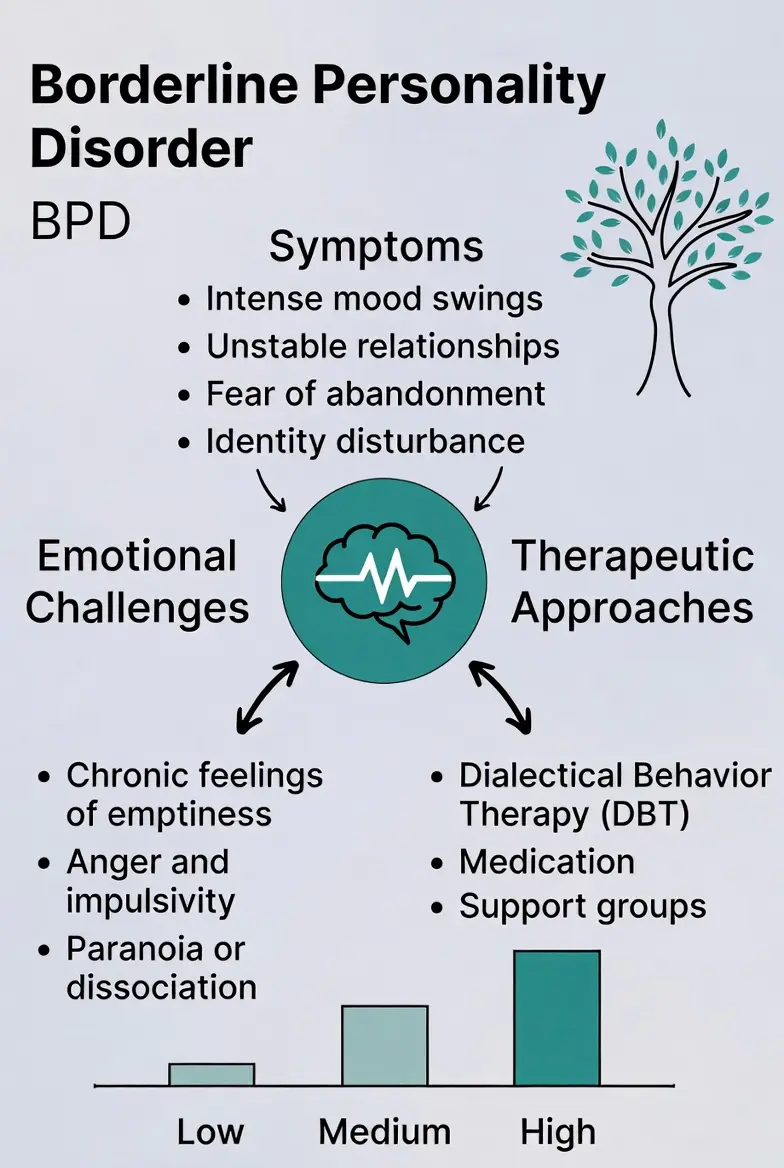
Explaining the types of borderline personality disorder to a partner or friend requires moving away from clinical jargon.
The “Burn Victim” Analogy
Imagine a person who has third-degree burns over 90% of their body. Even a gentle breeze or a light touch causes agonizing pain. People with BPD lack the “emotional skin” most people have. A “minor” disagreement isn’t a breeze to them—it’s a blow to an open wound.
The “Flipped Switch” Analogy
Explain that your brain has a “safety switch” that flips when you feel threatened. When the switch is on, you are “Jekyll”—loving and kind. When the switch flips (due to fear), you become “Hyde”—defensive and angry. It isn’t a choice; it’s a neurological survival response.
Dialectical Behavior Therapy (DBT) and BPD Types
Regardless of whether an individual identifies with the impulsive, petulant, discouraged, or self-destructive subtype, the clinical approach to recovery remains largely the same. Dialectical Behavior Therapy (DBT) is the gold-standard treatment.
Developed by Dr. Marsha Linehan, DBT is based on the “dialectical” idea of balancing two opposites: Acceptance (accepting yourself and your emotions as they are) and Change (working toward new behaviors). For borderline personality disorder, DBT combines several types of therapy, including cognitive-behavioral techniques and eastern mindfulness practices.
The Four Modules of DBT
- Mindfulness: Helps the quiet BPD or discouraged type stay in the present moment, rather than spiraling into internalized shame about the past.
- Distress Tolerance: Crucial for the impulsive type, this teaches skills like “TIPP” (Temperature, Intense Exercise, Paced Breathing, Paired Muscle Relaxation) to survive a crisis without acting out.
- Emotion Regulation: Vital for petulant BPD, this module helps patients identify and “label” their emotions, reducing the intensity of mood swings.
- Interpersonal Effectiveness: Helps all different types of borderline personality navigate relationship “chaos” by teaching how to ask for needs to be met while maintaining self-respect.
BPD vs. “Jekyll and Hyde” Personality (Myth vs. Reality)
Many partners of those with BPD describe the experience as living with a “Jekyll and Hyde” personality. While this is a common trope, it is important to clarify what is a Jekyll and Hyde personality disorder in a clinical context.
In BPD, this “switching” is not a split identity (like in Dissociative Identity Disorder). Instead, it is the result of emotional dysregulation and splitting. When a person with BPD feels safe and loved, they are “Jekyll”—kind, empathetic, and nurturing. When they feel threatened, rejected, or abandoned, their brain enters a “fight-or-flight” state. In this state, they become “Hyde”—defensive, angry, or cold.
This switch is a neurological survival mechanism. The brain “shuts down” its ability to see the other person’s good qualities to protect itself from the pain of perceived betrayal.
Are There Other “Types” of Borderline Personality Disorder?
Beyond Millon’s 4 types, some researchers discuss types of borderline personality disorder subtypes based on “comorbidity” (having two disorders at once). These are often used in borderline personality disorders lists for research purposes:
- The Affective Type: High overlap with Mood Disorders (Depression/Anxiety).
- The Aggressive Type: High overlap with Antisocial Personality Disorder traits.
- The Identity-Disturbed Type: Focuses almost entirely on a lack of sense of self.
While these labels can help clinicians pick the right medication or therapy focus, they can also be harmful if they make a patient feel “boxed in.” The most important thing is treating the individual, not the label.
FAQs About Types of Borderline Personality Disorder
How many types of borderline personality disorder are there?
Officially, there is only one BPD diagnosis in the DSM-5. However, clinically, the 4 types (Impulsive, Petulant, Discouraged, Self-Destructive) are widely used to describe different symptom patterns.
What are the 4 types of borderline personality disorder?
They are Impulsive (acting out), Petulant (irritable/passive-aggressive), Discouraged (quiet/internalized), and Self-Destructive (self-harm/sabotage).
Can my “type” change over time?
Yes. It is very common for someone to start as an impulsive type in their teens and transition into a discouraged (quiet) or self-destructive type in adulthood as they learn to mask their symptoms better.
Key Takeaways: Understanding BPD Without Oversimplifying It
- Look Beyond the Label: Whether you identify as “Quiet” or “Impulsive,” the core of the disorder is emotional sensitivity.
- Diagnosis Requires a Professional: A borderline personality disorder test found online is a starting point, but a clinical interview is the only way to confirm a diagnosis.
- Remission is Possible: BPD has one of the highest recovery rates of all personality disorders. With the right therapy, most people eventually “graduate” out of the diagnostic criteria.
- Practice Compassion: If you are a loved one, remember that the “Hyde” side of BPD is a reaction to intense, invisible pain—not a lack of love for you.
Authoritative References & Resources
- National Institute of Mental Health (NIMH): Borderline Personality Disorder
- American Psychiatric Association (APA): What is Borderline Personality Disorder?
- McLean Hospital: Essential Guide to Borderline Personality Disorder McLean
- National Education Alliance for Borderline Personality Disorder (NEA-BPD)
- Cochrane Library: Psychosocial Interventions for BPD

Related Posts






Subscribe to Our Newsletter
Get mental health tips, updates, and resources delivered to your inbox.
MORE from Author
Read More In my practice as a clinical psychologist, I often observe that the difference between a patient who crumbles under pressure…
- We all have "up" days and "down" days. Perhaps you feel energized after a promotion or sluggish on a rainy…


 To define bipolar disorder accurately, we must look at it as a chronic mood dysregulation condition. In psychology and medicine,…
 To answer whether bipolar fits the bill, we first have to define what a neurodivergent person actually is. The term…

Are you looking for a Therapist?
Connect with qualified mental health professionals who understand
bipolar disorder, mood changes, and emotional challenges.
Private • Supportive • Confidential