
Dorsal Vagal Shutdown: Symptoms, Causes, Duration, and How to Recover

Medically reviewed by Laura Athey Updated Date: April 20, 2026
In my clinical work at Reflection Psychological Services, I have personally understood that Dorsal Vagal Shutdown is the body’s ultimate “emergency brake.” I’ve realized through talking with patients that this state is a biological collapse—a survival mechanism triggered when the nervous system perceives a threat as life-threatening and inescapable.
Unlike the high-energy “fight-or-flight” response, shutdown manifests as profound numbness, dissociation, and physical exhaustion.
Symptoms often include brain fog, digestive “stalling,” and a feeling of being “behind glass.” I have personally understood that while this state is protective, staying in it long-term can erode your sense of identity.
Recovery requires a gentle, somatic approach to restore safety and “thaw” the nervous system, moving you back toward connection and vitality.
In my clinical work, I have personally understood that shutdown is not a choice; it is a physiological necessity. I’ve realized through working with survivors of chronic stress and neurodivergent adults that the dorsal vagal shutdown’s meaning is rooted in the body’s oldest survival strategy: immobilization.
“Why Do I Feel Shut Down, Numb, and Exhausted?”
Have you ever reached a point where you weren’t just tired, but felt completely “erased”? Perhaps you’ve experienced a day where your body felt like lead, your emotions were inaccessible, and even the simplest task felt like trying to swim through wet concrete.
Many people describe this as “hitting a wall,” but in reality, it is something much deeper and more biological. It is a state known as dorsal vagal shutdown.
If you are asking, “What is dorsal vagal shutdown?”, you are likely looking for a name for the profound sense of numbness, exhaustion, and dissociation that has taken over your life.
You might feel broken, lazy, or hopelessly depressed, but it is important to understand that what you are experiencing is not a character flaw. It is a sophisticated, albeit distressing, survival mechanism of your nervous system.
What does dorsal vagal shutdown feel like? It feels like the power has been cut to your emotional and physical house. In this state, your brain has decided that life has become “too much” to handle, and in an act of radical self-protection, it has pulled the emergency brake.
This guide is designed to help you understand the Polyvagal Theory behind this collapse, recognize the symptoms, and—most importantly—provide the gentle somatic tools you need to find your way back to safety and connection.
What Is Dorsal Vagal Shutdown?
To understand the dorsal vagal shutdown’s meaning, we must first recognize that our nervous system is a surveillance system. Its primary job is to keep us alive. Is dorsal vagal shutdown real? Absolutely. It is a recognized physiological state within the framework of Polyvagal Theory, developed by Dr. Stephen Porges.
In the simplest terms, what is a dorsal vagal shutdown? It is the “last resort” of the autonomic nervous system. When your system perceives a threat that is too big to fight and too fast to run away from, it defaults to the oldest part of the vagus nerve—the dorsal branch.
This branch triggers a state of immobilization, metabolic conservation, and “feigning death.” While a gazelle might do this to survive a predator, humans do this in response to chronic stress, trauma, or overwhelming life events.
Polyvagal Theory Explained Simply
The polyvagal theory dorsal vagal shutdown explanation relies on a “ladder” of three distinct states:
- Ventral Vagal (Safety & Connection): The top of the ladder. This is where we feel social, creative, and calm.
- Sympathetic (Fight or Flight): The middle of the ladder. This is high-energy mobilization—anxiety, anger, or frantic productivity.
- Dorsal Vagal (Shutdown): The bottom of the ladder. If “fight or flight” fails to resolve the danger, the system collapses into shutdown to preserve what little energy remains.
Understanding this hierarchy is vital because it proves that shutdown is a survival response, not a failure of will. Your body isn’t trying to punish you; it is trying to save you from perceived annihilation.
What Does Dorsal Vagal Shutdown Feel Like?
The subjective experience of this state is often described as a “living death” or a “gray world.” What does dorsal vagal shutdown feel like? Unlike the high-octane panic of the sympathetic state, the dorsal state is quiet, heavy, and cold.
- Emotional Numbness: You may feel “flat.” Even things that usually bring you joy or sadness feel distant, as if they are happening to someone else.
- Extreme Fatigue: This isn’t just “sleepy” tired. It is a deep, bone-weary exhaustion that sleep doesn’t seem to fix.
- Dorsal Vagal Shutdown Dissociation: You might feel “spacey” or disconnected from your body, as if you are watching your life from a balcony.
- Dorsal Vagal Collapse: Physically, your posture may slump, your voice might become monotone, and your heart rate and blood pressure drop.
- The “I Don’t Care” Paradox: You might feel a profound sense of hopelessness, yet simultaneously feel too numb to truly panic about it.
Symptoms of Dorsal Vagal Shutdown
Identifying the symptoms of dorsal vagal shutdown is essential for distinguishing this state from simple laziness or a standard depressive episode. Because the vagus nerve connects the brain to the gut, heart, and lungs, the dorsal vagal shutdown symptoms manifest across the entire body.
Physical Symptoms
- Digestive Issues: Constipation, bloating, or “slow” digestion (the system shuts down non-essential functions).
- Low Blood Pressure & Heart Rate: Feeling faint or dizzy when standing.
- Cold Extremities: Poor circulation as the body pulls blood toward the core.
- Decreased Pain Sensitivity: A physical “numbing” that mirrors the emotional one.
Emotional & Cognitive Symptoms
- Brain Fog: Difficulty processing information or making basic decisions.
- Loss of Identity: A sense of “Who am I?” because your preferences and passions have gone offline.
- Shame: A deep, visceral sense that there is something fundamentally wrong with you.
- Social Withdrawal: An inability to make eye contact or engage in “small talk.”
Behavioral Symptoms
- Task Paralysis: Staring at a screen or a pile of laundry for hours, unable to start.
- Increased Sleep: Sleeping for 10+ hours and still feeling unrefreshed.
- Avoidance: Avoiding phone calls, emails, and social obligations because they feel like threats to your limited energy.
Dorsal Vagal Shutdown vs. Freeze vs. Depression
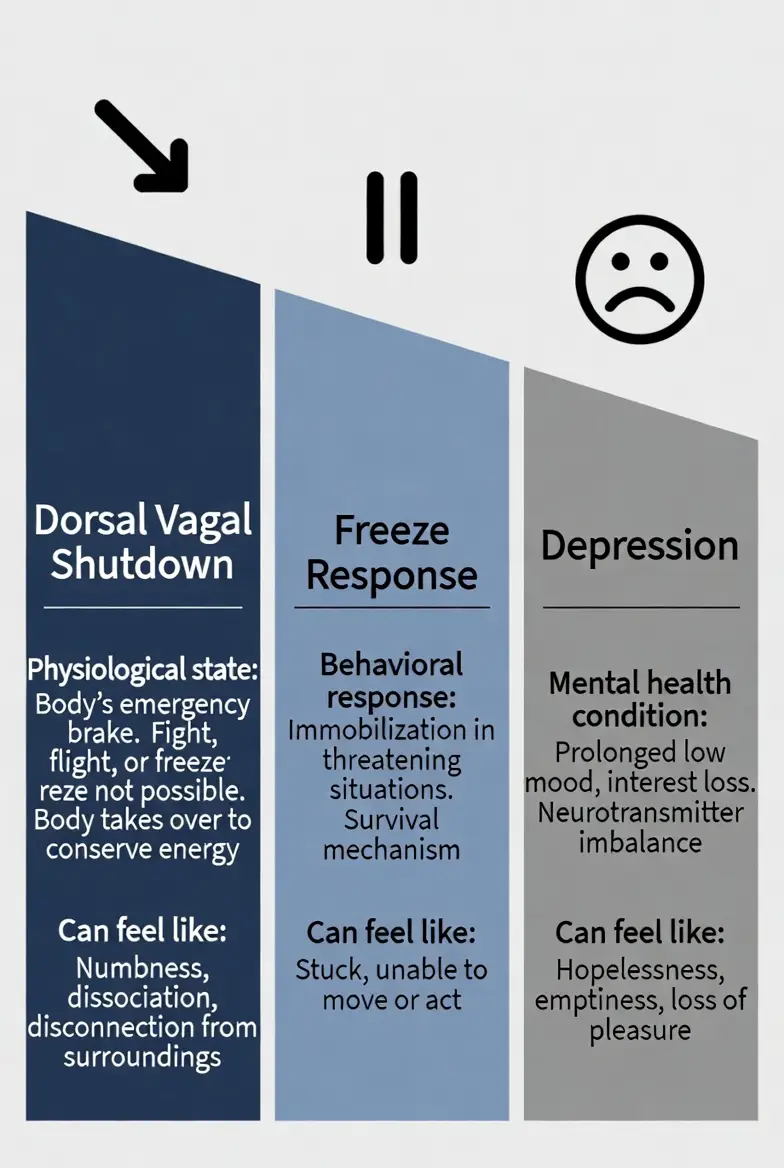
There is often significant confusion surrounding the terms dorsal vagal shutdown vs freeze. While they look similar from the outside, they are physiologically different.
- Dorsal Vagal Freeze: This is a “high-arousal” state of immobility. Imagine a car with the gas and the brake slammed down at the same time. There is a lot of internal energy (panic), but the body is stuck.
- Dorsal Vagal Shutdown: This is “low-arousal” collapse. The engine has been turned off entirely. There is no panic—only numbness and low energy.
Why it’s misdiagnosed as depression: Many people in shutdown are told they have clinical depression. While the symptoms overlap (lethargy, hopelessness), the cause is different.
Depression is often treated with “top-down” talk therapy or antidepressants, but dorsal vagal shutdown symptoms often require a “bottom-up” somatic approach to convince the nervous system it is safe enough to come back online.
What Causes Dorsal Vagal Shutdown?
The nervous system does not collapse without reason. What causes dorsal vagal shutdown is usually a cumulative “overload” of the system’s capacity to cope.
- Chronic Stress: Living in a state of “fight or flight” for years without reprieve will eventually lead the system to blow a fuse.
- Trauma & Complex PTSD: Relational trauma or childhood emotional neglect often “primes” the nervous system to default to shutdown as a primary defense.
- Burnout: Professional or caregiver burnout, where the demands of life consistently exceed the resources available.
- Medical Trauma: Surgeries or chronic illnesses can trigger a “biological shutdown” to facilitate healing, which the system then gets stuck in.
- Long-Term Overwhelm: Sensory overload or high-conflict environments where “escaping” is not an option.
In cases of chronic dorsal vagal shutdown, the system has essentially decided that the world is permanently unsafe, and it remains in a low-power “safe mode” to prevent further damage.
Dorsal Vagal Shutdown and ADHD
There is a profound overlap between dorsal vagal shutdown and ADHD, particularly regarding the concept of “ADHD Paralysis.” I have personally understood that for neurodivergent individuals, the world is often a source of constant sensory and executive function overload.
When an ADHD brain faces a mountain of tasks, the sheer volume of “noise” can trigger a nervous system threat response. I’ve realized that what looks like procrastination is often a dorsal vagal shutdown ADHD response.
The system is so overwhelmed by the effort of masking and managing executive dysfunction that it simply “shuts off” to prevent a total circuit blow. In this state, “trying harder” only increases the perceived threat, pushing the individual deeper into the basement of the polyvagal ladder.
How Long Does Dorsal Vagal Shutdown Last?
One of the most frequent questions I hear is, “How long does dorsal vagal shutdown last?” The answer depends entirely on the environment and the degree of perceived safety.
- Acute Shutdown: This can last from a few hours to a few days. It usually follows a specific high-stress event, like a major argument or a grueling work deadline.
- Chronic Shutdown: I have personally understood that dorsal vagal shutdown for years is possible if the underlying stressor (like an abusive relationship or a toxic job) remains unchanged.
I’ve realized through talking with patients that you cannot “think” your way out of a timeline. The duration is determined by when the body finally receives enough “cues of safety” to believe it is no longer in life-threatening danger. Dorsal vagal shutdown, how long does it last, is ultimately a question of how quickly we can restore a sense of biological security.
Is Dorsal Vagal Shutdown Dangerous?
I want to provide immediate reassurance here: Is dorsal vagal shutdown dangerous? In the short term, no. It is a brilliant physiological adaptation designed to keep you alive. However, I have personally understood that staying in a state of dorsal vagal collapse for long periods can have health implications.
Chronic low-metabolic states can affect your immune system, digestion, and cardiovascular health. I’ve realized that the primary “danger” is the impact on your quality of life—the loss of connection, the erosion of identity, and the deep sense of hopelessness. I
f you are experiencing suicidal ideation or a total inability to care for yourself, that is the time to seek professional support.
Dorsal Vagal Shutdown, Dissociation & Collapse
I have personally understood that dorsal vagal shutdown dissociation is the mind’s way of “checking out” when the body is stuck. If you cannot physically leave a painful situation, your mind leaves for you.
This “collapse” is both emotional and somatic. I’ve realized through my work that grounding exercises—like “feeling your feet on the floor”—can actually feel threatening at first to someone in deep shutdown.
If the body feels like a place of pain or failure, “coming back into it” feels like entering a burning building. Recovery must be handled with extreme gentleness.
Dorsal Vagal Shutdown Test & Self-Assessment
While this is not a clinical diagnosis, you can use this checklist to reflect on your current state. If you check more than 4 of these, you may be in a dorsal state:
- Do I feel “numb” or “empty” rather than just sad?
- Is my breathing shallow and my heart rate unusually low?
- Do I feel disconnected from my body (like I’m floating or “foggy”)?
- Have I lost interest in things I used to love (anhedonia)?
- Does looking at or talking to people feel physically taxing?
- Do I feel like I am moving through “invisible mud”?
The Bipolar Connection: Shutdown as a Biological Crash
While Bipolar Disorder involves chemical and genetic factors, the depressive phases are often physiologically identical to a dorsal vagal shutdown. In this context, shutdown functions as the biological “crash” following the high-energy state of mania or hypomania.
When the nervous system remains in intense sympathetic arousal for too long, it hits a point of exhaustion. To prevent systemic failure, the brain shifts the individual into immobilization. Recognizing these “lows” as a protective response is vital.
Recovery for those on the bipolar spectrum requires both clinical management and somatic tools to “thaw” out of this protective numbness safely.
How to Get Out of Dorsal Vagal Shutdown
I have personally understood that the biggest mistake people make is trying to jump from “Shutdown” straight to “Productivity.” You cannot bypass the “Fight or Flight” (Sympathetic) state on your way back to “Safety” (Ventral).
1. What Not to Do First
- Forcing Motivation: Shaming yourself for being “lazy” will only keep you in shutdown.
- Aggressive Exercise: Jumping into a high-intensity workout can shock a collapsed system.
- Positive Thinking: You cannot “affirm” your way out of a biological nerve response.
2. How to Gently Come Out of Shutdown
I’ve realized that the goal is to introduce “micro-mobilization.” We want to tell the body, “It’s okay to move a little bit.” How to get out of dorsal vagal shutdown involves slow, rhythmic, and sensory-based cues. You must climb the polyvagal ladder one rung at a time.
Dorsal Vagal Shutdown Exercises

To begin the ascent up the polyvagal ladder, we use “bottom-up” tools. I have personally understood that dorsal vagal shutdown exercises should never feel like a workout; they should feel like a gentle invitation to return to the world.
- Orienting Responses: I’ve realized that slowly scanning the room and naming five colors you see tells the brain you are in a physical space that is currently safe.
- Micro-Movements: Start by just wiggling your toes or circling your wrists. I have personally understood that for a collapsed system, a wrist circle is a massive victory.
- Temperature Shifts: I often recommend splashing cold water on the face or holding an ice cube. This sensory “pop” can gently pull you out of dorsal vagal dissociation without overwhelming the system.
- The “Voo” Breath: Gently fogging up an imaginary mirror or making a low “Voo” sound on the exhale creates a vibration that stimulates the vagus nerve toward regulation.
Dorsal Vagal Shutdown Treatment & Healing Options
When a person is in chronic dorsal vagal shutdown, self-help exercises may not be enough. I have personally understood that professional dorsal vagal shutdown treatment requires a specialist who speaks the language of the nervous system.
- Somatic Experiencing (SE): This focuses on releasing stored tension in the body rather than just talking about memories.
- EMDR: Helpful if the shutdown is a “freeze-frame” of a past traumatic event.
- Safe and Sound Protocol (SSP): A non-invasive acoustic treatment designed to “retrain” the nervous system to process frequencies associated with safety.
- Medication: While there is no “shutdown pill,” I’ve realized that some patients benefit from medication that addresses the underlying anxiety or depression that feeds the collapse.
How to Reset the Vagus Nervous System
I am often asked, “How to reset vagus nervous system?” and I always clarify: we aren’t looking for a “reset” like a computer button, but a “reregulation.” I have personally understood that you cannot force a reset.
How do I know if my vagus nerve is out of balance? Signs include poor digestion, chronic brain fog, and a “flat” vocal tone. If you are wondering about vagus nerve entrapment symptoms, it’s important to note that while physical entrapment (like from a neck injury) is rare, “functional” entrapment—where the nerve is stuck in a dorsal signal—is very common.
I’ve realized that rebuilding the vagal tone is like physical therapy for your emotions; it takes time, repetition, and immense patience.
Long-Term Effects of Chronic Dorsal Vagal Shutdown
I have personally understood that the long-term effects of dorsal vagal shutdown are cumulative. I’ve realized through my work that living in “safe mode” for too long can lead to:
- Identity Loss: You forget what you like, what you want, and who you are.
- Emotional Blunting: A permanent “dimmer switch” on all emotions, including love and joy.
- Physical Health Issues: Chronic inflammation and gut health issues are common in long-term collapse.
Frequently Asked Questions
What are the physical symptoms of a dorsal vagal state?
Beyond the feeling of numbness, you may notice objective physical shifts. Because the dorsal branch of the vagus nerve influences the organs below the diaphragm, common symptoms include a significantly slowed heart rate, shallow or “invisible” breathing, and digestive “stalling” (constipation or low appetite).
I have personally understood that many patients also experience a literal drop in body temperature, especially in the hands and feet, as the body pulls blood toward the core for survival.
How do I know if my vagus nerve is out of balance?
You can identify an imbalance by your “resilience factor.” If you find that you have a very narrow “window of tolerance”—meaning you move quickly from being slightly stressed to being completely “checked out” or numb—your vagus nerve is likely stuck in a defensive pattern.
I’ve realized that a healthy vagus nerve allows for “vagal tone,” where the heart rate fluctuates naturally with the breath (Respiratory Sinus Arrhythmia), allowing you to bounce back from stress rather than collapsing under it.
Is dorsal vagal shutdown dangerous?
In the short term, no; it is a brilliant adaptation to keep you alive during an overwhelming threat. However, I have personally understood that staying in a “chronic” shutdown for months or years can lead to long-term health complications.
I’ve realized through my work that prolonged metabolic suppression can affect the immune system and lead to chronic inflammation. The primary “danger” is the erosion of your quality of life and the loss of connection to those you love.
What is the “thawing” phase?
This is a critical concept in recovery. As you move out of the “numbness” of the dorsal state, you will likely pass through the “sympathetic” state on your way back to calm. I have personally understood that this feels like a sudden surge of anxiety, anger, or “tingling” as the energy returns to your limbs.
I’ve realized that many people mistake this for getting worse, but it is actually a sign that your system is “thawing” and coming back online.
Can I reset the vagus nerve instantly?
I’ve learned through conversations with my clients that there is no “instant reset” button, despite what social media might claim. You cannot force the nervous system into safety. I have personally understood that “resetting” is actually a process of re-patterning.
It requires consistent, small “cues of safety” over time to convince the primitive brain that the environment is no longer a threat.
Conclusion
As we conclude this guide at Reflection Psychological Services, I want to leave you with a final thought: Your body is on your side. I have personally understood that even when you are in the deepest shutdown, your nervous system is doing exactly what it was evolved to do—keep you alive.
I’ve realized that the path out of the fog is paved with self-compassion. How to stop dorsal vagal shutdown isn’t about fighting your body; it’s about listening to it. You aren’t broken, and you aren’t lazy. You are just waiting for the signal that it is safe to come back. When you’re ready, the light is still there.
Authoritative References
2. Dr. Stephen Porges (Official Research Site)
3. Psychology Today: The Freeze and Shutdown States
4. Dr. Laura Athey-Lloyd, Psy.D. – Clinical Authority
5. Verywell Mind: Somatic Healing for the Vagus Nerve

Related Posts






Subscribe to Our Newsletter
Get mental health tips, updates, and resources delivered to your inbox.
MORE from Author
Read More Watching someone you care about struggle with bipolar depression and anxiety can be heartbreaking. You may notice that they withdraw…
 In my practice as a clinical psychologist, I often observe that the difference between a patient who crumbles under pressure…
 We all have "up" days and "down" days. Perhaps you feel energized after a promotion or sluggish on a rainy…
 To define bipolar disorder accurately, we must look at it as a chronic mood dysregulation condition. In psychology and medicine,…
Are you looking for a Therapist?
Connect with qualified mental health professionals who understand
bipolar disorder, mood changes, and emotional challenges.
Private • Supportive • Confidential