
Emotional Dysregulation Symptoms: Causes, Signs, and Treatment Across Ages and Conditions

Medically reviewed by Laura Athey Updated Date: May 13, 2026

Have you ever felt like your emotions were a tidal wave, hitting you with such force that you were left gasping for air while everyone else seemed to be standing on dry land? In my clinical practice, I often meet individuals who describe their internal experience not as a series of feelings, but as a series of “hijacks.” They don’t just feel sad; they feel despair. They don’t just feel annoyed; they feel a white-hot rage that seemingly comes from nowhere.
Understanding emotional dysregulation symptoms is critical because, for many, these experiences are shrouded in shame. Patients often come to me after years of being told they are “too sensitive,” “dramatic,” or “difficult.”
Whether we are looking at emotional dysregulation symptoms in children or emotional dysregulation symptoms in adults, the core issue is a breakdown in the brain’s ability to modulate the intensity and duration of emotional responses. This guide is designed to help you recognize the signs, understand the biological “why” behind the storm, and identify the pathways toward a more stable emotional life.
Understanding Emotional Dysregulation
At its simplest, emotional dysregulation is the inability to flexibly respond to and manage emotional experiences. While a typical emotional response might look like a bell curve—rising in response to a trigger and gradually fading—dysregulation looks more like a vertical spike that stays at the ceiling far longer than the situation warrants.
In my practice, I find it essential to distinguish between a “bad mood” and clinical dysregulation. We all have moments of irritability. However, a formal emotional dysregulation diagnosis is considered when these symptoms consistently interfere with executive function, damage relationships, or lead to impulsive behaviors.
It is the difference between feeling frustrated by a traffic jam and feeling so enraged by it that your entire day is ruined and you find yourself screaming at strangers.
The Developmental Lens: Adults vs. Children
Dysregulation manifests differently depending on your stage of development. In children, the “brakes” of the brain—the prefrontal cortex—are still under construction. Therefore, symptoms often look like physical “meltdowns.”
In adults, the brain is fully developed, yet the communication between the emotional centers (the amygdala) and the logical centers remains frayed. For an adult, dysregulation might look less like a tantrum and more like “emotional flooding,” where one becomes paralyzed by the intensity of their internal state.
Core Symptoms of Emotional Dysregulation
Recognizing the signs of emotional dysregulation requires looking at the person as a whole—body, mind, and behavior. It is rarely just about “anger.”
General and Behavioral Signs
- Low Frustration Tolerance: A “glitch” in a task or a minor setback feels like a catastrophic failure.
- Rapid Mood Swings: Often referred to as a “labile mood,” where one can move from euphoria to deep sadness in minutes.
- Impulsivity: Making snap decisions, spending money, or ending relationships in the heat of an emotional moment.
- Interpersonal Volatility: A pattern of “push-pull” in relationships, often driven by intense reactions to perceived slights.
Physical Manifestations
One of the most overlooked emotional dysregulation symptoms is how it wears down the body. When your nervous system is constantly “red-lining,” you remain in a state of high cortisol. This leads to:
- Chronic Fatigue: The “emotional hangover” that follows a period of high intensity.
- Sleep Disturbances: Difficulty falling asleep because the brain cannot “power down” from the day’s emotional triggers.
- Somatic Complaints: Unexplained headaches, chest tightness, or digestive issues often accompany periods of feeling deregulated.
Emotional Dysregulation Symptoms in Children

For parents, identifying emotional dysregulation symptoms in children can be the difference between effective support and a cycle of ineffective punishment. In children, dysregulation is often a “can’t,” not a “won’t.”
The ADHD and Autism Connection
In cases of emotional dysregulation and ADHD, the child struggles with inhibition. They cannot stop the first wave of emotion from reaching their mouths or limbs. You may see sudden, explosive anger followed by immediate, deep regret.
In autism, emotional dysregulation symptoms, the trigger is often sensory or related to a change in routine. A child may experience an “autistic meltdown,” which is a total neurological system crash. Unlike a tantrum, which is goal-oriented (wanting a toy), a meltdown is the result of the brain being unable to process more information.
I once worked with a young patient, “Leo,” whose parents were exhausted by his daily outbursts. They had tried “time-outs,” but Leo only grew more frantic. In our sessions, we realized that Leo’s executive function was so overwhelmed that being sent away felt like abandonment, which increased his dysregulation.
I taught the parents “co-regulation”—the act of staying physically present and calm while Leo was “storming.” By using her own calm nervous system to soothe his, Leo’s brain began to learn neuroplasticity—physically building the pathways to settle him.
Emotional Dysregulation Symptoms in Adults:
When we discuss emotional dysregulation symptoms in adults, we are dealing with a complex interplay of personality, history, and neurobiology. In an adult, the “alarm system” of the brain is often calibrated too high. This is the “why” behind the biology: the amygdala (the fear center) is hyperactive, and the prefrontal cortex (the logical manager) is underactive.
BPD and Intense Emotional Responses
In BPD, emotional dysregulation symptoms, the sensitivity to social stimuli is extraordinary. I often observe patients who describe their skin as feeling “one layer too thin.” A partner being ten minutes late isn’t just a nuisance; it is interpreted by the brain as a sign of impending abandonment. The resulting emotional surge is so painful that the individual may engage in self-harm or intense conflict just to try and “regulate” that pain.
Complex PTSD and the Nervous System
For those with complex PTSD, emotional dysregulation symptoms, the dysregulation is a survival mechanism that stayed turned on long after the danger passed. These adults often struggle with:
- Emotional Numbing: A “dissociative” state where they feel nothing at all to protect themselves from feeling too much.
- Hypervigilance: Constantly scanning environments for “triggers,” which keeps the brain in a state of perpetual irritability.
- Flashbacks: Not just visual memories, but “emotional flashbacks” where the person suddenly feels the exact terror or shame they felt as a child, even in a safe environment.
Comparison of Symptoms Across Conditions
| Condition | Primary “Flavor” of Dysregulation | Common Behavioral Outcome |
| ADHD | Impulsive, brief, explosive | Immediate regret / Social friction |
| BPD | Interpersonal, intense fear | “Push-pull” relationship cycles |
| C-PTSD | Hypervigilance / Numbing | Withdrawal / Emotional flashbacks |
| Bipolar (Labile) | High-energy shifts | Risky behavior / Sleep loss |
Why Adult Dysregulation Is So Exhausting
The reason emotional dysregulation in adults is so draining is that it requires a constant “double processing.” You are trying to live your life—go to meetings, pay bills, parent children—while simultaneously fighting a massive internal fire.
This leads to “burnout,” which many mistake for standard depression, when in reality, it is the exhaustion of a system that never gets to rest.
Causes and Triggers of Emotional Dysregulation
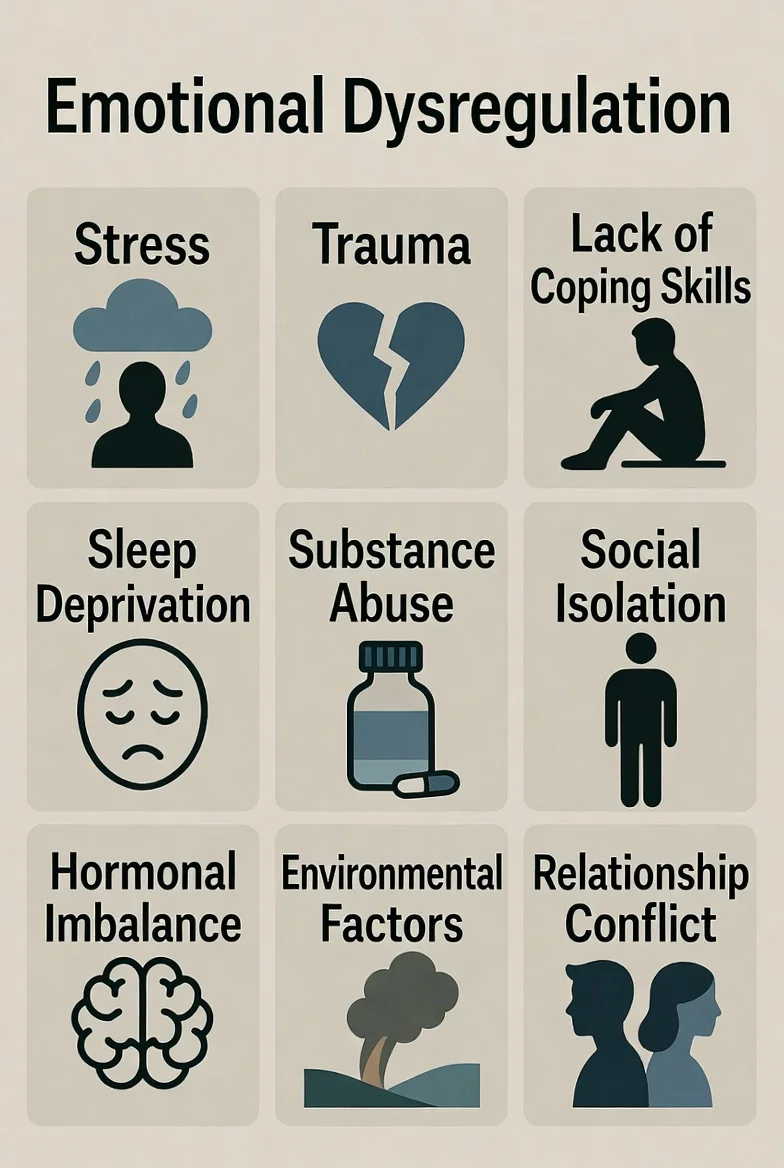
When patients ask me, “What can cause dysregulation of emotions?” I explain that it is rarely a single event. It is usually a combination of a “vulnerable” nervous system and an environment that is either overwhelming or invalidating.
Biological and Psychological Factors
The emotional dysregulation symptoms’ causes often begin with neurobiology. In ADHD and autism, the brain is simply wired to process stimuli more intensely.
However, psychology plays an equal role. If a child grows up in an “invalidating environment”—where their emotions are dismissed or punished—they never learn the vital executive function skills of self-soothing.
Common Triggers
- Sensory Overload: For many, especially those with neurodivergence, a loud office or a chaotic household acts as a constant “drain” on emotional reserves.
- Rejection or Criticism: For those with BPD or ADHD, perceived rejection can trigger an immediate “amygdala hijack.”
- Physiological Stress: A lack of sleep or poor nutrition can lower your “emotional floor,” making you far more dysregulated than you would be on a good day.
Types and Examples of Emotional Dysregulation
To help my patients identify their patterns, I categorize emotional dysregulation examples into five specific types. Understanding which type you lean toward can help guide your treatment.
Affective (Feeling)
This is the “classic” dysregulation. It is the experience of feeling “too much.”
- Example: Feeling a level of grief over a broken mug that most people would feel over a major loss.
Behavioral (Acting)
This is how the emotion comes out. It is often the most destructive part of dysregulation disorder.
- Example: Throwing a phone during an argument or impulsively quitting a job because of a frustrating email.
Cognitive (Thinking)
When you are dysregulated, your “logical brain” shuts down. You might experience “tunnel vision” or be unable to remember things clearly.
- Example: Being unable to process instructions from a boss because you are so anxious about a mistake you made.
Interpersonal (Relating)
This involves how we interact with others when our internal world is chaotic.
- Example: A child who hits a peer because they are overwhelmed by the noise of the classroom or an adult who “ghosts” a friend because they felt a minor slight.
Physiological (Body)
This is the “gut-brain” connection. Your body reacts before your mind even knows why.
- Example: Developing a severe tension headache or stomach pain immediately following an emotional conflict.
Treatment and Management
The most important thing to know about emotional dysregulation treatments is that they work. Your brain has neuroplasticity, meaning you can literally “thicken the cable” between your emotional and logical brain centers.
Evidence-Based Therapy
- DBT (Dialectical Behavior Therapy): This is the gold standard. It teaches four key pillars: mindfulness, distress tolerance, emotion regulation, and interpersonal effectiveness.
- CBT (Cognitive Behavioral Therapy): Helps you catch the “thoughts” that fuel the emotional fire.
Medication Options
While there is no “magic pill,” emotional dysregulation symptom treatment often includes
- ADHD Medications: Stimulants can help with the “inhibitory” part of regulation.
- Mood Stabilizers: Often used if the shifts are extreme or related to the bipolar spectrum.
- SSRIs: Can help lower the baseline “volume” of anxiety and depression.
In my years of practice, I have found that no amount of therapy can fix a brain that isn’t sleeping. I once had a patient who was convinced they had BPD. After three weeks of strictly regulating their circadian rhythms and improving their sleep hygiene, their “explosive” symptoms dropped by 60%. Sleep is the “glue” that keeps your prefrontal cortex attached to your amygdala.
Frequently Asked Questions
How do you know if you have emotional dysregulation?
If you frequently feel that your reactions are “out of your control,” if it takes you a long time to calm down after a minor event, or if your emotions are causing problems in your job or marriage, you are likely experiencing dysregulation.
Can children outgrow emotional dysregulation?
They don’t necessarily “outgrow” it, but they can “out-learn” it. As the brain matures, children gain better executive function, but those with ADHD or trauma often need specific skills-based training to bridge the gap.
Is emotional dysregulation always a mental health disorder?
No. It can be a temporary response to extreme stress or grief. However, when it is a long-term pattern, it usually points toward an underlying neurobiological or psychological condition.
What is a labile mood?
A labile mood refers to emotions that change very quickly and intensely. One moment you are laughing, and the next you are in tears. It is a hallmark sign of several dysregulation disorders.
Conclusion
Recognizing emotional dysregulation symptoms is the first step toward self-compassion. You are not “broken” or “difficult”; your brain’s alarm system is simply hyper-sensitive. Whether you are navigating this for yourself or your child, know that with the right combination of therapy, lifestyle adjustments, and professional support, the tidal waves can become manageable ripples.
References
- National Institute of Mental Health (NIMH) – ADHD and Emotion
- American Psychological Association (APA) – Emotion Regulation
- Journal of Clinical Psychology – DBT Effectiveness
- CHADD – Emotional Regulation in Children and Adults

Related Posts






Subscribe to Our Newsletter
Get mental health tips, updates, and resources delivered to your inbox.
MORE from Author
Read More Watching someone you care about struggle with bipolar depression and anxiety can be heartbreaking. You may notice that they withdraw…
 In my practice as a clinical psychologist, I often observe that the difference between a patient who crumbles under pressure…
 We all have "up" days and "down" days. Perhaps you feel energized after a promotion or sluggish on a rainy…
 To define bipolar disorder accurately, we must look at it as a chronic mood dysregulation condition. In psychology and medicine,…
Are you looking for a Therapist?
Connect with qualified mental health professionals who understand
bipolar disorder, mood changes, and emotional challenges.
Private • Supportive • Confidential