
OCPD vs Autism, and Finding the Right Support for Your Family

Medically reviewed by Laura Athey Updated Date: February 16, 2026

Are you feeling overwhelmed by the maze of neurodivergent labels and diagnostic terms lately? You are certainly not alone in this journey. Many families reach out to me because they feel stuck between different clinical descriptions. Perhaps you are wondering if a loved one has autism, or maybe the term “OCPD” surfaced during a recent therapy session.
Understanding the nuances of an autism diagnosis, the differences in OCPD vs autism, and finding the right support is a deeply personal process. In my clinical experience, I have seen how the right information can transform a family’s quality of life. This guide will help you navigate these complex topics with clarity and empathy. We will explore diagnostic tools, look at how conditions like OCD and ADHD overlap, and discuss finding autism-friendly environments for every stage of life.
“In my work with patients navigating mood disorders and complex diagnoses, I frequently encounter what I call the ‘Rigidity Trap.’ A patient might come in believing they have OCPD because they are perfectionists at work. However, upon closer evaluation, we find that their need for order isn’t about moral superiority (typical of OCPD) but about sensory regulation and safety (typical of Autism). Distinguishing between a personality structure and a neurotype is critical because the treatment approaches—and the path to self-acceptance—are vastly different.”
What Color Are Autism Awareness Ribbons?
If you have looked for ways to show support, you might feel confused by the different symbols available. Symbols evolve as our understanding of neurodiversity grows. Traditionally, the puzzle piece and the blue ribbon were the primary markers for autism awareness. Many organizations used these to represent the “mystery” of the condition.
However, the conversation is shifting toward more inclusive imagery. Many people in the community now prefer the rainbow infinity symbol. This represents the vast spectrum of human experience and neurodiversity. You might also see a gold infinity symbol, often used with the hashtag ActuallyAutistic. Gold is used because the chemical symbol for gold is “Au,” the first two letters of autism. While the blue ribbon remains a recognized historical marker, the move toward infinity symbols reflects a preference for seeing autism as a natural neurological difference rather than a puzzle to be solved.
Who Can Provide a Reliable Autism Diagnosis?
Getting a clear answer starts with finding the right expert. A general practitioner might notice signs, but they usually refer families to specialists for a formal autism diagnosis. In my private practice, I often work alongside a multidisciplinary team to ensure we see the whole picture. So, who exactly should you look for?
Professionals Qualified to Diagnose Autism
- Developmental Pediatricians: These doctors specialize in child development and physical health.
- Clinical Psychologists: They use standardized testing to evaluate social and cognitive patterns.
- Neuropsychologists: These experts look at the relationship between brain function and behavior.
- Psychiatrists: Medical doctors who can diagnose and manage co-occurring mental health conditions.
What Assessment Tools Are Used?
Clinicians don’t just “guess” based on a short interview. We use gold-standard tools like the ADOS-2 (Autism Diagnostic Observation Schedule) and the ADI-R (Autism Diagnostic Interview-Revised). These tests involve structured play, social interaction, and detailed family histories. It is a comprehensive process that looks at communication, sensory needs, and repetitive behaviors.
What Is the POPS Score for OCPD?
You may have heard of the POPS score while researching personality assessments. It is important to clarify that this is not a standard tool for an autism diagnosis. The POPS (Passive-Aggressive-Oppositional-Personality Scale) is sometimes discussed in the context of personality disorders.
However, for OCPD (Obsessive-Compulsive Personality Disorder), clinicians usually rely on the SCID-5 or the Millon Clinical Multiaxial Inventory (MCMI). If you are looking for an OCPD test, be wary of online quizzes. A formal diagnosis requires a clinical interview to distinguish between personality traits and developmental neurotypes.
OCPD vs Autism: What Is the Difference?
One of the most frequent questions I receive involves the overlap of OCPD vs autism. Both can involve a high need for routine and a preference for rules. However, the internal “why” is very different. Understanding the difference between autism and OCPD is crucial for getting the right therapy.
Core Traits of Autism
Autism is a developmental neurotype present from birth. It primarily affects how a person processes sensory input and communicates with the world. You might notice sensory sensitivities, such as being bothered by loud noises or certain textures.
Social communication may feel like a second language that needs to be “learned” rather than sensed intuitively. Repetitive behaviors in autism are often self-soothing or related to a deep passion for a specific topic.
Core Traits of OCPD
OCPD is a personality disorder characterized by an extreme need for perfection, order, and control. Unlike autism, OCPD is often ego-syntonic, meaning the person believes their way of doing things is the “right” or “moral” way. They may sacrifice relationships or leisure time to ensure a task is perfect.
While an autistic person follows a routine for comfort, someone with OCPD follows a routine to avoid perceived failure or disorder.
Key Differences Table
| Feature | Autism | OCPD |
| Social Understanding | Developmental difference in cues | Usually intact, but strained by rigidity |
| Motivation for Routines | Comfort and sensory regulation | Perfectionism and moral control |
| Emotional Empathy | Often high, but expressed differently | Typically intact, but hidden by logic |
| Onset of Symptoms | Early childhood (age 0-3) | Patterns emerge in early adulthood |
OCPD vs Autism in Women
The comparison of OCPD vs autism in women is particularly complex. Women are often socialized to be “helpers” and “perfectionists.” Consequently, an autistic woman might use “masking” to appear neurotypical.
This masking often looks like extreme perfectionism, leading to a misdiagnosis of OCPD. In my experience, many women diagnosed with OCPD in their 20s later discover they are actually autistic once their sensory needs are properly evaluated.
Autism and OCPD Comorbidity
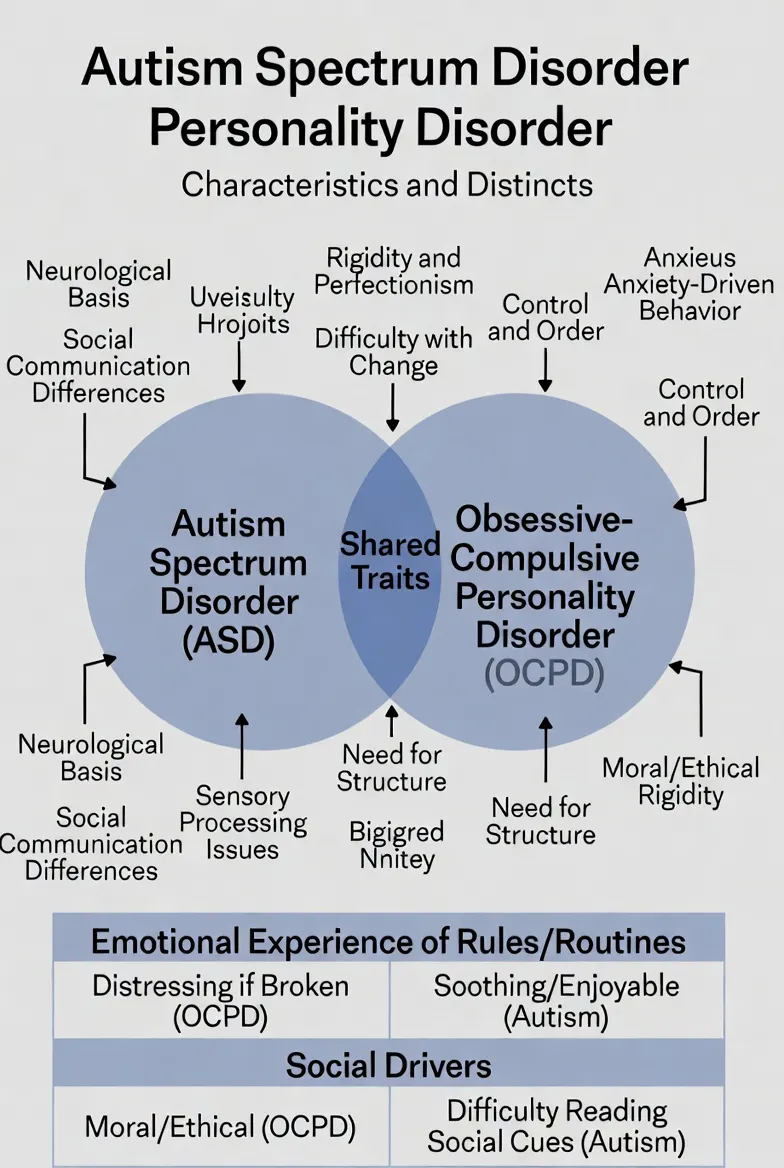
Can someone have both? Yes, autism and OCPD comorbidity is possible. When these coexist, the person may experience a “double hit” of rigidity. They have the developmental social differences of autism paired with the intense moral perfectionism of OCPD. This combination often requires a specialized therapeutic approach that respects the neurodivergent brain while addressing the anxiety-driven need for control.
Can OCPD Be Misdiagnosed as Autism?
It happens more often than you might think. This is especially true in high-achieving adults. Both groups may struggle with “black-and-white” thinking. If a clinician only looks at the behavior—like needing a desk organized a certain way—they might miss the cause. If the person organizes to avoid a sensory “meltdown,” it is likely autism. If they organize because they feel a moral “need” for order, it points toward OCPD.
OCD vs Autism in Adults
We must also look at ocd vs autism in adults. While they sound similar, OCD (Obsessive-Compulsive Disorder) is an anxiety disorder, not a personality disorder or a developmental neurotype. During my interviews with patients, I often find that the “looping” thoughts of OCD feel intrusive and unwanted.
Key Differences
In OCD vs autism, the main difference is the presence of “egodystonic” thoughts. This means people with OCD hate their obsessions; they cause intense distress. In contrast, an autistic person’s “obsessions” (special interests) are usually a source of great joy and relaxation.
Similarities Between OCD and Autism
The confusion arises because both involve repetitive behaviors. A person might wash their hands repeatedly or flip a light switch. In autism, this might be a “stim” to regulate the nervous system.
In OCD, it is a compulsion performed to stop a scary thought from coming true. There is a significant overlap between autism and ocd, and many individuals carry both diagnoses.
Autism and OCD in Women
In women, autism and ocd often manifest as internalized compulsions. Instead of visible hand-washing, it might be mental counting or checking. Because women are often experts at hiding their struggles, these traits can be dismissed as “being organized” until the anxiety becomes unmanageable.
What Makes a Daycare Autism Friendly?
Choosing the right environment for a child is one of the most stressful tasks for parents. If you are looking for a program, you need to know what makes a daycare autism friendly. It isn’t just about having the right toys. It is about the philosophy of the staff.
Sensory-Friendly Environment
A high-quality daycare will prioritize sensory needs. Look for classrooms with dimmable lights rather than harsh fluorescents. Are there quiet zones where a child can go if they feel overwhelmed? Noise-canceling headphones should be available and normalized.
Staff Training
The best programs use neurodiversity-affirming practices. Ask the directors if their staff is trained in de-escalation rather than punishment. Do they understand that a meltdown is a result of a central nervous system overload, not “bad behavior”?
Predictable Routines
Consistency is vital. An autism-friendly daycare uses visual schedules. These schedules help children see what is coming next, which reduces transition-related anxiety. Clear language and AAC (Augmentative and Alternative Communication) supports should be integrated into the daily flow.
Are Adult Autism Residential Programs Right for Your Family?
As children grow, families often consider long-term care. You might wonder, are adult autism residential programs right for your family? This is a deeply personal decision that depends on the individual’s support needs and the family’s capacity.
Types of Residential Options
There isn’t a one-size-fits-all model. Some adults thrive in group homes, which offer 24/7 staffing and a community feel. Others prefer supported living, where they have their own apartment but receive help with groceries and bills. The goal is always the “least restrictive environment” that keeps the person safe and happy.
When to Consider Residential Care
Consider this option if caregiver burnout is affecting the health of the family. It is also a great choice if the adult wants more independence or needs specific skill-building that is hard to provide at home. Transition planning should start years in advance to ensure a smooth move.
Reddit Discussions: Why People Search “OCPD vs Autism Reddit”
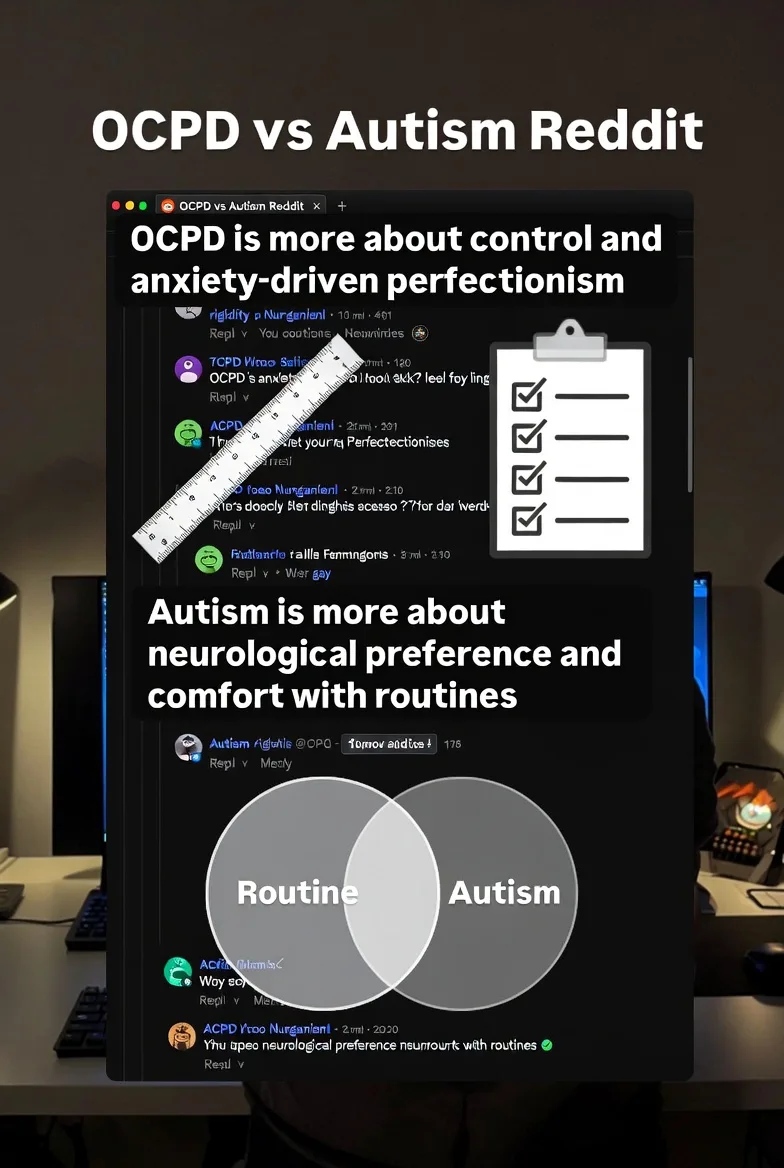
If you search OCPD vs. autism on Reddit, you will find thousands of threads. Why is this? Many adults who were “missed” by the school system are now looking for answers. Reddit provides a space for people to share lived experiences that don’t always fit into a clinical textbook.
While these communities are great for support, I always caution my patients about the risks of self-diagnosis. While your feelings are valid, a professional can help you tease apart the differences between ocpd autism adhd and other overlapping conditions. Use Reddit for community, but use a clinician for your roadmap.
Autism, OCPD, ADHD, and the Neurodivergence Conversation
The world of neurodivergence is wider than we once thought. When we talk about ocpd autism adhd, we are looking at different ways the brain can be wired.
- OCPD vs ADHD: While OCPD is about rigid control, ADHD is often about impulsivity and difficulty with focus. However, some people with ADHD develop OCPD-like traits as a “coping mechanism” to keep their lives from falling apart.
- Is OCPD neurodivergent? This is a hot debate. Traditionally, neurodivergence refers to developmental conditions like autism and ADHD. However, many are beginning to include personality structures like OCPD under this umbrella.
Frequently Asked Questions
What is the difference between autism and OCPD?
Autism is a developmental difference in how the brain processes communication and sensory input from birth. OCPD is a personality disorder focused on perfectionism and control that typically emerges in early adulthood.
Can OCPD be misdiagnosed as autism?
Yes. High-achieving adults with rigid routines are often misdiagnosed. A clinician must determine if the rigidity is for sensory comfort (Autism) or to meet a moral standard of perfection (OCPD).
What is the POPS score for OCPD?
The POPS score refers to a specific personality assessment scale. It is not a diagnostic tool for autism, but is sometimes used in research regarding personality traits and oppositional patterns.
Is OCPD neurodivergent?
Clinically, it is classified as a personality disorder. However, in the social model of neurodiversity, any brain that functions outside the “typical” norm can be considered neurodivergent.
Can OCD look like autism?
Yes, due to repetitive behaviors. The difference is that OCD behaviors are driven by unwanted, distressing thoughts (obsessions), while autistic behaviors are often for self-regulation or interest-based enjoyment.
Is OCD linked to autism?
There is a high co-occurrence rate. Many autistic individuals also meet the criteria for OCD, as the autistic brain may be more prone to the “looping” thought patterns seen in OCD.
What makes a daycare autism friendly?
A supportive daycare offers sensory-controlled environments, staff trained in neurodiversity-affirming care, visual schedules, and clear, predictable daily routines to help children feel safe.
Who can provide a reliable autism diagnosis?
Diagnosis should be performed by a specialist, such as a developmental pediatrician, a child psychologist, a neuropsychologist, or a psychiatrist trained in developmental disorders.
Are adult autism residential programs worth it?
They can be life-changing. These programs provide safety and community for adults who need more support than a family can provide at home, fostering independence in a structured way.
What color are autism awareness ribbons?
While the blue ribbon was traditional, the community is moving toward rainbow and gold infinity symbols. These represent the diversity and value of the autistic spectrum.
Conclusion
Navigating the world of neurodivergence—whether you are distinguishing between Autism vs. OCPD, seeking a reliable autism diagnosis, or looking for the right residential program—is often described by my patients as “living in limbo.” The uncertainty of labels and the fight for services can feel isolating.
But remember this: A diagnosis is not a definition of your child or yourself; it is a map. Whether the label is Autism, OCPD, or a combination of both, the goal remains the same—to understand the unique operating system of the brain so you can stop fighting against it and start working with it.
References
- National Institute of Mental Health (NIMH) – Autism Spectrum Disorder
- Centers for Disease Control and Prevention (CDC) – Autism Signs and Symptoms
- American Psychological Association (APA) – Understanding Personality Disorders
- Autism Self Advocacy Network (ASAN) – Resources
- PubMed Central – Differential Diagnosis of OCPD and ASD

Related Posts





Subscribe to Our Newsletter
Get mental health tips, updates, and resources delivered to your inbox.
MORE from Author
Read More Watching someone you care about struggle with bipolar depression and anxiety can be heartbreaking. You may notice that they withdraw…
 In my practice as a clinical psychologist, I often observe that the difference between a patient who crumbles under pressure…
 We all have "up" days and "down" days. Perhaps you feel energized after a promotion or sluggish on a rainy…
 To define bipolar disorder accurately, we must look at it as a chronic mood dysregulation condition. In psychology and medicine,…
Are you looking for a Therapist?
Connect with qualified mental health professionals who understand
bipolar disorder, mood changes, and emotional challenges.
Private • Supportive • Confidential