
What Does Bipolar Depression Feel Like?

Medically reviewed by Carolina Estevez, Psy.D Updated Date: January 27, 2026

When people ask, “What does bipolar depression feel like?” they are often looking for something deeper than a clinical checklist. While standard depression is often described as a cloud of sadness, bipolar depression is frequently experienced as a profound, leaden “weight” or a total emotional vacuum. It is the crushing “down” that follows—or exists independently of— the “up” of mania or hypomania.
Lived experience tells us that bipolar depression feels less like a mood and more like a physical and cognitive takeover. It is the sensation of your brain “shutting down” its pleasure centers, leaving you in a state of static. For many, it feels like being trapped behind a thick wall of glass; you can see the world moving, you can hear people talking, but you cannot participate in the vitality of life. It is an exhausting, pervasive emptiness that affects how you move, how you think, and how you perceive your very existence.
Understanding this feeling is vital for diagnosis. Because bipolar depression can look identical to Major Depressive Disorder (MDD) on the surface, recognizing the specific “flavor” of bipolar lows—often characterized by extreme lethargy and cognitive “fog”—is the first step toward getting the correct treatment.
What Is the Depression Phase of Bipolar Disorder?
To understand the sensation, we must first understand the structure. What is the depression phase of bipolar disorder? In clinical terms, it is one of the two “poles” that define the condition. While the manic or hypomanic phase is defined by an overflow of energy, the depressive phase is a period of significant depletion.
For many individuals, the depressive phase is actually the dominant part of the illness. Research suggests that people with Bipolar II, in particular, spend significantly more time in these “lows” than they ever do in “highs.” This phase is not a personal failing or a reaction to a “sad event”; it is a biological state where the neurotransmitters responsible for motivation and reward—primarily dopamine and norepinephrine—are not functioning at their baseline levels.
This phase is dangerous because it often arrives with a sense of permanency. When you are in it, your brain convinces you that you have always felt this way and always will. This “cognitive distortion” is a hallmark of the bipolar depressive experience.
What Does a Bipolar Depressive Episode Look Like?
When observing from the outside, what does a bipolar depressive episode look like? While the internal feeling is one of turmoil or emptiness, the external manifestation often involves a total withdrawal from the world.
Behavioral and Physical Markers
If you are wondering how someone with bipolar depression acts, look for these specific shifts:
- Psychomotor Retardation: This is the most visible sign. The person moves as if they are walking through waist-deep water. Their speech may slow down, and their reaction times are delayed.
- Social Ghosting: A person in this state will often stop responding to texts, skip work, and withdraw from social obligations. This isn’t out of “laziness,” but a total lack of the “social energy” required to interact.
- Changes in Hygiene and Environment: You may notice a “depression room”—an accumulation of laundry or dishes—as the person loses the executive function required to maintain their surroundings.
The Cognitive Facade
On the surface, the person may appear “flat” or “robotic.” Their facial expressions may lack their usual range (affective flattening). Internally, however, they may be experiencing intense self-loathing or “nihilistic” thoughts—the belief that nothing matters and nothing is real.
Emotional & Physical Feelings People With Bipolar Disorder Experience
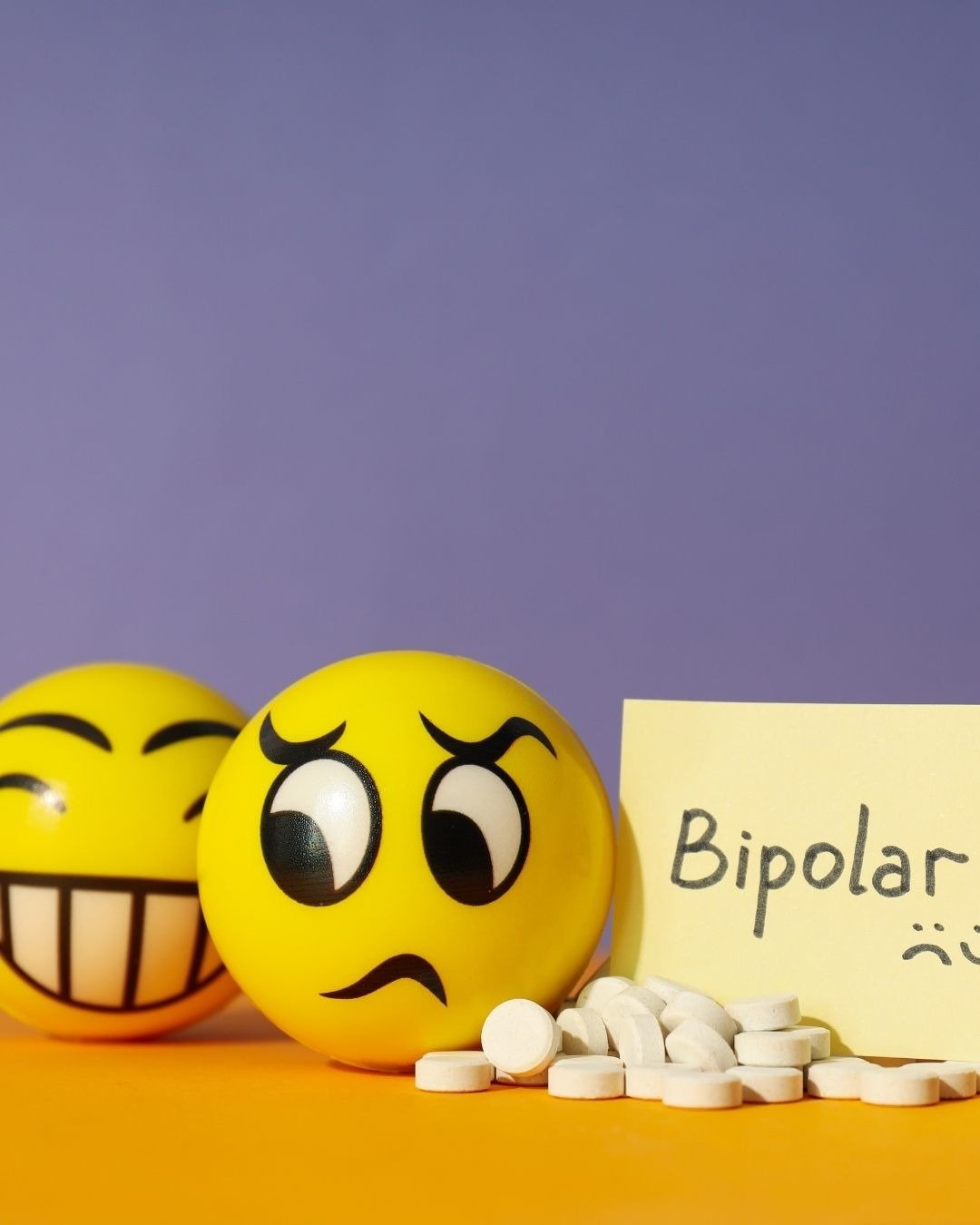
The feelings experienced with bipolar disorder are often described as “atypical” compared to standard clinical depression. There is a specific physical toll that people with bipolar disorder experience during these episodes.
The Physicality of the Low
- Leaden Paralysis: Many describe a sensation where their limbs literally feel like they are made of lead or concrete. Getting out of bed isn’t just a mental struggle; it feels like a physical impossibility.
- Hypersomnia: Unlike regular depression, where people often struggle with insomnia, bipolar depression frequently causes people to sleep for 12, 14, or even 16 hours a day and still wake up feeling utterly exhausted.
- The “Pit” in the Stomach: There is often a physical sensation of dread or a “hollow” feeling in the chest or stomach that no amount of food or comfort can fill.
The Emotional Spectrum
Emotionally, the experience often swings between intense psychic pain and total numbness (anhedonia).
- Anhedonia: This is the inability to feel pleasure. You could be sitting in the sun, eating your favorite meal, or talking to your favorite person, and feel absolutely nothing.
- Inappropriate Guilt: You may feel a crushing sense of shame for being depressed, which creates a “guilt loop” that further feeds the depression.
Bipolar Depression vs Regular Depression — How It Feels Different
A common query for those seeking a diagnosis is the difference between bipolar vs depression. While they share the same DNA of “sadness,” they feel fundamentally different in their “vibe” and progression.
Emotional Volatility
Standard depression (unipolar) tends to be more of a consistent, low-level hum. Bipolar depression, however, often feels “unstable.” Even in the depths of a low, a person with bipolar disorder might experience “mixed features”—bursts of agitation, racing thoughts, or irritability that feel “jagged” compared to the “flatness” of regular depression.
Response to the World
In regular depression, sometimes a very positive event can temporarily lift a person’s mood (mood reactivity). In bipolar depression, the mood is often “autonomous,” meaning it doesn’t matter if you win the lottery; the biological “low” remains unmoved by external reality.
The “Atypical” Profile
Bipolar depression is much more likely to involve oversleeping and overeating (specifically craving carbohydrates), whereas regular depression often involves a loss of appetite and inability to sleep. If your depression feels “heavy and hungry,” it may be a sign of a bipolar spectrum disorder.
Bipolar Mood Swings — What They Feel Like Day to Day
Living with bipolar disorder, mood swings daily are often described as “emotional whiplash.” It is not just about being “happy” one day and “sad” the next; it is about the constant management of energy levels.
On a day-to-day basis, bipolar and mood swings feel like:
- The Morning Struggle: Waking up and having to “inventory” your brain to see which version of yourself has shown up today.
- The Energy Crash: You might start the day with a burst of “false energy” (hypomania), only to hit a wall at 2:00 PM and find yourself unable to speak or move for the rest of the evening.
- Mixed States: The feeling of being “tired but wired.” This is arguably the most uncomfortable part of the disorder—your body is exhausted and depressed, but your mind is racing with anxiety and agitation.
Signs of a Bipolar “Crash” After Mania or Hypomania
For many, the most terrifying aspect of the disorder is the “crash.” If you have ever wondered what the transition looks like, the signs of a bipolar crash are often sudden and physically jarring. It is the moment the high-octane fuel of mania runs out, leaving the system in a state of total collapse.
The Emotional Freefall
A crash feels like the floor dropping out from under your life. The confidence of the previous week is replaced by an overwhelming sense of shame and regret. As the “filter” of mania disappears, you are forced to confront the consequences of your actions—whether that is overspending, strained relationships, or neglected work.
Physical Exhaustion
The body often pays the price for the lack of sleep during the high. When the crash hits, the exhaustion is profound. You may feel:
- A sudden, heavy need for sleep that lasts for days.
- Physical aches and pains that weren’t there before.
- A “brain fog” so thick that following a simple conversation feels like solving a complex puzzle.
Example of a Manic Episode (For Comparison)
To truly understand what depression feels like, one must contrast it with its opposite. An example of a manic episode (or the milder hypomania) is a state of “overflow.”
Imagine your brain has been overclocked. You have 15 different ideas at once, and each one feels like a billion-dollar stroke of genius. You might find yourself cleaning your entire house at 3:00 AM, calling friends you haven’t spoken to in years, or feeling a sense of spiritual “connectedness” to everything.
The Deceptive High
While this energy feels “good” initially, it is often brittle. It eventually turns into irritability (dysphoria) or impulsivity. The reason this matters for the depressive phase is that the “higher” the mania goes, the deeper the subsequent depression tends to be. The brain essentially “short-circuits” from the overstimulation, necessitating a long, dark period of recovery.
Bipolar 1 vs Bipolar 2 — How Depression Feels in Each
The experience of depression is not a monolith; it varies significantly depending on your specific diagnosis. When looking at bipolar 1 vs 2, the difference lies in the frequency and intensity of the “lows.”
What Does Bipolar 2 Depression Feel Like?
Because Bipolar II does not involve full-blown mania (only hypomania), the depression is often the “star” of the show. What does bipolar 2 depression feel like? It often feels chronic.
- The Baseline Low: Many with Bipolar II feel they live in a state of “low-grade depression” for months or even years, interrupted only briefly by bursts of productivity.
- The Suicidal Weight: Statistically, Bipolar II depression is associated with high levels of suicidal ideation because the lows are so frequent and the “breaks” (hypomania) are so short.
Bipolar 1 vs Bipolar 2 Emotional Differences
In Bipolar I, the depression is often episodic and intense. It is the “equal and opposite reaction” to a manic episode. It may feel like a sudden, catastrophic event. In Bipolar II, the depression feels more like a pervasive atmosphere. It’s the difference between being hit by a sudden storm (Type I) and living in a city where it rains 300 days a year (Type II).
How a Person With Bipolar Disorder Thinks During Depression
The internal monologue of a bipolar person changes completely during a low. If you want to understand how a person with bipolar disorder thinks during this time, you have to look at the “logic of hopelessness.”
Cognitive Distortions
The brain becomes a master at “filtering out” the positive. Common thought patterns include:
- Fortune Telling: “I will never feel better again. This is my permanent state.”
- Personalization: “Everything that is going wrong in the world—and my life—is specifically my fault.”
- Emotional Reasoning: “I feel like a burden; therefore, I am a burden.”
The Loss of Executive Function
Depression also attacks the “working memory.” You might find yourself standing in the middle of a room, forgetting why you went there, or staring at a computer screen for hours, unable to type a single sentence. This cognitive slowing is one of the most frustrating aspects for high-achieving individuals, as they lose the very tools they rely on to fix their situation.
Bipolar Disorder Symptoms in Females vs Men
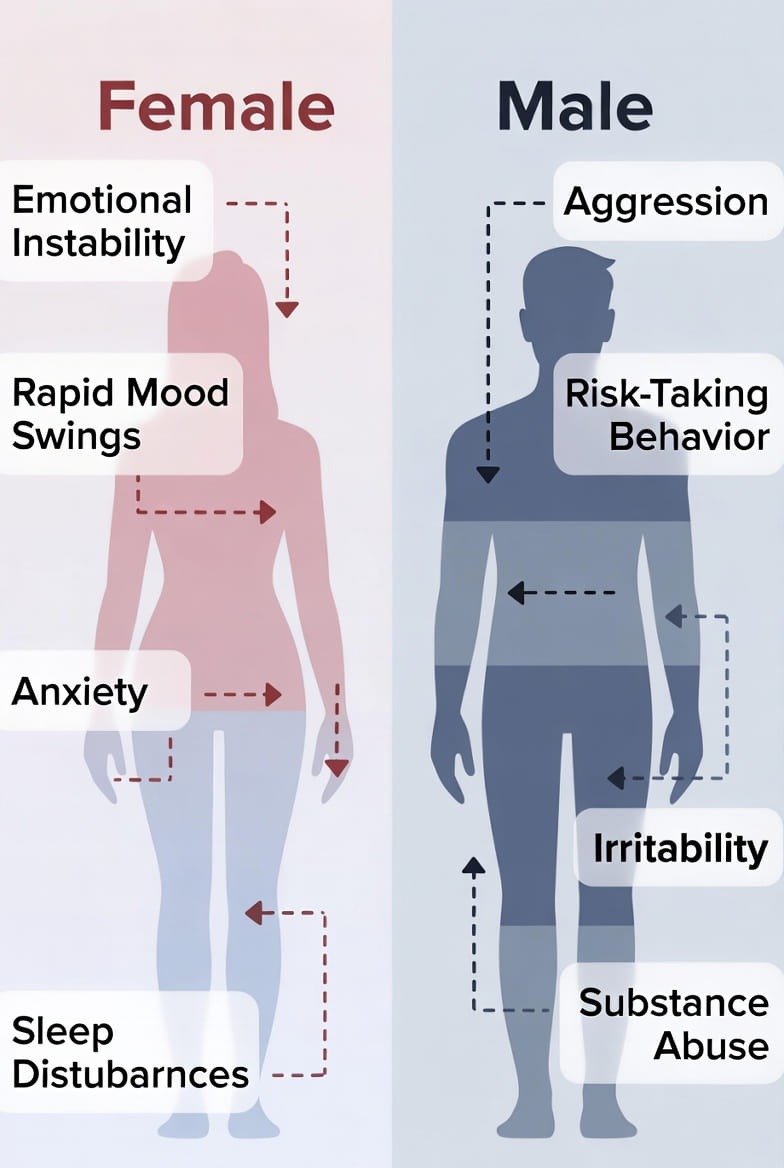
Gender plays a significant role in how these feelings are expressed and diagnosed.
Bipolar Disorder Symptoms in Females
Women are more likely to be diagnosed with Bipolar II and experience rapid cycling. Bipolar disorder symptoms in females are often influenced by the endocrine system.
- Hormonal Overlap: Premenstrual changes, postpartum periods, and menopause can act as “magnifiers” for bipolar depression, making the lows feel even more physically taxing.
- The “Depression First” Trap: Because women are statistically more likely to seek help for depression than mania, they are often misdiagnosed with Major Depression for years before the bipolarity is recognized.
Bipolar Symptoms in Men
In contrast, bipolar symptoms in men often manifest as “irritable depression.” Instead of sadness or crying, a man may experience:
- High levels of anger and hostility.
- Increased risk-taking or substance use as a way to “numb” the internal emptiness.
- Social withdrawal that looks like “coldness” or “detachment.”
How Long Does a Depressive Episode Last in Bipolar Disorder?
One of the most common questions from those currently suffering is, “When will this end?” Understanding how long a depressive episode lasts in bipolar disorder is difficult because the “clock” is different for everyone.
The Clinical Average
Statistically, an untreated depressive episode in bipolar disorder can last anywhere from 6 to 12 months. However, with modern psychiatric intervention, this timeline is often significantly shortened. Many patients find that the “acute” phase—the period of deepest despair—begins to lift within 6 to 12 weeks once the correct medication protocol is established.
Why Duration Varies
The answer to how long bipolar episodes last depends on several factors:
- Subtype: As noted, Bipolar 2 depression tends to be more chronic and lingering.
- Rapid Cycling: Some individuals experience four or more episodes a year, meaning their depression may be shorter but occurs much more frequently.
- Treatment Adherence: Consistency with mood stabilizers is the number one factor in preventing an episode from stretching into a “chronic” state.
What Causes Bipolar Disorder?
To understand the feeling, we must acknowledge the cause. People often ask what causes bipolar disorder as a way to validate that their feelings are not “imaginary” or a character flaw.
The consensus in 2026 is that bipolar disorder is a complex polygenic condition. This means there isn’t one “bipolar gene,” but rather hundreds of small genetic variations that affect how the brain handles stress and regulates energy.
- Neurochemistry: It involves an instability in the systems that manage dopamine (reward/energy) and serotonin (mood/sleep).
- Brain Structure: Neuroimaging often shows that the amygdala (the brain’s emotional smoke detector) is overactive, while the prefrontal cortex (the logical controller) is underactive during a depressive state.
- Environmental Triggers: For those with the genetic predisposition, a high-stress event, a change in sleep patterns, or even seasonal light changes can “flip the switch” into a depressive episode.
Real Stories — What Bipolar Depression Feels Like (Reddit-Style Insights)
Searching for what bipolar depression feels like on Reddit reveals a community of people trying to put words to the wordless. By looking at bipolar disorder stories from people in these communities, a few consistent themes emerge that clinical textbooks often miss.
The “Colorless” World
A common description on forums is that the world literally looks less vibrant. “It’s like someone turned the saturation down on my life,” one user writes. This is actually backed by science; some studies suggest that during deep depression, the retina’s ability to perceive contrast is diminished.
The Loss of the “Self”
Many users describe the feeling of their personality disappearing. “I’m not sad; I’m just… gone,” is a frequent sentiment. This is the experience of depersonalization, where the individual feels like a ghost inhabiting their own body.
The “Wait”
The most shared experience on Reddit is the “waiting game.” Because there is no “cure,” the community often focuses on “white-knuckling” through the low, reminding each other that “this too shall pass.” This peer-to-peer validation is often what helps people survive the months-long duration of a cycle.
Understanding Bipolar Depression Feelings

If you are currently feeling the “weight” we have described, the most important takeaway is this: Bipolar depression is a biological state, not a permanent identity.
- Validation: You are not “lazy” or “unmotivated.” Your brain is currently experiencing a physiological “energy crisis.”
- Recognition: Understanding what bipolar depression feels like involves physical pain and cognitive slowing can help you communicate your needs to doctors and loved ones.
- Hope: While the episodes are long and the feelings are intense, they are treatable. In 2026, we have more tools than ever—from new-generation antipsychotics to neuro-stimulation—to help pull the brain out of the “gray.”
Professional help is the bridge between “white-knuckling” it and actually recovering. If you recognize these patterns in yourself, seeking a psychiatric evaluation is the first step toward turning the lights back on.
Frequently Asked Questions
What does bipolar depression feel like compared to grief?
Grief is usually tied to a specific loss and often comes with “waves” of memories and the ability to still feel moments of joy. Bipolar depression is often “autonomous”—it exists regardless of your circumstances and is characterized by a total loss of interest in everything (anhedonia) and a physical heaviness that grief rarely possesses.
Can you feel “happy” during a bipolar depressive episode?
It is rare to feel true happiness, but you may experience mixed feelings. This feels like having the “engine” of mania (racing thoughts, agitation) inside the “body” of depression. It is often described as an extremely uncomfortable, “electric” sadness rather than a peaceful one.
Is it normal to feel physical pain during the low?
Yes. Many people experience “psychosomatic” pain, such as unexplained backaches, headaches, or a literal sensation of pressure on the chest. This is due to the way the brain processes emotional and physical pain using similar neural pathways.
How does someone with bipolar depression act in relationships?
They may become “emotional ghosts.” Because social interaction requires immense energy, a person in a low mood may stop communicating entirely. This isn’t a lack of love, but a survival mechanism to conserve what little mental energy they have left.
Why does bipolar 2 depression feel so much longer?
Bipolar 2 is often “depressive-dominant.” Without the high-energy “distraction” of full mania, the brain spends more time in a sub-clinical or major depressive state. It often feels like a permanent “gray” filter over life rather than a sudden crash.
Conclusion
Understanding what bipolar depression feels like is the first step in stripping away the shame that often accompanies the diagnosis. When you realize that the “leaden” limbs, the “colorless” world, and the “silent” brain are biological symptoms—not character flaws—you can begin to treat yourself with the compassion required for recovery.
Bipolar disorder is a heavy burden, but it is one that can be lightened. The transitions between the “up” and the “low” are exhausting, but they are also proof that no state is permanent. In 2026, the goal of treatment isn’t just to stop the sadness, but to return you to a state of euthymia—where you can feel the full range of human emotions without being controlled by them.
If the descriptions in this article resonated with you, do not “white-knuckle” through the pain. Reach out to a psychiatrist or a specialized therapist. You are not losing your mind; you are experiencing a manageable medical condition. The glass wall can be broken, and the “saturation” of your life can be restored.
Authoritative Reference
- National Institute of Mental Health (NIMH):Bipolar Disorder Education
- American Psychiatric Association:Diagnostic and Statistical Manual of Mental Disorders (DSM-5-TR)
- Mayo Clinic:Bipolar Disorder Symptoms & Causes
- Harvard Health:Understanding Bipolar Depression
- DBSA: Depression and Bipolar Support Alliance

Related Posts


Subscribe to Our Newsletter
Get mental health tips, updates, and resources delivered to your inbox.
MORE from Author
Read More Watching someone you care about struggle with bipolar depression and anxiety can be heartbreaking. You may notice that they withdraw…
 In my practice as a clinical psychologist, I often observe that the difference between a patient who crumbles under pressure…
 We all have "up" days and "down" days. Perhaps you feel energized after a promotion or sluggish on a rainy…
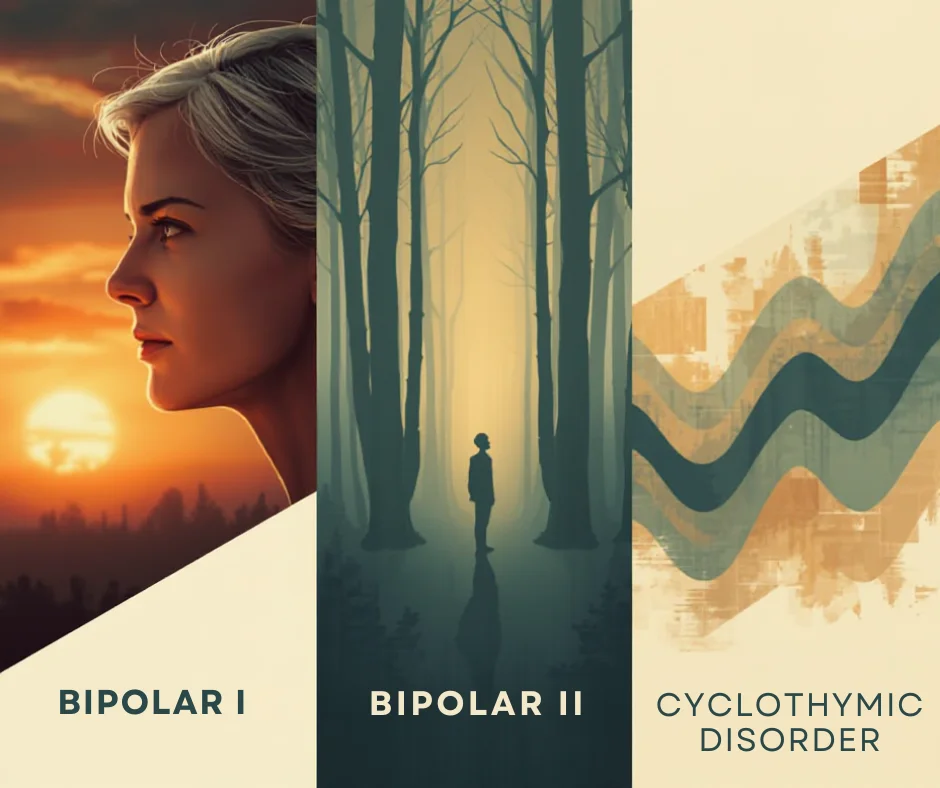 To define bipolar disorder accurately, we must look at it as a chronic mood dysregulation condition. In psychology and medicine,…
Are you looking for a Therapist?
Connect with qualified mental health professionals who understand
bipolar disorder, mood changes, and emotional challenges.
Private • Supportive • Confidential