
The Window of Tolerance: A Complete Guide to Trauma, Regulation, and Resilience

Medically reviewed by Laura Athey Updated Date: March 16, 2026
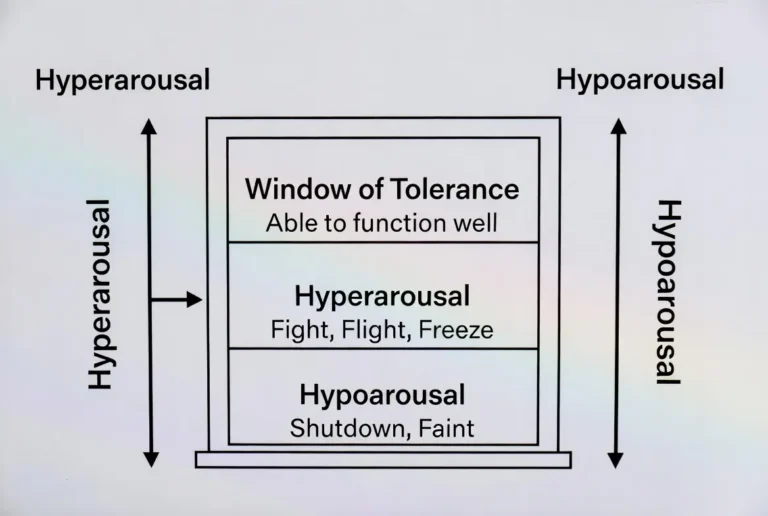
In the journey of trauma recovery and emotional health, few concepts are as transformative as the window of tolerance. At its simplest level, this term describes the “optimal arousal zone” where a human being can function most effectively. When you are within this window, you can handle the ups and downs of life—stress, frustration, excitement, and sadness—without losing your cool or shutting down entirely.
However, for many people, especially those living with the legacy of trauma, staying in this “green zone” feels nearly impossible. Emotional regulation is the ability to navigate life’s intensity while remaining connected to your thoughts and feelings. When the nervous system is balanced, you are resilient. But when the system is pushed beyond its limits, it enters a state of dysregulation.
What does window of tolerance mean in a therapeutic context? It is a roadmap of your nervous system. By understanding the window of tolerance, survivors and clinicians alike can identify when the brain has shifted into a survival mode (like fight, flight, or freeze) and, more importantly, learn the specific somatic tools required to return to a state of calm and social engagement.
Who Created the Window of Tolerance?
The term was coined by Dr. Dan Siegel, a clinical professor of psychiatry at the UCLA School of Medicine and a pioneer in the field of interpersonal neurobiology. Siegel developed the concept to help patients understand the biological reality of their emotional experiences.
Siegel’s work emphasizes that our minds are not just “inside our heads” but are deeply integrated with our nervous systems and our relationships. Dan Siegel’s window of tolerance highlights that the brain’s ability to integrate information—to connect the logical left brain with the emotional right brain—is dependent on staying within this regulated zone.
Since its inception, the window of tolerance Siegel created has been adopted globally by trauma therapists, including those specializing in EMDR, Somatic Experiencing, and Sensorimotor Psychotherapy. It has become a foundational piece of psychoeducation, often shared via a Dan Siegel window of tolerance PDF in clinical settings to give clients a visual language for their invisible internal struggles.
Window of Tolerance Explained
To understand what is a window of tolerance, imagine a river flowing between two high banks.
- The River: This represents your “Optimal Arousal Zone.” Here, you are present, grounded, and curious. You can feel emotions, but they don’t drown you.
- The Banks: These represent your thresholds.
What is window of tolerance in therapy? It is the sweet spot where “top-down” processing (thinking) and “bottom-up” processing (feeling) work together.
Everyday Examples of Being in the Window:
- Receiving constructive criticism at work and feeling a sting of hurt, but being able to listen and respond professionally.
- Getting stuck in heavy traffic and feeling frustrated, but still being able to choose a podcast and drive safely without “road rage.”
- Grieving a loss while still being able to nourish yourself and talk to a friend.
When we are in our window, we have access to our “prefrontal cortex”—the part of the brain responsible for logic, empathy, and moral judgment. When we are pushed out of the window, this part of the brain essentially goes offline, leaving the “reptilian brain” in charge of our survival.
The Three Nervous System States
To truly master emotional regulation, one must recognize the three distinct states of the nervous system as defined by this model.
1. Hyperarousal (The “Too Much” Zone)
This is the Fight/Flight response. When you are hyperaroused, your sympathetic nervous system is overactive. You are characterized by:
- Emotional outbursts and anger.
- Panic, racing thoughts, and hypervigilance.
- Physical tension and a racing heart.
- A feeling of being “stuck on.”
2. Hypoarousal (The “Too Little” Zone)
This is the Freeze/Shutdown response. This occurs when the nervous system becomes so overwhelmed that it “blows a fuse” to protect you. Characteristics include:
- Numbness and dissociation.
- Feeling “spaced out” or empty.
- Low energy, lethargy, and inability to move.
- A feeling of being “stuck off.”
3. The Regulated Window (The “Just Right” Zone)
This is the state of Social Engagement. You feel safe enough to be vulnerable, to learn, and to connect. You are physically relaxed but mentally alert.
In my work with trauma survivors, I often explain that the window of tolerance isn’t about being ‘calm’—it’s about being ‘contained.’ You can be incredibly angry or deeply sad and still be within your window, provided you are still the ‘observer’ of your experience rather than being consumed by it.
The tragedy of chronic trauma is that it shrinks this window so small that even a minor inconvenience—like a spilled cup of coffee—can trigger a massive hyperarousal spike or a hypoarousal collapse. Our goal in therapy isn’t just to stay in the window; it’s to use somatic awareness to widen the window so that you can experience the full spectrum of human life without losing your sense of self.
Window of Tolerance and Trauma

This section addresses the window of tolerance trauma survivors face. Why is it that some people seem naturally “thick-skinned” while others are easily overwhelmed? The answer lies in the history of the nervous system.
How Trauma Narrows the Window
When a person experiences PTSD, CPTSD, or developmental trauma, their nervous system is re-wired for survival. Because the brain perceives the world as fundamentally dangerous, it keeps the “security guards” on high alert.
How trauma can affect your window of tolerance:
- Narrowing the Zone: The actual “width” of your window shrinks. You have very little room to maneuver before you hit a trigger.
- Sensitivity to Slights: Triggers that others might find minor (a certain smell, a specific tone of voice) are perceived by your brain as life-threatening.
- The “Cliff” Effect: Instead of a gradual climb into stress, trauma survivors often experience an “all or nothing” response—moving from calm to a full panic attack in milliseconds.
For those with developmental trauma, the window may have never been properly formed. If a child grows up in an unpredictable environment, their nervous system never learns what “safety” feels like, making the window of tolerance and trauma recovery a process of building a window for the very first time.
Window of Tolerance & Polyvagal Theory
The concept of the window of tolerance is deeply intertwined with Polyvagal Theory, developed by Dr. Stephen Porges. This theory explains the vagus nerve’s role in our safety and threat responses.
- Ventral Vagal (The Window): This is the newest part of our nervous system. It allows for social connection and “rest and digest.”
- Sympathetic (Hyperarousal): The mobilization system. It prepares us to fight or run.
- Dorsal Vagal (Hypoarousal): The oldest part of the system. It is the “emergency brake” that leads to fainting, shutdown, and immobilization.
Understanding the window of tolerance polyvagal theory overlap is essential because it shifts the focus from “shame” to “biology.” You aren’t “weak” for shutting down; your dorsal vagal system is simply trying to save your life from a perceived threat.
Is the Window of Tolerance a DBT Skill?
A common question among those in therapy is: is window of tolerance a dbt skill? Technically, the specific term “Window of Tolerance” is not one of the original skills in Dialectical Behavior Therapy (DBT) created by Marsha Linehan. However, the concept is central to DBT’s Emotion Regulation and Distress Tolerance modules.
In DBT, patients learn about “Emotional Mind” (Hyperarousal), “Wise Mind” (The Window), and “Reasonable Mind.” While the terminology differs, many therapists integrate window of tolerance language into DBT because it provides a more biological, somatic explanation for why “skills” sometimes fail when a person is too far out of their window.
In this next section, we move from understanding the biology of the nervous system to the active, restorative work of widening the window. This is where the “work” of therapy becomes practical, daily habits that rewire the brain for resilience.
How to Increase Your Window of Tolerance (Step-by-Step)
If you feel like your window is currently the size of a needle’s eye, don’t lose heart. The nervous system is plastic; it can be retrained. Learning how to increase window of tolerance is a gradual process of “pendulation”—moving gently between challenge and safety.
Bottom-Up vs. Top-Down Regulation
To widen your window of tolerance, you need two types of tools:
- Bottom-Up (Body to Brain): These techniques use the body to calm the nervous system directly. If you are in a state of hyperarousal, no amount of “positive thinking” will stop your heart from racing. You must use the body to tell the brain it is safe.
- Top-Down (Brain to Body): These are cognitive tools like mindfulness and reframing. Once you are back inside your window, top-down skills help you stay there by identifying triggers before they explode.
Consistency Over Intensity
A common mistake is trying to “force” a wider window. You cannot expand window of tolerance by overwhelming yourself with “exposure.” Instead, it is about small, consistent “micro-doses” of regulation. It is the difference between a sudden flood (trauma) and a gentle irrigation system (healing).
Exercises to Expand the Window of Tolerance (Practical Tools)
Building a larger window requires a “toolkit” of window of tolerance exercises. What works for one person in hyperarousal might be useless for someone in hypoarousal.
For Hyperarousal
When you are “revved up,” you need to discharge energy or ground it.
- Weight and Pressure: Use a weighted blanket or push your hands firmly against a wall. This provides “proprioceptive input,” telling your brain exactly where your body ends and the world begins.
- The “Voo” Breath: Taking a deep breath and making a low “Voo” sound as you exhale vibrates the vagus nerve, signaling the parasympathetic nervous system to engage.
- Temperature Change: Splashing ice-cold water on your face or holding an ice cube can “reset” the nervous system during a panic spike.
For Hypoarousal
When you are “shut down” or numb, you need gentle stimulation.
- Sensory Engagement: Smelling a strong scent (like peppermint or citrus) or tasting something sour.
- Movement: Gently stomping your feet or dry-brushing your skin to “wake up” the nerves.
- Sights: Identifying five things you see in the room that are a specific color (e.g., “five blue things”).
How to Get Back Into the Window of Tolerance
The goal is to catch yourself before you are “gone.” How to get back into window of tolerance starts with somatic tracking—noticing the physical signs of the “edges” of your window.
Early Warning Signs:
- Hyper-edge: Clenched jaw, shallow breathing, irritability, “looping” thoughts.
- Hypo-edge: Feeling heavy, losing focus, a “foggy” brain, or a quietening of the voice.
Once you notice the edge, use a “bridge” back to the center. This might be a simple phrase like, “I am safe in this room, and I am noticing I feel tight in my chest.” This creates “dual awareness”—you are feeling the stress, but you are also aware of your current safety. How to expand the window of tolerance over time is simply the act of returning to center, over and over again, with self-compassion rather than judgment.
Window of Tolerance Worksheets, PDFs & Visuals
Visual aids are critical for nervous system work because, during dysregulation, the language centers of the brain (Broca’s area) often shut down. Having a window of tolerance worksheet on your fridge or a window of tolerance graphic on your phone can act as a lighthouse.
- Free Resources: Many organizations offer a window of tolerance worksheet pdf free download. Look for those that include a “Personalized Plan” section where you can write down your specific triggers and your unique “glimmers” (signs of safety).
- Therapist Handouts: A window of tolerance therapist aid usually provides a structured way to track your daily arousal levels.
- Printables: Using a printable window of tolerance pdf allows you to color-code your zones, which is a powerful way to engage the creative right brain in the healing process.
Window of Tolerance for Kids & Teens

Children have naturally narrower windows because their prefrontal cortex is still under construction. A window of tolerance for kids needs to be simplified.
- The Traffic Light Model: Green is “Good to Go” (The Window), Yellow is “Slow Down/Caution” (Hyperarousal), and Blue is “Stalled/Icy” (Hypoarousal).
- School Stress: Teachers can use a window of tolerance visual in the classroom to help students identify when they need a “sensory break.”
- Emotional Literacy: Instead of asking “Why did you do that?”, parents can ask, “Where is your nervous system right now?” This removes shame and focuses on regulation.
Books & Experts on the Window of Tolerance
If you want to dive deeper into the literature, several “giants” in the field have expanded on Dan Siegel’s window of tolerance.
- Janina Fisher: Author of Healing the Fragmented Selves of Trauma Survivors. Janina Fisher’s window of tolerance work is famous for its focus on “parts” and how different internal parts of us can be in different zones at the same time.
- Pat Ogden: The founder of Sensorimotor Psychotherapy. Pat Ogden’s window of tolerance approach emphasizes the physical “posture” of trauma and how changing our body position can widen our window.
- Bessel van der Kolk: While he uses different terminology in The Body Keeps the Score, his work is the backbone of understanding why the nervous system “remembers” what the mind tries to forget.
In this final section, we address the most common points of confusion regarding this concept and clarify the boundaries of the terminology to ensure you have a complete, “top-notch” understanding of the subject.
Frequently Asked Questions (FAQ)
What is the window of tolerance?
The window of tolerance is a term used to describe the zone of arousal in which a person is able to function most effectively. When we are within this window, we can process information and emotions without becoming overwhelmed or shutting down.
What is an example of tolerance in psychology?
An example of tolerance is a “resilience threshold.” For instance, an individual might be able to handle a high-pressure deadline at work with focus (staying in the window). However, if they are then hit with a personal crisis, they might exceed their tolerance and experience a panic attack (hyperarousal) or become emotionally numb (hypoarousal).
Is the window of tolerance evidence-based?
Yes. While it is a metaphorical model, it is based on the biological reality of the Autonomic Nervous System (ANS) and the Prefrontal Cortex. It aligns with neuroimaging studies showing that during trauma triggers, the “thinking brain” (prefrontal cortex) deactivates while the “survival brain” (amygdala) takes over.
How long does it take to widen it?
Widening the window is a “neuroplastic” process, meaning it involves building new neural pathways. While immediate grounding skills work in minutes, permanently widening the window usually takes months of consistent therapeutic work and nervous system “re-training.”
Clarifying Unrelated “Window” and “Tolerance” Meanings
When searching for information on nervous system regulation, you may encounter various unrelated terms. To ensure the highest level of topical authority, it is important to distinguish the psychological window of tolerance from these common homonyms.
A. Tolerance in Social & Cultural Contexts
In sociology and ethics, tolerance refers to the capacity to endure or respect opinions and behaviors that one does not necessarily agree with.
- Religious Tolerance: The state of being that allows for the practice of multiple faiths within a society.
- Range of Tolerance: In ecology, this refers to the environmental conditions (like temperature) that an organism can survive in.
- Diversity and Respect: It is vital to respect diversity in terms of tolerance to maintain social cohesion, but this is a philosophical skill rather than a nervous system state.
B. Physical Windows & Technology
If you are searching for physical home improvements or software, you might see terms that have nothing to do with trauma:
- Home Improvement: Searches like Wallside windows cost per window, Indianapolis windows, Cleveland windows, or Milwaukee window refer to literal glass window installation.
- Technology: Windows Easy Transfer for Windows 10 refers to an outdated Microsoft utility for moving files between computers.
C. Home Services
General maintenance questions like “How often should you schedule professional window cleaning?” refer to residential upkeep. While a clean environment can help with mental clarity, it is not a clinical intervention for the nervous system.
Summary & Key Takeaways
The window of tolerance is one of the most empowering frameworks in modern psychology. It shifts the narrative from “What is wrong with me?” to “What is happening in my nervous system?” By understanding your zones of arousal, you can stop blaming yourself for your reactions and start providing your body with the safety it craves.
- Trauma shrinks the window, but intentional, somatic practice can expand it.
- Hyperarousal is a “stuck on” state; Hypoarousal is a “stuck off” state.
- Healing is gradual. You don’t need to be perfect; you just need to be able to notice when you’ve left the window and have a few tools to help you find your way back.
Authoritative Clinical & Research References
- National Institute for the Clinical Application of Behavioral Medicine (NICABM)
- Dr. Dan Siegel’s Mindsight Institute — Interpersonal Neurobiology
- The Polyvagal Institute — Understanding the Autonomic Nervous System
- Janina Fisher, Ph.D. — Trauma-Informed Stabilization Treatment (TIST)
- Therapist Aid — Window of Tolerance Worksheet and Psychoeducation

Related Posts






Subscribe to Our Newsletter
Get mental health tips, updates, and resources delivered to your inbox.
MORE from Author
Read More Watching someone you care about struggle with bipolar depression and anxiety can be heartbreaking. You may notice that they withdraw…
 In my practice as a clinical psychologist, I often observe that the difference between a patient who crumbles under pressure…
 We all have "up" days and "down" days. Perhaps you feel energized after a promotion or sluggish on a rainy…
 To define bipolar disorder accurately, we must look at it as a chronic mood dysregulation condition. In psychology and medicine,…
Are you looking for a Therapist?
Connect with qualified mental health professionals who understand
bipolar disorder, mood changes, and emotional challenges.
Private • Supportive • Confidential