
Hyperfixation vs Special Interest — And How It Shapes Big Decisions

Medically reviewed by Laura Athey Updated Date: April 8, 2026
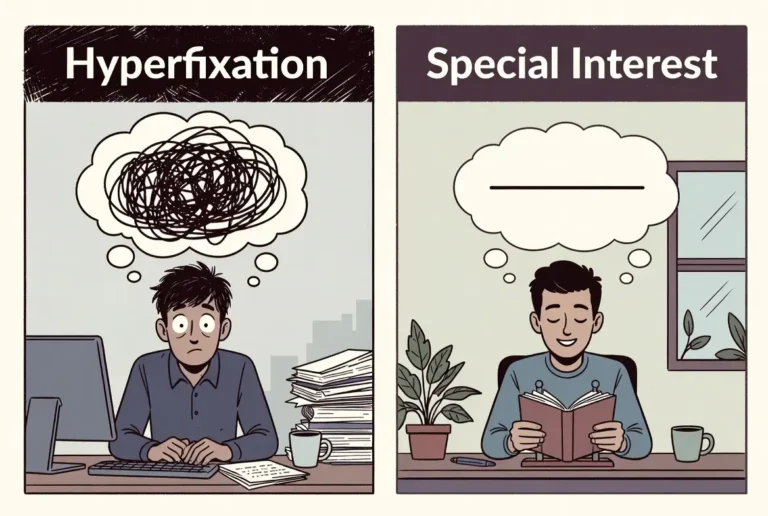
Have you ever sat down to check one quick thing on your phone and realized four hours have passed? Maybe you intended to look up a simple recipe, but ended up researching the chemical history of yeast. For many, this intense pull toward a topic is a daily reality. We often see the terms hyperfixation vs special interest used interchangeably, but they are quite different.
In my clinical practice as a psychologist, I often work with neurodivergent adults who feel “consumed” by their passions. They want to know if their intense focus is a superpower or a symptom. Understanding hyperfixation vs adhd is often the first step toward better time management. It is about how your brain seeks out dopamine and processes information.
I once worked with a patient who spent an entire weekend building a complex spreadsheet for his personal budget. He wasn’t just “doing his taxes”; he was caught in a deep dive into compound interest. By the time he finished, he knew more than most financial advisors. This mix of intense curiosity and narrowed focus is at the heart of the special interest ADHD vs autism conversation. Let’s break down what these terms actually mean for your brain.
What Is Hyperfixation?
To understand what hyperfixation is, we have to look at the brain’s reward system. It is an intense, temporary state of focus. Most often, we see this in Attention Deficit Hyperactivity Disorder. The ADHD brain often struggles to regulate attention. It either gives too little or far too much.
Hyperfixation Examples in Daily Life
When you are hyperfixed, the world around you disappears. You might find yourself researching compound interest for hours without a break. Other hyperfixation examples include a deep dive into auto loan APR comparisons or watching every single review of internet providers before making a choice.
It is also possible to have a hyperfixation on a person. This often feels like an intense “crush” where you want to know every detail about their life. This is different from a healthy interest because it feels urgent and all-consuming.
Hyperfixation vs Obsession
Many people ask, “Is hyperfixation the same as obsession?” In clinical terms, an obsession is often distressing and intrusive. It is something you don’t want to think about. Hyperfixation, however, is usually engaging.
Even if it is disruptive, it often feels productive or exciting at the moment. It is more about a hyperfixation vs hobby distinction; a hobby is something you do for fun, while a hyperfixation is something your brain feels it must do.
What Are Special Interests?
While hyperfixation is often temporary, a special interest is a long-term passion. This is a core feature of Autism spectrum disorder. A special interest is more than just a favorite subject. It is often integrated into a person’s identity and provides a sense of stability and joy.
Special Interest vs Normal Interest
A special interest vs normal interest is defined by its depth and intensity. A neurotypical person might enjoy gardening. An autistic person with a special interest in gardening might learn the Latin names of every plant, the soil chemistry required for each, and the history of botanical illustration.
Do autistic people hyperfixate? Yes, they absolutely do. In fact, many individuals are hyperfixated and special-interest collectors. They might have a lifelong special interest in trains, but spend a week hyperfixing on a specific type of engine. Conversely, can people with ADHD have a special interest? Yes, though for those with ADHD, these interests often rotate more frequently, lasting months rather than years.
Hyperfixation vs. Special Interest: Understanding Your Focus
When navigating the neurodivergent landscape, the line between an intense hobby and a neurological trait can feel incredibly blurry. One of the most common debates—frequently seen playing out in patient support groups and “hyperfixation vs. special interest” Reddit threads—is how to accurately categorize these profound periods of focus.
While both phenomena involve deep, immersive attention that can look identical from the outside, the underlying neurological drivers and the internal “energy” of the focus are fundamentally different. Understanding this distinction is not just about clinical labels; it is a vital step in learning how to work with your nervous system rather than against it.
The Sprint: Hyperfixation (The Dopamine Drive)
Hyperfixation is best described as a mental sprint. It is an intense, all-consuming state of flow most frequently associated with ADHD. The core biological driver here is the brain’s urgent, powerful hunt for dopamine.
When a dopamine-starved brain discovers a novel, highly stimulating subject—whether it is a newly released video game, a complex crafting technique, or a niche research rabbit hole—it locks on with laser precision. The internal energy is one of intense urgency and euphoria.
During a hyperfixation episode, you might entirely lose your sense of time (time blindness), forgetting to eat, sleep, or even use the restroom because the immediate neurological reward is so high.
However, because this state relies heavily on novelty, hyperfixation is inherently temporary. It typically lasts anywhere from a few intense days to a few weeks. Once the brain extracts all the “newness” and the dopamine rush fades, the drop-off is notoriously abrupt.
The spark simply dies overnight, often leaving the individual with a room full of half-finished projects, unused supplies, and a lingering sense of confusion or burnout.
The Marathon: Special Interests (The Drive for Mastery)
In sharp contrast, a special interest (often abbreviated in the community as a SPIN) is a marathon. Predominantly associated with the autism spectrum, a special interest is a deep, highly focused, and fiercely sustained passion.
Unlike the frantic, dopamine-chasing energy of hyperfixation, the energy surrounding a special interest is rooted in calm, predictability, and mastery. It is driven by the autistic brain’s inherent tendency to systemize and deeply understand the world.
Engaging with a special interest provides a profound sense of safety, routine, and identity. Whether the focus is on a specific historical era, a branch of neuroscience, or a particular media franchise, the engagement brings deep joy and acts as a powerful tool for emotional regulation.
Rather than burning out abruptly, special interests are often lifelong companions. They may slowly evolve, mature, or take on new facets over the decades, but the core attachment and the comfort it brings rarely vanish.
Clinical Comparison Guide
To help simplify these clinical differences, here is a breakdown of how the two traits diverge:
| Feature | Hyperfixation | Special Interest |
| Duration | Days to weeks (Highly temporary) | Years to lifelong (Sustained) |
| Core Emotion | Urgency, excitement, novelty | Calm, deep joy, mastery, identity |
| Root Condition | Often ADHD (Dopamine-seeking) | Often Autism (Systemizing and regulation) |
| Ending | Ends abruptly (“The spark dies”) | Evolves slowly over time |
Practical Application: Managing Your Time and Energy
Recognizing the clinical difference between a hyperfixation and a special interest is a powerful tool for executive functioning and burnout prevention.
If you can identify the frantic, urgent energy of a hyperfixation setting in, you can immediately implement protective boundaries. Knowing that it is a temporary dopamine rush allows you to set strict visual timers to enforce mandatory breaks for eating, hydrating, and sleeping. It also provides a crucial mental pause before you spend hundreds of dollars on a new hobby that you might completely abandon by next week. You can enjoy the intense focus safely, knowing it will eventually pass.
Conversely, if you are engaging in a special interest, your management strategy should look entirely different. Because this is a core regulatory tool for your nervous system, it is essential to schedule dedicated time to immerse yourself in it. Society often pathologizes intense interests in adults, which can lead to internalized shame.
By recognizing your special interest as a valid, healthy, and necessary coping mechanism, you can strip away the guilt. You can intentionally lean into the grounding effect it provides, using it as a reliable anchor to stabilize yourself during times of sensory overstimulation or emotional distress.
Is It a Passion, Hobby, or Hyperfixation?

Distinguishing between a special interest vs normal interest can be tricky. Use this mini self-reflection checklist to help you decide.
- Does the interest disrupt your sleep or basic needs? (Leans toward Hyperfixation)
- Have you had this interest for more than a year? (Leans toward Special Interest)
- Does the topic feel like a “part of who you are”? (Leans toward Special Interest)
- Do you suddenly lose interest as soon as you “master” it? (Leans toward Hyperfixation)
If you are still unsure, you can look for an is it a hyperfixation or special interest quiz online. However, remember that these labels aren’t mutually exclusive. You can have a passion that starts as a hyperfixation and grows into a lifelong special interest.
Excel vs Online Calculators for Compound Interest
Our brains often use these intense focus states to solve problems. Let’s look at a practical example: Excel vs Online Calculators: Which is Best for Compound Interest? The Hyperfixation Trap
A neurotypical person might use Online Compound Interest Calculators to get a quick answer. It’s fast and beginner-friendly. But if you are in a hyperfixation state, you might find that “too easy.” You might spend three hours in Microsoft Excel building your own manual formulas.
You want full customization. You want to see how a 0.5% change in interest affects you over forty years. While Online Calculators vs. Manual Calculations usually favor the calculator for speed, the hyperfixing brain wants control. This is a perfect example of how hyperfixation vs interest works; the interest is in the money, but the hyperfixation is in the spreadsheet.
Low-Interest Auto Loans vs Traditional Financing
Choosing a car involves another deep dive. Low-Interest Auto Loans vs. Traditional Financing: Which Is Right for You? For most, this is a chore. For someone hyperfixing on an auto loan, it is a mission.
They might stay up until 2 AM researching every manufacturer incentive and credit union rate. They compare a 1.9% APR from a dealer against a traditional bank loan with flexible terms. While the research is useful, the hyperfixation vs adhd struggle often leads to “analysis paralysis.” You become so obsessed with the “perfect” loan that you forget to actually buy the car.
Cox Special Offer vs Competitors
Even choosing an internet provider like Cox Communications can trigger a focus state. When looking at a Cox Special Offer vs. competitors like Comcast or AT&T, the hyperfixing brain reads every fine-print clause.
They compare pricing tiers, introductory rates, and contract lengths across ten different websites. This level of detail is a classic special interest ADHD vs autism behavior. One person does it because they love the “system” of data (Autism); the other does it because the “hunt” for the best deal provides a dopamine rush (ADHD).
Can a Hyperfixation Become a Special Interest?

The short answer is: absolutely. Can a hyperfixation become a special interest? Yes, if the “spark” doesn’t die out. Many careers are built this way.
For example, a temporary fascination with compound interest can transition into a lifelong finance hobby or even a career in accounting. I once met a telecom analyst who started by hyperfixing on internet provider fine print. Over time, that temporary focus became a deep, mastery-based special interest. Hyperfixation and special interest are two sides of the same neurodivergent coin.
When Intensity Becomes a Cycle
As a psychologist specializing in mood disorders, I often have to help patients distinguish between neurodivergent focus and the “hyper-focus” found in Bipolar Disorder. In a manic or hypomanic episode, a person might stay up for 48 hours researching a new business idea. On the surface, this looks like a hyperfixation.
However, the key difference is the accompanying symptoms. In Bipolar mania, the intense focus is usually joined by a decreased need for sleep, grandiosity, and rapid speech. A hyperfixation in an ADHD or Autistic context is generally about the topic itself, whereas in Bipolar, it is driven by an overall elevation in mood and energy.
I once worked with a patient who believed her “new hobby” in stock trading was a special interest, only to realize it was part of a broader cycle of mood instability. Understanding whether your intensity is driven by your “wiring” or your “mood” is essential for choosing the right support and maintaining long-term stability.
Frequently Asked Questions
Can autistic people have hyperfixations instead of special interests?
Yes. Many autistic people experience short-term, intense fixations alongside their long-term interests.
What is the difference between hyperfixation and genuine interest?
Hyperfixation usually feels involuntary and intense, often leading to a loss of time or neglecting physical needs. A genuine interest is more balanced.
What is the difference between passion and hyperfixation?
A passion is sustained and integrated into your life over time. A hyperfixation is usually more temporary and urgent.
Can people with ADHD have a special interest?
Yes. While ADHD is known for “rotating” interests, many people with ADHD maintain deep passions for years, especially if they are “twice-exceptional” (ADHD and Autism).
Do autistic people hyperfixate?
Yes, frequently. It is a common part of the neurodivergent experience to have both long-term and short-term intense focuses.
Conclusion
In conclusion, understanding hyperfixation vs special interest is not just about clinical labels; it is about learning how your unique brain interacts with the world. Whether you are deep-diving into the nuances of Excel vs Online Calculators or spending weeks decoding a Cox Special Offer, your ability to focus intensely is a powerful tool. However, like any high-powered tool, it requires a manual.
As we have explored, hyperfixations provide a burst of dopamine and urgency often linked to ADHD, while special interests offer the sustained mastery and identity common in Autism. Both can lead to incredible expertise, but they can also lead to “analysis paralysis” if left unchecked. By recognizing the special interest ADHD vs autism patterns in your own life, you can begin to work with your brain instead of against it.
Do you feel like your current “deep dive” is a fleeting spark or a lifelong flame? Taking the time to observe these cycles—and using tools like timers or “Is it a hyperfixation or special interest quizzes”—can help you enjoy your passions without letting them overwhelm your life. Your focus is a gift; the goal is to ensure you are the one steering the ship.
References:
- NIMH – Attention Deficit Hyperactivity Disorder
- CDC – Autism Spectrum Disorder
- ADDitude Magazine – Hyperfocus vs Hyperfixation
- Autism Self Advocacy Network (ASAN)
- Journal of Neurodevelopmental Disorders

Related Posts






Subscribe to Our Newsletter
Get mental health tips, updates, and resources delivered to your inbox.
MORE from Author
Read More Watching someone you care about struggle with bipolar depression and anxiety can be heartbreaking. You may notice that they withdraw…
 In my practice as a clinical psychologist, I often observe that the difference between a patient who crumbles under pressure…
 We all have "up" days and "down" days. Perhaps you feel energized after a promotion or sluggish on a rainy…
 To define bipolar disorder accurately, we must look at it as a chronic mood dysregulation condition. In psychology and medicine,…
Are you looking for a Therapist?
Connect with qualified mental health professionals who understand
bipolar disorder, mood changes, and emotional challenges.
Private • Supportive • Confidential