
Bipolar Test


Bipolar Test for Quick, Private Results
A bipolar test is not like a test for diabetes or high cholesterol.
Bipolar disorder cannot be diagnosed with a blood test, an X-ray, or even a brain scan!
Instead, the first step in diagnosing bipolar disorder is through a screening test or diagnostic evaluation by a mental health professional.1
A diagnostic test identifies whether or not you have bipolar disorder, while a screening test just provides a rough estimate of whether or not bipolar disorder is likely. The benefit of a screening test is that you can take it on your own if you are considering whether you might have Bipolar Disorder.
A positive screen merely shows the POSSIBILITY of bipolar disorder!
It MUST be followed up by a consultation with a mental health professional, such as a board-certified psychiatrist or a licensed psychologist who specializes in mood disorders.
I know you are in a hurry to go ahead with your bipolar test, but it is important to first understand what these tests can and cannot tell you. If you screen positive, you need to follow up with a skilled clinician. Only go ahead with these bipolar self-tests if you understand you cannot diagnose bipolar disorder over the Internet! The only benefit of taking an online screening test is that it will provide you with a series of structured questions that tap into the various symptoms and behavioral presentation of Bipolar Disorder, followed by a way that you can score your responses and determine if you screened positive.
What Is Bipolar Disorder?
To understand how a test works, we must first define the bipolar meaning. Bipolar disorder is a chronic brain-based mood disorder characterized by dramatic shifts in energy, activity levels, and the ability to carry out day-to-day tasks.
These are not just “mood swings” in the way most people experience them. Bipolar disorder symptoms occur in distinct “episodes.”
- Mania: A period of extremely high energy, euphoric mood, or intense irritability.
- Hypomania: A less severe version of mania that doesn’t necessarily require hospitalization but is still a clear departure from your normal self.
- Depression: A crushing period of low energy, hopelessness, and loss of interest in life.
The complexity of bipolar symptoms is why diagnosis is often delayed. Statistics show that it takes an average of 10 years for an individual to receive a correct bipolar diagnosis after seeking help. This is often because people seek help during the “low” (depression) but don’t mention the “highs” (mania), leading to a misdiagnosis of Major Depressive Disorder.
What Are the Signs of Bipolar Disorder?
Before taking a bipolar test free, it helps to know the specific “clusters” of symptoms that clinicians look for. Use these lists to cross-reference your own experiences.
Step 1 – Testing for Bipolar Mania
Bipolar disorder is characterized by periods of mania (i.e. the “ups”) and, in some cases, periods of depression (i.e. the “downs”) along with periods of a normal, stable mood. So the first step is to test for any episodes of mania.
Here are two quick tests for mania:
Mood Disorder Questionnaire (MDQ)
Has there ever been a period of time when you were not your usual self and:
- You felt so good or so hyper that other people thought you were not your normal self or you were so hyper that you got into trouble?
- You were so irritable that you shouted at people or started fights or arguments?
- You felt much more self-confident than usual?
- You got much less sleep than usual and found you didn’t really miss it?
- You were much more talkative or spoke much faster than usual?
- Thoughts raced through your head or you couldn’t slow your mind down?
- You were so easily distracted by things around you that you had trouble concentrating or staying on track.
- Did you have much more energy than usual?
- You were much more active or did many more things than usual?
- You were much more social or outgoing than usual, for example, you telephoned friends in the middle of the night?
- Were you much more interested in sex than usual?
- You did things that were unusual for you or that other people might have thought were excessive, foolish, or risky?
- Spending money got you or your family into trouble?
A “Yes” to 7 or more of the above questions suggests you may have had a period of mania. Bipolar mania is harder to diagnose than bipolar depression, and the MDQ is NOT 100% reliable. Even though this test has been validated through clinical research and is widely used in medical practice, it sometimes gives false positives.
You can also screen for bipolar mania with the Hypomania Checklist (HCL-10).
HCL-10 Test for Bipolar Mania
This test is a refinement of the Hypomania Checklist (HCL-32 and HCL-15) and includes the 10 bipolar signs and symptoms that research shows most reliably indicate at least mild mania.
Check through the following 10 bipolar signs and symptoms, counting “1” for each “yes” if you have experienced this for a period of at least 4 days:
1. More drive and energy.
2. More self-confidence.
3. Increased social activity and work motivation.
4. Increased physical activity.
5. More plans and ideas.
6. Less shy, less inhibited.
7. More talkative than usual.
8. More puns and jokes, faster thinking, laughing more.
9. Extremely happy mood, over-euphoric.
10. Over-activity (e.g., shopping, business, telephone calls, traveling, driving, visiting people).
If you scored 7 or above (i.e. answered “yes”), then you have a positive screen for mild, moderate or potentially “Bipolar I” type of mania.
(You can also take the more detailed HCL-32 online bipolar self-test.)
Step 2 – Testing for Bipolar Depression
Have you had episodes of serious “downs”? For example, have you experienced two weeks or longer of feeling sad or hopeless? Or have you been unable to work or enjoy usually pleasurable activities like sex or time with loved ones? During these downs, consider if you experience at least 4 of the following:
- Loss of interest and pleasure in most things
- Appetite or weight change
- Sleep disturbance
- Physical slowing or agitation
- Fatigue or low energy
- Feeling hopeless and helpless
- Poor concentration
- Suicidal thoughts
Step 3 – Test for bipolar behavior
The final step in your bipolar test (once you have checked for BOTH depression AND mania) is to establish you are actually demonstrating “bipolar behavior” – are your symptoms having a demonstrable negative impact on your daily functioning?
Do your manic episodes lead to problems at work or home such as fights, legal problems, money problems, of falling out with family members or friends?
Does your behavior during these periods make the people close to you concerned, annoyed, irritated, or critical? A “Yes” to these questions is the third and final element in a positive screen.
Another strong indicator is having a close blood relative (parent, grandparent, brother, sister, uncle, aunt) who has been diagnosed as bipolar (or manic depressive).
Remember – This is not really a definitive bipolar test -it is just a self-screen. Consult with a mental health professional and read this excellent Fact Sheet on self-testing for bipolar disorder.
The most common misdiagnosis is confusing major (but unipolar) depression with bipolar depression. However, it is possible to test for bipolar depression.
Bipolar Type 2 / Soft Bipolar Test
As you may know there are different types of bipolar disorder. Some tests focus on testing across the “bipolar spectrum”. Click to discover tests for bipolar ii and soft bipolar.
The BEST bipolar test
You MUST understand the bipolar test here is only a FIRST STEP. We are not pretending that an accurate, reliable and definitive diagnosis can be performed using a checklist over the Internet!
The “gold standard” as far as tests for bipolar disorder are concerned is NOT just a questionnaire, but instead, an EXTENDED CONVERSATION with a skilled and experienced clinician who specializes in Bipolar or mood disorders. Look for these signs indicating that you are being properly screened:
- You are asked in detail about family history, including relatives who were diagnosed with Bipolar Disorder, and those who did not get formally diagnosed but who demonstrated mood swings and other indications of mania.
- You are encouraged to bring someone who has known you very well and for a long time in order to provide some objectivity and perspective.
- A systematic and detailed life history and timeline of all potential bipolar disorder signs and symptoms is taken, for example, through using the life chart method.
- A recognized set of criteria is used to assess you, for example, the diagnostic criteria from the Diagnostic and Statistical Manual of Mental Disorders, Fifth Edition (DSM-5).
What Is the 48-Hour Rule for Bipolar People?
You may have heard of the “what is the 48 hour rule for bipolar people” while browsing support forums. It is important to clarify that this is not an official diagnostic rule in the DSM-5-TR.
Instead, it is an informal “early warning system” used by many patients and clinicians. The idea is that if you experience a significant shift in mood, energy, or sleep patterns that lasts for more than 48 hours, you should take it seriously.
- Why it’s useful: It encourages self-awareness and helps patients catch a manic or depressive “spiral” before it reaches a crisis point.
- Why it’s misleading: A clinical diagnosis of Bipolar II requires hypomania to last at least 4 days, and Bipolar I mania must last at least 7 days (unless hospitalization is required). A 48-hour “mood” might just be a reaction to stress or poor sleep.
Is There a Test to Confirm Bipolar Disorder? (Critical Section)
One of the most frustrating things for patients is learning that there is no test to confirm bipolar disorder in the way a biopsy confirms a tumor.
How Do They Test for Bipolar Disorder?
How do you test for bipolar disorder if you can’t use a machine? The process is a “Clinical Evaluation.” A psychiatrist or psychologist uses the DSM-5-TR (Diagnostic and Statistical Manual of Mental Disorders) criteria. They look for a specific number of symptoms that occur over a specific duration of time.
Is There a Test for Bipolar Disorder That Is Objective?
Can you test for bipolar disorder with a brain scan? Not for an individual diagnosis. While research shows that the brains of people with bipolar disorder may have different patterns in the amygdala or prefrontal cortex, these scans are not sensitive enough to diagnose one single person. How to test for bipolar currently remains a subjective process based on history, observation, and reported behavior.
Are There Blood Tests or Genetic Tests for Bipolar Disorder?
“Is there a blood test for bipolar?” is a question I hear every week. Currently, the answer is no.
The Role of Lab Work
While there is no blood test for bipolar disorder, your doctor will likely order blood tests during your evaluation. Why?
- To rule out hyperthyroidism (which can look like mania).
- To rule out vitamin deficiencies (which can look like depression).
- To check for drug or alcohol use that might be mimicking mood symptoms.
Is There a Genetic Test for Bipolar Disorder?
Genetic testing for bipolar is an area of intense research. We know that bipolar disorder is one of the most heritable mental health conditions (about 80% genetic). However, there is no single “bipolar gene.” Instead, it is a combination of hundreds of small genetic variations. Companies that promise to “diagnose” your mental health through a cheek swab are often overstating the current science. At best, pharmacogenetic testing (like GeneSight) can help predict which medications might work better for you, but it cannot tell you if you have the disorder.
Free Online Bipolar Tests: What They Can and Can’t Tell You
Searching for a bipolar disorder test free is a great way to gather data before seeing a doctor. If you use a bipolar test free no sign up, you are likely taking one of two scientifically validated screens:
1. The Mood Disorder Questionnaire (MDQ)
The MDQ is the most common free bipolar test. It asks 13 “yes/no” questions about manic symptoms.
- Accuracy: It is excellent at “screening in” Bipolar I. However, it often misses Bipolar II (hypomania).
- Limit: It can give “false positives” if you have ADHD or Borderline Personality Disorder.
2. The Hypomania Checklist (HCL-32)
This is a more detailed online bipolar test. It is specifically designed to catch the “softer” symptoms of hypomania that the MDQ might miss.
The “Quick” Tests
Many people search for a quick bipolar test or a 3 minute bipolar test. While these are helpful for a “gut check,” they lack the nuance to differentiate between bipolar and “emotional dysregulation” caused by trauma or life stress. A printable bipolar test can be a wonderful tool to fill out and bring to your doctor’s appointment to help guide the conversation.
Bipolar Tests Online: Popular Platforms Explained
In the age of digital health, many people turn to well-known websites for a sense of direction. When searching for an “am i bipolar test,” you will likely encounter several popular platforms. Each has a different approach to how they present a bipolar test quiz.
Bipolar Test on IDRlabs
The bipolar test IDRlabs offers is popular because of its visual interface, often using “spider charts” to show how your symptoms overlap with the bipolar spectrum.
- Pros: It is a bipolar test free no sign up option that provides a quick visual representation of symptoms like “distractibility” or “grandiosity.”
- Cons: It is not a clinical tool. While it uses research-backed concepts, the scoring algorithm is proprietary and not a substitute for a medical record review.
Psychology Today Bipolar Test
The Psychology Today bipolar test is often more comprehensive, sometimes requiring 10–15 minutes to complete.
- Pros: It often includes questions about functional impairment (e.g., “Has this mood caused legal or work problems?”).
- Cons: Some versions on this platform require a fee for a “full report.”
The “Do I Have Bipolar Test” Quizzes
General search results for a “do i have bipolar test” or “are you bipolar test” often lead to shorter, consumer-grade quizzes. These are best used as “conversation starters.” If you take an online bipolar test and score high, the next logical step is to print your results and take them to a professional.
Bipolar Tests for Teens and Parents
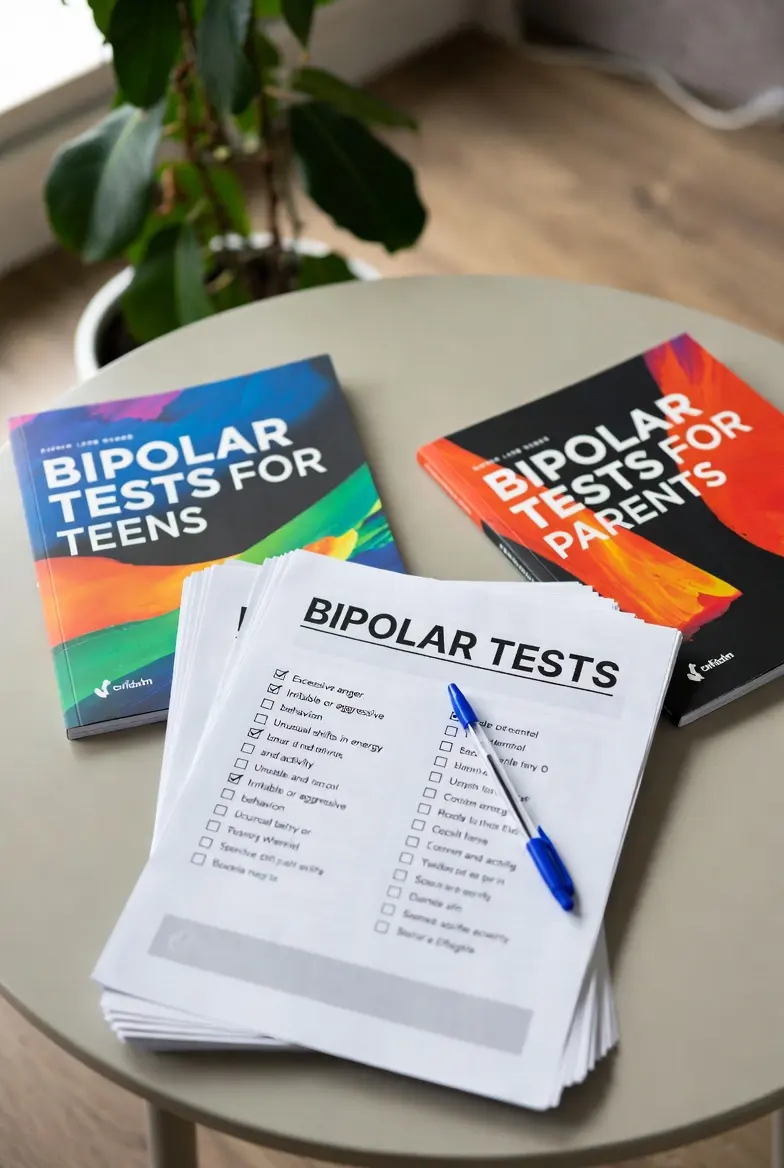
Diagnosing bipolar disorder in adolescents is notoriously difficult. A teenage bipolar test must account for the fact that teen brains are still developing, and “moodiness” can be normal.
Warning Signs in Adolescents
A bipolar test for teens looks for symptoms that go beyond typical “angst.” These include:
- Extreme “Giddiness”: Out-of-place happiness that seems forced or manic.
- Explosive Rage: “Bipolar rage” in teens can last for hours and is often triggered by very small things.
- Decreased Sleep: Unlike a typical teen who wants to sleep all day, a manic teen may stay up until 4:00 AM working on projects and feel fine at school the next day.
Bipolar Test for Someone Else
If you are searching for a bipolar test for someone else, you are likely looking at the Parent General Behavior Inventory (PGBI). This is a validated tool where parents rate their child’s mood fluctuations over time. If you suspect your child is struggling, a bipolar test free for teens online can help you decide if it’s time to consult a pediatric psychiatrist.
Bipolar vs. Depression vs. BPD: Comparison Tests Explained
One of the greatest challenges in psychiatry is “Differential Diagnosis.” Many conditions look like bipolar disorder but require completely different treatments.
Bipolar vs. Depression Test
Most people with bipolar disorder are first diagnosed with “Unipolar” depression. A depression test will ask about sadness and lethargy, but it won’t ask about that one week last year when you felt like you were “on top of the world” and spent $3,000 on a new hobby.
- The Difference: Bipolar involves cycles. Unipolar depression does not have “up” periods.
BPD vs. Bipolar Test
There is significant confusion between Borderline Personality Disorder (BPD) and Bipolar.
- Bipolar: Moods are “episodic.” A manic episode lasts days or weeks, regardless of what is happening in your life.
- BPD: Moods are “reactive.” A person with BPD may feel suicidal in the morning and happy in the afternoon, usually triggered by an interaction with another person.
| Feature | Bipolar Disorder | Borderline Personality (BPD) |
| Mood Duration | Days to Weeks | Minutes to Hours |
| Triggers | Often Biological (Sleep/Season) | Often Interpersonal (Conflict) |
| Primary Symptom | Change in Energy/Sleep | Fear of Abandonment |
| Medication | Mood Stabilizers (Lithium) | Primarily Therapy (DBT) |
Bipolar Symptoms in Women
Research shows that bipolar symptoms in women often differ from the “textbook” symptoms seen in men. Traits of a bipolar woman may include:
- Rapid Cycling: Having four or more mood episodes in a single year.
- Mixed Features: Feeling depressed and “wired” at the same time (a very high-risk state for suicide).
- Hormonal Influence: Symptoms often worsen during the premenstrual phase, pregnancy, or menopause, leading to misdiagnoses like “Severe PMS” or “Postpartum Depression.”
Because of these nuances, women are more likely to be misdiagnosed with depression or anxiety for years before the bipolar spectrum is identified.
How Do Clinicians Actually Diagnose Bipolar Disorder?
If you move past the how to know if your bipolar quiz phase and see a doctor, here is how to test for bipolar disorder in a clinical setting.
The Clinical Interview
This is the “Gold Standard.” The doctor will ask about your mood history from childhood to the present. They are looking for a “timeline.” How do you test for bipolar accurately? By looking at the spacing of your highs and lows.
Collateral Information
A doctor may ask to speak with your spouse or parent. Why? Because during mania, you may feel great and not realize your behavior is odd. How to check if your bipolar status is accurate often requires an “outside observer” who can say, “Yes, they didn’t sleep for three days and bought a car they couldn’t afford.”
The Life Chart Method
How to test for bipolar effectively often involves creating a “Life Chart.” This is a graph that maps your moods alongside major life events (jobs, breakups, moves). If your “crashes” happen every spring or after every big success, it points strongly toward a bipolar diagnosis.
Bipolar Disorder Subtypes: Why the Type Matters
When you ask “how to test for bipolar,” you are actually testing for which type you have.
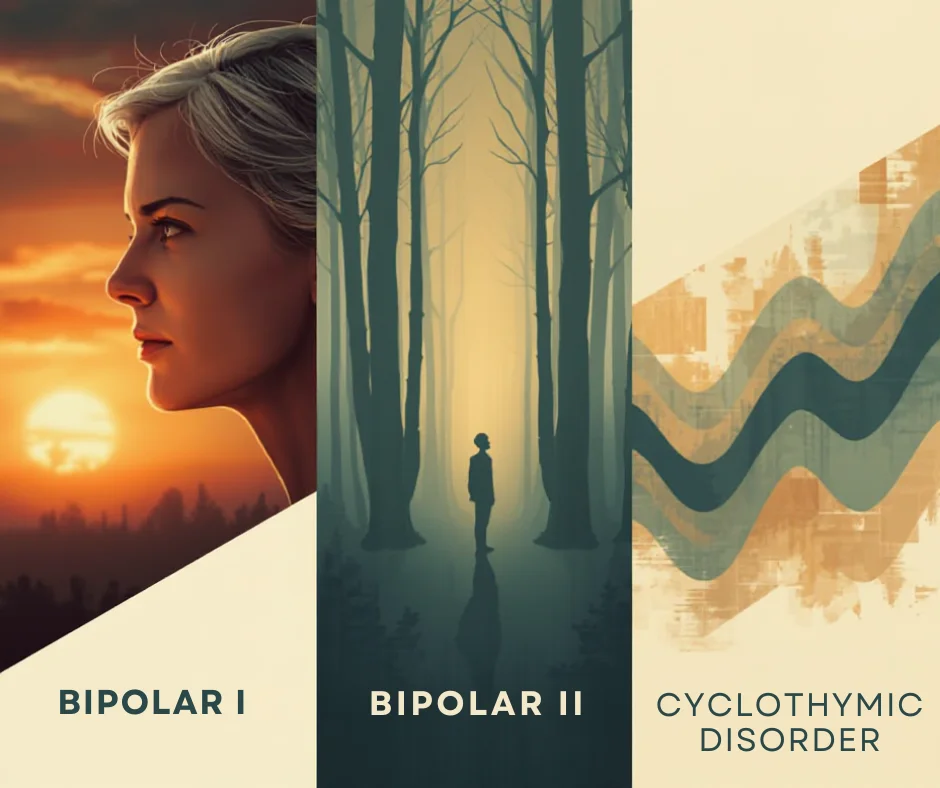
- Bipolar I: Defined by at least one full manic episode. Depression is common but not technically required for the diagnosis.
- Bipolar II: Defined by at least one major depressive episode and at least one hypomanic episode. You never go into full, “sky-high” mania.
- Cyclothymia: A milder, chronic version where moods fluctuate for at least two years but never reach the full “Blue Book” definition of mania or depression.
What Is the Difference Between Bipolar 1 and 2? Essentially, it is the “peak” of the high. Bipolar 1 can cause a total break from reality (psychosis); Bipolar 2 is often seen as “extreme productivity” followed by a devastating “crash.”
Axis I Disorders and Bipolar Disorder (Historical Context)
While researching, you might see the term “What Disorders Are in Axis 1?” This refers to an older version of the DSM (DSM-IV).
- Axis I: Was for clinical disorders like Bipolar and Schizophrenia.
- Axis II: Was for personality disorders.
In the current DSM-5-TR, we no longer use the “Axis” system. We treat the person as a whole. However, understanding this helps you see that Bipolar has always been viewed as a primary medical illness of the brain.
Bipolar Test: Final Summary & Next Steps
Navigating the path to a bipolar disorder diagnosis is often a journey of self-discovery as much as it is a medical process. By using a bipolar test free online, you have already taken the most important step: acknowledging that your experience is valid and deserves an explanation.
The Path from Screening to Stability
- Step 1: The Gut Check. You noticed symptoms like racing thoughts, “bipolar rage,” or periods of deep despair.
- Step 2: The Self-Screen. You utilized tools like the MDQ or bipolar test idrlabs to see if your patterns match the clinical profile.
- Step 3: Professional Evaluation. You take your printable bipolar test results to a board-certified psychiatrist for an in-depth clinical interview.
- Step 4: The Rule Out. Your doctor performs blood work and reviews your “Life Chart” to rule out thyroid issues, ADHD, or BPD.
- Step 5: Targeted Treatment. Once the type (Bipolar I, II, or Cyclothymia) is identified, you begin a customized regimen of mood stabilizers and therapy.
Quick FAQ Recap
Is there a blood test for bipolar?
No, but blood tests rule out physical mimics like hyperthyroidism.
Can I take a bipolar test for someone else?
Yes, parents can use tools like the PGBI for teens, but only a doctor can diagnose them.
What is the difference between Bipolar 1 and 2?
Bipolar 1 involves full mania (often requiring hospital care); Bipolar 2 involves hypomania (extreme energy but no psychosis) and intense depression.
Is a 3-minute bipolar test accurate?
It is a helpful “early warning,” but it cannot replace a 60-minute clinical interview.
Authoritative References
Related Posts




Subscribe to Our Newsletter
Get mental health tips, updates, and resources delivered to your inbox.
MORE from Author
Read More ADHD and depression often occur together, and each makes the other harder to live with. Adults with ADHD are almost…
 We all have "up" days and "down" days. Perhaps you feel energized after a promotion or sluggish on a rainy…
 To define bipolar disorder accurately, we must look at it as a chronic mood dysregulation condition. In psychology and medicine,…
Are you looking for a Therapist?
Connect with qualified mental health professionals who understand
bipolar disorder, mood changes, and emotional challenges.
Private • Supportive • Confidential