
The Feeling Wheel: How to Identify, Understand & Express Emotions
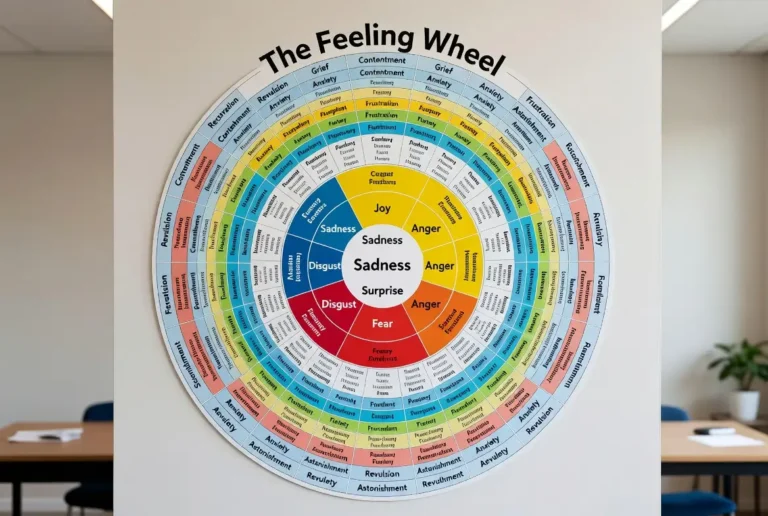
At some point, we have all been asked, “How are you feeling?” and responded with a generic “fine,” “okay,” or “stressed.” While these words are convenient, they rarely capture the true depth of the human experience. This is where the feeling wheel becomes an essential tool.
What is the feeling wheel?
Put simply, it is a visual circular diagram designed to help individuals identify, label, and communicate their emotions with greater precision. Often used in therapy, education, and personal development, the wheel acts as a map for the internal landscape. It moves from broad, core emotions in the center to more nuanced, specific descriptors on the outer edges.
By using what is a feeling wheel—a process known as emotional granularity—individuals can move past vague sensations of discomfort and identify the exact nature of their distress. Whether you are looking for a feeling wheel pdf for personal journaling, a printable feeling wheel for your classroom, or an emotion wheel for therapeutic use, this tool bridges the gap between feeling something and understanding it. In this guide, we will explore the history, the science, and the practical application of the wheel for adults, teens, and children.
Who Created the Feeling Wheel? (History & Origins)
While various versions of emotion diagrams exist today, the original feeling wheel was created by Dr. Gloria Willcox in 1982. Published in the Transactional Analysis Journal, her design was intended to help people move from a state of emotional confusion to clarity. Dr. Willcox identified six core emotions—Sad, Mad, Scared, Joyful, Powerful, and Peaceful—placing them at the center of the wheel.
It is common to confuse Willcox’s tool with the Plutchik Emotion Wheel, created by Dr. Robert Plutchik. While Plutchik’s model focuses on the evolutionary purpose of emotions (pairing opposites like joy/sadness and anger/fear), the Willcox wheel is more focused on the vocabulary of feeling.
In recent years, the tool has seen a massive resurgence thanks to the Gottman Institute feeling wheel. The Gottmans, world-renowned for their research on relationship stability, adapted the concept to help couples navigate conflict. The Gottman feeling wheel emphasizes naming emotions to de-escalate “flooding” during arguments. Whether you are using the original Willcox version or a feeling wheel Gottman adaptation, the goal remains the same: transforming raw sensation into meaningful language.
What Is an Emotion Wheel & How Does It Work? (Core Concept)
To understand what is an emotion wheel and how does it work, we must first understand the layers of our emotional brain. We rarely feel just one thing at a time. The emotional feeling wheel is organized into three distinct tiers:
- Primary Emotions (The Center): These are the most basic, “big” feelings. Most wheels include 6 to 8 core categories such as Anger, Fear, Sadness, Disgust, Surprise, and Joy.
- Secondary Emotions (The Middle Ring): These add a layer of context to the primary emotion. For example, if the core is “Anger,” the secondary emotion might be “Frustrated” or “Hateful.”
- Tertiary Emotions (The Outer Ring): These provide the highest level of emotional granularity. Under “Frustrated,” you might find “Infuriated” or “Annoyed.”
The logic behind the emotion and feeling wheel is that the more specific we are about a feeling, the more power we have over it. Neuroscientists have found that “labeling” an emotion reduces activity in the amygdala (the brain’s fear center) and increases activity in the prefrontal cortex (the rational center). When you move from the center of the emotion feeling wheel to the outer edge, you are literally calming your nervous system through language.
How Does the Feeling Wheel Work? (Step-by-Step Explanation)
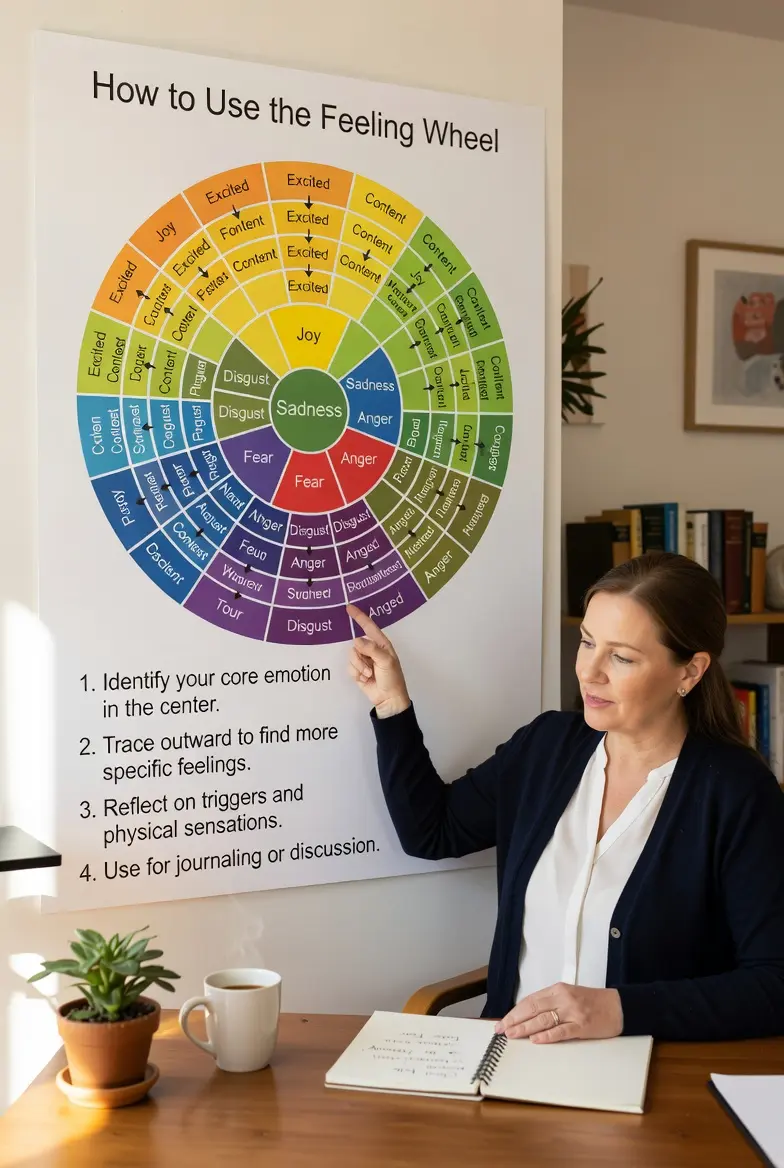
Using the tool effectively requires a “center-out” approach. If you find yourself in a state of overwhelm, follow these steps to how to ID your feeling wheel:
- Step 1: Identify the Core. Look at the center. Which of the broad categories feels closest to your state? Are you generally “Scared,” “Sad,” or “Mad”?
- Step 2: Narrow the Field. Move to the next ring. If you are “Mad,” is it because you feel “Hurt” or “Threatened”?
- Step 3: Pinpoint the Nuance. Move to the outer ring. Perhaps “Hurt” is actually “Devastated” or “Embarrassed.”
- Step 4: Check for Resonance. Once you find a word, say it out loud or write it down. Does your body feel a slight sense of relief? That “click” of recognition is the goal of the how am I feeling wheel.
Many people find success by asking, “How are you feeling today wheel?” as part of their morning routine. By identifying triggers—the “why” behind the word—and noticing where that feeling sits in your body (e.g., “tightness in chest” for “anxious”), you turn a vague how are you feeling wheel exercise into a profound act of self-awareness.
In my clinical practice, I often tell patients that ‘if you can name it, you can tame it.’ Most people come into therapy stuck in a ‘Primary’ state—they are just ‘angry’ or ‘depressed.’
The magic happens when we use a feeling wheel for adults to realize that their ‘anger’ is actually ‘disrespect’ or ‘loneliness.’ Once we find the specific word, we can find the specific solution. You cannot ‘fix’ anger if the root is actually loneliness. The wheel is the diagnostic tool that helps us stop fighting the wrong battles.
How to Use the Feeling Wheel (Adults & Therapy)
While it may look like a simple chart, the feeling wheel for adults is a versatile instrument for mental health maintenance.
How Do You Use the Feeling Wheel in Therapy?
Therapists often use the wheel to help clients who struggle with alexithymia—the inability to identify or describe emotions. In a session, a therapist might present the how to use the feeling wheel guide to help a client process a traumatic memory. By identifying that a past event makes them feel “Powerless” (under “Scared”) rather than just “Sad,” the client can begin to reclaim their agency.
Journaling Prompts
One of the most effective how to use a feeling wheel strategies is through journaling. Try these prompts:
- The “Three Layer” Scan: Write down a core feeling, its secondary descriptor, and its tertiary nuance. Explain the event that led to the outer-ring emotion.
- Opposite Sides: Find your current emotion on the wheel. Look at the word directly opposite it. What would it take for your nervous system to move toward that opposite state?
Using the how to use feeling wheel method during moments of high stress acts as an emotional “brake,” preventing impulsive reactions in relationships or at work.
Why Should You Use the Feelings Wheel? (Benefits)
The why should you use the feelings wheel question is answered by the concept of Emotional Intelligence (EQ). Research consistently shows that individuals with high EQ have better health outcomes, stronger relationships, and higher career success.
- Conflict Resolution: Instead of saying “You make me mad,” you can say “I feel ‘Dismissed’ when you look at your phone during dinner.” This moves the conversation from accusation to connection.
- Reduced Anxiety: Anxiety thrives on the “unknown.” By using a feeling wheel calm technique, you name the unknown, making it less threatening.
- Emotional Charting: Keeping a daily emotion chart or feeling chart allows you to see patterns. You might notice you feel “Inadequate” (under “Sad”) every Sunday evening, which could point toward workplace burnout.
Feeling Wheel Printable & PDF Resources
For many, the most effective way to use this tool is to have a physical copy in hand. Digital versions are helpful for quick checks, but a feeling wheel printable allows for tactile interaction—coloring, circling, and pinning it to a visible spot.
How to Choose Your Version
- Color-Coded PDFs: These are best for visual learners. Most feelings wheel pdf versions use warm colors (reds, oranges) for high-energy emotions like anger or excitement, and cool colors (blues, purples) for low-energy states like sadness or peace.
- Black-and-White Versions: These are ideal for “Active Contemplation.” Coloring the wheel yourself is a therapeutic exercise that forces you to sit with each word and decide what color “resentment” or “insecurity” feels like to you.
- Minimalist Design: For adults and professionals, a clean, text-based emotion wheel pdf fits well in a clinical binder or office setting without looking “juvenile.”
Pro-Tip for Printing: When downloading a free printable feeling wheel, print on cardstock or laminate the page. This allows you to use dry-erase markers to circle your daily “Emotional State” and wipe it clean the next day.
Feeling Wheel for Kids (Parents & Educators)
Introducing a kids feeling wheel is a game-changer for emotional literacy. Children often lack the vocabulary to explain why they are acting out. A “tantrum” is rarely just about a broken toy; it’s about a feeling of “Powerlessness” or “Overwhelm.”
Classroom & Home Activities
- The “Emotion Check-In”: Start each school day or family dinner by passing around a feeling wheel for kids. Ask: “Which slice of the pie are you eating today?”
- Acting It Out: For younger children, have them spin a feeling wheel kids version and act out the emotion it lands on. This helps them recognize the facial expressions and body language associated with different feelings.
- The “Anger Horn”: A popular therapeutic technique for children involves using the wheel to identify anger, then “blowing” that anger through a decorated paper tube (the horn) to release the physical tension.
By providing a feelings wheel for kids pdf, you give them a “bridge” between their big feelings and their words, significantly reducing behavioral outbursts.
Feeling Wheel for Teens (Middle & High School)
Teens face a unique set of emotional pressures—social media comparison, identity formation, and academic stress. For them, a feelings wheel for teens must be more sophisticated, moving beyond “sad/mad” into “isolated,” “vulnerable,” or “disrespected.”
Combatting the “Shutdown”
When a teen says “I don’t know” or “I’m fine,” it’s often because they are experiencing a “blended” emotion that is too complex to name.
- Journaling Prompts: Ask them to pick three words from the outer ring of a how are you feeling today wheel and write 2-3 sentences on when they last felt that way.
- Numerical Intensity: Ask them to find their feeling on the wheel and then rate it from 1–10. This helps them distinguish between “mild annoyance” and “explosive fury.”
Feeling Wheel in Couples & Gottman Method Therapy
The Gottman feeling wheel is a cornerstone of “Conflict Repair.” In the heat of an argument, our brains enter “Fight or Flight,” making it impossible to communicate rationally.
De-Escalation with the Wheel
The Gottman Institute suggests that naming the emotion reduces “flooding” (the physiological state of being overwhelmed).
- Emotional Bids: If one partner can say, “I’m not just angry; I’m feeling ‘unappreciated’ right now,” it provides the other partner with a specific “bid” for connection rather than a defensive wall.
- The “Vulnerability Scan”: In Gottman institute feeling wheel sessions, couples are encouraged to look for the “softer” emotions (like hurt or shame) hiding behind the “hard” emotions (like anger or disgust).
Feeling Wheel App & Digital Tools
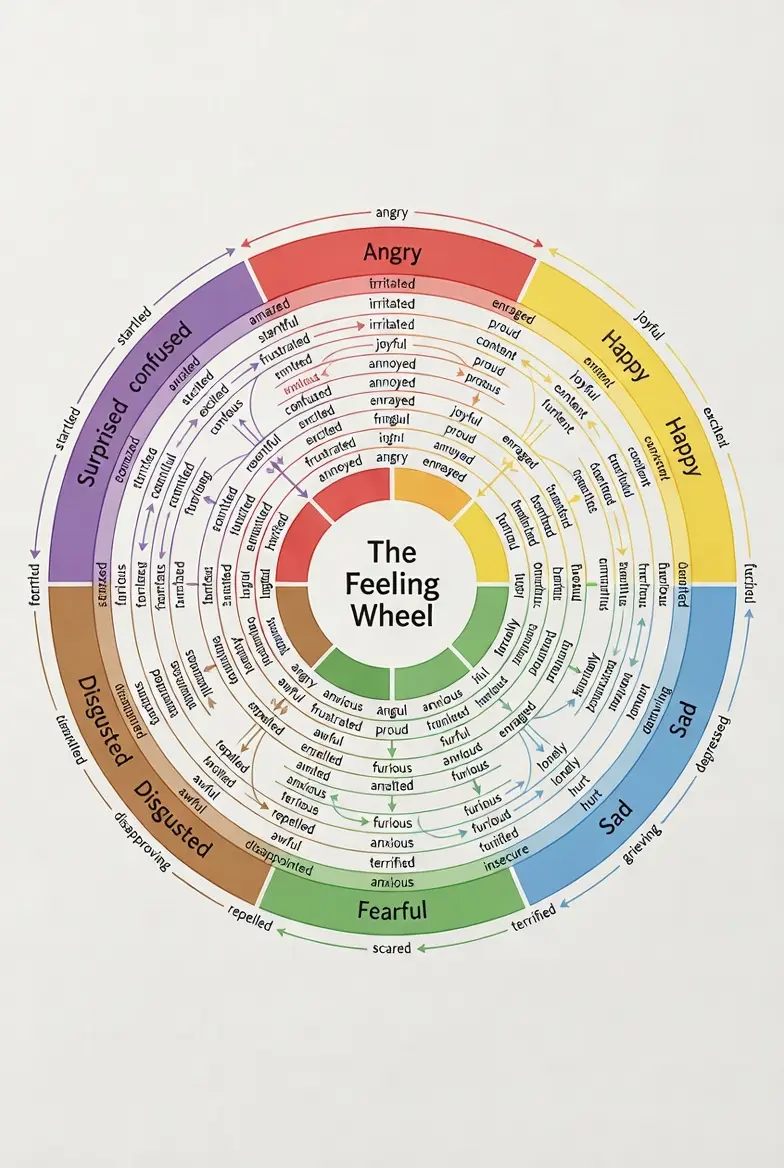
If you aren’t a “paper and pen” person, several feelings wheel app options allow you to track your emotions on the go.
- Pros: Digital tools often include “Mood Tracking” over time, showing you how your emotions fluctuate according to your sleep, diet, or work cycle.
- Cons: They lack the tactile, mindfulness-inducing quality of a physical emotion wheel.
- Privacy: Always ensure that any app you use for emotional logging has end-to-end encryption, as this is your most sensitive data.
How to Make a Feeling Wheel (DIY Guide)
If you can’t find a feeling wheel chart that resonates with you, make your own! This is an excellent exercise for families or therapy groups.
- Trace a Circle: Use a large dinner plate on a piece of cardboard or heavy paper.
- Divide into “Slices”: Create 6 to 8 main sections for your core emotions.
- Add the Rings: Draw two concentric circles inside the large one to create your “Secondary” and “Tertiary” levels.
- Personalize the Words: Use words that feel authentic to you. Instead of “Disgust,” maybe you use “Cringe.” Instead of “Joy,” maybe you use “Hype.”
- Add Sensation Notes: In the outer margins of your feeling worksheet, write down where you feel that emotion in your body (e.g., “butterflies” for “excited”).
In this final section, we move into advanced emotional awareness—connecting the mind to the body—and clear up common points of confusion to ensure you have a “complete” toolkit.
Feeling Wheel vs. Emotion Sensation Wheel (Advanced Version)
For those who have mastered the standard wheel, the emotion sensation feeling wheel adds a critical layer: interoception. Interoception is the ability to sense what is happening inside your body.
Integrating Body Awareness
The sensation wheel doesn’t just ask what you are feeling; it asks where and how you are feeling it physically.
- The “Tight” Chest: Often associated with the “Anxious” slice of the wheel.
- The “Heavy” Limbs: Often associated with “Despair” or “Grief.”
- The “Warm” Glow: Associated with “Gratitude” or “Contentment.”
This trauma-informed approach is vital because the body often knows we are upset before our “thinking brain” does. By using an emotion and feeling wheel that includes physical sensations, you can catch a “Hyperarousal” spike (from the Window of Tolerance) before it turns into an emotional explosion.
Common Misinterpretations & FAQs
What is the feeling wheel?
The feeling wheel is a circular diagram used to expand emotional vocabulary, moving from 6-8 core emotions to over 100 specific descriptors.
How do I use the feelings wheel?
Start at the center with a broad feeling (e.g., “Sad”). Move outward to the next ring to find a more specific word (e.g., “Lonely”). Move to the final ring for the most precise word (e.g., “Isolated”).
Is the feeling wheel evidence-based?
Yes. The concept is based on “affect labeling.” Research in the field of affective neuroscience shows that naming an emotion reduces the physiological stress response in the brain.
Why is it helpful?
It increases emotional granularity. High emotional granularity is linked to better stress management, reduced likelihood of depression, and improved social relationships.
Conclusion: Building Emotional Awareness One Word at a Time
The journey toward emotional health isn’t about “getting rid” of bad feelings; it’s about becoming a better listener to the messages your brain is sending. The feeling wheel is the translation device for those messages.
Whether you are using a printable feeling wheel on your refrigerator to help your children, or a feeling wheel pdf in your private therapy sessions, the act of naming your experience is an act of self-care. It moves you from a state of being controlled by your emotions to a state of understanding them.
Emotional literacy is a muscle—it gets stronger the more you use it. Download your feeling wheel pdf printable today and start building the clarity you deserve.
Authoritative Clinical & Research References



Subscribe to Our Newsletter
Get mental health tips, updates, and resources delivered to your inbox.
MORE from Author
Read More In my practice as a clinical psychologist, I often observe that the difference between a patient who crumbles under pressure…
- We all have "up" days and "down" days. Perhaps you feel energized after a promotion or sluggish on a rainy…


 To define bipolar disorder accurately, we must look at it as a chronic mood dysregulation condition. In psychology and medicine,…
 To answer whether bipolar fits the bill, we first have to define what a neurodivergent person actually is. The term…
Are you looking for a Therapist?
Connect with qualified mental health professionals who understand
bipolar disorder, mood changes, and emotional challenges.
Private • Supportive • Confidential