
Disorganized Thinking: Definition, Examples, Causes, Bipolar Mania vs Schizophrenia & Treatment

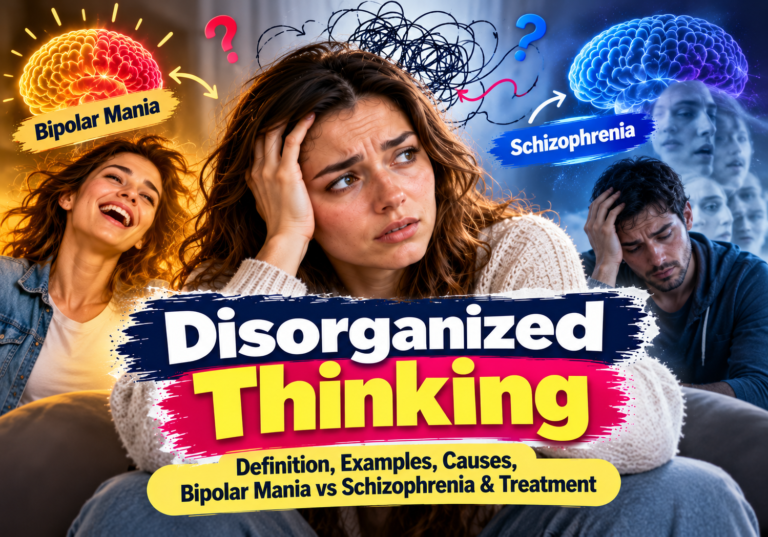
Disorganized thinking is a disturbance in how thoughts are connected and organized. It makes speech hard to follow: jumping between loosely related topics, never getting to the point, or, in severe cases, producing jumbled “word salad”. Clinicians also call it formal thought disorder. Because no one can see thoughts directly, it is recognized mainly through disorganized speech.
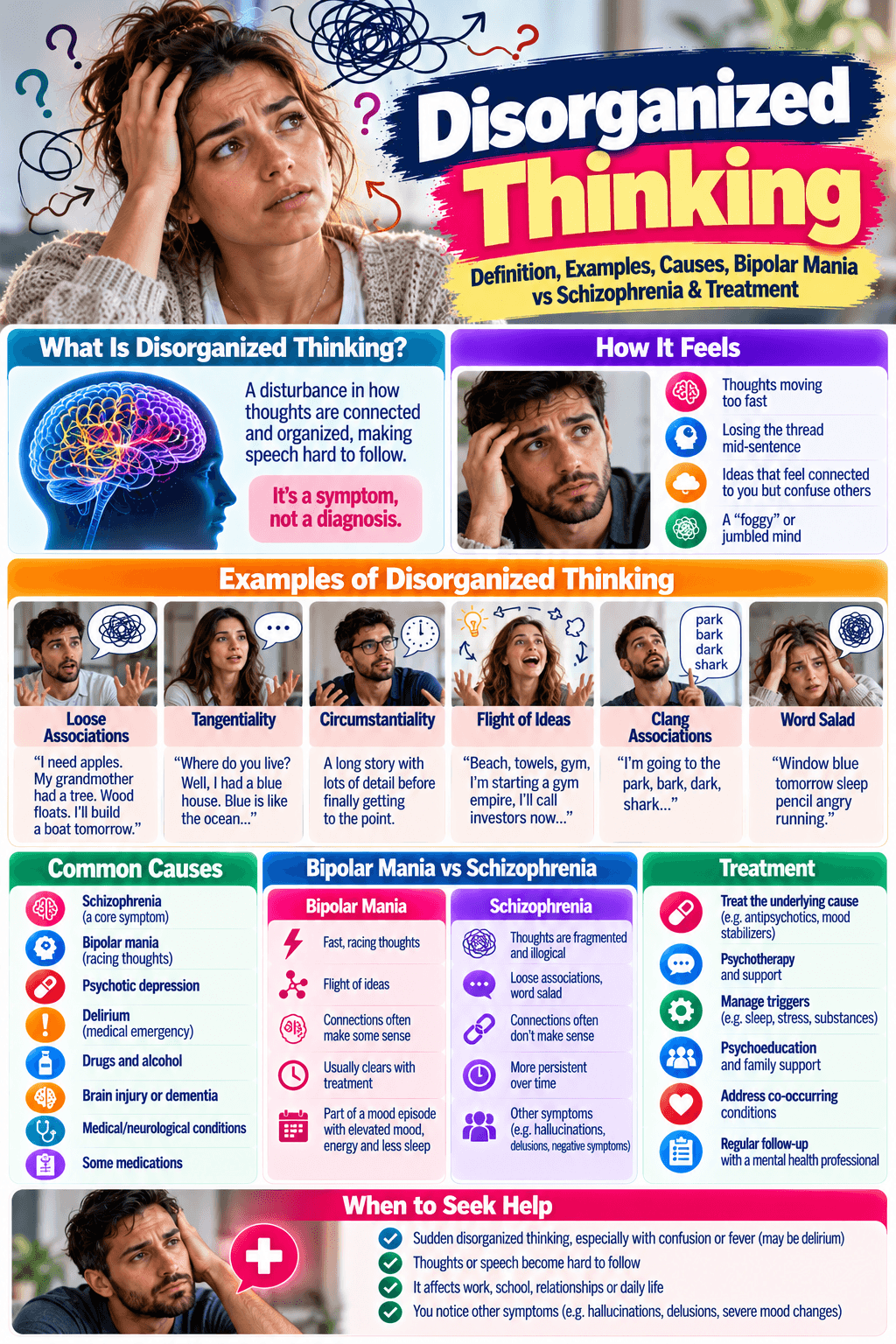
Disorganized thinking is best known as a symptom of schizophrenia, but it is also common in bipolar mania. There, racing thoughts and “flight of ideas” can make speech fast and hard to follow, and severe episodes can become psychotic. Other causes include psychotic depression, delirium, drugs and alcohol, and brain injury or dementia. It is a symptom, not a diagnosis, and treatment depends on the cause.
Key takeaways
- Disorganized thinking means problems with the flow and logic of thoughts, shown in speech.
- Common types: loose associations, tangentiality, circumstantiality, flight of ideas, clanging, word salad, thought blocking.
- It is a positive symptom of schizophrenia and one of the DSM-5-TR’s core psychosis symptoms.
- In bipolar mania, thinking is fast and jumps quickly between ideas (flight of ideas), usually with connections a listener can still follow. It typically clears when the episode is treated.
- ADHD distractibility and anxious “brain fog” are not true thought disorder.
- Sudden disorganized thinking, especially with confusion or fever, can be delirium, a medical emergency.
What Is Disorganized Thinking? (Psychology Definition)
Disorganized thinking definition: a disturbance in the form of thought, meaning the logical organization, sequence and goal-direction of ideas, as opposed to the content of thought. Clinicians distinguish:
- Thought process (form): how thoughts connect. Disorganized thinking is a problem here.
- Thought content: what a person thinks about, such as delusions or obsessions.
Someone can hold a delusion (a content problem) while speaking in perfectly organized sentences, and someone can talk about everyday things in a disorganized way. See hallucinations vs delusions.
For AP Psychology: disorganized thinking is a symptom of schizophrenia and other psychotic disorders in which thoughts are fragmented and illogical, often shown as “word salad” or loose associations. It is classified as a positive symptom.
What does disorganized thinking feel like?
People describe:
- thoughts moving too fast to hold on to
- losing the thread mid-sentence
- ideas that feel connected to them but confuse others
- a “foggy” or “jumbled” mind
During mania, many people say their thoughts are racing like “a radio flipping through stations”. Others with thought disorder may not notice their speech is hard to follow.
Examples of Disorganized Thinking
| Type | What it is | Example |
|---|---|---|
| Loose associations / derailment | Ideas jump between topics with weak or no logical link | “I need apples. My grandmother had a tree. Wood floats. I’ll build a boat tomorrow.” |
| Tangentiality | Answers drift off-topic and never come back | Q: “Where do you live?” A: “I had a blue house. Blue is like the ocean. Sharks are misunderstood…” |
| Circumstantiality | Lots of unnecessary detail, but eventually reaches the point | A long story about breakfast and the toaster before saying the appointment is at 10:30 |
| Flight of ideas | Rapid, continuous jumps between ideas, often triggered by words, sounds or surroundings; typical of mania | “We should go to the beach, beach towels, towels for the gym, I’m starting a gym empire, I’ll call investors now…” |
| Clang associations | Words chosen by sound or rhyme rather than meaning; seen in mania and psychosis | “I’m going to the park, bark, dark, shark…” |
| Word salad (incoherence) | Words strung together with no grammar or meaning | “Window blue tomorrow sleep pencil angry running.” |
| Thought blocking | Sudden stop mid-sentence, with the thought lost | “And then I went to the… (long pause) …what was I saying?” |
| Neologisms | Made-up words with private meanings | “I need my flarbstick to fix the phone.” |
| Perseveration | Repeating the same word or idea | Returning to the same phrase whatever the question |
| Poverty of speech / content | Very little speech, or many words that convey little meaning | Short, empty answers, or vague, repetitive talk |
What are the 2 types of disorganized thinking?
Clinicians often divide the symptom into:
- Disorganized speech (formal thought disorder), as in the examples above. It is sometimes further split into “positive” thought disorder (derailment, tangentiality, incoherence) and “negative” thought disorder (poverty of speech).
- Grossly disorganized behavior: difficulty carrying out goal-directed tasks, unpredictable agitation, inappropriate dress or actions, or catatonia.
Disorganized Thinking in Bipolar Disorder (Mania)
The DSM-5-TR criteria for a manic or hypomanic episode include:
- “Flight of ideas or subjective experience that thoughts are racing”
- Being more talkative than usual, or feeling pressure to keep talking
- Distractibility
What it looks like in mania
- Pressured speech: fast, loud and hard to interrupt
- Racing thoughts: ideas tumbling over each other
- Flight of ideas: rapid jumps where the links (puns, sounds, things in the room) are often still understandable
- Distractibility: attention pulled by every sound or sight
- In severe mania, speech can become truly incoherent, and psychotic symptoms (grandiose delusions, hallucinations) can appear
Mild racing thoughts can also occur in hypomania. Disorganized or slowed thinking, poor concentration and indecision are common in bipolar depression, and depression with psychotic features can cause thought disorder too. In mixed episodes, racing thoughts can combine with low mood and agitation.
See bipolar psychosis, signs of hypomania vs normal happiness, early warning signs of a bipolar episode and what is bipolar 1?.
Disorganized thinking in mania vs schizophrenia
Classic research by psychiatrist Nancy Andreasen found that formal thought disorder is common in mania as well as schizophrenia. It is not a feature that tells them apart on its own. Key differences:
| Bipolar mania | Schizophrenia | |
|---|---|---|
| Speed | Fast, pressured | Normal, slow, or variable |
| Connections | Often understandable (flight of ideas, wordplay, distractibility) | More likely to be bizarre or hard to follow; may include poverty of speech |
| Mood | Elevated, expansive or irritable | Often flat or not matching the content |
| Course | Comes with a mood episode and usually clears as the episode resolves | Often more persistent, with other psychotic and negative symptoms |
| Sleep | Greatly reduced need for sleep | Disrupted sleep, but not a defining “no need for sleep” |
When thought disorder and psychosis persist even between mood episodes, clinicians consider schizoaffective disorder.
Disorganized Thinking in Schizophrenia
Is disorganized thinking a positive symptom? Yes. In schizophrenia, “positive” means something added to normal experience, such as hallucinations, delusions or disorganized speech. It does not mean “good”. “Negative” symptoms are things that are reduced, such as motivation, emotional expression and speech.
The DSM-5-TR lists five core symptom groups for schizophrenia:
- delusions
- hallucinations
- disorganized speech
- grossly disorganized or catatonic behavior
- negative symptoms
At least two are required, and at least one must be delusions, hallucinations or disorganized speech.
Disorganized thinking in schizophrenia, examples:
- answers that drift away from the question
- sentences whose parts don’t connect
- invented words
- in severe cases, incoherent speech
Grossly disorganized behavior can include difficulty with self-care, dressing inappropriately for the weather, or unpredictable agitation.
Research links psychosis to differences in brain networks and in neurotransmitters including dopamine and glutamate, though the full picture is still being studied.
What Causes Disorganized Thinking?
| Cause | Key features |
|---|---|
| Schizophrenia spectrum disorders | Persistent, with hallucinations, delusions and negative symptoms |
| Bipolar mania or mixed episodes | Fast, pressured speech, flight of ideas, little need for sleep |
| Psychotic depression | Severe depression with delusions or hallucinations |
| Schizoaffective disorder | Psychosis plus major mood episodes |
| Brief psychotic disorder / postpartum psychosis | Sudden onset; postpartum psychosis is an emergency |
| Delirium | Sudden confusion, poor attention and fluctuating alertness, often from infection, dehydration, medications or surgery; common in older adults; medical emergency |
| Drugs and alcohol | Stimulants, cannabis (especially high-potency), hallucinogens, and alcohol or sedative withdrawal. See substance-induced mood disorder. |
| Neurological conditions | Head injury, stroke, epilepsy, brain infections, dementia |
| Severe sleep deprivation | Can cause confusion and, in extreme cases, psychotic symptoms; also a common mania trigger |
Is It ADHD, Anxiety or a Thought Disorder?
Many people searching “ADHD disorganized thinking” or “disorganized thinking anxiety” are worried they have a psychotic thought disorder. Usually they don’t.
| ADHD | Anxiety | Formal thought disorder (psychosis/mania) | |
|---|---|---|---|
| What happens | Attention jumps; hard to stay on track or organize tasks | Worry hijacks attention; mind goes blank or loops | Logical links between thoughts break down |
| Can others follow? | Yes; tangents make sense | Yes | Often hard or impossible |
| Can you redirect? | Usually, with a prompt | Usually, after calming down | Often difficult |
| Pattern | Lifelong | Linked to stress and worry | Often new, or with an episode |
ADHD and anxiety can make thinking feel disorganized, but they don’t produce word salad, loose associations or psychosis. See ADHD and anxiety, generalized anxiety disorder and cognitive function.
Autistic people may communicate in literal or unusual ways that are not thought disorder. See autism and hallucinations.
How Is Disorganized Thinking Assessed?
A clinician will usually:
- do a mental status exam, listening to the form and content of speech
- take a history: when it started, whether it is getting worse, mood episodes, sleep, substance use, family history
- ask about other psychotic symptoms
- run medical tests where needed (blood tests, drug screen, sometimes a brain scan or EEG) to rule out delirium and physical causes
- use structured scales in research or specialist settings, such as Andreasen’s Thought, Language and Communication scale
Disorganized Thinking Treatment
Treatment targets the underlying cause:
- Bipolar mania: mood stabilizers such as lithium or valproate, and/or antipsychotics such as quetiapine, plus restoring sleep. Thought disorder usually improves as the episode resolves. See bipolar disorder medications and mood stabilizers vs antipsychotics.
- Schizophrenia and other psychotic disorders: antipsychotic medication, plus psychosocial treatment. Coordinated specialty care for a first episode of psychosis combines medication, therapy, family support, and help with work and school.
- Psychotic depression: antidepressant plus antipsychotic, or ECT in severe cases.
- Delirium: urgent medical treatment of the cause (infection, dehydration, medication review).
- Substance-related: stopping the substance, safe withdrawal management, and addiction treatment.
Therapies that help:
- Cognitive remediation therapy: exercises to strengthen attention, memory and planning
- CBT for psychosis (CBTp)
- Psychoeducation and family therapy
- Practical strategies: slowing down, writing key points before conversations, routines, and good sleep. See bipolar and sleep and the best therapy for bipolar disorder.
How to Help Someone With Disorganized Thinking
- Stay calm and patient. Speak slowly, using short, simple sentences.
- Ask one question at a time and give time to answer.
- Don’t argue with confused or delusional ideas; focus on feelings and safety.
- Reduce stimulation: a quiet room, fewer people, TV off.
- Write down important information.
- Encourage medical help, especially if it’s new or getting worse, and help them get there.
- Note warning signs and share them with their care team: less sleep, faster speech, unusual ideas.
When Is Disorganized Thinking an Emergency?
Seek urgent medical help if disorganized thinking:
- starts suddenly, especially with confusion, fever, headache, drowsiness or a recent fall or head injury
- comes with hallucinations, paranoia, or a risk to self or others
- appears after giving birth (possible postpartum psychosis)
- comes with days of little or no sleep and extreme energy (possible mania)
- follows drug use, or alcohol or sedative withdrawal
If you are in crisis: call or text 988 (Suicide & Crisis Lifeline, US), call your local emergency number, or go to the nearest emergency department.
Frequently Asked Questions About Disorganized Thinking
What is disorganized thinking?
A disturbance in the logical flow and organization of thoughts, usually seen as speech that is hard to follow: loose associations, tangents or word salad.
What does disorganized thinking mean in psychology?
It refers to formal thought disorder, a problem with thought process rather than thought content, seen in schizophrenia, mania and other conditions.
Is disorganized thinking a positive symptom of schizophrenia?
Yes. It is a positive symptom, meaning something added to normal experience, alongside hallucinations and delusions.
Can bipolar disorder cause disorganized thinking?
Yes. Mania commonly causes racing thoughts, flight of ideas and pressured speech, and severe mania or psychotic depression can cause more severe thought disorder. It usually improves with treatment of the episode.
What is the difference between flight of ideas and loose associations?
Flight of ideas involves rapid jumps between ideas with links that are usually understandable, and is typical of mania. Loose associations involve jumps with weak or no logical link, and are more typical of psychosis.
Can ADHD cause disorganized thinking?
ADHD causes distractibility and difficulty organizing tasks, but not formal thought disorder; tangents usually still make sense.
Can anxiety cause disorganized thinking?
Anxiety can cause racing thoughts, mind blanks and difficulty concentrating, but not true thought disorder.
Is disorganized thinking treatable?
Yes. Treating the cause (mania, psychosis, delirium or substance use) often greatly improves it, and therapy can help with remaining difficulties.
The Bottom Line on Disorganized Thinking
Disorganized thinking is a breakdown in how thoughts link together, seen most clearly in speech. It is a hallmark of schizophrenia, but it is also central to bipolar mania, where racing thoughts and flight of ideas usually clear as the episode is treated. It can also signal medical emergencies like delirium. ADHD and anxiety can make thinking feel scattered, but that is different from true thought disorder. If you or someone you love is showing new or worsening disorganized thinking, get an assessment promptly. Most causes are treatable, and early help leads to better recovery.
References
- American Psychiatric Association. Diagnostic and Statistical Manual of Mental Disorders, 5th ed., Text Revision (DSM-5-TR). 2022.
- Andreasen NC. Thought, language, and communication disorders. II. Diagnostic significance. Archives of General Psychiatry. 1979;36(12):1325–1330.
- Kircher T, Bröhl H, Meier F, Engelen J. Formal thought disorders: from phenomenology to neurobiology / historical roots. Frontiers in Psychiatry. 2018.
- National Institute of Mental Health. Understanding Psychosis.
- National Institute of Mental Health. Schizophrenia.
- National Institute of Mental Health. Bipolar Disorder.
Related Posts





Subscribe to Our Newsletter
Get mental health tips, updates, and resources delivered to your inbox.
MORE from Author
Read More ADHD and depression often occur together, and each makes the other harder to live with. Adults with ADHD are almost…
 We all have "up" days and "down" days. Perhaps you feel energized after a promotion or sluggish on a rainy…
 To define bipolar disorder accurately, we must look at it as a chronic mood dysregulation condition. In psychology and medicine,…
Are you looking for a Therapist?
Connect with qualified mental health professionals who understand
bipolar disorder, mood changes, and emotional challenges.
Private • Supportive • Confidential