
Borderline Personality Disorder in Women: A Comprehensive Clinical and Relational Guide

Borderline Personality Disorder (BPD) is a complex mental health condition that remains one of the most misunderstood diagnoses in modern psychology. While the disorder affects all genders, the borderline personality disorder female experience is uniquely shaped by a combination of biological factors, societal expectations, and distinct clinical presentations.
Historically, BPD has been diagnosed more frequently in women, with some clinical samples showing a 3:1 female-to-male ratio. However, modern research suggests that this may be due to the way women with borderline personality disorder express their symptoms compared to men. While men may externalize their distress through aggression or antisocial behavior, women often internalize their pain, leading to high rates of self-harm, eating disorders, and chronic shame. Understanding the nuance of BPD in females is essential for accurate diagnosis, compassionate relationships, and effective treatment.
What Is Borderline Personality Disorder?
At its core, BPD is a disorder of the emotional regulation system. It is characterized by a pervasive pattern of instability in affects, self-image, and interpersonal relationships. For many, the experience of BPD is like living with “emotional third-degree burns”—where even the slightest touch or perceived slight can cause excruciating psychological pain.
Emotional Dysregulation as the Core Feature
The hallmark of the disorder is emotional dysregulation. While most people can return to a “baseline” emotional state relatively quickly after a stressful event, individuals with BPD experience emotions that are more intense and longer-lasting. What are the symptoms of borderline personality disorder? According to the DSM-5-TR, a person must meet at least five of nine specific criteria involving fear of abandonment, identity disturbance, and chronic feelings of emptiness.
In females, these symptoms often manifest as a desperate search for stability in an internal world that feels constantly shifting. The “borderline” label originally referred to the idea that patients were on the border between neurosis and psychosis, but today, it is understood as a specialized form of emotional processing disorder.
Borderline Personality Disorder Female Symptoms
The borderline personality disorder female symptoms often present a profile of “acting in” rather than “acting out.” While every individual is different, women tend to display a specific constellation of behaviors and cognitive patterns.
Emotional and Cognitive Symptoms
- Intense Rejection Sensitivity: A woman with BPD may perceive a late text message as proof that she is being abandoned, triggering a spiral of despair or panic.
- Chronic Emptiness: Many women describe a “physical hole” in their chest or a sense that they do not exist when they are not around others.
- Dissociation: Under high stress, women may “zone out” or feel disconnected from their bodies as a survival mechanism against emotional flooding.
Behavioral and Identity Signs
Signs of BPD in females frequently include rapid shifts in goals, values, and career paths. One month, she may be dedicated to a specific lifestyle or belief system; the next, she may find it entirely repulsive. This identity disturbance is often coupled with impulsive behaviors that are used as “emotional outlets,” such as binge eating, compulsive spending, or self-harming behaviors that serve to distract from internal agony.
Signs a Woman Has BPD
Recognizing the signs a woman has BPD requires looking past the surface-level “drama” often portrayed in the media and seeing the underlying fear-based patterns.
- Fear of Abandonment: This is the “engine” of the disorder. It leads to frantic efforts to keep people close, which ironically often pushes them away.
- Idealization and Devaluation: Commonly known as “splitting.” A woman may see her partner as perfect (idealization) one day and entirely cruel or incompetent (devaluation) the next.
- Unstable Self-Image: She may look in the mirror and see a different person every day, struggling to define her “core” personality without the presence of another person to mirror.
- Intense, Short-Lived Moods: Unlike bipolar disorder, where moods last weeks, BPD mood swings (dysphoria, irritability, or anxiety) usually last a few hours or a day.
These borderline personality traits in females are often masked by high levels of empathy and “people-pleasing” in the early stages of a relationship, as she tries to become exactly what she thinks the other person wants to avoid rejection.
Borderline Personality Disorder Female vs. Male
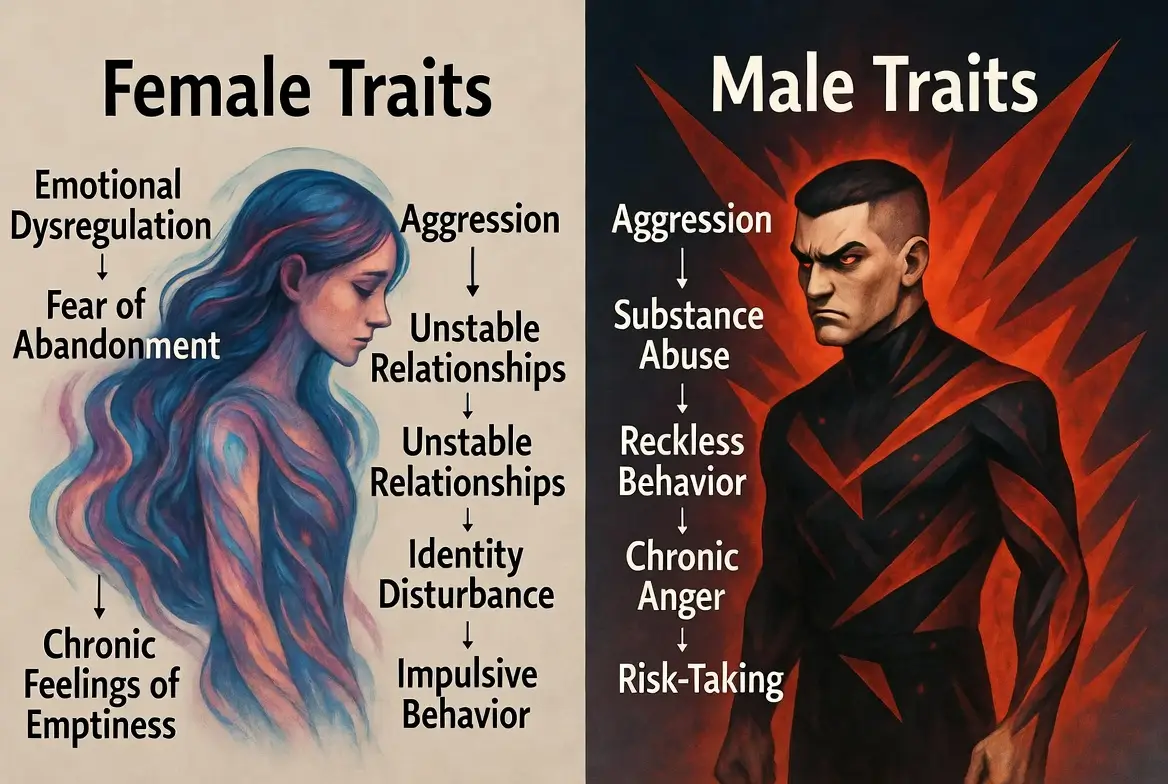
When discussing borderline personality disorder, female vs. male, the differences lie more in expression and diagnosis than in the core pathology.
- Internalization vs. Externalization: Women are more likely to internalize their symptoms, leading to higher rates of depression, anxiety, and self-harm. Men are more likely to externalize, often being misdiagnosed with Antisocial Personality Disorder (ASPD) or having issues with physical aggression.
- Clinical Bias: Clinicians have historically been more likely to assign the BPD label to women. When a man presents with emotional instability, he is often diagnosed with PTSD or Intermittent Explosive Disorder.
- Comorbidities: Women with BPD frequently struggle with co-occurring eating disorders (bulimia or anorexia) and PTSD, while men often show higher rates of substance use disorders.
Borderline Personality Disorder Traits in Females
While the diagnostic criteria are the same for everyone, certain borderline personality disorder female traits are influenced by gender socialization.
Attachment Anxiety and People-Pleasing
Many women with BPD develop a “chameleon-like” personality. Because they lack a stable sense of self, they adopt the interests, speech patterns, and values of those they admire. This is often driven by a deep attachment anxiety—the belief that “if I am not exactly who you want me to be, you will leave me.”
Shame and Self-Blame
Women are socially conditioned to be nurturers and “peacekeepers.” When a woman with BPD experiences an emotional outburst, the subsequent shame is often debilitating. This leads to a cycle of “quiet BPD,” where the woman hides her symptoms from the world, only for the pressure to build until an inevitable internal or external collapse occurs.
Daily Life With BPD: The Female Experience
What are the daily struggles of BPD? For a woman living with this condition, every day is a marathon of emotional regulation.
Morning may begin with a sense of “identity confusion”—the feeling of waking up and not knowing which “version” of herself will show up. Simple interactions, like a coworker’s neutral tone of voice, can trigger hours of “relationship vigilance,” where she mentally replays the interaction to search for signs of disapproval.
The exhaustion is not just mental; it is physical. Constant “fight-or-flight” activation leads to chronic fatigue, headaches, and a “mood-dependent” ability to function. On a “good” day, she may be hyper-productive and charismatic; on a “bad” day, getting out of bed feels like an impossible task.
Borderline Personality Disorder and Relationships
The most significant impact of the disorder is often seen in borderline personality disorder and relationships. Because BPD is an attachment-based disorder, it is most active in intimate settings.
Push–Pull Dynamics
The “push-pull” dynamic is a classic feature of how borderline personality disorder affects relationships.
- The Pull: Fearing abandonment, she becomes hyper-attentive, affectionate, and dependent.
- The Push: Fearing that closeness will lead to her being controlled or eventually hurt, she suddenly creates distance through conflict or withdrawal.
This cycle is agonizing for both parties. The woman feels she is fighting for her survival, while the partner feels they are being pushed away for no apparent reason. These repair and reconciliation cycles can become addictive but are ultimately unsustainable without intervention.
Relationships With a Woman Who Has BPD
Entering a relationship with borderline personality disorder can be an experience of extreme highs and lows. In the beginning, many partners describe the connection as the most intense and passionate of their lives. Because women with BPD are often hyper-attuned to the emotions of others, they can be incredibly empathetic, validating, and “all-in.”
The “Exhaustion” Factor
However, as the relationship progresses, partners often ask: Is dating someone with BPD exhausting? The honest answer for many is yes. The emotional intensity requires a high level of patience and resilience. Partners often fall into a “caregiver” role, where they feel responsible for the woman’s emotional stability.
This can lead to caregiver burnout, especially if boundaries are not clearly established. It is important to realize that her “explosions” or “withdrawals” are usually not about malice, but about a desperate, misunderstood attempt to find safety.
Symptoms of BPD in Females in Relationships
The symptoms of BPD in females in relationships often revolve around the concept of “interpersonal hypersensitivity.” Small shifts in the partner’s behavior are magnified.
- Reassurance Seeking: Frequent questions like “Do you still love me?” or “Are you going to leave?” even after a positive interaction.
- Fear-Based Reactions: If a partner is late coming home, her mind may immediately jump to “they are having an affair” or “they died,” leading to frantic calling or texting.
- Sudden Emotional Withdrawal: To protect herself from potential hurt, she may “shut down” or act cold, a behavior often referred to as “splitting” the partner into the “bad” category.
What Not to Say to Someone With BPD
Communication is the most fragile part of the dynamic. Knowing what not to say to someone with BPD is just as important as knowing what to say. Avoid statements that minimize her internal reality or threaten the stability of the bond.
- “You’re overreacting”: To her, the emotion is physically real. This phrase invalidates her nervous system and usually escalates the crisis.
- “If you keep this up, I’m leaving.”: Threatening abandonment is the ultimate trigger. It reinforces her deepest fear and causes her to panic further.
- “Just calm down”: This is functionally impossible during an emotional “flood.” It is like telling someone with a broken leg to “just walk it off.”
What Triggers a Person With Borderline Personality Disorder
Understanding what triggers a person with borderline personality disorder is key to de-escalation. While triggers are individual, most fall into the category of “perceived separation.”
- Silence or Withdrawal: When a partner takes a “time-out” or goes silent during a fight, the woman with BPD often interprets this as the end of the relationship.
- Criticism: Even constructive feedback can be perceived as a total rejection of her character.
- Uncertainty: Vague plans or “we need to talk” without context can trigger a massive anxiety spike.
Causes of BPD in Females
The causes of BPD in females are rarely tied to a single event. Instead, it is a “biosocial” phenomenon.
- Genetics and Temperament: Some girls are born with a “highly sensitive” nervous system.
- Childhood Trauma: High rates of emotional, physical, or sexual abuse are reported among women with BPD.
- Invalidating Environments: Growing up in a home where emotions were punished, ignored, or mocked teaches a child that their internal “compass” is broken.
- Social Conditioning: Women are often taught to suppress anger and prioritize others’ needs. When this is combined with BPD, it creates a “pressure cooker” effect.
Borderline Personality Disorder Female Test
Many women find themselves taking a borderline personality disorder test online after years of feeling “too much.” While a borderline personality disorder female test can provide a helpful “red flag,” it is not a diagnosis.
Screening tools are designed to see if you have the traits of BPD. However, only a licensed psychiatrist or psychologist can confirm the diagnosis. A professional assessment is necessary because BPD often “hides” behind other conditions like Bipolar II, ADHD, or Complex PTSD (CPTSD). If you score high on a quiz, the next step is a clinical interview.
Borderline Personality Disorder Female Treatment
The good news is that borderline personality disorder treatment is more effective today than ever before. BPD is no longer considered a “life sentence.”
Dialectical Behavior Therapy (DBT)
Developed by Dr. Marsha Linehan (who struggled with BPD herself), DBT is the gold standard. It teaches four specific skill sets:
- Mindfulness: Being present in the moment.
- Distress Tolerance: Getting through a crisis without making it worse.
- Emotion Regulation: Learning to turn down the “volume” of intense feelings.
- Interpersonal Effectiveness: Communicating needs and boundaries clearly.
Other Modalities
- Schema Therapy: Focuses on changing deep-seated “life themes” or patterns.
- Trauma-Informed Care: Addressing the underlying PTSD that often fuels BPD symptoms.
- Medication: While no drug “cures” BPD, doctors may prescribe mood stabilizers or antidepressants to help manage the “peaks and valleys” of the emotional cycle.
Long-Term Effects of Borderline Personality Disorder
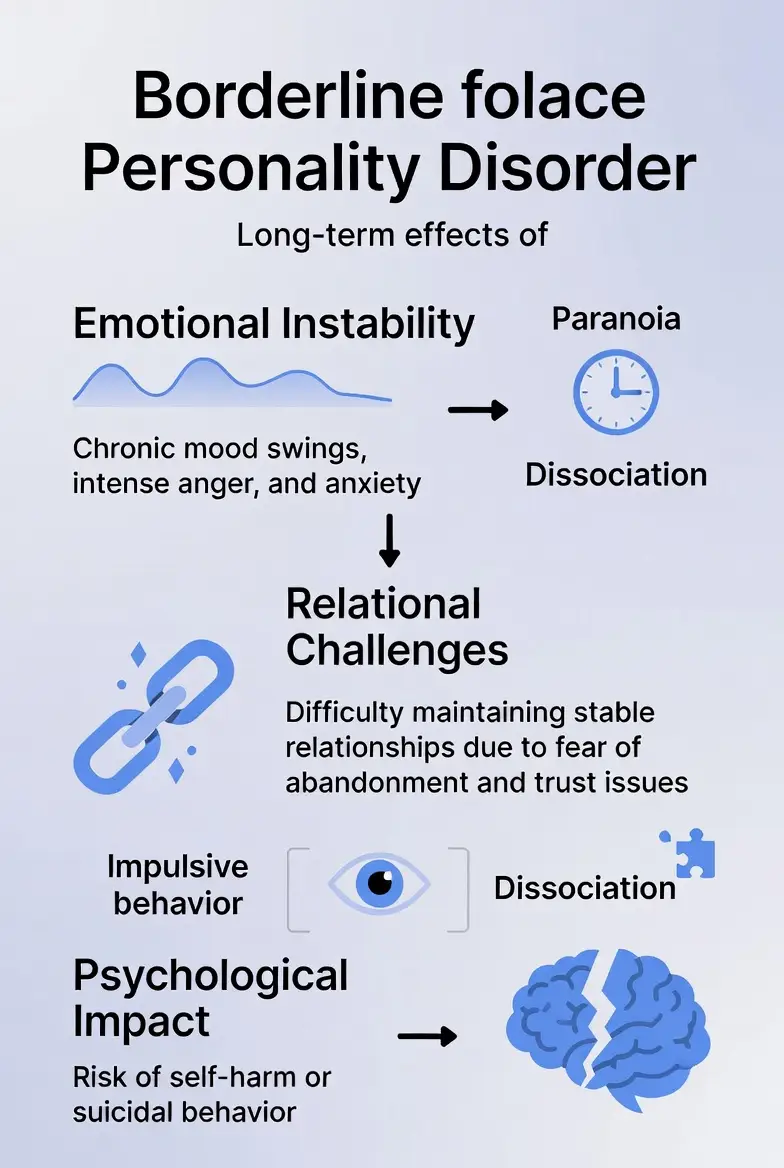
What are the long-term effects of borderline personality disorder? If left untreated, BPD can lead to a “fragmented” life—unfinished degrees, unstable career paths, and a string of broken relationships. However, with treatment, the prognosis is excellent.
Research shows that “remission” is common. Over time, the “intensity” of the symptoms tends to burn out, especially as women learn to build a stable sense of self. Many women with BPD go on to have successful careers and stable, loving marriages once they have the tools to regulate their emotions.
Types of Borderline Personality Disorder
While the clinical diagnosis remains “BPD,” experts often categorize the condition into four informal subtypes to better describe how the symptoms manifest. Understanding what are the different types of borderline personality disorder? can help a woman identify why her experience might not match the “loud” stereotypes seen on television.
- Quiet BPD (Discouraged): This is common in women. Instead of exploding at others, they “implode.” They experience intense self-hatred, shame, and isolation. To the outside world, they may seem high-functioning but are suffering deeply within.
- Petulant BPD: Characterized by being difficult, cynical, and stubborn. They often feel unloved and unappreciated, leading to a “passive-aggressive” style of relating to others.
- Self-Destructive BPD: These women turn their pain into reckless behaviors. They may engage in substance abuse, risky sexual encounters, or self-harm as a way to “punish” themselves for perceived flaws.
- Impulsive BPD: This type is driven by a need for immediate gratification. They may be highly charismatic and energetic, but struggle with “thrill-seeking” behaviors that lead to instability in finances and safety.
Borderline Personality Disorder Female Reddit: What People Share
In the digital age, female Borderline Personality Disorder Reddit communities have become a vital source of peer support. On subreddits like r/BPD or r/BPDlite, thousands of women share their daily victories and setbacks.
Validation vs. Misinformation
These platforms provide much-needed validation—hearing another woman describe the “physical pain” of a breakup makes the sufferer feel less “crazy.” However, it is vital to approach these forums with caution. Lived experience is not the same as medical advice. Some communities can inadvertently reinforce “splitting” behaviors or discourage professional treatment. Use Reddit for community, but use your therapist for strategy.
Borderline Personality Disorder PDF & Resources
For those looking for structured help, searching for a borderline personality disorder pdf can yield excellent results. Many non-profits and clinical centers offer free workbooks and educational guides.
- DBT Skills Training Handouts: Many of the foundational skills of DBT are available in PDF format to help you track your moods and practice “STOP” skills.
- National Education Alliance for BPD (NEA.BPD): Offers a wealth of resources, including “Family Connections” guides for loved ones.
- NAMI (National Alliance on Mental Illness): Provides fact sheets that can be shared with employers or family members to explain the condition without stigma.
Frequently Asked Questions
How do people with BPD act in real life?
In real life, people with BPD often act like “emotional sponges.” They may be incredibly kind, creative, and intuitive, but they can quickly become overwhelmed by stress, leading to sudden withdrawals, intense crying spells, or bursts of anger that seem disproportionate to the situation.
What are the symptoms of BPD in females?
Core symptoms include a frantic fear of abandonment, unstable relationships, identity confusion, chronic feelings of emptiness, and impulsive behaviors used to cope with intense emotional pain.
Is dating someone with BPD exhausting?
It can be emotionally taxing due to the “high-conflict” cycles and the need for constant reassurance. However, with clear boundaries and professional treatment, these relationships can also be deeply rewarding and loyal.
Can women with BPD recover?
Yes. BPD has one of the highest recovery rates among personality disorders. With specialized therapies like DBT, many women reach “remission,” where they no longer meet the diagnostic criteria for the disorder.
Conclusion
The journey of women with borderline personality disorder is often one of profound resilience. Living with a nervous system that feels “too much” in a world that often demands “less” is a significant challenge. However, the very sensitivity that causes pain in BPD is also the source of a woman’s greatest strengths: her empathy, her passion, and her deep capacity for connection.
A borderline personality disorder diagnosis is not a life sentence; it is a roadmap. It identifies the areas where the emotional “brakes” need strengthening and provides a path toward a life worth living. By moving away from stigma and toward evidence-based treatment, women with BPD can transform their emotional intensity into a powerful asset.
Authoritative References
- National Institute of Mental Health (NIMH) – BPD Overview
- The Linehan Institute – Behavioral Tech
- McLean Hospital – Borderline Personality Disorder in Women
- American Psychiatric Association (APA) – DSM-5-TR Fact Sheets
- National Education Alliance for Borderline Personality Disorder (NEA.BPD)
Subscribe to Our Newsletter
Get mental health tips, updates, and resources delivered to your inbox.
MORE from Author
Read More We all have "up" days and "down" days. Perhaps you feel energized after a promotion or sluggish on a rainy…
 To define bipolar disorder accurately, we must look at it as a chronic mood dysregulation condition. In psychology and medicine,…
Are you looking for a Therapist?
Connect with qualified mental health professionals who understand
bipolar disorder, mood changes, and emotional challenges.
Private • Supportive • Confidential