
DSM-5 ADHD: What Does DSM Stand for in Psychology? Understanding Criteria, Diagnosis & Common Myths
If you have ever sat in a therapist’s office or researched mental health online, you have likely encountered a specific three-letter acronym that carries immense weight. But What Does DSM Stand for in Psychology? For clinicians and patients alike, the DSM -5 ADHD is the “gold standard”—the map we use to navigate the complex landscape of the human mind.
In my clinical practice, I often see patients who are relieved to finally have a “name” for their struggles. However, a diagnosis is only as good as the criteria used to create it. When we talk about Attention-Deficit/Hyperactivity Disorder, the DSM-5 ADHD criteria serve as the definitive checklist. Whether you are seeking an adhd diagnosis for adults or trying to understand a child’s behavior, knowing how the “manual” works is the first step toward clarity.
In this guide, we will untangle the technical language of the manual, explore the specific dsm 5 adhd symptoms, and debunk the common myths that lead to misdiagnosis.
What Does DSM Stand for in Psychology?
To understand the current state of mental health care, we must first define our tools. DSM stands for the Diagnostic and Statistical Manual of Mental Disorders. It is published by the American Psychiatric Association (APA) and is currently in its fifth edition, text revision, known as the DSM-5-TR.
Where is ADHD Located in the DSM-5?
Many people ask, “is adhd in the dsm 5?” and specifically, “Where is adhd located in the dsm 5?” ADHD is classified under the Neurodevelopmental Disorders section. This is a critical distinction because it separates ADHD from mood disorders or anxiety. It signifies that ADHD is a condition that typically begins early in development, often before a child enters grade school.
If you are looking for what section ADHD is adhd in the dsm 5, you will find it alongside Autism Spectrum Disorder and Intellectual Disabilities. It is important to note that the DSM-5 removed the old multiaxial system. Previously, clinicians used “Axes” (like Axis I or Axis II) to categorize conditions. Today, how ADHD is adhd classified in the dsm-5 is through a single, streamlined diagnostic statement that focuses on the neurodevelopmental nature of the brain.
DSM-5 ADHD Definition & Diagnostic Overview
According to the dsm 5 adhd definition, the disorder is characterized by a “persistent pattern of inattention and/or hyperactivity-impulsivity that interferes with functioning or development.” It is not just about being “energetic” or “forgetful”; it is about a chronic inability to regulate these traits across different areas of life.
DSM-5 Guidelines for ADHD Diagnosis
For a formal dsm 5 adhd diagnosis, several strict dsm 5 guidelines adhd must be met:
- Age of Onset: Several symptoms must have been present before age 12.
- Settings: Symptoms must occur in two or more settings (e.g., at home and work, or school and with friends).
- Impairment: There must be clear evidence that the symptoms interfere with social, academic, or occupational functioning.
- Exclusion: The symptoms must not be better explained by another mental disorder (like anxiety or a mood disorder).
For those seeking an adhd diagnosis for adults, clinicians often have to act as detectives, looking for retrospective evidence of childhood struggles, even if a person wasn’t diagnosed as a kid.
DSM-5 ADHD Criteria
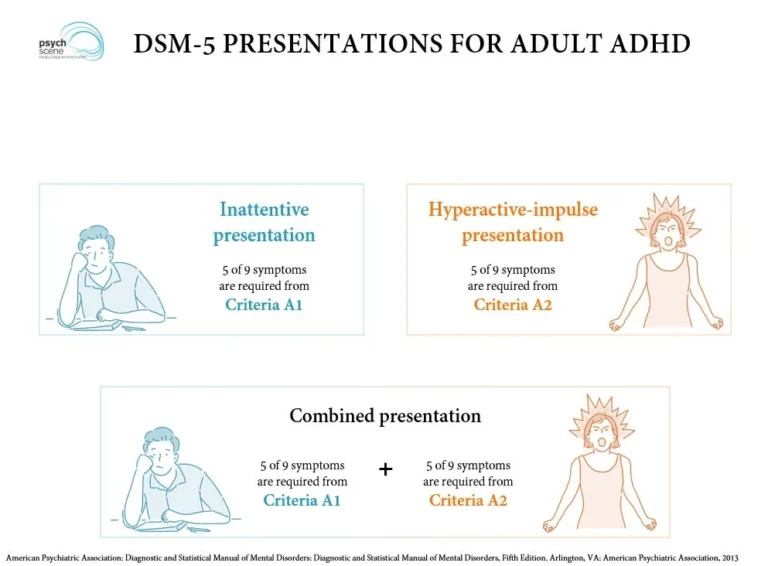
What are the actual signs? The manual breaks ADHD into two main symptom clusters. To answer “What are the 9 markers for ADHD?“, we actually have to look at two separate lists of nine.
Inattention (9 Symptoms)
A person meeting the dsm 5 adhd criteria for inattention often:
- Fails to give close attention to details or makes careless mistakes.
- Has difficulty sustaining attention in tasks or play activities.
- Does not seem to listen when spoken to directly.
- Fails to follow through on instructions or finish chores/work.
- Has difficulty organizing tasks and activities.
- Avoids tasks that require sustained mental effort (like paperwork).
- Loses things necessary for tasks (keys, eyeglasses, phones).
- Is easily distracted by extraneous stimuli.
- Is forgetful in daily activities.
Hyperactivity and Impulsivity (9 Symptoms)
The dsm 5 signs of adhd in this category include:
- Fidgeting with or tapping hands/feet or squirming in a seat.
- Leaving the seat in situations where remaining seated is expected.
- Running or climbing in inappropriate situations (in adults, this may be a feeling of restlessness).
- Unable to play or engage in leisure activities quietly.
- Is “on the go,” acting as if “driven by a motor.”
- Talking excessively.
- Blurting out answers before a question is completed.
- Difficulty waiting their turn.
- Interrupting or intruding on others.
Symptom Thresholds
- For Children: At least 6 out of 9 symptoms in either category.
- For Adults (17+): At least 5 out of 9 symptoms in either category.
ADHD Types in the DSM-5
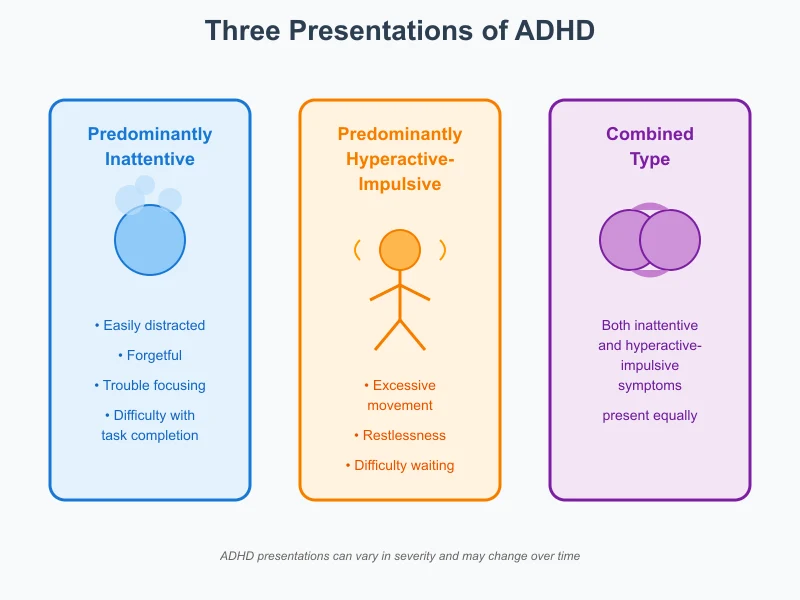
Many people still use the term “ADD,” but technically, that is an outdated term. How many types of ADHD are there in the DSM-5? There are three “presentations” that a clinician can specify:
- Predominantly Inattentive Presentation: The individual meets the threshold for inattention but not hyperactivity. This is often what people mean when they say “ADD.”
- Predominantly Hyperactive-Impulsive Presentation: The individual meets the threshold for hyperactivity but not inattention.
- Combined Presentation: The individual meets the threshold for both clusters.
It is important to understand that these types can change over the lifespan. A child who is “Combined” may grow into an adult who is “Predominantly Inattentive.”
DSM-5 ADHD Test & Checklist — What You Should Know
A common misconception is that there is a single, official dsm 5 adhd test that you “pass” or “fail.” In reality, a diagnosis is a clinical judgment.
While you may find a DSM-5 ADHD Checklist or a dsm 5 adhd diagnostic criteria pdf online, these are screening tools, not diagnostic ones. I once interviewed a patient who brought in three different dsm 5 adhd symptom checklists he found on Reddit.
While they were helpful for starting the conversation, we still spent two hours going over his developmental history and workplace performance to ensure the symptoms weren’t actually caused by chronic sleep deprivation or anxiety.
A real evaluation includes structured interviews, self-reports, and often observer reports from spouses or parents.
Do I Have ADHD? What Your Daily Habits Reveal About Your Brain
For many, the question “Do I Have ADHD? What Your Daily Habits Reveal About Your Brain” arises from daily frustrations. In dsm 5 adhd adults, the symptoms often look different than they do in kids.
- Chronic Procrastination: Not just “putting things off,” but an inability to start even when the consequences are high.
- Hyperfocus: Being so absorbed in a specific task (like a video game or a project) that you forget to eat or sleep.
- Time Blindness: A consistent inability to estimate how long a task will take.
- Emotional Impulsivity: Quickly becoming frustrated or overwhelmed by small setbacks.
These daily habits are the “real world” versions of the dsm 5 adhd criteria. If your habits are causing significant impairment in your relationships or your career, it is worth looking at the clinical definitions.
Are You Falling for These Common Pitfalls in Free Online ADHD Assessments?
In the age of TikTok and Instagram, many are asking, “Are You Falling for These Common Pitfalls in Free Online ADHD Assessments?” Free quizzes are often “symptom-only.” They might ask if you lost your keys, but they don’t ask if you have lost your keys since you were seven years old.
The biggest pitfall is Confirmation Bias. If you suspect you have ADHD, you are more likely to answer “yes” to vague questions. A professional DSM-5 ADHD test looks for impairment. If you are forgetful, but it doesn’t hurt your life, it isn’t a disorder. A diagnosis requires a professional to rule out other possibilities.
Are You Experiencing These Lesser-Known Depression Symptoms from the DSM-5?
Misdiagnosis is common because many disorders look alike. Are You Experiencing These Lesser-Known Depression Symptoms from the DSM-5? Consider the overlap:
- Inattention: Both ADHD and Major depressive disorder can make it hard to focus. However, in depression, it is often due to “slowing down,” whereas in ADHD, it is “jumping around.”
- Motivation: ADHD is a problem of activation (starting the task), while depression is a problem of anhedonia (not caring about the task).
- Fatigue: Hyperactive ADHD can lead to burnout that looks like depressive lethargy.
A trained clinician uses the DSM to distinguish between these overlapping states to ensure you get the right treatment.
What Is the 10-3 Rule for ADHD?
While the DSM provides the diagnosis, it doesn’t provide the “hack.” Many patients ask, “What is the 10-3 rule for ADHD?” This is a productivity strategy where you commit to 10 minutes of focused work followed by a 3-minute break.
This is not a dsm 5 adhd criterion, but it is a tool designed to work with the ADHD brain’s dopamine needs. It lowers the barrier to entry for tasks that seem overwhelming. It is a “workaround” for the executive dysfunction described in the manual.
ADHD vs. Mood Dysregulation
As a clinical psychologist with deep roots in mood disorder research, I find the “differential diagnosis” between ADHD and Bipolar Disorder to be one of the most critical applications of the DSM. In my clinical sessions, I often meet patients who have been told they are “hyperactive” when they are actually experiencing a hypomanic episode. Conversely, the emotional impulsivity of ADHD is frequently mistaken for the mood swings of Bipolar II.
The DSM-5-TR helps us distinguish these by looking at the tenor of the symptoms. ADHD is chronic and pervasive; the “motor” is always running. Bipolar Disorder is episodic; the “motor” speeds up for a week or two and then crashes into a depressive stall.
I once interviewed a patient who was convinced he had ADHD because he couldn’t focus at work. However, after reviewing his history using the DSM criteria, we realized his inattention only occurred during periods of high energy and decreased need for sleep. By using the manual correctly, we were able to provide him with the mood stabilization he actually needed, rather than stimulants that could have worsened his condition.
Frequently Asked Questions
What are the DSM-5 criteria for ADHD?
The criteria include a list of 18 symptoms (9 inattentive, 9 hyperactive). Children need 6, while adults need 5, and they must be present in multiple settings and have started before age 12.
Is ADHD in the DSM-5?
Yes, it is officially classified as a Neurodevelopmental Disorder.
What category is ADHD in DSM-5?
It falls under the category of Neurodevelopmental Disorders, alongside Autism and Learning Disorders.
How many types of ADHD are there in the DSM-5?
There are three presentations: Predominantly Inattentive, Predominantly Hyperactive-Impulsive, and Combined.
What is the DSM-5 code for ADHD?
The most common codes are F90.0, F90.1, and F90.2, depending on the presentation.
Is ADHD a mental illness according to DSM-5?
Yes, in the context of the manual, it is classified as a mental disorder, specifically a neurodevelopmental one.
Conclusion
In conclusion, understanding What Does DSM stands for in Psychology is about more than just knowing a title. It is about understanding the rigorous framework used to validate your experience. The DSM-5 ADHD criteria are not meant to label you, but to provide a pathway toward effective treatment and self-understanding.
Whether you are navigating dsm 5 adhd in children or seeking an adhd diagnosis for adults, remember that the manual is a living document. It evolves as our understanding of the brain grows. If you find that your daily habits align with the symptoms we have discussed, the next step is a conversation with a professional. You don’t have to navigate your brain’s unique wiring alone.
Next Step: Would you like me to generate a DSM-5 ADHD Symptom Tracker for you to use over the next week before your next appointment?
References:
Related Posts


Subscribe to Our Newsletter
Get mental health tips, updates, and resources delivered to your inbox.
MORE from Author
Read More In my practice as a clinical psychologist, I often observe that the difference between a patient who crumbles under pressure…
- We all have "up" days and "down" days. Perhaps you feel energized after a promotion or sluggish on a rainy…


 To define bipolar disorder accurately, we must look at it as a chronic mood dysregulation condition. In psychology and medicine,…
 To answer whether bipolar fits the bill, we first have to define what a neurodivergent person actually is. The term…
Are you looking for a Therapist?
Connect with qualified mental health professionals who understand
bipolar disorder, mood changes, and emotional challenges.
Private • Supportive • Confidential