
Feelings Are Not Facts: The Psychology Behind the Phrase And Why It Matters in Real Life

You’ve probably heard the phrase, “Feelings are not facts.” It sounds simple, but in moments of anxiety or anger, emotions can feel like absolute truth.
We often let these temporary states shape our decisions—even affecting our financial and physical well-being. However, while emotions are valid experiences, they are not objective evidence of reality.
This guide explores the psychology behind this idea through Cognitive Behavioral Therapy (CBT) and neuroscience. You’ll learn why we confuse feelings with facts and how to separate them.
We’ll also examine how “emotional reasoning” influences everyday choices—from spending habits to health decisions, including treatments like Dupilumab.
As psychologist Dr. Laura Athey-Lloyd explains, emotions are data, not directives. Creating space between feeling and reaction allows clarity—and that’s where real change begins.
What Does “Feelings Are Not Facts” Mean?
It can be confusing at first. If I feel sad, isn’t the sadness real? Yes, the experience of the emotion is real. However, the story your brain tells you about that emotion is often false.
Feelings Are Not Facts: Meaning (Simple Explanation)
To put it simply, feelings are not facts, meaning that emotions are internal reactions, not external realities. Just because you feel like a failure does not mean you are a failure. Just because you feel unsafe does not mean you are in immediate danger.
Think of emotions like the weather. A storm is real, wet, and intense. But the storm is not the sky itself. It passes. When we practice emotional reasoning, we mistake the storm for the sky. We assume that because we feel something strongly, it must be true.
This is a cognitive distortion. It tricks our brains into bypassing logic. Consequently, we make decisions based on temporary moods rather than long-term evidence.
Feelings Are Not Facts: Psychology
Why do our brains do this? It comes down to evolution. Our limbic system (the emotional brain) reacts faster than our prefrontal cortex (the thinking brain).
The Role of Cognitive Distortions
In psychology, specifically in feelings are not facts, CBT (Cognitive Behavioral Therapy), this phenomenon is known as “emotional reasoning.” It was identified by Aaron T. Beck, the founder of CBT. Beck noticed that people with depression and anxiety often treated their feelings as substantiated evidence.
- The Distortion: “I feel guilty, so I must have done something wrong.”
- The Reality: You might feel guilty due to past trauma or habit, even if you are entirely innocent.
This creates a feedback loop. The negative thought creates a negative feeling. The feeling then “proves” the thought is true. To break the cycle, we must recognize that thoughts and feelings are not facts. They are mental events. They are hypotheses that need testing, not truths that need obeying.
Thoughts and Feelings Are Not Facts
CBT teaches us to become scientists of our own experience. We learn to look at our internal dialogue and ask, “Is this true? Or is this just a feeling?”
The phrase “thoughts are not threats, feelings are not facts” is a mantra for grounding. It reminds us that a scary thought is just a collection of neurons firing. It cannot hurt you physically. Similarly, an overwhelming feeling is a rush of neurochemicals. It is not a prediction of the future.
Bipolar Disorder: Navigating Emotional Intensity
For individuals living with Bipolar Disorder, the distinction between feelings and reality is critical—and often difficult. During a manic episode, a person may feel invincible, wealthy, or destined for a grand purpose.
These feelings are not facts, but the biochemical surge makes them feel undeniably true. Conversely, during depressive episodes, the feeling of hopelessness can be crushing. The brain convinces the individual that life will never get better.
This is where the mantra becomes a survival tool. Recognizing that “my brain is lying to me right now” can save lives. It helps separate the symptom (the intense mood) from the self.
By acknowledging that your feelings are not facts, specifically during mood swings, patients can adhere to treatment plans and resist impulsive decisions driven by temporary, albeit intense, emotional states.
Practical Application: The Worksheet Approach
How do we move this from theory to practice? We write it down. When you keep everything in your head, it gets messy. Putting it on paper brings the prefrontal cortex online.
Feelings Are Not Facts Worksheet Section
If you are struggling to separate reality from emotion, a feelings are not facts worksheet is highly effective. You can create a simple table in a journal.
Here is a structured template you can use immediately:
| The Situation | The Emotion (0-100%) | The “Emotional Truth” | The Objective Facts | Re-framed Thought |
| My boss didn’t say hi to me this morning. | Anxiety (85%), Shame (70%) | “She is mad at me. I’m going to get fired.” | She was on the phone. She smiled at me yesterday. | “She is likely busy. Her silence is not about me.” |
Using feelings as not facts worksheets helps you slow down. It forces you to look for evidence. Most of the time, you will find that the evidence does not support your emotional conclusion.
Also, many therapists offer a feelings are not facts pdf as a resource. These documents often include lists of cognitive distortions to help you identify when you are spiraling.
Who Said “Feelings Are Not Facts”?
This is a common question. The phrase has permeated pop culture, therapy offices, and even reality TV.
Origins and Attribution
So, who said feelings are not facts? While the concept is rooted in ancient Stoic philosophy and formalized by Aaron Beck in CBT, the exact quote is often attributed to various sources. In modern pop culture, the phrase gained massive traction thanks to RuPaul.
Yes, RuPaul’s feelings are not facts is a popular search for a reason. On RuPaul’s Drag Race, he famously advises queens not to let their inner saboteur take over. He reminds them that their insecurities (feelings) are not the reality of their talent (facts).
However, you will also find similar sentiments in 12-step recovery programs (Alcoholics Anonymous). The “Big Book” literature discusses how alcoholics cannot rely on their emotions to guide them because their emotions are volatile.
Whether it is a therapist, a drag superstar, or a sponsor, the message remains the same: Do not believe everything you feel.
Feelings Are Not Facts: Bible Perspective

While this article focuses on psychology and medicine, it is worth noting that this concept has deep roots in spiritual traditions. Many people search for feelings that are not facts bible perspective, to find grounding.
Theologically, there is often a distinction made between the fluctuating nature of human emotion and the steadfast nature of spiritual truth. For instance, verses like Jeremiah 17:9 warn that “the heart is deceitful above all things”.
In this context, “heart” refers to our emotional center. The text suggests that our internal emotional state is unstable. It changes with the wind, hunger, or fatigue.
Therefore, relying solely on how you feel about your faith or your standing in the world can be misleading. A feeling of abandonment does not mean you are actually abandoned.
A feeling of guilt does not always mean you have sinned (it could be false guilt). Spiritual maturity, much like emotional maturity, involves trusting a foundational truth rather than a fleeting mood.
My Feelings Are Valid But Not True
This is a crucial distinction. In therapy, we often hear the phrase: “My feelings are valid.” And they are. But there is a massive difference between validity and truth.
Understanding the Difference
- Validity: Your emotion is a real, physiological experience. You have every right to feel it. No one should tell you to “calm down” or that you are “crazy.”
- Truth: The cause or the conclusion of that feeling may be factually incorrect.
Think of it like a “phantom limb” sensation. An amputee might feel genuine pain in a leg that is no longer there. The pain (the feeling) is 100% valid and real. However, the leg (the fact) is not there.
We must learn to say, “My feelings are valid but not true.” Similarly, when dealing with others, we can acknowledge that “your feelings are valid but not true.” This validation lowers defenses. It allows us to investigate the facts without dismissing the person’s pain.
It is a compassionate way to approach conflict, both internally and in relationships.
Facts vs Feelings Examples (Real-Life Scenarios)
To truly grasp this, let’s look at how facts vs feelings examples play out in our daily lives. We often choose the emotional narrative because it feels safer or more familiar, even when it hurts us.
Relationships
- The Feeling: “My partner is quiet tonight. I feel anxious. They must be losing interest in me.”
- The Fact: Your partner worked a 10-hour shift and is physically exhausted. Their silence is a biological result of fatigue, not a relational signal.
- The Result: If you act on the feeling, you might start a fight. If you act on the fact, you might offer them a glass of water and space to rest.
Work
- The Feeling: “I feel like a fraud. Everyone in this meeting is smarter than me.” (Imposter Syndrome).
- The Fact: You were hired based on your resume, experience, and skills. You have completed all your projects on time.
- The Result: Factual rather than emotional thinking allows you to speak up and contribute. Emotional thinking keeps you silent.
Social Media
- The Feeling: “Everyone else is happier and richer than I am. I feel like a failure.”
- The Fact: Social media is a curated highlight reel. It is a marketing tool, not a documentary. You are comparing your “behind-the-scenes” bloopers to their “final cut” movie.
- The Result: Recognizing feelings and facts examples helps you scroll with detachment rather than envy.
Which Is More Important, Facts or Feelings?
This brings us to the ultimate question: Which is more important, facts or feelings?
The answer is: Neither. They serve different purposes.
- Feelings give us data about what we value. They tell us what we love, what we fear, and what we need to protect. They are the engine of our motivation.
- Facts give us the roadmap to get there safely. They provide the objective reality we must navigate.
Are facts and feelings the same? Absolutely not. If you try to navigate a ship using only your “feeling” of where North is, you will get lost. You need a compass (facts). However, without the desire (feeling) to explore, the ship never leaves the harbor.
Healthy decision-making requires a partnership. We acknowledge the feeling, but we let the facts drive the car.
Myth-Busting in Everyday Decisions
Now, let’s take this “Fact-Checking” mindset out of your head and into your wallet. We make thousands of consumer decisions based on emotional reasoning. We buy things because we feel scared, hopeful, or insecure.
Marketers know this. They sell us feelings. We are going to apply the feelings are not facts framework to four common areas where myths often overpower reality: fabric, debt, insurance, and medicine.
Is There Any Stretch in Rayon Fabric? Unraveling the Myths and Facts
Have you ever bought a garment because it felt like it would be forgiving, only to have it shrink or tear? This is a classic case of sensory feelings vs. material facts.
The Myth: “It feels soft, so it must be stretchy.”
Many consumers touch Rayon (or Viscose) and feel its silk-like drape. The feeling suggests luxury and flexibility.
The Fact: The Science of Cellulose
So, is there any stretch in rayon fabric? The short answer is no, not naturally.
Rayon is a semi-synthetic fiber made from regenerated cellulose (wood pulp). On a microscopic level, these fibers are not like springs; they are more like paper.
- 100% Rayon: Has almost zero elasticity. If you pull it, it will distort or rip. It does not snap back.
- Rayon Blends: If your rayon top stretches, check the label. It is likely blended with Spandex (Elastane).
- The Weave Matters: A rayon knit (like a t-shirt) will stretch mechanically because of the loop structure. A rayon woven (like a blouse) will be rigid.
Expert Take: Don’t trust your hands alone. Trust the care label. Emotional buying leads to ruined clothes in the dryer. Rayon is extremely weak when wet—a fact that no amount of “feeling” can change.
Are Debt Settlement Companies a Scam or a Lifesaver? Uncovering the Facts
Financial stress triggers our deepest survival instincts. When drowning in bills, we feel panic. We look for a lifeline. This makes us vulnerable to promises of “quick fixes.”
The Emotional Hook
You see an ad: “Cut your debt by 50%! Pay pennies on the dollar!” The feeling of relief is immediate. You want to believe it.
The Facts: Risks vs. Rewards
Are debt settlement companies a scam or a lifesaver? The facts are murky. While not always a “scam” in the legal sense, the reality is often far from the “lifesaver” marketing claims.
- The Mechanism: These companies ask you to stop paying your creditors and instead pay into a savings account. Once the account grows, they negotiate a lump-sum payment.
- The Risk: During this time, your credit score tanks. You will likely face aggressive collection calls and potential lawsuits.
- The Hidden Cost: The IRS often counts forgiven debt as taxable income. You might save on the loan, but get hit with a massive tax bill.
- The Verdict: According to the Federal Trade Commission (FTC), many people in these programs drop out with more debt than they started with due to fees and interest.
Medical/Psychological Note: The stress of a lawsuit often outweighs the temporary relief of “doing something.” A factual approach would involve consulting a non-profit credit counselor first.
Is Health Insurance for the Self-Employed Worth It? The Facts Revealed
Entrepreneurs often have a “Superman” complex. We feel healthy, strong, and invincible. We think, “I rarely get sick, so why pay the premium?”
The Emotional Gamble
The feeling is that insurance is a waste of money if you don’t use it every month. This is “loss aversion”—we hate losing cash more than we value potential protection.
The Fact: Risk Pools and Catastrophe
Is health insurance for the self-employed worth it? From a public health perspective: Yes.
- One Event: A single appendix rupture or car accident can cost $50,000+. That is a fact that destroys businesses.
- Preventative Care: The ACA (Marketplace) plans cover preventative screenings at 100%. Detecting high blood pressure early (a fact) is cheaper than treating a stroke later.
- Tax Benefits: Self-employed premiums are often 100% tax-deductible. This is a mathematical fact that lowers your effective cost.
Don’t let the feeling of invincibility guide your risk management.
Is Dupilumab Treatment a Game Changer for Chronic Conditions? Discover the Facts
Living with a chronic condition like severe eczema (atopic dermatitis) or asthma is exhausting. The feeling is often one of desperation. You itch, you wheeze, and you just want it to stop. When a new drug hits the market with flashy commercials, hope surges. But is that hope based on marketing or medicine?
The Emotional Hope vs. Clinical Reality
Patients often feel that a “biologic” is a magic bullet. They see clear skin in ads and assume it works overnight. This is emotional reasoning at play—projecting a desire for a cure onto a complex treatment.
The Facts: Mechanism and Efficacy
So, is Dupilumab treatment a game-changer for chronic conditions? From a medical standpoint: Yes, for many, but it is not magic.
- Mechanism of Action: Dupilumab (brand name Dupixent) is a monoclonal antibody. It works by blocking two specific proteins (Interleukin-4 and Interleukin-13) that drive inflammation. It targets the source of the fire, not just the smoke.
- FDA Approvals: It is factually approved for specific conditions: moderate-to-severe atopic dermatitis, moderate-to-severe asthma, and chronic rhinosinusitis with nasal polyps, among others.
- The Timeline Fact: Unlike a steroid cream that works in hours, biologics take time. Clinical trials show that significant improvement often takes 16 weeks or more. If you rely on the feeling of “it’s not working yet” after two weeks, you might quit a life-changing therapy prematurely.
- Side Effects: Facts matter here, too. While generally safe, it can cause conjunctivitis (eye inflammation) or injection site reactions.
Doctor’s Note: Do not let fear or hype drive your medical choices. Consult an allergist or dermatologist. Look at the data for your specific severity level.
Why Feelings Are Not Facts (But Still Matter)
We have spent a lot of time saying what feelings aren’t. But let’s be clear about what they are. If we dismiss our emotions entirely, we become robots. That is not healthy either.
Emotional Signals as Data
Why are feelings not facts? Because they are reactive. However, they are vital data.
- Fear tells you to pay attention to risk.
- Anger tells you a boundary has been crossed.
- Sadness tells you that you have lost something valuable.
The problem isn’t the feeling; it is the interpretation.
- Emotional Truth: “I feel unsafe.” (This is true: you are experiencing fear).
- Empirical Truth: “I am in a locked room with a puppy.” (Fact: You are safe).
We must learn to distinguish between emotional truth and empirical truth. Use the feeling to alert you (“I need to look around”), but use facts to decide your next move (“The puppy is harmless”).
Feelings Are Not Facts Quotes & Cultural Impact
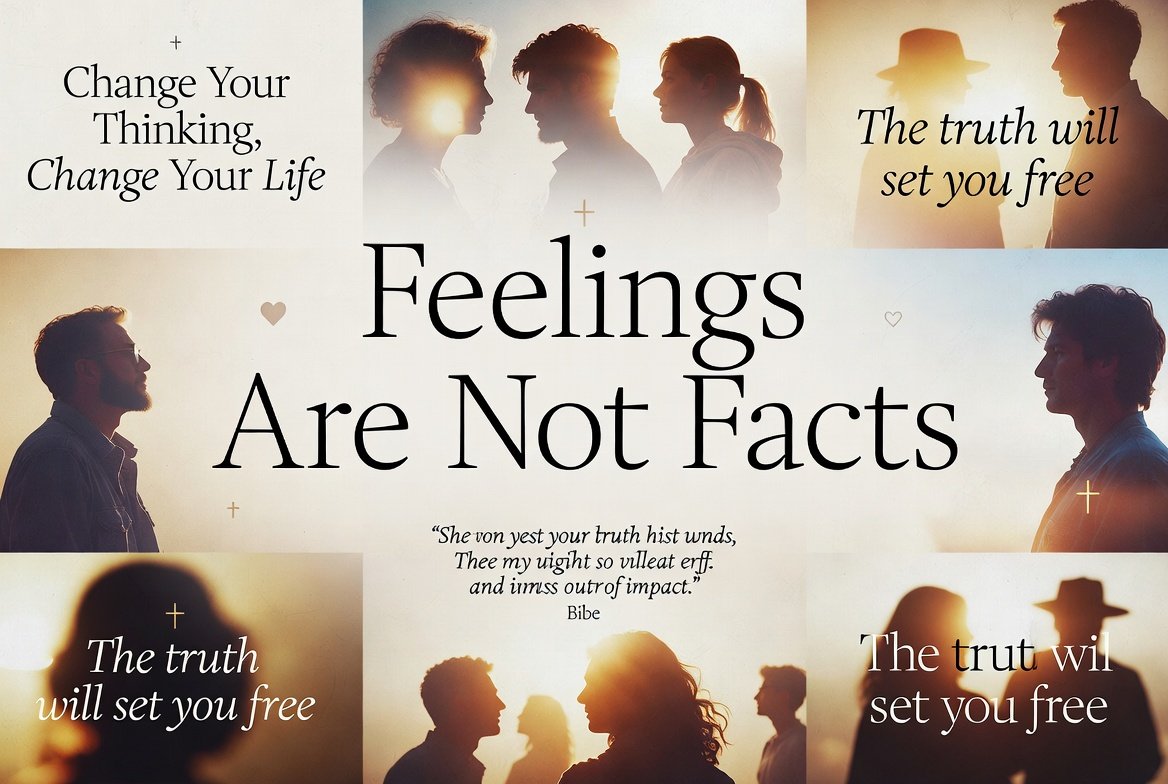
The phrase has taken on a life of its own. It has moved from the therapist’s couch to the cultural mainstream.
Pop Culture and Memes
You can find feelings are not facts quotes on everything from Instagram graphics to coffee mugs.
- “Your feelings are valid, but they are not facts.”
- “Don’t believe everything you think.”
The feelings are not facts. Meme culture often uses humor to highlight our irrationality. Seeing a feelings are not facts t-shirt can be a gentle, daily reminder to stay grounded. It normalizes the struggle. It says, “Hey, we all have crazy thoughts sometimes. It doesn’t mean they are true.”
This cultural shift is positive. It reduces the stigma around mental health and encourages factual rather than emotional conversations.
Becoming Less Emotionally Reactive
Knowledge is power, but action changes lives. How do you actually stop the spiral in real-time? Here is a 5-step toolkit.
1. The Pause Method
When a strong emotion hits, stop. Do not speak. Do not text. Do not buy. Just breathe for 90 seconds. Neuroscientists suggest that the chemical surge of an emotion lasts roughly 90 seconds. If you don’t feed it with thoughts, it will subside.
2. Label It
Name the emotion. “I am feeling anxiety.” “I am feeling shame.” This engages the prefrontal cortex and dampens the amygdala (fear center).
3. Fact-Check (The Evidence Log)
Use a feelings are not facts worksheet. Ask:
- What is the evidence for this thought?
- What is the evidence against this thought?
- Am I using a cognitive distortion (like catastrophizing)?
4. Reframe
Create a new, balanced thought.
- Old: “They haven’t texted back. They hate me.”
- New: “They are busy. I will hear from them later. I am okay.”
5. Download Resources
Many therapists offer a feelings are not facts PDF or feelings are not facts worksheet download. Keep these on your phone. Having a template ready when you are stressed is a game-changer.
Frequently Asked Questions
Here are quick, evidence-based answers to the most common questions about emotional reasoning.
Is it true that feelings are not facts?
Yes. Feelings are internal emotional experiences, while facts are objective, verifiable realities. While your feelings are real to you, they do not necessarily reflect the external truth of a situation.
What does “feelings aren’t facts” mean?
The phrase “feelings aren’t facts” means that just because you believe or feel something strongly doesn’t make it true. It is a reminder to separate your emotional reaction from objective evidence before making decisions.
Who said feelings are not facts?
The concept originates from Cognitive Behavioral Therapy (CBT) and Aaron Beck, but the specific phrase is often attributed to the 12-Step recovery movement (Alcoholics Anonymous). In pop culture, RuPaul famously uses the phrase to mentor contestants.
Are facts and feelings the same?
No. Facts are objective data (e.g., “It is 70 degrees outside”). Feelings are subjective reactions to that data (e.g., “It feels cold”). They are distinct categories of information.
Which is more important, facts or feelings?
Both are important for a balanced life. Feelings provide motivation, values, and connection. Facts provide safety, logic, and structure. Effective decision-making requires integrating both.
Conclusion
Navigating life requires a sturdy compass. If you rely solely on your feelings, you will be tossed around by every storm, mood swing, and marketing ploy. Whether you are managing a relationship, choosing a fabric, settling debt, or treating a chronic illness, the principle remains the same: Feelings are not facts.
Your emotions are valid. They deserve to be felt. But they do not deserve to drive the bus. By using the tools of CBT, practicing the pause, and demanding evidence, you can reclaim control. You can move from reactive panic to responsive wisdom.
So the next time you feel overwhelmed, remember: The storm is real, but the sky is blue above it. Check the facts.
Authoritative References
1. American Psychological Association (APA)
2. Federal Trade Commission (FTC) – Consumer Advice
Related Posts






Subscribe to Our Newsletter
Get mental health tips, updates, and resources delivered to your inbox.
MORE from Author
Read More In my practice as a clinical psychologist, I often observe that the difference between a patient who crumbles under pressure…
- We all have "up" days and "down" days. Perhaps you feel energized after a promotion or sluggish on a rainy…


 To define bipolar disorder accurately, we must look at it as a chronic mood dysregulation condition. In psychology and medicine,…
 To answer whether bipolar fits the bill, we first have to define what a neurodivergent person actually is. The term…
Are you looking for a Therapist?
Connect with qualified mental health professionals who understand
bipolar disorder, mood changes, and emotional challenges.
Private • Supportive • Confidential