
What Is Generativity vs Stagnation? Erikson’s Stage of Midlife Development Explained

Medically reviewed by Laura Athey Updated Date: April 28, 2026

In the landscape of human growth, we often focus heavily on childhood milestones. But psychological development doesn’t stop when we turn 18.
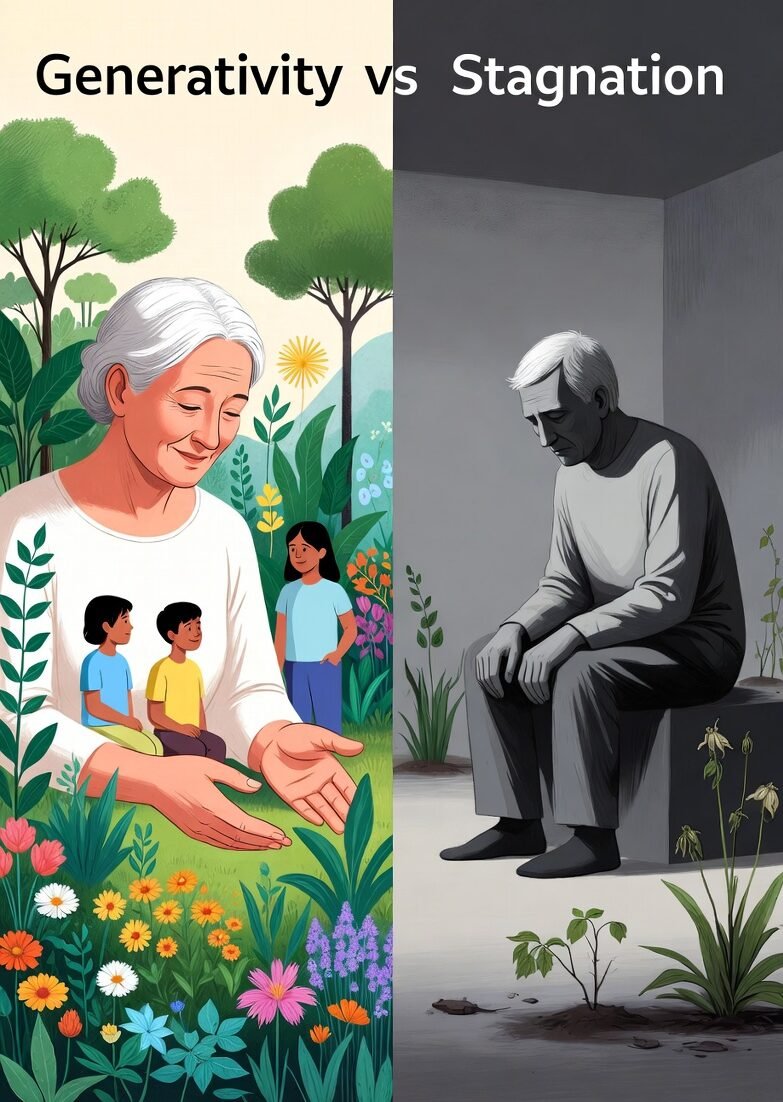
What is generativity vs stagnation in psychology? Generativity vs Stagnation is the seventh stage of Erik Erikson’s theory of psychosocial development. It occurs during middle adulthood (roughly ages 40 to 65). During this time, individuals face a conflict between the desire to create things that will outlast them (generativity) and the feeling of having done nothing of value for the next generation (stagnation).
The Core Conflict:
- Generativity: Refers to “making your mark” on the world through creating or nurturing things that will outlast an individual.
- Stagnation: Refers to the failure to find a way to contribute. These individuals may feel disconnected or uninvolved with their community and society.
Generativity vs Stagnation centers on the conflict between the need to contribute to society and future generations (generativity) versus the feeling of lack of purpose and self-absorption (stagnation). Success in this stage leads to the virtue of Care.
What Does Generativity Mean in Erikson’s Theory?
When clients ask me, “What does generativity mean?” I often tell them to think of a gardener planting trees they will never sit under.
In Erikson’s view, generativity is not limited to biological parenting. It is an extension of love into the future. It is the concern for establishing and guiding the next generation.
The Virtue of Care
If you successfully navigate this stage, you develop the psychological virtue of Care. This is a widening commitment to take care of the persons, the products, and the ideas one has learned to care for.
Key Aspects of Generativity:
- Parenting and Grandparenting: Raising children to be healthy, maladaptive adults is the most common form of generativity.
- Mentorship: Passing down skills and wisdom to younger colleagues (e.g., a senior manager training a junior dev, rather than fearing being replaced).
- Creative Contribution: Writing books, creating art, or solving problems that improve society.
- Social Activism: Working to improve the community or environment for future inhabitants.
Clinical Insight: I often see childless adults worry they cannot achieve generativity. This is a misconception. I have worked with teachers, aunts, and community leaders who display higher levels of generativity than some biological parents. Generativity is about impact, not biology.
What Does Erikson Mean by Stagnation?
The flip side of the coin is stagnation.
What does Erikson mean by stagnation? Stagnation is the feeling of being “stuck.” It is a sense of unproductiveness and interpersonal impoverishment. When a person fails to find a way to contribute, they become self-absorbed.
Characteristics of Stagnation:
- Self-Absorption: Placing one’s own comfort and security above the needs of others.
- Regression: Acting like an adolescent (the stereotypical “midlife crisis” sports car purchase often stems from this desire to recapture youth rather than embrace maturity).
- Boredom: A chronic sense that life is repetitive and meaningless.
- Lack of Psychological Growth: Refusing to adapt to the changing world or connect with younger people.
The “Rejected” Self: In therapy, stagnation often presents as bitterness. The person feels the world has moved on without them. They may criticize the younger generation (“Kids these days…”) as a defense mechanism against their own feelings of irrelevance.
You may interested to read our full guide on autonomy vs shame and doubt
Generativity vs Stagnation Age Range
What age is generativity vs stagnation? Historically, Erikson placed this stage between ages 40 and 65.
However, in our modern world, these boundaries are fluid.
- Early Entry: Some individuals, forced by circumstance to mature early, may enter a generative mindset in their 30s.
- Delayed Entry: With lifespans increasing and careers extending, many people do not fully grapple with these questions until their 50s or even 60s.
Cultural Variability: In collectivist cultures, generativity is often expected earlier, as caring for extended family is a primary duty. In individualistic cultures (like the US), the focus on “career success” can sometimes delay the shift toward “community success,” leading to a harder crash into stagnation later in life.
Examples of Generativity vs Stagnation
To make this concrete, let’s look at generativity vs stagnation examples across different areas of life.
Subsection A: Real-Life Generativity Examples
- The Mentor: A 50-year-old executive realizes she won’t be CEO. Instead of being bitter, she starts a mentorship program for young women in her company. She derives joy from their success.
- The Community Builder: A man whose children have left home decides to run for the school board to ensure better facilities for other people’s children.
- The “Keeper of Culture”: A grandmother teaches her grandchildren the traditional recipes and stories of their heritage, ensuring the family narrative survives.
Subsection B: Real-Life Stagnation Examples
- The Resentful Employee: A manager refuses to teach his subordinates how to do key tasks because he is afraid they will take his job. He hoards information and feels isolated.
- The Disconnected Parent: A father provides financially for his kids but takes no interest in their emotional lives or distinct personalities, viewing them only as extensions of himself.
- The Eternal Youth: An individual spends all their energy and money on plastic surgery and younger partners, desperately trying to deny the aging process rather than evolving into a role of wisdom.
Generativity vs Stagnation in Psychology
It is important to place this stage in context.
What is generativity vs stagnation in psychology compared to other stages?
- NOT Childhood: Clients sometimes confuse this with Industry vs. Inferiority (age 6-12). Industry is about learning skills; Generativity is about using those skills to help others.
- Follows Intimacy: You cannot be truly generative until you have mastered Intimacy vs. Isolation (Young Adulthood). You need to be able to form close bonds before you can care for a “next generation.”
- Precedes Integrity: Generativity is the setup for Integrity vs. Despair (Old Age). If you are generative now, you will look back on your life with integrity. If you are stagnant now, you risk despair later.
Why the Order Matters: In my practice, I see people trying to skip stages. They try to be “mentors” (Generativity) without ever having formed deep personal relationships (Intimacy). It rarely works. Their mentorship often feels hollow or performative because it lacks the foundation of genuine connection.
Why Do People Feel Generative or Stagnant?
What drives one person to become a beloved mentor while another becomes a bitter recluse? As a psychologist, I look at the underlying psychological drivers.
Why do people feel generative vs stagnation?
It often comes down to how we process our own mortality. By middle adulthood, the “infinite horizon” of youth disappears. We realize our time is limited.
Psychological Drivers of Generativity:
- Need for Purpose: The human drive to matter. We want to know that our life had weight.
- “Biological Clock” of Contribution: Just as there is a biological drive to reproduce, there is a psychological drive to create.
- Cultural Expectations: Society expects adults to take on leadership roles. Meeting these expectations builds self-esteem.
Risk Factors for Stagnation:
- Burnout: When you have given too much without replenishment, you retreat.
- Unresolved Identity Issues: If you never figured out who you were in adolescence (Identity vs. Role Confusion), you have nothing to give away now.
- Narcissism: An inability to see beyond one’s own immediate needs makes caring for the next generation impossible.
Factors That Contribute to Success at the Generativity vs Stagnation Stage
Success in this stage isn’t accidental. It is built on specific behaviors and attitudes.
What factors contribute to success at the generativity versus stagnation stage?
Research in lifespan psychology points to “prosocial behavior”—actions intended to help others—as the biggest predictor of success.
Protective Factors:
- Meaningful Work: This doesn’t mean a high-paying job. It means work that aligns with your values. A janitor who mentors young staff can be more generative than a CEO who only cares about stock prices.
- Community Involvement: Volunteering, coaching a Little League team, or serving on a religious council connects you to the stream of life.
- Positive Relationships: Having a supportive partner or network allows you the emotional safety to look outward.
- Adaptive Coping: The ability to handle aging (gray hair, slower pace) with humor rather than denial.
Clinical Insight:
I often prescribe “legacy projects” to stagnant clients. I ask them to teach one skill to one person. It breaks the seal of self-absorption.
What Happens If Generativity Is Not Achieved?
What happens if generativity is not achieved?
The consequences of failing this stage are profound, both for the individual and for society.
The “Stagnation Cycle”:
- Regret: The person begins to look back with bitterness (“I wasted my time”).
- Isolation: Because they are not contributing, younger people stop seeking them out. This confirms their belief that they are irrelevant.
- Premature Aging: Psychological stagnation often leads to physical decline. The “will to live” weakens when there is no purpose.
- Poor Mental Health: High correlation with depression and anxiety in later years.
Connection to Integrity vs Despair

You cannot understand Stage 7 without looking at what comes next: Stage 8 (Integrity vs. Despair).
How does generativity lead to integrity?
Imagine you are 80 years old looking back at your life.
- If you were Generative (Stage 7), you see a garden you planted. You see children you raised, businesses you built, or students you taught. You feel Integrity (“My life was good”).
- If you were Stagnant (Stage 7), you see a barren field. You feel Despair (“I ran out of time”).
Comparison Table: Stage 7 vs. Stage 8
| Stage | Generativity vs Stagnation | Integrity vs Despair |
| Age | Middle Adulthood (40–65) | Late Adulthood (65+) |
| Core Conflict | Contribution vs Self-Absorption | Reflection vs Regret |
| Primary Focus | The Future (Next Generation) | The Past (Life Review) |
| Virtue | Care | Wisdom |
| Action | Creating / Giving | Accepting / Letting Go |
Is Generativity vs Stagnation Relevant Today?
Erikson wrote this theory in the 1950s. Does it hold up in the digital age?
Absolutely. In fact, it might be more relevant than ever.
Modern Contexts of Generativity:
- The “Sandwich Generation”: Adults caring for aging parents and young children are engaging in intense generativity (often to the point of exhaustion).
- Childfree Adults: We are redefining generativity. You don’t need biological children to leave a legacy. Digital mentorship, content creation (blogs, videos), and environmental activism are powerful modern forms of generativity.
- Career Pivots: The “Midlife Crisis” is often just a desperate search for generativity. People quit high-paying corporate jobs to become teachers or nurses because they are starving for meaning, not money.
Conclusion: The Choice to Care
Generativity is, ultimately, a choice. It is the choice to care for a future you will not see. It is the antidote to the fear of death.
By investing in others, we ensure that a part of us lives on. As a psychologist, I can tell you: The happiest people in the second half of life are not the ones with the most money. They are the ones who planted the most trees.
FAQ Section
What is generativity vs stagnation?
It is the seventh stage of Erik Erikson’s psychosocial development theory (ages 40–65). It describes the conflict between the desire to create things that will outlast you (generativity) and the feeling of being unproductive or self-absorbed (stagnation).
What stage is generativity vs stagnation?
It is Stage 7 of 8 in Erikson’s theory. It follows Intimacy vs. Isolation and precedes Integrity vs. Despair.
What age is generativity vs stagnation?
It typically occurs during middle adulthood, roughly between the ages of 40 and 65, though modern lifespans can extend this phase.
What is an example of generativity vs stagnation?
Generativity: A 50-year-old manager mentoring a younger employee to take over their role.
Stagnation: A 50-year-old manager refusing to share knowledge because they fear being replaced.
What does generativity mean in Erikson’s theory?
It means “establishing and guiding the next generation.” This can be through parenting, teaching, mentoring, creating art, or contributing to society.
Why do people feel stagnation in midlife?
Stagnation often stems from a lack of purpose, unresolved identity issues from youth, or burnout. It feels like being “stuck” or disconnected from the flow of life.
References & High-Quality Sources
- McAdams, D. P., & de St. Aubin, E. (1992).
- Verywell Mind
- Simply Psychology
- The Journal of Adult Development

Related Posts






Subscribe to Our Newsletter
Get mental health tips, updates, and resources delivered to your inbox.
MORE from Author
Read More Watching someone you care about struggle with bipolar depression and anxiety can be heartbreaking. You may notice that they withdraw…
 In my practice as a clinical psychologist, I often observe that the difference between a patient who crumbles under pressure…
 We all have "up" days and "down" days. Perhaps you feel energized after a promotion or sluggish on a rainy…
 To define bipolar disorder accurately, we must look at it as a chronic mood dysregulation condition. In psychology and medicine,…
Are you looking for a Therapist?
Connect with qualified mental health professionals who understand
bipolar disorder, mood changes, and emotional challenges.
Private • Supportive • Confidential