
What Is Erikson’s Stages: Ages, Chart, Real-Life Examples, and Psychology Insights

Medically reviewed by Laura Athey Updated Date: April 28, 2026
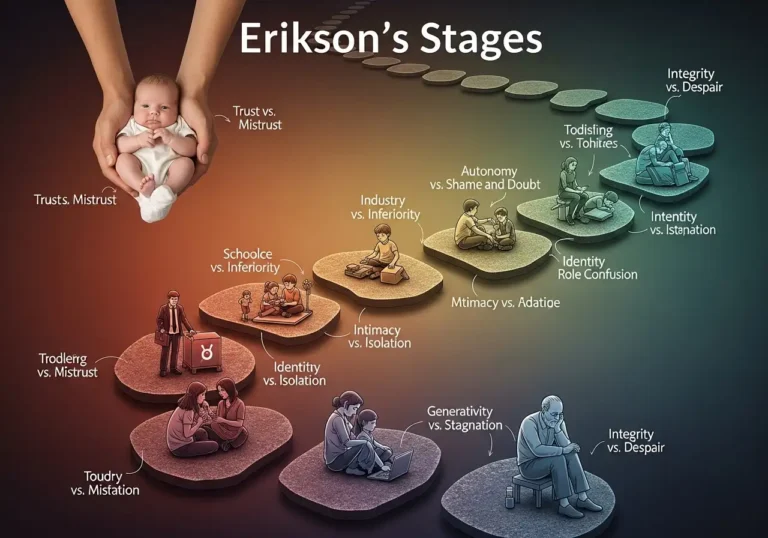
In my clinical practice, I often find that patients arrive in my office feeling “stuck,” yet they are unable to articulate exactly why. They might be a successful 30-year-old struggling to commit to a partner or a 50-year-old questioning if their career has actually mattered. What Is Erikson’s Stages?
To help them make sense of these feelings, I frequently turn to the framework provided by Erik Erikson.
Erikson’s stages of development describe eight psychosocial stages that individuals move through from infancy to old age. Unlike other theories that focus solely on childhood, Erikson’s model is a lifelong map.
Each stage involves a specific psychological conflict—a “crisis”—that serves as a turning point. If we navigate the crisis successfully, we emerge with a “virtue” or a psychological strength. If the conflict remains unresolved, it can lead to persistent feelings of inadequacy or confusion.
Understanding these stages is not just an academic exercise; it is a tool for self-compassion. Whether you are a parent trying to understand a toddler’s tantrum or an adult navigating a midlife transition, Erikson’s theory provides the “why” behind our most challenging emotional hurdles.
Who Was Erik Erikson?
Erik Erikson (1902–1994) was a German-American developmental psychologist and psychoanalyst who fundamentally changed how we view the human experience.
While he was heavily influenced by Sigmund Freud, Erikson broke away from Freud’s heavy emphasis on psychosexual stages.
Erikson believed that personality development is psychosocial rather than just biological. He argued that our interactions with society and culture are the primary drivers of who we become.
He is perhaps most famous for coining the term “identity crisis,” a concept he developed while observing the struggles of adolescents and veterans.
His work shifted the focus of psychology toward the idea that we never stop growing; our identity is a fluid, lifelong project.
What Is Erikson’s Theory of Psychosocial Development?
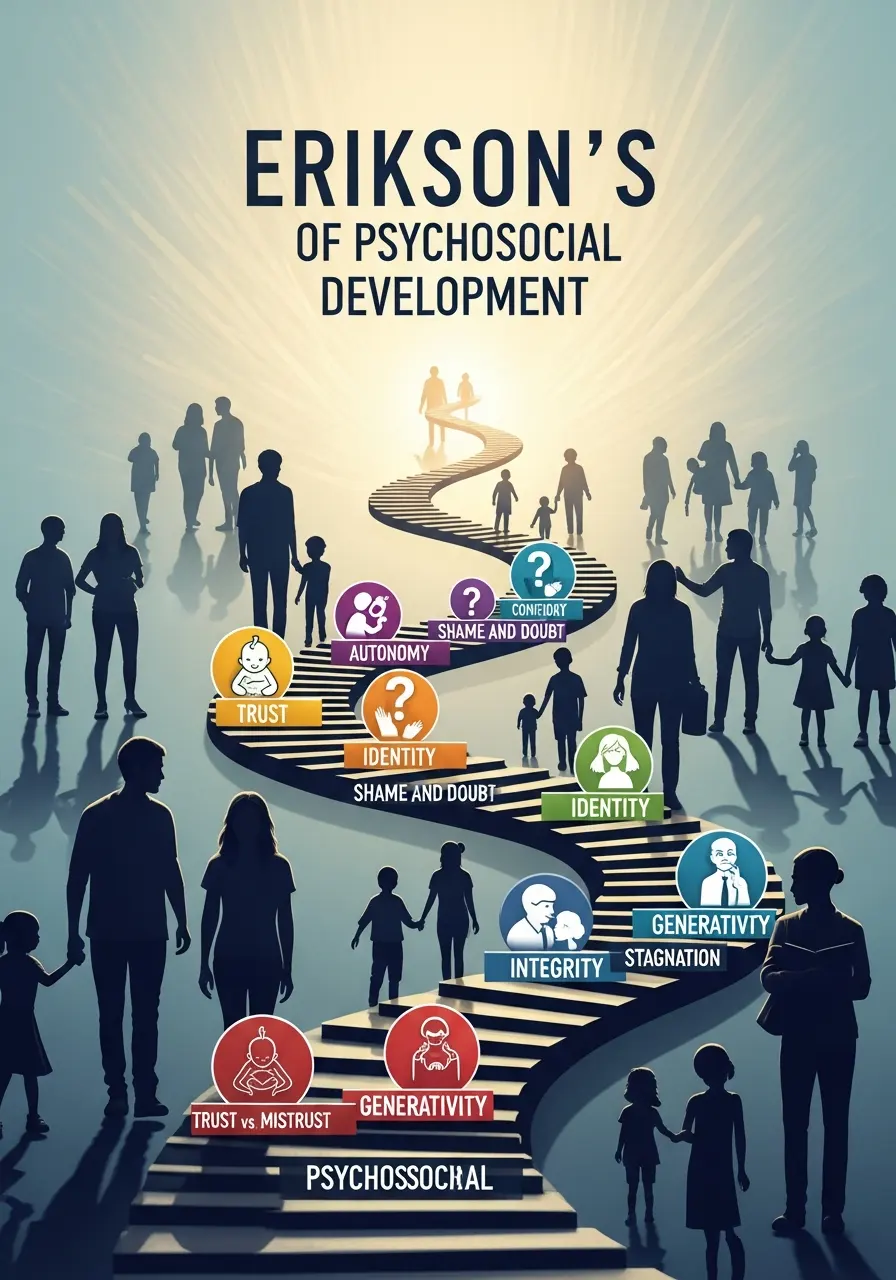
The main idea of Erikson’s psychosocial theory is the epigenetic principle. This principle suggests that we develop through a predetermined unfolding of our personalities in eight stages. Our progress through each stage is determined by our success, or lack of success, in all the previous stages.
Unlike a ladder where you leave one rung behind, Erikson’s stages are more like building blocks. The strengths you gain in infancy (trust) provide the foundation for the independence you seek in toddlerhood (autonomy).
If a foundation is shaky, the subsequent blocks may feel unstable, but Erikson remained optimistic: he believed that we can revisit and repair these stages later in life through therapy, relationships, and self-reflection.
Erikson’s Stages of Development Chart
To help visualize this lifelong journey, I often use a stages of development chart with my clients. This table summarizes the core conflicts and the “virtue” gained from a successful resolution.
Erikson’s Stages of Development by Age
| Stage | Age Range | Psychosocial Conflict | Key Virtue Gained |
| 1 | Infancy (0–18 months) | Trust vs. Mistrust | Hope |
| 2 | Early Childhood (2–3 years) | Autonomy vs. Shame & Doubt | Will |
| 3 | Preschool (3–5 years) | Initiative vs. Guilt | Purpose |
| 4 | School Age (6–11 years) | Industry vs. Inferiority | Competence |
| 5 | Adolescence (12–18 years) | Identity vs. Role Confusion | Fidelity |
| 6 | Young Adulthood (19–40 years) | Intimacy vs. Isolation | Love |
| 7 | Middle Adulthood (40–65 years) | Generativity vs. Stagnation | Care |
| 8 | Maturity (65+ years) | Integrity vs. Despair | Wisdom |
The Eight Stages of Human Development Explained
This is the main topic of Erikson’s work, and it requires an exploration of the deep psychological “why” behind each transition. Each stage is a battle between two opposing forces.
Stage 1: Trust vs. Mistrust
In the first year of life, the world is a vast, unknown place. The infant’s primary question is, “Is the world a safe place, or is it unpredictable and dangerous?” The Biology of Bonding: When a caregiver responds consistently to a baby’s cries, hunger, and discomfort, the infant’s nervous system learns to regulate.
This builds a sense of trust. Biologically, this is linked to the development of the limbic system and the attachment bonds that influence future relationships. If care is inconsistent or rejecting, the child develops mistrust, viewing the world as a place where their needs won’t be met.
- Real-Life Example: A baby who is held and comforted when they cry learns that they can rely on others, developing the virtue of hope.
Stage 2: Autonomy vs. Shame and Doubt
As children gain physical control over their bodies (walking, talking, toilet training), they begin to assert their independence. This is the era of “No!” and “I do it!”
The Psychology of Choice: Success in this stage leads to autonomy. When parents allow children to make small choices (like picking out their own clothes), the child develops a sense of will.
However, if a child is punished for their attempts at independence or overly criticized for “accidents,” they begin to feel a deep sense of shame and doubt regarding their abilities.
- Real-Life Example: A toddler who successfully pours their own milk—even with a small spill—feels a sense of mastery.
Stage 3: Initiative vs. Guilt
During the preschool years, children begin to plan activities, make up games, and initiate social interactions. This is the third stage of psychosocial development.
The Purpose of Play: Children at this age are like little explorers. They are testing their power and influence over the world. If they are encouraged to explore and lead, they develop initiative.
If their efforts are met with “stop asking so many questions” or “you’re doing it wrong,” they may develop guilt, feeling that their curiosity is a nuisance to others.
- Real-Life Example: A child organizing a “pretend” school with their stuffed animals is practicing leadership and developing purpose.
Stage 4: Industry vs. Inferiority
From ages 6 to 11, the child’s world expands to include teachers, peers, and academic performance. The focus shifts to industry—the ability to learn and perform complex tasks.
The Drive for Competence: This stage is all about social comparison. Children want to feel that they are “good at things.” If they are encouraged for their hard work and achievements, they develop competence.
If they struggle in school or are constantly compared unfavorably to peers, they may develop a lasting sense of inferiority.
- Real-Life Example: A student who struggles with math but is praised for their persistence in learning the material develops a sense of industry despite the difficulty.
In my practice, I often see how circadian rhythms and sleep hygiene act as a “silent partner” in developmental success. I once worked with a 10-year-old patient, “Leo,” who was struggling with Stage 4 (Industry vs. Inferiority).
He felt “stupid” compared to his classmates. We discovered his late-night gaming was disrupting his REM sleep, which is critical for neuroplasticity and memory consolidation. By fixing his sleep hygiene, Leo’s ability to learn improved, which in turn boosted his sense of “industry.”
Without the biological foundation of rest, the psychological work of the stages becomes exponentially harder.
Experience Integration: The Case of “Elena”
In my practice, I recently worked with an anonymized patient, “Elena,” a 26-year-old who felt paralyzed by an inability to make career decisions. She was stuck in what Erikson calls Stage 5: Identity vs. Role Confusion.
Elena’s parents had been very “helpful,” choosing her college major and even vetting her internships. While they meant well, Elena had never navigated Stage 3 (Initiative) or Stage 5 (Identity) on her own terms. She didn’t know who she was because she had never been allowed to “try on” different identities.
Our therapeutic intervention focused on “Safe Exploration.” I encouraged Elena to join classes and social groups that had nothing to do with her parents’ expectations.
As she experimented with different roles, her executive function—specifically her decision-making and planning—began to strengthen. By revisiting the “crisis” of identity, she was able to move toward fidelity (being true to herself) and finally progress into Stage 6 (intimacy).
Stage 5: Identity vs. Role Confusion
This is perhaps the most famous of Erikson’s stages. As teenagers move from childhood to adulthood, they must answer the question, “Who am I?”
Adolescents experiment with different styles, friend groups, beliefs, and career goals. If they are allowed to explore, they emerge with a strong sense of identity. If they are pressured to conform to their parents’ ideas or fail to find a place in society, they experience role confusion.
They may feel adrift, unsure of their values or their purpose in life. This stage is where we develop fidelity, the ability to commit to others and to one’s own values, even in the face of conflict.
Stage 6: Intimacy vs. Isolation
As we enter our 20s and 30s, the focus shifts to forming deep, meaningful relationships. This is the sixth stage of Erikson’s psychosocial development.
The Vulnerability of Love: Erikson argued that we must have a strong sense of identity (Stage 5) before we can truly experience intimacy. If we don’t know who we are, we fear losing ourselves in someone else. Success in this stage leads to the virtue of love. Failure to form these bonds can lead to isolation, a sense of being alone in the world, even when surrounded by people.
Stage 7: Generativity vs. Stagnation
As we enter the longest phase of the human lifespan—typically spanning from our 40s to our mid-60s—the psychological focus shifts from the “self” to the “collective.”
In my practice, I often observe that this is the stage where the “mid-life crisis” actually occurs. It is not necessarily about wanting a sports car; it is a profound existential confrontation with generativity.
The Drive to Create and Nurture: Generativity refers to “making your mark” on the world. This can manifest through parenting, mentoring younger colleagues, engaging in creative projects, or contributing to the community.
The underlying biological and psychological “why” is our innate need to feel that our lives have had a lasting impact. When we succeed in this stage, we develop the virtue of care.
Conversely, stagnation occurs when an individual feels disconnected from society or unproductive. This often looks like a “graying” of the internal world—a sense of being “stuck” or uninvolved. People in stagnation may feel that they are merely existing rather than living.
- Real-Life Example: A middle-aged manager who shifts their focus from personal promotion to mentoring junior staff is successfully navigating this stage.
Stage 8: Integrity vs. Despair
The final stage of Erikson’s theory occurs as we enter the twilight of our lives. As physical strength wanes and we retire from the workforce, the “crisis” becomes one of reflection. We look back at the previous seven stages and ask: “Did I live a meaningful life?”
The Synthesis of a Lifetime: Success in this stage leads to integrity. This is the ability to look back on one’s life—with all its mistakes and triumphs—and feel a sense of wholeness. This resolution produces the virtue of wisdom. It allows a person to face the end of life with a sense of peace rather than fear.
If an individual looks back and sees only missed opportunities or failed rungs on the developmental ladder, they may fall into despair. This often manifests as bitterness, depression, and a deep fear of death, as they feel it is “too late” to start over or find meaning.
- Real-Life Example: An elderly person sharing stories of their life with grandchildren, accepting both their successes and failures with grace, exemplifies integrity.
Real-Life Examples of Erikson’s Stages of Development
To truly understand real-life examples of Erikson’s stages of development, we have to look at how these internal “crises” manifest in everyday behavior. Here are scenarios I frequently see in a clinical setting:
The “Failed” Toddler Independence
Imagine a 3-year-old trying to put on their own shoes. A parent, in a rush, sighs loudly and says, “You’re too slow; let me do it; you always mess it up.” If this happens repeatedly, the child begins to experience shame and doubt.
In adulthood, this may manifest as an employee who is terrified to take initiative on a project because they “know” they will fail
The Adolescent Identity Search
Consider a high school student who changes their “aesthetic” every three months—moving from an athlete to a theater enthusiast to a social activist.
While parents may find this exhausting, it is a healthy example of avoiding role confusion. They are “testing” identities to see which one fits their internal values.
The Mid-Life Career Shift
I once worked with a successful corporate lawyer who, at age 50, decided to quit their firm and become a high school teacher. They weren’t “running away” from their job; they were running toward generativity.
They felt their legal work was no longer “giving back” to the next generation, and the shift to teaching allowed them to find the care and purpose they were missing.
How Erikson’s Theory Applies to Parenting and Education
For parents and teachers, Erik Erikson’s life stages explained through this lens offer a roadmap for support.
- In Education: Teachers who understand Stage 4 (Industry vs. Inferiority) know that their primary job isn’t just teaching facts; it is helping children feel competent. When a child struggles with a subject, a teacher’s encouragement of their effort prevents the child from feeling inferior to their peers.
- In parenting, understanding Stage 3 (Initiative vs. Guilt) helps parents realize that a 4-year-old’s constant “Why?” questions aren’t meant to be annoying—they are the seeds of curiosity and purpose.
Strengths and Limitations of Erikson’s Theory
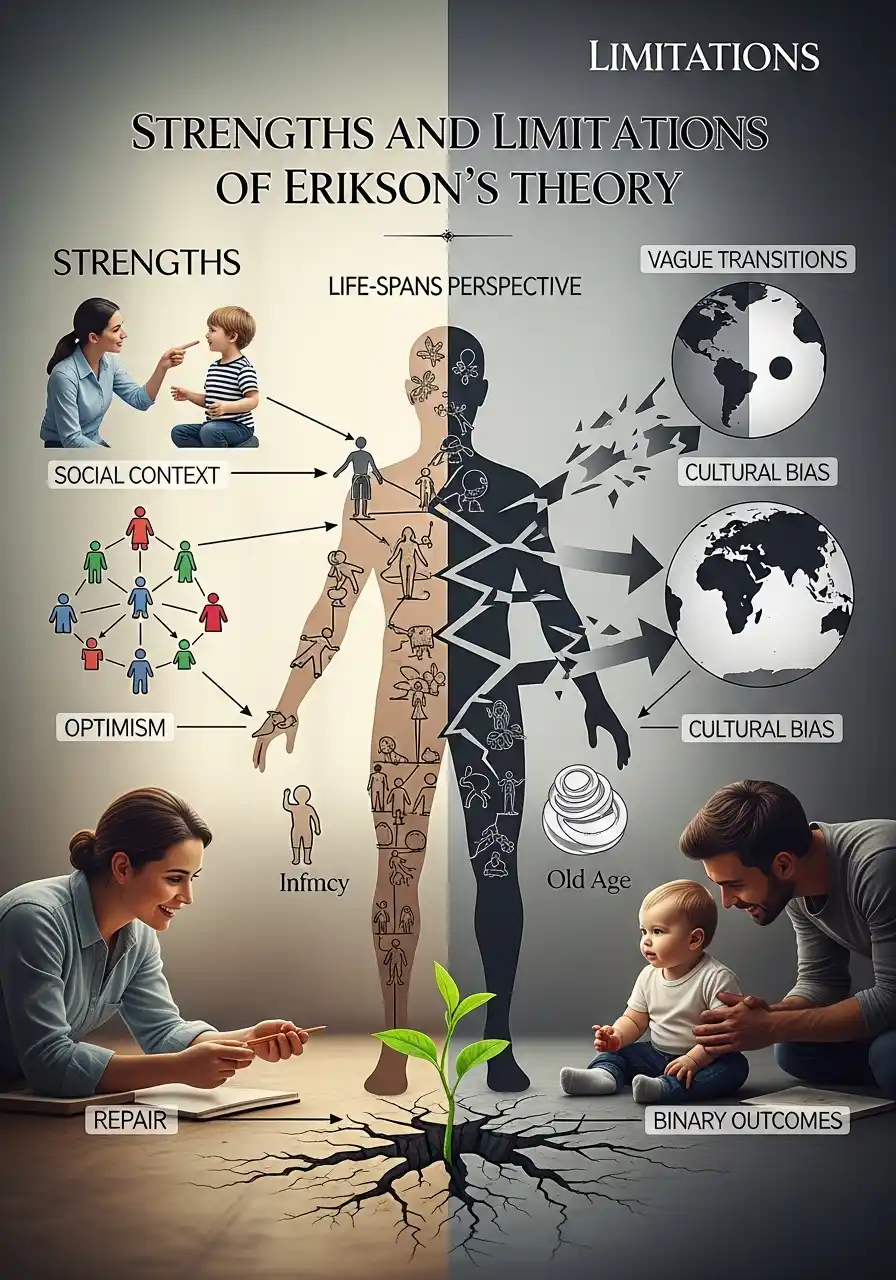
Every psychological theory has its “blind spots.” When we look at Erikson’s stage theory, it is important to weigh its contributions against modern critiques.
Strengths
- Life-Span Perspective: It is one of the few theories that acknowledges we keep developing after age 18.
- Social Context: It acknowledges the role of culture, family, and society in shaping the self.
- Optimism: It suggests that even if a stage went “wrong,” it can be repaired later in life.
Limitations
- Vague Transitions: The theory doesn’t explain exactly what is needed to move from one stage to the next.
- Cultural Bias: The stages (especially the focus on “Autonomy” and “Identity”) reflect Western, individualistic values and may not apply perfectly to collectivist cultures.
- Binary Outcomes: Life is rarely a simple choice between “trust” or “mistrust”; most people exist somewhere in the middle.
Comparing Erikson’s Theory With Other Developmental Theories
To provide a full picture, we must look at how Erikson compares to his contemporaries.
| Feature | Erikson (Psychosocial) | Piaget (Cognitive) | Freud (Psychosexual) |
| Focus | Social interaction and ego identity. | Thought processes and logic. | Biological and sexual drives. |
| Lifespan | Birth to old age (8 stages). | Birth to adolescence (4 stages). | Birth to adolescence (5 stages). |
| Main Goal | Resolving social conflicts. | Understanding the physical world. | Managing instinctual urges. |
Frequently Asked Questions
What are Erikson’s stages of development?
Erikson’s stages of development are a series of eight psychosocial stages that every individual passes through from birth to old age.
Each stage is defined by a central conflict—such as trust vs. mistrust or identity vs. role confusion—that must be resolved to develop a healthy personality and specific psychological virtues.
What is the core of Erikson’s theory?
The main idea of Erikson’s psychosocial theory is the epigenetic principle, which states that human development occurs in a predetermined order.
Success in each stage builds a foundation for the next, suggesting that our social experiences across the entire lifespan shape who we become.
Identifying the third stage of psychosocial development
The third stage is Initiative vs. Guilt, typically occurring during the preschool years (ages 3 to 5). During this time, children begin to assert power and control over their world through directing play and other social interactions. Success leads to a sense of purpose.
Understanding the sixth stage of Erikson’s theory
The sixth stage is intimacy vs. isolation, which takes place during young adulthood (ages 19 to 40). The primary focus is on forming intimate, loving relationships with other people. Resolving this conflict successfully leads to the virtue of love.
What are the eight stages of human development?
The eight stages, in chronological order, are:
- Trust vs. Mistrust (Infancy)
- Autonomy vs. Shame and Doubt (Toddlerhood)
- Initiative vs. Guilt (Preschool)
- Industry vs. Inferiority (School Age)
- Identity vs. Role Confusion (Adolescence)
- Intimacy vs. Isolation (Young Adulthood)
- Generativity vs. Stagnation (Middle Adulthood)
- Integrity vs. Despair (Late Adulthood)
How can I identify a “damaged” amygdala based on Erikson’s stages?
While Erikson focuses on psychology, and the amygdala is biological, they intersect in Stage 1 (Trust).
If the amygdala—the brain’s emotional center—is physically damaged or hyper-reactive due to trauma, an infant may struggle to develop trust, instead defaulting to a baseline of mistrust and chronic anxiety.
Conclusion
In my clinical practice, I often remind my patients that Erikson’s stages of development are not a race to be won but a map to be explored.
This framework offers far more than a simple list of ages and conflicts; it provides a profound, compassionate language for the inherent struggles of being human.
By shifting our perspective to see these “crises” not as failures but as essential opportunities for growth, we gain the agency to navigate life’s transitions with intentionality rather than fear.
The beauty of Erikson’s model lies in its inherent hope. Whether you are currently focused on building trust in infancy, navigating the turbulent waters of identity in adolescence, or seeking integrity in your later years, the theory affirms that identity is a fluid, lifelong work in progress.
Crucially, because of neuroplasticity, it is never too late to revisit a previous stage.
If you missed the virtue of autonomy as a child or struggled with intimacy in your twenties, the psychological “building blocks” can be repaired through therapy, healthy relationships, and self-awareness.
By understanding where you sit on this developmental arc, you can move forward with the wisdom and care necessary to lead a truly integrated life.
Authoritative & References
- Erikson Institute
- American Psychological Association (APA)
- Simply Psychology – Erik Erikson
- Harvard University – Center on the Developing Child

Related Posts





Subscribe to Our Newsletter
Get mental health tips, updates, and resources delivered to your inbox.
MORE from Author
Read More Watching someone you care about struggle with bipolar depression and anxiety can be heartbreaking. You may notice that they withdraw…
 In my practice as a clinical psychologist, I often observe that the difference between a patient who crumbles under pressure…
 We all have "up" days and "down" days. Perhaps you feel energized after a promotion or sluggish on a rainy…
 To define bipolar disorder accurately, we must look at it as a chronic mood dysregulation condition. In psychology and medicine,…
Are you looking for a Therapist?
Connect with qualified mental health professionals who understand
bipolar disorder, mood changes, and emotional challenges.
Private • Supportive • Confidential