
Emotional Identification: Definition, Benefits, and Practical Activities for Kids & Adults

Medically reviewed by Laura Athey Updated Date: April 29, 2026

In a world that constantly asks “How are you?”, we rarely give an honest answer. Often, it’s because we genuinely don’t know.
Emotional identification (also known as affect labeling or emotion recognition) is the psychological ability to recognize, label, and distinguish between different emotional states in oneself and others. It is the cognitive process of connecting a physical sensation (e.g., a racing heart) to an emotional concept (e.g., anxiety or excitement).
What is emotional identification in psychology? Clinically, we view it as the bridge between the body and the mind. It is the first step in the “emotional processing” chain. You cannot manage what you cannot measure, and you cannot measure what you cannot name.
Synonyms often used in therapy:
- Affect Labeling: The act of putting feelings into words.
- Emotional Granularity: The ability to distinguish between precise emotions (e.g., knowing the difference between “disappointed” and “frustrated,” rather than just saying “bad”).
- Emotion Recognition: Often refers to identifying emotions in others via facial expressions.
Is Emotional Identification Part of Emotional Intelligence?
A common question I hear is: Can emotion identification be considered an aspect of emotional intelligence?
Yes, absolutely. It is the foundation upon which the entire house of Emotional Intelligence (EQ) is built.
According to Daniel Goleman’s framework of Emotional Intelligence, there are four pillars:
- Self-Awareness (This is where emotional identification lives).
- Self-Management.
- Social Awareness.
- Relationship Management.
Why Identification Comes Before Regulation
You cannot practice “emotional regulation” without identification. Imagine trying to treat a physical illness without a diagnosis. You wouldn’t take antibiotics for a broken leg. Similarly, you cannot use deep breathing (a tool for anxiety) if you are actually feeling shame (which requires self-compassion).
The Risk of Poor Identification: When we lack this skill, we engage in emotional suppression. The energy of the emotion doesn’t vanish; it manifests as:
- Behavioral Outbursts: “Acting out” feelings because we can’t speak them.
- Somatization: Physical symptoms like headaches or stomach aches.
- Miscommunication: Telling a partner “You are annoying me” when the real feeling is “I feel lonely and hurt.”
Why Emotional Identification Matters (The Goal and Benefits)
What is the goal of emotion identification? The goal is not to be “happy” all the time. The goal is integration. It is about connecting your thinking brain with your feeling brain so you can make wise decisions.
The Neuroscience: “Name It to Tame It”
Dr. Dan Siegel coined the phrase “Name it to Tame it,” and the science backs this up. When you are in a state of high emotion (anger, panic), your amygdala (the brain’s alarm bell) is firing wildly.
The moment you assign a word to that feeling (“I am feeling angry”), you activate the prefrontal cortex (the logic center). This simple act sends soothing neurotransmitters to the amygdala, physically calming your nervous system.
Benefits of Emotional Identification Therapy:
- Reduced Anxiety and Depression: Studies show that affect labeling diminishes the intensity of negative emotional responses.
- Trauma Recovery: In my work with trauma survivors, regaining the ability to feel and name sensations is often the turning point in recovery. It shifts the experience from “I am in danger” to “I am remembering danger.”
- Improved Relationships: When you can say “I feel insecure,” rather than acting jealous, you invite connection rather than conflict.
Emotional Identification for Kids
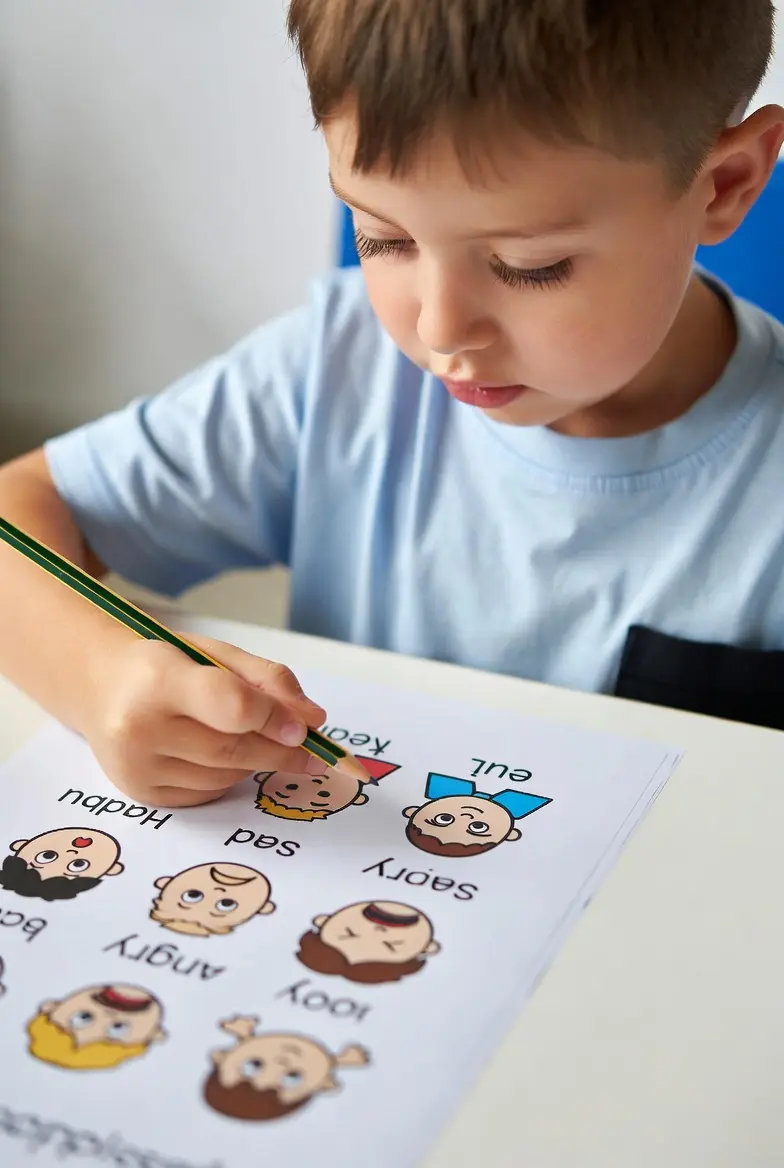
Children are not born with an emotional vocabulary. They are born with sensations—crying, kicking, smiling. It is our job as caregivers to teach them the language of their own hearts.
A. Developmental Importance
Emotional identification for kids is as crucial as teaching them to read.
- Toddlers (1–3): Can identify basic states (Happy, Sad, Mad).
- Preschoolers (3–5): Begin to understand cause and effect (“I am sad because you took the toy”).
- School Age (6+): Can grasp complex and mixed emotions (“I am excited and nervous about school”).
If we skip this step, children rely on “behavioral communication”—hitting, screaming, or shutting down—to show us how they feel.
B. Emotional Identification Activities for Kids
Learning about feelings shouldn’t be a lecture; it should be play. Here are some emotional identification games I recommend to parents:
1. Emotion Charades Write emotions on slips of paper. Take turns acting them out using only your face and body language.
- Goal: Teaches facial and emotional identification.
- Tip: Start simple (Happy/Sad) and get harder (Embarrassed/Proud).
2. The Mirror Game Sit in front of a mirror with your child. Make a “mad face” and ask them to copy you. Then ask, “What does your tummy feel like when you make this face?”
- Goal: Connects the external expression to the internal physical sensation.
3. “Inside Out” Color Sorting Use colored pom-poms or LEGOs to represent feelings (Red = Anger, Blue = Sadness). Ask the child to fill a jar with the colors that match their day.
- Goal: Visualizing emotional capacity.
C. Worksheets & Printables (Downloadable Resource Strategy)
Sometimes, visual aids are the best tools.
Essential Tools:
- Emotional Identification Wheel: A simplified wheel with 4–6 core emotions in the center (Joy, Sadness, Anger, Fear) expanding into nuance.
- Emotional Identification Chart: A poster with faces showing different expressions. This is vital for non-verbal children or those on the autism spectrum.
- Feelings Check-In Sheet: A daily PDF where a child can circle a face representing their mood morning, noon, and night.
Emotional Identification for Teens
Adolescence is a time of intense emotional turbulence. The teenage brain is literally remodeling itself, with the emotion centers (amygdala) often outpacing the logic centers (prefrontal cortex).
Emotional identification for teens is about more than just “feeling sad.” It is about navigating identity, social pressure, and hormonal shifts.
The Challenges:
- Alexithymia: Many teens experience a temporary inability to name their emotions due to overwhelming intensity. They might say, “I’m just numb” or “I don’t care.”
- Social Masking: Teens are experts at hiding vulnerability to fit in. They might project “anger” when they actually feel “shame” or “rejection.”
Tools for Teens:
- Journaling Prompts: Instead of asking “How was your day?”, provide prompts like: “What was the hardest emotion you felt today?” or “What color was your mood during 3rd period?”
- Music as a Bridge: Ask your teen to create a playlist for their current mood. Often, they can identify with lyrics (“This song feels like me right now”) better than they can speak the words.
- Mood Tracking Apps: Apps like Daylio or How We Feel allow teens to track their emotional weather without having to talk to an adult immediately.
Emotional Identification for Adults
If you think this is just for kids, think again. Many adults are walking around with the emotional vocabulary of a 5-year-old. We say “I’m stressed” or “I’m busy” as a catch-all for fear, grief, loneliness, and overwhelm.
Emotional identification for adults is often remedial work. We have spent decades suppressing feelings to be “professional” or “strong.”
Signs of Low Emotional Identification in Adults:
- Numbness: Feeling “flat” or disconnected from joy and pain alike.
- Explosive Reactivity: Going from 0 to 100 over minor inconveniences (spilled coffee = rage).
- Physical Symptoms: Chronic tension headaches, jaw clenching, or IBS that flares with stress.
Practical Exercises:
- Body Scan Emotional Mapping: Close your eyes. Scan your body from toes to head. Where is the tension? Is your chest tight? Is your stomach churning?
- Step 2: Ask yourself, “If this sensation had a name, what would it be?” (e.g., Tight chest = Anxiety).
- The 3-Step “Name it to Tame it”:
- Notice: “I notice my heart is racing.”
- Name: “This is anxiety.”
- Need: “I need to take a breath.”
Emotional Identification in Therapy and Clinical Settings
For therapists, emotional identification therapy is a cornerstone of treatment. You cannot process trauma if the client cannot feel safe enough to name it.
Modalities Using Emotional Identification:
- CBT (Cognitive Behavioral Therapy): Teaches clients to identify the thought behind the feeling. (“I feel worthless” -> “I had the thought that I failed.”)
- DBT (Dialectical Behavior Therapy): Has entire modules dedicated to “Emotion Regulation,” starting with observing and describing emotions without judgment.
- Trauma-Focused Therapy: Often starts with somatic (body-based) identification because trauma lives in the body.
Tools for Clinicians:
- Emotional Identification Checklist: A list of 50+ emotion words given to clients to circle during a session.
- The “Sensations” Word Bank: Helping clients move from “I feel bad” to “I feel heavy/shaky/hot/cold.”
Tools for Emotional Identification

You don’t have to do this alone. There are established tools designed to expand your emotional vocabulary.
A. The Emotion Wheel
Based on psychologist Robert Plutchik’s theory, the emotional identification wheel is a visual tool that categorizes emotions.
- Center: Core emotions (Joy, Trust, Fear, Surprise, Sadness, Disgust, Anger, Anticipation).
- Outer Rings: Nuanced emotions (e.g., Anger -> Rage -> Annoyance).
- How to Use: Start in the middle. “I feel angry.” Then look outward. “Is it actually frustration? Or maybe resentment?” This granularity gives you power.
B. Emotional Identification Chart
This is often a grid of faces. It is essential for:
- Autism Spectrum Disorder (ASD): Many autistic individuals struggle to read facial cues. A chart with clear labels helps map the visual to the concept.
- ESL Learners: For those learning English, emotional nuance is often the hardest part of language.
C. Emotional Identification Checklist
A simple daily log.
- Morning: How do I feel waking up?
- Afternoon: How did I feel during that meeting?
- Evening: How do I feel now that the day is done?
- Goal: Spotting patterns. (e.g., “I always feel anxious on Sunday nights.”)
Facial and Emotional Identification
Recognizing emotions in others is the flip side of the coin. Facial and emotional identification is the basis of empathy.
- Microexpressions: These are fleeting facial expressions (lasting less than a second) that reveal true emotion. Learning to spot a quick flash of “disgust” or “fear” can change how you navigate a conversation.
- Social Skills Training: For children with autism, we explicitly teach that “eyebrows down + lips tight = angry.” We use flashcards and videos to practice this “decoding.”
Emotional Identification Activities (All Ages Summary)
Here is a quick reference guide for implementing these strategies.
| Age Group | Activity | Goal |
| Kids (3–10) | Emotion Charades | Learning to recognize facial cues and body language in a fun, low-pressure way. |
| Teens (11–18) | Music/Lyrics Journaling | Bridging the gap between intense internal feelings and external expression. |
| Adults (19+) | The Emotion Wheel | Expanding vocabulary from “stressed” to specific states like “overwhelmed” or “unsupported.” |
| Seniors | Life Review Storytelling | Identifying the emotional arc of their life story (integrity vs. despair). |
How to Improve Emotional Identification (Step-by-Step Framework)
If you are ready to build this muscle, follow this 5-step framework.
- Pause: When a strong feeling hits, stop. Don’t react. Just pause.
- Scan Body: Where do you feel it? Throat? Chest? Belly? Hands?
- Name Primary Emotion: Use the “Big 4” (Mad, Sad, Glad, Scared). “I am feeling scared.”
- Identify Secondary Emotion: Look closer. “Is it fear? or is it vulnerability?” “Is it anger? or is it shame?”
- Connect to Need: “Because I feel vulnerable, I need reassurance.” (This is the ultimate goal—getting your needs met).
Conclusion: The Power of a Name
Emotional identification is not just about words; it is about witnessing yourself.
When you can say, “I am feeling grief,” you stop fighting the feeling and start honoring it. You move from a state of chaos to a state of clarity.
Whether you are a parent teaching a toddler that it’s okay to be mad, or an adult learning that “busy” isn’t a feeling, this work is the foundation of mental health.
Frequently Asked Questions
What is emotional identification?
It is the ability to recognize, label, and understand your own emotions and the emotions of others. It involves connecting physical sensations (like a racing heart) to emotional words (like “anxiety”).
What is the goal of emotion identification?
The goal is to regulate emotions. By naming a feeling, you activate the brain’s logic center, which calms the emotional center. This allows you to respond thoughtfully rather than reacting impulsively.
Can emotion identification be considered part of emotional intelligence?
Yes. It is the first pillar of Emotional Intelligence (Self-Awareness). Without the ability to identify emotions, you cannot manage them or empathize with others.
How do you teach emotional identification to children?
Use play and visual aids. Emotion charades, “The Mirror Game,” and using an Emotion Wheel or chart with faces are effective ways to build their vocabulary.
Can adults improve emotional identification skills?
Absolutely. Mindfulness, journaling, therapy, and using tools like the Plutchik Emotion Wheel can help adults relearn the language of emotion that they may have suppressed.
References & High-Quality Sources
- Yale Center for Emotional Intelligence
- The Atlas of Emotions
- The Gottman Institute
- Greater Good Science Center
- Dr. Dan Siegel

Related Posts






Subscribe to Our Newsletter
Get mental health tips, updates, and resources delivered to your inbox.
MORE from Author
Read More Watching someone you care about struggle with bipolar depression and anxiety can be heartbreaking. You may notice that they withdraw…
 In my practice as a clinical psychologist, I often observe that the difference between a patient who crumbles under pressure…
 We all have "up" days and "down" days. Perhaps you feel energized after a promotion or sluggish on a rainy…
 To define bipolar disorder accurately, we must look at it as a chronic mood dysregulation condition. In psychology and medicine,…
Are you looking for a Therapist?
Connect with qualified mental health professionals who understand
bipolar disorder, mood changes, and emotional challenges.
Private • Supportive • Confidential