
Generalized Anxiety Disorder DSM-5 Criteria, Code, and Clinical Meaning (DSM-5-TR Explained)

Medically reviewed by Laura Athey Updated Date: April 30, 2026
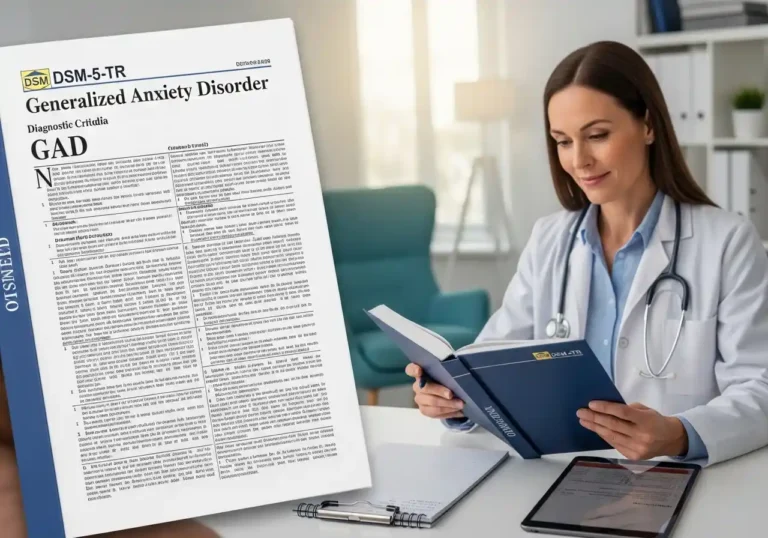
In my practice as a clinical psychologist, I often find that patients arrive at their first session with a mix of exhaustion and a search for a name for their suffering. They describe a mind that refuses to quiet, a body that feels permanently braced for a blow, and a sense of dread that is as persistent as it is vague. Generalized Anxiety Disorder DSM-5 Criteria.
When we sit down to translate these lived experiences into a formal diagnosis, we turn to the gold standard of psychiatric assessment: the Diagnostic and Statistical Manual of Mental Disorders, Fifth Edition, Text Revision (DSM-5-TR).
In the DSM-5-TR, Generalized Anxiety Disorder (GAD) is defined as excessive anxiety and worry occurring more days than not for at least six months, concerning multiple areas of life—such as work, school, or health—accompanied by specific physical and cognitive symptoms.
It is a diagnosis that distinguishes pathological, chronic worry from the normal, transient stress of modern life. As a clinician, I use the DSM-5-TR criteria to ensure diagnostic accuracy, while simultaneously documenting with ICD-10 billing codes to ensure my patients receive the insurance coverage they deserve.
Understanding what a DSM-5 diagnosis actually entails is the first step in moving from a state of “unspecified” distress to a targeted, evidence-based recovery plan.
What Does DSM Stand for in Psychology?
Before diving into the specifics of GAD, it is helpful to understand the tool we are using. In the field of psychology, DSM stands for the Diagnostic and Statistical Manual of Mental Disorders. It is often referred to as the “clinician’s Bible.”
Published by the American Psychiatric Association (APA), the DSM provides a standardized language and set of criteria for the classification of mental disorders. The current version, the DSM-5-TR (released in 2022), is a “text revision” that updated prevalence data and clarified the wording of certain criteria to help clinicians be more precise.
For those using this information for academic or clinical reports, the correct generalized anxiety disorder DSM-5 citation (for the TR version) is:
DSM-5-TR Diagnostic Criteria for Generalized Anxiety Disorder
To reach a diagnosis of GAD, a clinician must determine that a patient’s experience aligns with the specific Generalized Anxiety Disorder DSM-5-TR criteria. The manual outlines six primary criteria (A through F) that must be met.
A. Excessive Anxiety & Worry (The 6-Month Rule)
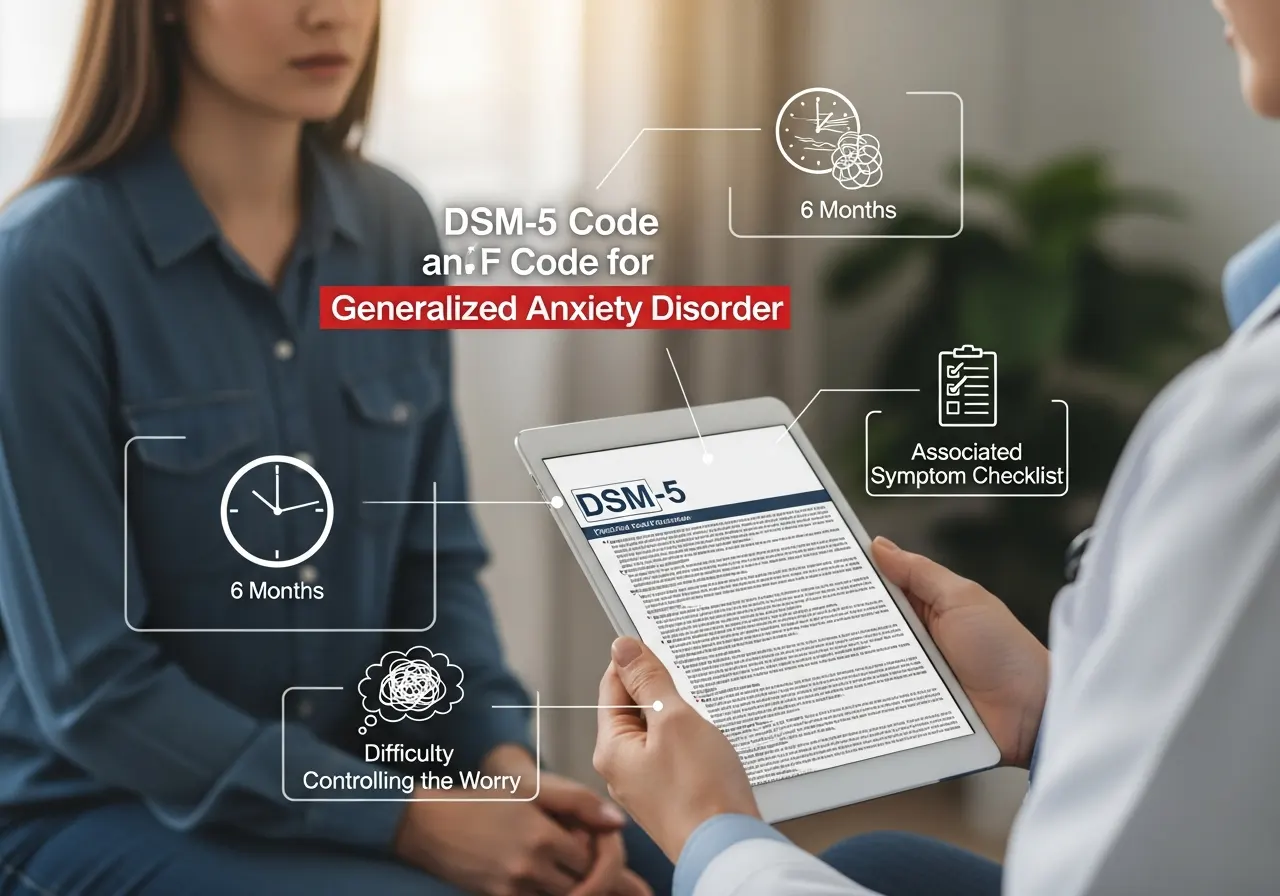
The hallmark of GAD is excessive anxiety and worry that occurs more days than not for at least 6 months. This worry must be about a number of events or activities. It isn’t just about one thing—like a specific debt or a single relationship—but a “generalized” spread of anxiety that migrates from one topic to the next.
B. Difficulty Controlling the Worry
The individual finds it difficult to control the worry. Unlike normal stress, where you might be able to “put the thought away” to enjoy a movie or a meal, GAD worry feels intrusive and unmanageable.
C. The Associated Symptom Checklist
For adults, the anxiety and worry must be associated with three or more of the following six symptoms (with at least some symptoms present for more days than not for the past 6 months):
- Restlessness or feeling keyed up or on edge.
- Being easily fatigued.
- Difficulty concentrating or mind going blank.
- Irritability.
- Muscle tension.
- Sleep disturbance (difficulty falling or staying asleep, or restless, unsatisfying sleep).
D. Clinically Significant Distress or Impairment
This is a critical “gatekeeper” criterion. The symptoms must cause clinically significant distress or impairment in social, occupational, or other important areas of functioning. If a person worries but their life is entirely unaffected, they may not meet the threshold for a clinical disorder.
E. Rule Out: Substances and Medical Conditions
The disturbance is not attributable to the physiological effects of a substance (e.g., a drug of abuse, a medication) or another medical condition (e.g., hyperthyroidism).
F. Rule Out: Other Mental Disorders
The disturbance is not better explained by another mental disorder (e.g., anxiety about having a panic attack in panic disorder or social evaluation in social anxiety disorder).
DSM-5 Code and F Code for Generalized Anxiety Disorder
In the world of medical documentation, names are often replaced by numbers. It is important to distinguish between the generalized anxiety disorder dsm 5 code (used for clinical classification) and the ICD-10 code (used for insurance and billing).
| System | Code | Clinical Meaning |
| DSM-5-TR Diagnostic Code | 300.02 | The specific numerical identifier for GAD in the APA manual. |
| ICD-10-CM (F Code) | F41.1 | The “billing code” required by insurance companies in the US. |
While I diagnose based on the 300.02 criteria, the generalized anxiety disorder F code (F41.1) is what you will likely see on your insurance “Explanation of Benefits” or your electronic health record.
DSM-5-TR: The “Why” Behind the Biology
As a psychologist, I am less interested in the “label” and more interested in the “why.” Why does the brain develop GAD? Why does it feel so impossible to “just stop worrying”? To understand Generalized Anxiety Disorder DSM-5 beyond the checklist, we have to look at the intersection of neuroplasticity, the autonomic nervous system, and executive functions.
The Failure of the “Safety Signal”
The human brain is an incredible prediction machine. In a neurotypical brain, there is a clear distinction between a “threat” (a car veering into your lane) and a “safety signal” (locking your front door at night). In GAD, the brain’s “safety signal” mechanism is broken.
The prefrontal cortex—the part of the brain responsible for high-level executive function, logic, and perspective—fails to send a strong enough “all-clear” signal to the amygdala (the brain’s emotional smoke detector).
Consequently, the amygdala stays in a state of chronic hyper-arousal. This is the biological “why” behind the “difficulty controlling the worry.” It’s not a lack of willpower; it’s a biological failure of the brain’s “brakes.”
The “Bracing” Response: Muscle Tension as Armor
One of the most telling symptoms of generalized anxiety disorder dsm 5 is muscle tension. Why would worry make your shoulders tight? Because the brain believes a physical threat is imminent. It keeps the body “braced” for a blow that never comes.
When this happens over months, it leads to a phenomenon called “somatic crystallization.” The anxiety is no longer just a thought; it is “stored” in the physical tension of the body. This is why GAD patients often present with chronic back pain, jaw clenching, or tension headaches. Their body is literally doing exactly what the brain told it to do: prepare for a fight.
Neuroplasticity and the “Worry Groove”
The more we worry, the better we get at it. This is neuroplasticity in its most challenging form. Each time we engage in a “what-if” loop, we strengthen the neural pathways associated with anxiety.
Over time, the brain creates a “worry groove,” making it the default path for any new information. This is why GAD feels chronic; the brain has literally been rewired to prioritize the detection of threats over the enjoyment of peace.
In my practice, I’ve found that many GAD patients suffer from “revenge bedtime procrastination”—staying up late because it’s the only time they feel they have control over their day.
The Nuance: I worked with a patient, “Mark,” whose GAD was resistant to typical talk therapy. We realized that his sleep hygiene was sabotaging his executive function. Because he wasn’t reaching deep REM sleep, his prefrontal cortex didn’t have the energy to “talk down” his amygdala during the day.
By regulating his circadian rhythms through morning sunlight and a “digital sunset,” we gave his brain the physical capacity to use the cognitive tools we were practicing. You cannot “talk” your way out of a physiological deficit.
An Anonymous Case Study: “Elena”
Elena came to me with severe irritability and fatigue. She didn’t think she was “anxious”—she thought she was just “failing at life.” Through the lens of the DSM-5, we saw that her constant irritability was actually a manifestation of a nervous system that was “keyed up” 24/7.
Her fatigue wasn’t laziness; it was the result of her body being in a “fight” state for six months straight.
By applying the DSM-5 anxiety disorders criteria, we were able to validate that her struggle had a name. This validation alone allowed her to stop blaming her character and start treating her condition.
We used CBT to help her identify her “cognitive distortions” and eventually “rewire” those worry grooves into more balanced patterns of thought.
DSM-5 Criteria for Children and Adolescents
In my clinical work with younger populations, I often have to remind parents that the generalized anxiety disorder in children criteria are slightly more flexible than the adult version. Children often lack the sophisticated vocabulary to say, “I am experiencing cognitive rumination regarding my academic performance. “Instead, they show us their anxiety through their bodies and their behaviors.
The “One-Symptom” Rule
While adults must present with at least three of the six associated physical/cognitive symptoms, for children, only one symptom is required for a diagnosis. This is because a child’s nervous system is still developing, and anxiety often manifests as a single, overwhelming physical or emotional change rather than a complex cluster.
Common Childhood Presentations
- Perfectionism: A child may spend hours on a simple drawing or refuse to turn in homework unless it is “flawless.”
- Excessive Reassurance Seeking: Frequent questions like “Are you sure you’ll be there to pick me up?” or “Are you mad at me?”
- Somatic Complaints: Recurrent stomachaches or headaches, particularly on Sunday nights or before school tests.
- School and Safety Worry: Unlike adults who worry about finances, children typically focus on school performance, sports, or the safety of their parents.
Differential Diagnosis: Distinguishing GAD from Other Disorders
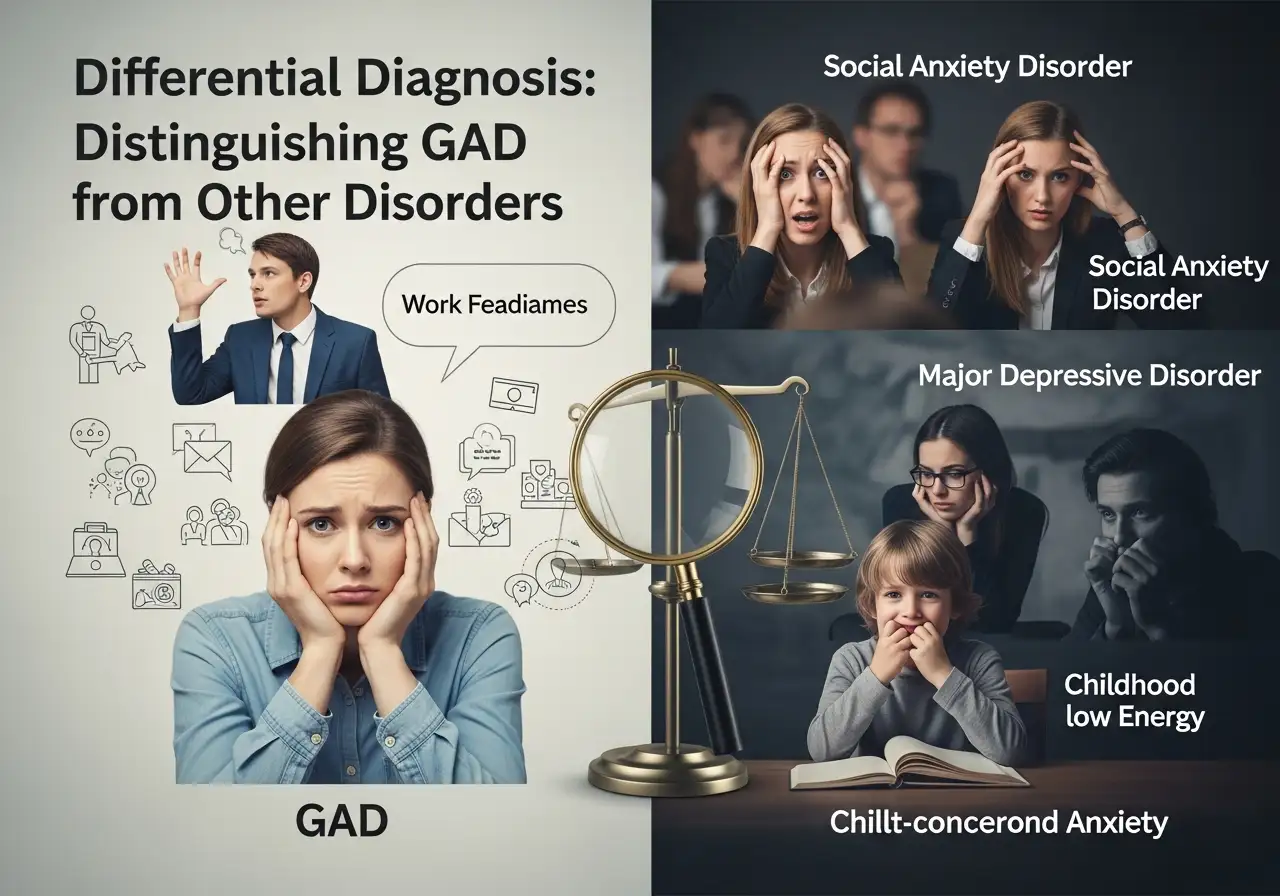
One of the most important aspects of E-E-A-T in a psychological evaluation is the “differential diagnosis.” This is the process of ensuring that GAD isn’t actually something else. Many disorders overlap with GAD, and a misdiagnosis can lead to ineffective treatment.
GAD vs. Social Anxiety Disorder
In Social Anxiety Disorder, DSM-5, the worry is specifically about being judged, embarrassed, or scrutinized by others. In GAD, the worry is “generalized”—the person worries about social judgment plus their health, the economy, and whether they left the stove on.
GAD vs. Major Depressive Disorder
There is a high comorbidity between GAD and major depressive disorder, according to DSM-5 criteria. While GAD is characterized by “anxious apprehension” (worrying about the future), depression is characterized by “low mood and anhedonia” (rumination about the past and loss of interest). If both are present, we diagnose both.
GAD vs. Adjustment Disorder
Adjustment disorder dsm 5 is used when anxiety is a response to a specific, identifiable stressor (like a breakup or a job loss) and typically resolves within six months. If the anxiety lasts longer or becomes “free-floating” and untethered from the original event, it may have transitioned into GAD.
Treatment Recommendations for GAD
While the DSM-5-TR is primarily a diagnostic manual rather than a treatment guide, it provides the clinical framework used to determine which evidence-based interventions will be most effective.
Psychotherapy: The Software Update
Cognitive Behavioral Therapy (CBT) remains the gold standard. We work on “cognitive reframing”—identifying the irrational “what-if” thoughts and replacing them with more balanced “even-if” thoughts. This process encourages neuroplasticity, helping the brain build new, calmer pathways.
Pharmacotherapy: The Hardware Support
When anxiety is severe, medication is often used to stabilize the nervous system.
- SSRIs and SNRIs: These are the first-line generalized anxiety disorder DSM-5 treatment options. They help regulate serotonin and norepinephrine, providing a “floor” for the patient’s mood.
- Buspirone: A non-sedating anti-anxiety medication that can be very effective for the chronic worry characteristic of GAD.
Frequently Asked Questions
What are the DSM-5 diagnostic criteria for GAD?
The criteria include excessive worry for 6+ months, difficulty controlling that worry, and at least 3 associated symptoms (like fatigue, irritability, or muscle tension) for adults and only 1 for children.
What are the 7 diagnostic criteria for GAD?
Technically, there are six main criteria (A-F). However, some clinicians refer to the “7 criteria” by including the 6-month duration requirement as its own category.
What is the DSM-5 code for GAD?
The diagnostic code is 300.02, which corresponds to the ICD-10 code F41.1.
What does generalized anxiety feel like?
Clinically, it feels like a “low hum” of fear that never turns off, accompanied by physical tension, difficulty concentrating, and persistent “what-if” thoughts.
Where can I find a DSM-5 GAD criteria PDF?
Because the DSM-5-TR is a copyrighted medical manual, the full text is not legally available as a free PDF. Clinicians and students access it through the APA’s official portal or purchase hard copies.
Conclusion
The DSM-5-TR is an essential map, but it is not the territory. While the 300.02 code and the checklist of symptoms provide the structure for diagnosis, they only tell part of the story. The rest of the story is found in the individual’s resilience, their history, and their commitment to the recovery process.
If you recognize yourself or a loved one in these criteria, remember that a diagnosis is not a life sentence—it is a starting line. It is the moment where we stop guessing and start healing. By understanding the “why” behind the biology and utilizing the “how” of evidence-based treatment, the “low hum” of GAD can finally be quieted.
References & Resources
- American Psychiatric Association: DSM-5-TR Official Site
- National Institute of Mental Health (NIMH): Anxiety Disorders Resource
- Anxiety & Depression Association of America (ADAA): Understanding GAD
- Bipolar Lives: Expert Guides on Mood and Anxiety

Related Posts






Subscribe to Our Newsletter
Get mental health tips, updates, and resources delivered to your inbox.
MORE from Author
Read More Watching someone you care about struggle with bipolar depression and anxiety can be heartbreaking. You may notice that they withdraw…
 In my practice as a clinical psychologist, I often observe that the difference between a patient who crumbles under pressure…
 We all have "up" days and "down" days. Perhaps you feel energized after a promotion or sluggish on a rainy…
 To define bipolar disorder accurately, we must look at it as a chronic mood dysregulation condition. In psychology and medicine,…
Are you looking for a Therapist?
Connect with qualified mental health professionals who understand
bipolar disorder, mood changes, and emotional challenges.
Private • Supportive • Confidential