
Emotional Dysregulation Tests: How to Assess Emotional Control in Adults and Children

Do you ever feel like your emotions are a volume knob that someone has cranked up to ten, leaving you unable to find the “mute” button? In my practice as a clinical psychologist, I often see patients who describe their internal world as a constant storm. They aren’t just “moody”; they are experiencing a physiological state where their brain struggles to down-regulate intense feelings. This is why an emotional dysregulation test can be such a profound tool.
Many of my patients—especially those navigating ADHD or the complexities of bipolar disorder—initially feel broken or “dramatic.” I remember a patient, let’s call her Sarah, who came to me convinced she had a character flaw because she couldn’t “just get over” a minor critique at work.
It wasn’t until we used a formal emotional regulation test tool that she realized her brain was simply bypassing the usual “brakes” of the executive function system. Testing provided her with a clinical roadmap instead of a moral judgment. Whether you are looking for an emotional dysregulation test for adults or a child-specific assessment, understanding the “why” behind the results is the first step toward stability.
What Is Emotional Dysregulation?
Before diving into the tests, we must define the spectrum of regulation. Emotional regulation is the ability to monitor and manage your emotional state to stay functional. Emotional dysregulation, conversely, is a breakdown in this process. It isn’t just about feeling “big” emotions; it’s about the inability to bring those emotions back to a baseline.
Common emotional dysregulation symptoms include:
- Labile Mood: Rapid, often unpredictable shifts in emotion.
- Slow Return to Baseline: Feeling “wound up” for hours after a minor trigger.
- Emotional Flooding: Feeling so overwhelmed that you lose the ability to think logically.
- Impulsivity: Acting on a feeling before the “logical brain” can intervene.
In my practice, I often explain that this is a hardware issue, not a software one. It is frequently tied to neuroplasticity and the way the amygdala (the brain’s alarm) communicates with the prefrontal cortex (the brain’s manager).
When the manager is “offline,” the alarm keeps ringing. Understanding where you fall on this spectrum through emotional regulation questions and answers helps demystify the experience.
Types of Emotional Dysregulation Tests
If you search for an emotional dysregulation test online, you will find a dizzying array of options. It is important to know which tool serves which purpose. In the clinical world, we categorize these into three main buckets.
a. Self-Report Quizzes and Online Screeners
These are the most accessible. Tools like the IDRlabs assessment or free emotional dysregulation test options on sites like PsychCentral are excellent for initial self-awareness. They use a Likert scale (e.g., “Never” to “Always”) to help you see patterns in your reactivity. While not diagnostic, they are great for sparking a conversation with a therapist.
b. PDF-Based and Printable Assessments
For those who prefer a tangible tool, an emotional dysregulation test PDF is often used in “homework” for cognitive behavioral therapy (CBT) or dialectical behavioral therapy (DBT). These allow you to track your symptoms over time, which is vital for seeing if interventions are working.
c. Clinical Diagnostic Tools
These are the “gold standard” used by psychologists. They include:
- DERS (Difficulties in Emotion Regulation Scale): A 36-item measure that looks at non-acceptance of emotions and lack of emotional clarity.
- ERC (Emotion Regulation Checklist): Often used as an emotional dysregulation test for children, completed by parents or teachers.
| Test Type | Best For | Accessibility |
| Online Quiz | Initial Curiosity | High (Instant) |
| PDF Tracker | Progress Monitoring | Medium (Printable) |
| Clinical Scale (DERS) | Formal Treatment | Low (Requires Clinician) |
Emotional Dysregulation Test for Children

In children, dysregulation often looks like “behavior problems,” but it is actually a developmental lag in self-soothing. An emotionally dysregulated test child’s focus is less about internal thoughts and more about externalized actions.
When parents bring their children to me, they often describe “meltdowns” that seem to come out of nowhere. I encourage them to look for emotional regulation quiz questions that focus on the following:
- Frustration Intolerance: Does the child give up immediately if a toy doesn’t work?
- Recovery Time: Does it take 30+ minutes for them to stop sobbing after a “no”?
- Aggression: Does the emotional surge lead to hitting or throwing?
Using an emotional dysregulation test PDF for kids often involves “co-regulation” tracking. We look at how the child responds to a parent’s attempt to calm them. If a child is consistently “unreachable” during these moments, it may point toward ADHD, autism, or a sensory processing disorder. Early detection is key because the child’s brain has high neuroplasticity, meaning we can actually “teach” the brain new regulation pathways through play and therapy.
Emotional Dysregulation Test for Adults
This is the main topic of concern for many who feel they are “too much” for their partners or workplaces. An emotional dysregulation test for adults focuses heavily on the internal experience of “flooding” and the interpersonal fallout of mood shifts.
In my practice, I have found that adults often “mask” their dysregulation until they are behind closed doors. You might be perfectly professional at work, only to collapse into a “shame spiral” or an angry outburst the second you get home. This is why emotional regulation test difficulties are often hidden.
Why the Adult Brain Struggles: The Science of “The Hijack”
Why do some adults score so high on a free emotional dysregulation test? It often comes down to a concept called the “amygdala hijack.”
- The Biology: In a regulated adult, the prefrontal cortex (PFC) acts like a brake. When you get cut off in traffic, the PFC says, “It’s okay, they’re just in a rush.”
- The Dysregulation: In a dysregulated adult—often due to chronic stress, trauma, or ADHD—the PFC is underaroused. The amygdala fires, and the brain immediately enters “fight or flight.”
- The Result: You react as if you are in physical danger, even when the threat is just a social slight.
This section of an emotional dysregulation quiz typically reveals a high “interference” score. This means that your emotions are literally interfering with your executive function—your ability to plan, remember, and stay on task.
Interpreting Adult Results
If you take an emotional dysregulation test online for free, look closely at your “awareness” vs. “access” scores.
- Awareness: Do you know what you are feeling?
- Access: Do you have strategies to fix it?
Many adults are highly aware that they are upset, but have zero access to calming strategies. This distinction is vital because it tells us if you need “clarity work” or “skills work” (like DBT).
A nuance I often share with my patients is the “Sunset Effect.” Many adults score significantly higher on dysregulation scales in the evening. This isn’t just because the day was long; it’s because your circadian rhythms impact your threshold for frustration.
When you are tired, your prefrontal cortex “goes to sleep” before the rest of you does. I always suggest patients retake their emotional regulation quiz at different times of day to see if their “dysregulation” is actually “exhaustion.”
You may be interested in reading about emotional intelligence in ADHD
Benefits and Limitations of Self-Assessment
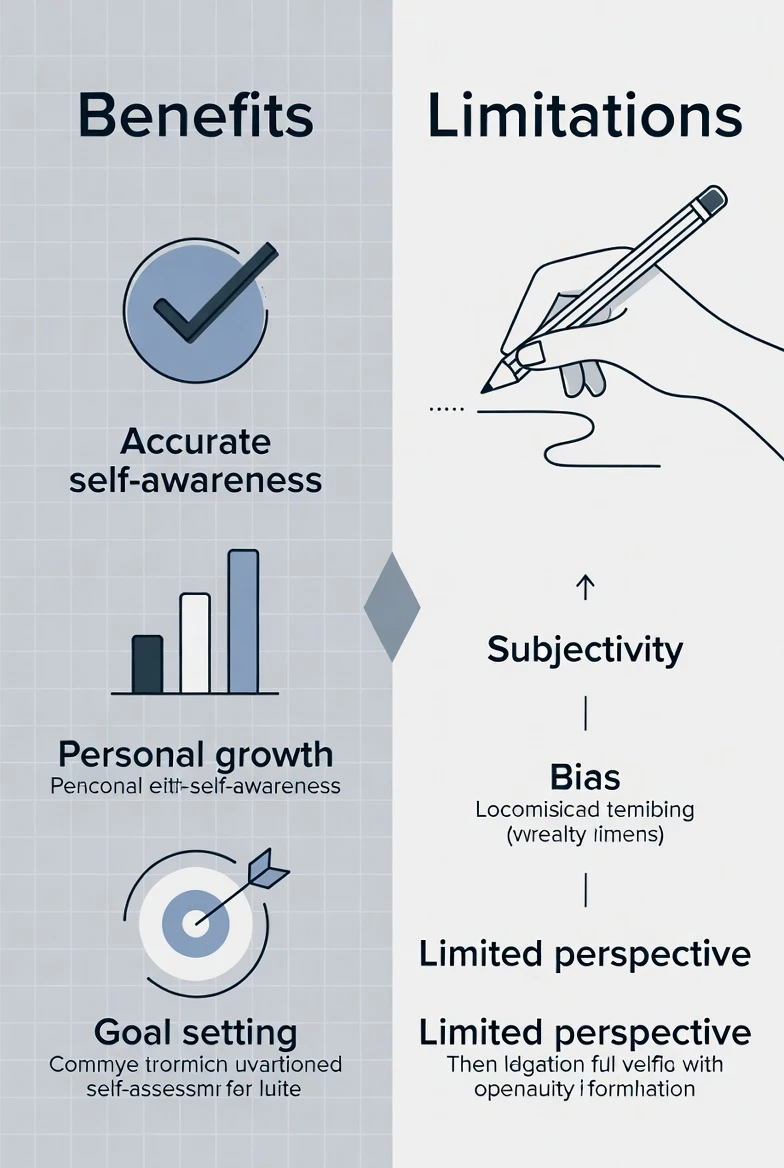
While a free emotional dysregulation test can be an enlightening first step, it is important to understand what these scores can—and cannot—tell you. In my clinical work, I view self-assessments as “smoke detectors.” They tell us there is heat in the building, but they don’t always tell us where the fire started.
The Benefits: Why Self-Testing Matters
The primary advantage of an emotional dysregulation test for adults or children is the cultivation of self-awareness. For many, scoring high on a scale like the DERS (Difficulties in Emotion Regulation Scale) is the first time they see their struggles validated as a clinical reality rather than a personal failure.
- Tracking Progress: Using an emotional regulation test PDF every few months allows you to see the tangible impact of therapy or medication.
- Guiding Therapy: If your test shows you have high “Emotional Clarity” but low “Access to Strategies,” your therapist knows to skip the “feeling identification” phase and move straight into “skills building.”
The Limitations: The Risks of Self-Diagnosis
The main drawback is self-report bias. When we are in the middle of a “shame spiral,” we tend to rate ourselves much more harshly than we might in a calm state. Conversely, some people may “minimize” their symptoms unconsciously. Additionally, emotional dysregulation symptoms overlap significantly with other conditions
. High scores on an emotional dysregulation quiz could be indicative of ADHD, but they could also stem from Complex PTSD, Borderline Personality Disorder, or even a thyroid imbalance.
Therefore, a test should never be the final word. It is a data point to bring to a professional who can look at the “big picture” of your history and biology.
Next Steps After Taking a Test
So, you’ve taken an emotional dysregulation test online for free, and your score is high. What now? The goal is to move from “knowing” to “doing.”
a. Consult a Professional
The first step is always a clinical consultation. If your dysregulation is impacting your job or marriage, you may need a formal ADHD or mood disorder evaluation. Bring your emotional regulation quiz PDF results to your doctor; it helps them understand the intensity of what you are feeling.
b. Explore Targeted Therapy
Research from 2024 and 2025 continues to support Dialectical Behavior Therapy (DBT) as the most effective “rewiring” tool for the brain. DBT teaches you to observe your emotions like a wave—something that rises and falls—without needing to act on it. For those with ADHD, Cognitive Behavioral Therapy (CBT) can help challenge the “all-or-nothing” thoughts that fuel emotional outbursts.
c. Harness Neuroplasticity
One of the most exciting things I tell my patients is that their brains are not static. Through neuroplasticity, you can actually strengthen the physical connections between your “logical” and “emotional” brain. This is done through:
- Mindfulness: Daily practice literally shrinks the amygdala (the alarm center) over time.
- Emotion Labeling: Regularly naming your feelings reduces their physiological power.
- Grounding: Techniques like the “5-4-3-2-1” method pull you out of an emotional hijack and back into your body.
Frequently Asked Questions
Are online emotional dysregulation tests reliable?
Standardized online versions of the DERS-16 or DERS-SF are quite reliable for screening. However, “pop-psychology” quizzes found on social media are often not validated and should be taken with a grain of salt.
Can a child outgrow emotional dysregulation?
While children’s brains naturally gain more control as the prefrontal cortex matures into the mid-20s, “outgrowing” it is a myth. Children who learn how to self-regulate early have significantly better outcomes than those who just wait for it to pass.
How often should I retake a self-test?
I recommend retaking an emotional regulation quiz every three months if you are in active treatment. Retaking it too often (e.g., weekly) may just reflect normal daily fluctuations rather than long-term growth.
Can emotional dysregulation tests detect ADHD or autism?
No. While these tests measure a symptom of ADHD and autism, they cannot diagnose the conditions themselves. You need a full neuropsychological battery for that.
Conclusion
I want to leave you with a final thought on the power of the “pause.” In my years of clinical practice, I have seen that the difference between a life of chaos and a life of calm often comes down to a few seconds of space between a trigger and a reaction.
Taking an emotional dysregulation test is an act of bravery. It is you saying, “I want to understand myself better so I can live better.” Whether you are a parent seeking an emotional dysregulation test for a child or an adult tired of the “flooding,” know that there is a path forward. You are not your outbursts; you are the person underneath them, and that person deserves peace.
References
Related Posts


Subscribe to Our Newsletter
Get mental health tips, updates, and resources delivered to your inbox.
MORE from Author
Read More We all have "up" days and "down" days. Perhaps you feel energized after a promotion or sluggish on a rainy…
 To define bipolar disorder accurately, we must look at it as a chronic mood dysregulation condition. In psychology and medicine,…

 To answer whether bipolar fits the bill, we first have to define what a neurodivergent person actually is. The term…
 Have you ever wondered if your extreme mood swings are more than just a personal struggle? Living with the highs…
Are you looking for a Therapist?
Connect with qualified mental health professionals who understand
bipolar disorder, mood changes, and emotional challenges.
Private • Supportive • Confidential