
Bipolar Test: Free Online Self-Check for Adults & What It Means


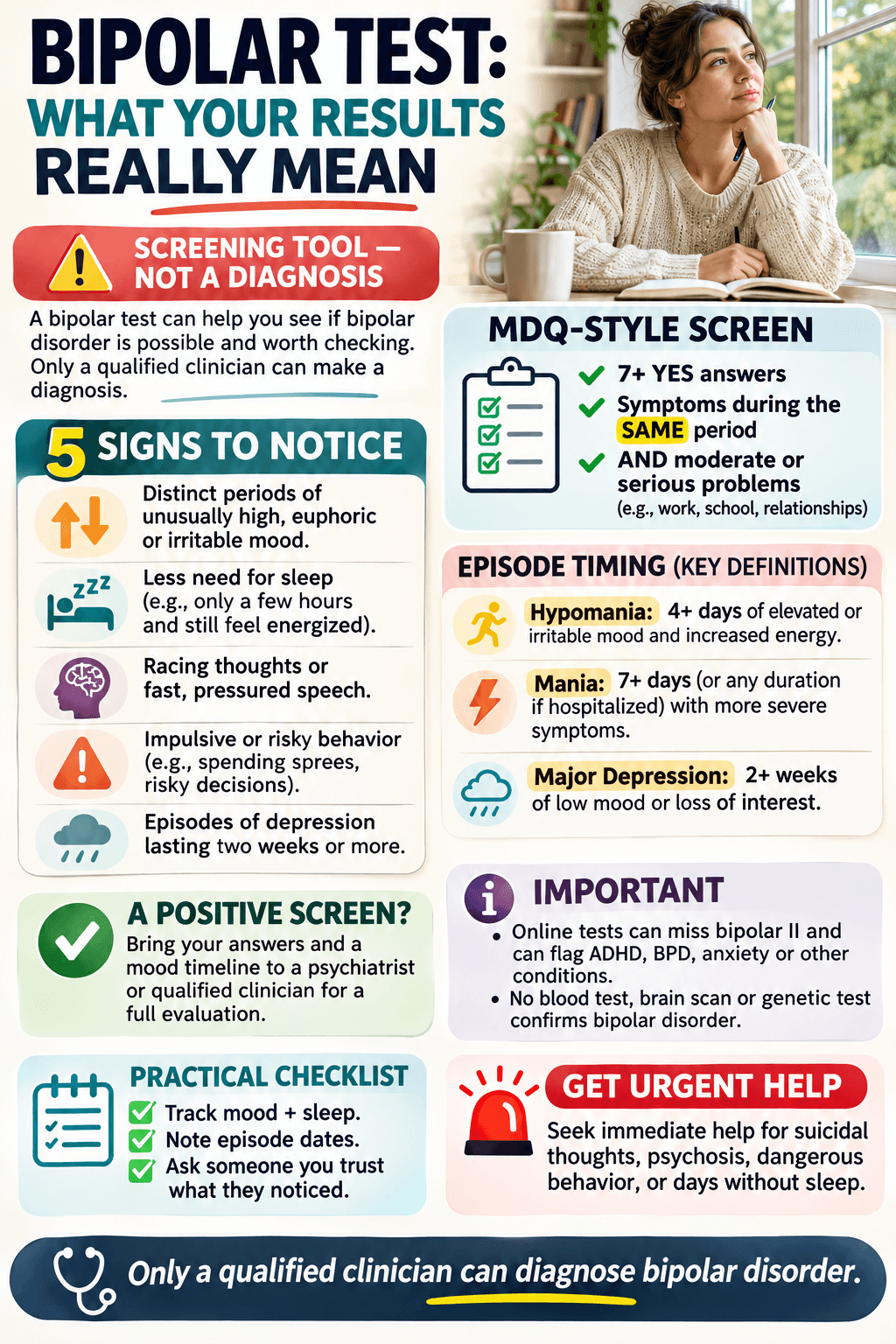
A bipolar test can help you see whether your mood history fits the pattern of bipolar disorder — but it isn’t like a test for diabetes or cholesterol. There is no blood test, brain scan or genetic test that can diagnose bipolar disorder. Online bipolar tests are screening tools: they estimate whether bipolar disorder is possible and worth checking. Only a qualified clinician can make a diagnosis.
That doesn’t make screening useless. A good bipolar test asks structured questions about the symptoms clinicians look for — especially periods of mania or hypomania that people often overlook — and gives you something concrete to take to a doctor. Studies show many people with bipolar disorder are first misdiagnosed, often with depression; in one large survey, 69% of respondents had initially been misdiagnosed, and over a third waited 10 years or more for the right diagnosis.
This page gives you a free bipolar self-test based on the questions used in validated screening tools, explains how to score it and what your results mean, compares popular online bipolar tests, and walks you through how doctors actually diagnose bipolar disorder.
Key takeaways
- A bipolar test is a screen, not a diagnosis. A positive result means “see a professional,” not “you have bipolar disorder.”
- The most widely used screening tools are the Mood Disorder Questionnaire (MDQ) and the Hypomania Checklist (HCL-32).
- Screening tests can miss cases (especially bipolar II) and can flag people who have other conditions, such as ADHD, BPD or anxiety.
- The key question in any bipolar test: have you had distinct periods of unusually high energy and reduced need for sleep that lasted days?
- Diagnosis comes from a clinical interview, your timeline, family history, input from people who know you, and ruling out medical causes.
What Is a Bipolar Test?
There are two very different kinds of “bipolar test”:
| Screening test | Diagnostic evaluation | |
|---|---|---|
| What it is | A short questionnaire you can take yourself, online or on paper | An in-depth assessment by a psychiatrist, psychologist or other qualified clinician |
| What it tells you | Whether bipolar disorder is possible and worth evaluating | Whether you meet criteria for bipolar disorder (and which type), or something else |
| Time | 3–15 minutes | Usually one or more appointments of 45–90 minutes |
| Examples | MDQ, HCL-32, Rapid Mood Screener, Bipolar Spectrum Diagnostic Scale | Clinical interview using DSM-5-TR criteria, often with structured interviews and a life chart |
The bipolar test on this page is a screening tool. Please read the results section before drawing conclusions.
What Is Bipolar Disorder? (Quick Overview)
Bipolar disorder is a mood disorder involving distinct episodes:
- Mania — at least 7 days (or any length if hospitalized) of abnormally elevated, expansive or irritable mood and increased energy, with symptoms like decreased need for sleep, racing thoughts, talkativeness and risky behavior. Can include psychosis.
- Hypomania — at least 4 days of similar but milder symptoms that are a clear change from your usual self, without severe impairment or psychosis. See signs of hypomania vs normal happiness.
- Major depression — at least 2 weeks of low mood or loss of interest plus other symptoms.
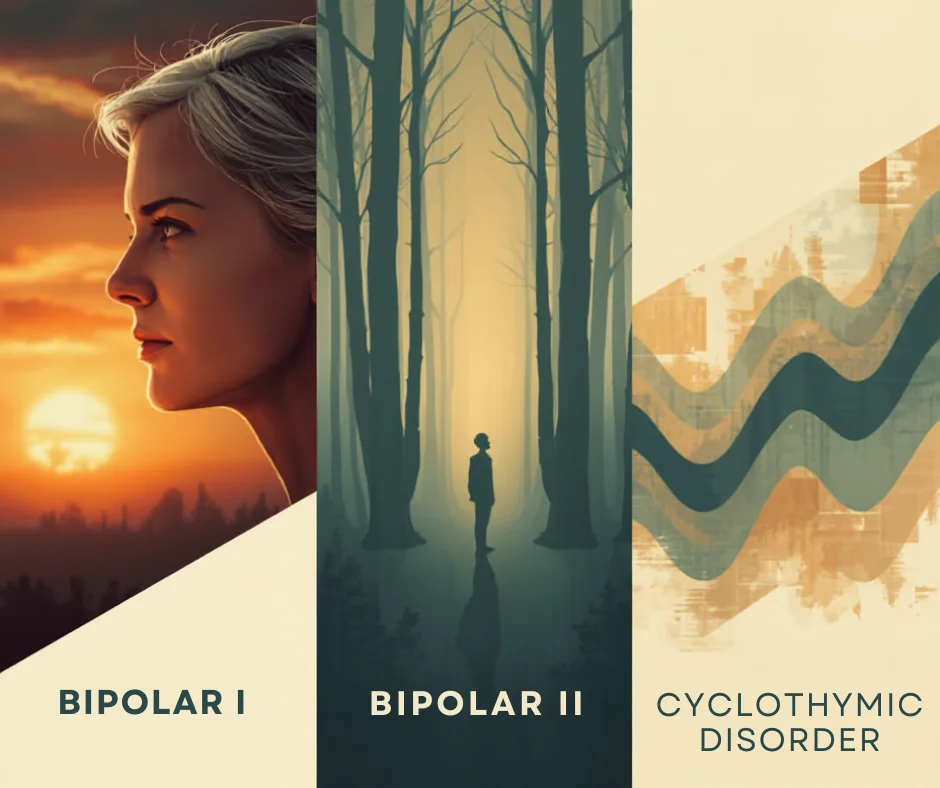
The main types are bipolar I (at least one manic episode), bipolar II (hypomania plus major depression) and cyclothymic disorder (long-term milder ups and downs). See bipolar symptoms, what is bipolar 1?, bipolar type 2 and cyclothymic disorder.
What Are 5 Signs of Bipolar Disorder?
Before taking a bipolar test, it helps to know what it’s looking for:
- Distinct periods of unusually high, euphoric or irritable mood that others notice
- Decreased need for sleep — sleeping only a few hours and still feeling energized
- Racing thoughts and fast, pressured speech
- Impulsive or risky behavior — spending sprees, risky sex, reckless decisions, starting many projects
- Episodes of depression lasting two weeks or more
Free Bipolar Test: 3-Step Self-Check for Adults
This free bipolar test follows the same logic as validated screening tools: first check for mania/hypomania, then depression, then impact on your life. It is not a substitute for a validated questionnaire administered with a clinician, but it will help you organize your experiences.
Take your time, and think about your whole life, not just the last few weeks. If possible, ask someone who knows you well to answer too — people often don’t recognize their own hypomania.
Step 1: Bipolar test for mania and hypomania
Has there ever been a period of time when you were not your usual self and…
- You felt so good or so hyper that other people thought you were not your normal self, or you got into trouble?
- You were so irritable that you shouted at people or started fights or arguments?
- You felt much more self-confident than usual?
- You got much less sleep than usual and found you didn’t really miss it?
- You were much more talkative or spoke much faster than usual?
- Thoughts raced through your head or you couldn’t slow your mind down?
- You were so easily distracted by things around you that you had trouble concentrating or staying on track?
- You had much more energy than usual?
- You were much more active or did many more things than usual?
- You were much more social or outgoing than usual — for example, calling friends in the middle of the night?
- You were much more interested in sex than usual?
- You did things that were unusual for you, or that others might have thought were excessive, foolish or risky?
- Spending money got you or your family into trouble?
Then ask:
- A. If you checked more than one, did several of these happen during the same period of time?
- B. How much of a problem did these cause — such as being unable to work, family, money or legal troubles, or getting into arguments? (No problem / minor / moderate / serious)
How to score Step 1: These questions mirror the Mood Disorder Questionnaire (MDQ). A positive MDQ screen requires all three: 7 or more “yes” answers, several occurring at the same time, and moderate or serious problems as a result.
Also count how long these periods lasted:
- 4–6 days of several symptoms → consistent with hypomania
- 7 days or more, or needing hospital care, or psychotic symptoms → consistent with mania
Step 2: Bipolar test for depression
Have you ever had a period of two weeks or longer when, most of the day, nearly every day, you felt sad, empty or hopeless — or lost interest or pleasure in most things?
If yes, did you also have at least four of these?
- Significant appetite or weight change
- Sleeping too much or too little
- Feeling physically slowed down, or restless and agitated
- Fatigue or loss of energy
- Feeling worthless or excessively guilty
- Poor concentration or indecisiveness
- Thoughts of death or suicide
A “yes” suggests you may have had a major depressive episode. On its own that points to depression; combined with a positive Step 1, it raises the possibility of bipolar disorder. For more, take our bipolar depression test or read do I have bipolar depression?
Step 3: Bipolar test for impact and risk factors
- Did your highs or lows cause problems at work or school, in relationships, with money or the law?
- Have people close to you been worried, annoyed or critical about your behavior during these periods?
- Does a parent, sibling or child have bipolar disorder (or a history of severe mood swings, hospitalization or suicide)?
- Did your first depression start in your teens or early 20s?
- Have you felt “wired,” agitated or unusually energized on an antidepressant? See manic switch.
- Do your moods follow a seasonal pattern?
What your bipolar test results mean
| Your results | What it may mean | Next step |
|---|---|---|
| Positive Step 1 (7+ yes, same time, moderate/serious problems) | Possible bipolar disorder | Book an evaluation with a psychiatrist or psychologist. Bring your answers. |
| Positive Step 1 + depression in Step 2 | Pattern consistent with bipolar I or II | Seek evaluation; mention any antidepressant reactions |
| Fewer than 7 “yes” but clear 4+ day highs | Possible bipolar II or cyclothymia — the MDQ can miss these | Still worth discussing with a professional |
| Depression only, no highs | More consistent with unipolar depression | See a professional for depression; mention any family history of bipolar disorder |
| Mood shifts within hours, often triggered by relationships or stress | May point to emotional dysregulation, BPD, ADHD or anxiety | Get an assessment for these — see sudden mood swings in adults |
If you have thoughts of suicide or self-harm, don’t wait for an appointment — see the crisis information below.
How Accurate Are Bipolar Tests?
No screening test is perfect. Here’s what research shows for the most-used tools:
| Bipolar test | Questions | What it’s best for | Accuracy notes |
|---|---|---|---|
| Mood Disorder Questionnaire (MDQ) | 13 yes/no + 2 follow-ups | Screening for bipolar I in clinical settings | In the original psychiatric outpatient study, it identified about 73% of people with bipolar disorder and correctly ruled out about 90% of those without it. Performs less well for bipolar II and in the general population. |
| Hypomania Checklist (HCL-32) | 32 items | Picking up milder hypomania, separating bipolar from unipolar depression | With the usual cutoff of 14, studies report roughly 78% sensitivity but lower specificity (about 60%), meaning more false positives. |
| Rapid Mood Screener (RMS) | 6 items | Quick screening for bipolar I in people with depressive symptoms | In its development study, endorsing 4+ items gave 88% sensitivity and 80% specificity for bipolar I. Designed for primary care; less studied for bipolar II. |
| Bipolar Spectrum Diagnostic Scale (BSDS) | Story-style description + checklist | Softer, “spectrum” presentations | Useful for bipolar II/spectrum; less widely used. |
False positives are common in people with ADHD, borderline personality disorder, substance use, anxiety or trauma, because these share symptoms like impulsivity, irritability and racing thoughts. False negatives are common when people don’t remember or recognize hypomania — which is why input from a partner or family member helps so much.
Free Online Bipolar Tests: Popular Platforms Explained
People searching for a “bipolar test free online” or “bipolar test idrlabs” will find many options. A few tips for using them wisely:
- Look for tests based on validated tools — such as the MDQ or HCL-32 — and that say which tool they use.
- Free, no sign-up tests are fine for a first look. Be cautious about sites that ask for unnecessary personal details or charge for “full results.”
- Personality-style quiz sites (such as IDRlabs) and general psychology sites (such as Psychology Today’s test center) can be interesting starting points, but they are not clinical tools.
- Pharmaceutical company quizzes (for example, mood questionnaires on medication brand websites) are often based on validated tools, but are designed to encourage a conversation about specific treatments. Take results to an independent clinician.
- Pop-culture quizzes are entertainment, not screening.
Printable bipolar test (PDF)
A printable bipolar test is useful: fill it out at home, ask a family member to complete one about you, and bring both to your appointment. You can print this page, or ask your doctor for a printed MDQ.
Is a 3-minute bipolar test accurate?
Very short tests (such as the 6-item Rapid Mood Screener) can be surprisingly good at flagging possible bipolar I, but they can’t capture the full picture — especially bipolar II, mixed features, or other conditions that mimic bipolar disorder. Treat any quick test as an early warning, not an answer.
Bipolar Test vs BPD, Depression and ADHD
Bipolar vs depression test
Most depression questionnaires don’t ask about highs. That’s why many people with bipolar disorder are first diagnosed with unipolar depression. If you’ve had depression, always ask yourself — and your doctor — whether you’ve ever had periods of unusually high energy and little need for sleep.
BPD vs bipolar test
| Feature | Bipolar disorder | Borderline personality disorder (BPD) |
|---|---|---|
| Mood duration | Episodes lasting days to weeks | Shifts lasting minutes to hours |
| Typical triggers | Can occur without a clear trigger; often linked to sleep loss or season | Usually interpersonal — rejection, conflict, fear of abandonment |
| Core feature | Change in energy, activity and sleep | Unstable relationships, self-image and emotions |
| Main treatment | Mood stabilizers, some antipsychotics, psychotherapy | Psychotherapy, especially DBT |
See is borderline personality disorder the same as bipolar? and our BPD test.
Bipolar vs ADHD
ADHD symptoms are lifelong and constant; bipolar symptoms come in episodes with changes in sleep need and energy. They can also occur together. See ADHD and depression and bipolar vs emotional dysregulation.
Bipolar Test for Teens and Parents
Diagnosing bipolar disorder in children and teens is challenging because moodiness, irritability and sleep changes can be normal parts of adolescence — or signs of other conditions such as ADHD, anxiety, depression or trauma.
Warning signs that go beyond typical teen moodiness include:
- Distinct periods of unusually elevated, giddy or grandiose mood that are out of character
- Sleeping very little without being tired — for example, staying up until 4 a.m. on projects and still feeling energized
- Racing speech, jumping between ideas, and unusual risk-taking
- Severe depressive episodes, especially with a family history of bipolar disorder
Bipolar test for someone else: Parents can use tools such as the Parent General Behavior Inventory (PGBI), a research-validated questionnaire in which parents rate a child’s mood symptoms, and symptom checkers from organizations such as the Child Mind Institute. Results should be discussed with a pediatrician or child and adolescent psychiatrist. Chronic, severe irritability without distinct episodes may fit other diagnoses, such as disruptive mood dysregulation disorder (DMDD).
Bipolar Symptoms in Women
Bipolar disorder affects men and women at similar rates, but women more often experience:
- More depressive episodes and bipolar II presentations
- Rapid cycling (four or more episodes a year)
- Mixed features — depression with agitation and racing thoughts, a high-risk state
- Mood changes linked to the menstrual cycle, pregnancy, the postpartum period and perimenopause
Women are often misdiagnosed with depression or anxiety first. See bipolar disorder symptoms in females.
Is There a Test to Confirm Bipolar Disorder?
Is there a blood test for bipolar disorder?
No. But your doctor will likely order blood tests to rule out conditions that can mimic or worsen mood symptoms, such as:
- Thyroid disease — an overactive thyroid can look like mania; an underactive thyroid can look like depression. See thyroid and bipolar.
- Vitamin B12 deficiency and anemia
- Substance use
- Other medical problems, depending on your symptoms
Can a brain scan diagnose bipolar disorder?
Not for an individual person. Research has found average differences in brain structure and activity in groups of people with bipolar disorder, but brain scans aren’t accurate enough to diagnose one person. Doctors may order a scan only to rule out other causes (for example, when symptoms start suddenly later in life).
Is there a genetic test for bipolar disorder?
No. Bipolar disorder is strongly heritable — twin studies estimate heritability at roughly 60–85% — but it involves many genes, each with a small effect, plus environmental factors. No genetic test can diagnose it. Pharmacogenetic tests may give information about how you metabolize certain medications, but they can’t tell you whether you have bipolar disorder, and their usefulness in choosing psychiatric medications is still debated.
How Do Doctors Diagnose Bipolar Disorder? (The “Gold Standard”)
A thorough evaluation usually includes:
- A clinical interview — your mood history from childhood to now, focusing on the timing, length and severity of highs and lows, using DSM-5-TR criteria.
- Collateral information — a partner, parent or close friend can describe behavior you may not have noticed, such as not sleeping for days or unusual spending.
- A life chart — a timeline of mood episodes alongside life events, treatments, seasons and triggers. See our bipolar mood chart and mood tracking apps.
- Family history — including relatives who were never formally diagnosed but had severe mood swings, hospitalizations, substance problems or suicide.
- Screening questionnaires such as the MDQ or HCL-32.
- Physical examination and lab tests to rule out medical causes.
- Assessment for other conditions — ADHD, BPD, anxiety, substance use, PTSD — which can co-occur or mimic bipolar disorder.
Bipolar testing for adults: where to get assessed (“bipolar test near me”)
- Your primary care doctor — can screen, order lab tests, and refer you
- A psychiatrist — can diagnose and prescribe treatment
- A psychologist — can perform detailed assessments and therapy
- Community mental health centers — often offer lower-cost evaluations
- Telehealth services — many offer psychiatric evaluations online
- In the UK, you can start with your NHS GP, who can refer you to a community mental health team; private psychiatric assessment services are also available
What to bring: your bipolar test results, a list of mood episodes (approximate dates and lengths), sleep patterns during those times, medications you’ve tried and how you reacted, family history, and — if possible — a trusted person who knows you well.
What Is the “48-Hour Rule” for Bipolar Disorder?
You may see the “48-hour rule” in online forums. It is not an official diagnostic rule. It’s an informal early-warning idea: if a significant change in mood, energy or sleep — especially two nights of reduced sleep — lasts more than a day or two, take it seriously and contact your care team.
It can help people already diagnosed catch a manic or depressive episode early. But remember that diagnosis uses longer timeframes: 4 days for hypomania, 7 days for mania and 2 weeks for major depression.
Axis I Disorders and Bipolar Disorder (Historical Note)
Older articles describe bipolar disorder as an “Axis I” disorder. That comes from the DSM-IV’s multi-axial system, where Axis I covered clinical disorders such as bipolar disorder, depression and schizophrenia, and Axis II covered personality disorders. The DSM-5 (2013) removed the axis system. Bipolar disorder now has its own chapter, “Bipolar and Related Disorders.”
What’s It Like Having Bipolar Disorder? Everyday Struggles
People living with bipolar disorder often describe:
- Unpredictability — not knowing when the next episode will come
- Depression that makes daily tasks, work and relationships hard
- Consequences of mania or hypomania — debt, damaged relationships, regret
- Medication side effects and the effort of finding the right treatment
- Sleep and routine needing constant protection
- Stigma, and the challenge of explaining the illness to others
- Cognitive effects such as concentration and memory difficulties
But many people with bipolar disorder live full, stable lives with treatment — medication such as lithium and other bipolar disorder medications, psychotherapy (see the best therapy for bipolar disorder), and lifestyle strategies.
Bipolar Test Reddit: What People Say
On Reddit and other forums, people often share their bipolar test results and ask whether they “really” have bipolar disorder. Common themes include scoring high on online tests but being diagnosed with something else, or scoring low and later being diagnosed with bipolar II. These discussions show why online tests are only a starting point. Use communities for support, and a professional for answers.
When to Get Help Urgently
Seek immediate help if you or someone you know:
- Has thoughts of suicide or self-harm
- Is experiencing psychotic symptoms (hallucinations, beliefs others say aren’t real)
- Is behaving in dangerous or out-of-control ways, or hasn’t slept for days
If you are in crisis: call or text 988 (Suicide & Crisis Lifeline, US) or go to the nearest emergency department. Outside the US, contact your local emergency number.
Frequently Asked Questions About Bipolar Tests
How do I check if I have bipolar?
Take a validated screening test, track your moods and sleep, ask people close to you what they’ve noticed, and see a professional for an evaluation. Only a clinician can diagnose bipolar disorder.
Is there a free bipolar test online?
Yes. Free screening tests based on validated tools such as the MDQ are widely available, including the self-check on this page. They screen for possible bipolar disorder but can’t diagnose it.
How accurate are online bipolar tests?
Validated tools like the MDQ and HCL-32 identify many people with bipolar disorder, but they miss some cases (especially bipolar II) and give false positives in people with other conditions.
What questions are on a bipolar test?
Most ask about periods of elevated or irritable mood, increased energy, decreased need for sleep, racing thoughts, talkativeness, distractibility, risky behavior, and whether these caused problems — plus episodes of depression.
Is there a blood test for bipolar?
No. Blood tests are used only to rule out other causes, such as thyroid problems, and to monitor some medications.
Can I take a bipolar test for someone else?
You can complete observer-based questionnaires (such as the PGBI for parents of children and teens), but only a clinician can diagnose another person.
What is the difference between bipolar 1 and 2?
Bipolar I involves at least one full manic episode. Bipolar II involves hypomania (milder, at least four days) and at least one major depressive episode. Psychosis can occur in mania and in severe depression, but not during hypomania.
Is a 3-minute bipolar test accurate?
It can be a useful early warning — some short tests perform well for bipolar I — but it can’t replace a full clinical evaluation.
What should I do if my bipolar test is positive?
Book an appointment with a doctor, psychiatrist or psychologist, and bring your results. See also am I bipolar?
The Bottom Line on Bipolar Tests
A bipolar test is a valuable first step — it puts words to your experiences and helps you decide whether to seek an evaluation. But no online quiz, blood test or brain scan can diagnose bipolar disorder. If your bipolar test is positive, or if you’ve had periods of unusually high energy and little need for sleep, see a professional. Bring your results, your mood history and, ideally, someone who knows you well. An accurate diagnosis is the foundation of treatment that works.
References
- Hirschfeld RMA, et al. Development and validation of a screening instrument for bipolar spectrum disorder: the Mood Disorder Questionnaire. American Journal of Psychiatry. 2000;157(11):1873–1875.
- Hirschfeld RMA, Lewis L, Vornik LA. Perceptions and impact of bipolar disorder: how far have we really come? Results of the National Depressive and Manic-Depressive Association 2000 survey. Journal of Clinical Psychiatry. 2003;64(2):161–174.
- Meyer TD, Castelao E, Gholamrezaee M, Angst J, Preisig M. Hypomania Checklist-32: cross-validation of shorter versions screening for bipolar disorders in an epidemiological study. Acta Psychiatrica Scandinavica. 2017;135(6).
- McIntyre RS, et al. The Rapid Mood Screener (RMS): a novel and pragmatic screener for bipolar I disorder. Current Medical Research and Opinion. 2021.
- National Institute of Mental Health. Bipolar Disorder.
- Child Mind Institute. Bipolar Test for Kids and Teens.
- American Psychiatric Association. Diagnostic and Statistical Manual of Mental Disorders, 5th ed., Text Revision (DSM-5-TR). 2022.
Related Posts


Subscribe to Our Newsletter
Get mental health tips, updates, and resources delivered to your inbox.
MORE from Author
Read More ADHD and depression often occur together, and each makes the other harder to live with. Adults with ADHD are almost…
 We all have "up" days and "down" days. Perhaps you feel energized after a promotion or sluggish on a rainy…
 To define bipolar disorder accurately, we must look at it as a chronic mood dysregulation condition. In psychology and medicine,…
Are you looking for a Therapist?
Connect with qualified mental health professionals who understand
bipolar disorder, mood changes, and emotional challenges.
Private • Supportive • Confidential