
Borderline Personality Disorder ICD-10 (BPD): ICD-10, ICD-11, Diagnosis, and Coding

Medically reviewed by Laura Athey Updated Date: February 22, 2026
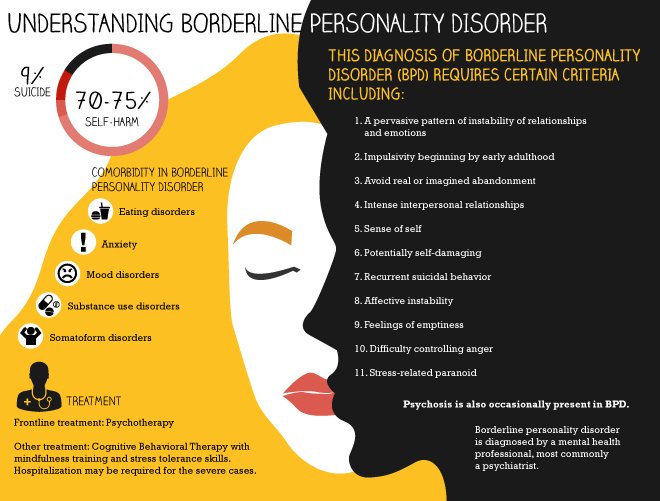
Navigating the landscape of mental health diagnoses requires an understanding of the systems used to categorize and code these conditions. For clinicians, researchers, and patients alike, the classification of borderline personality disorder (BPD) is central to ensuring proper treatment, insurance reimbursement, and global medical consistency. In the world of healthcare, the primary framework for this is the International Classification of Diseases (ICD).
The borderline personality disorder ICD 10 system is the standard used globally for clinical purposes. Whether you are a provider looking for a specific billing code or a patient trying to understand your medical records, knowing how BPD is defined within these diagnostic manuals is essential. This guide provides an exhaustive look at the ICD-10 and ICD-11 frameworks, clinical symptoms, and the critical differences between BPD and other psychiatric conditions.
What Is Borderline Personality Disorder?
To truly understand what borderline personality disorder (BPD) is, one must look beyond the colloquial descriptions of “moodiness” or “drama.” Clinically, BPD is a pervasive and enduring pattern of instability in interpersonal relationships, self-image, and affect, coupled with marked impulsivity. It is characterized by an agonizing sensitivity to rejection and a chronic struggle to regulate internal emotional states.
Alternate Terminology: Emotionally Unstable Personality Disorder (EUPD)
Depending on where you are in the world, you may hear another term for this condition. What is another name for borderline personality disorder? Under the ICD-10, the official term used in many healthcare systems is emotionally unstable personality disorder (EUPD).
The ICD-10 divides EUPD into two subtypes:
- Impulsive Type 2. Borderline Type
This naming convention highlights the core of the disorder—emotional volatility—rather than the “borderline” moniker, which originated from older psychoanalytic theories suggesting the condition was on the “border” between neurosis and psychosis.
While “BPD” is the dominant term in the United States (due to the DSM-5), “EUPD” remains the standard clinical term across much of Europe and other regions following the emotionally unstable personality disorder ICD-10 guidelines.
History of Borderline Personality Disorder in ICD-10
The history of borderline personality disorder ICD 10 reflects a massive shift in how psychiatry views personality. Historically, personality disorders were seen as moral failings or untreatable character flaws. As the ICD evolved, the classification moved toward a more diagnostic and empirical framework.
In earlier versions of the ICD, personality disorders were often vaguely defined. By the time the tenth revision was finalized, BPD was firmly placed under the F60 category (Disorders of adult personality and behavior).
The shift in the ICD-10 was significant because it provided specific behavioral markers, allowing for standardized research and better communication between international health organizations. It transitioned BPD from a purely psychoanalytic concept into a validated medical diagnosis with specific coding requirements.
Borderline Personality Disorder ICD-10 Code Explained
For billing and medical records, the borderline personality disorder ICD 10 code is the most vital piece of information. The ICD system uses alphanumeric codes to categorize every known medical and psychiatric condition.
Official Code: F60.3
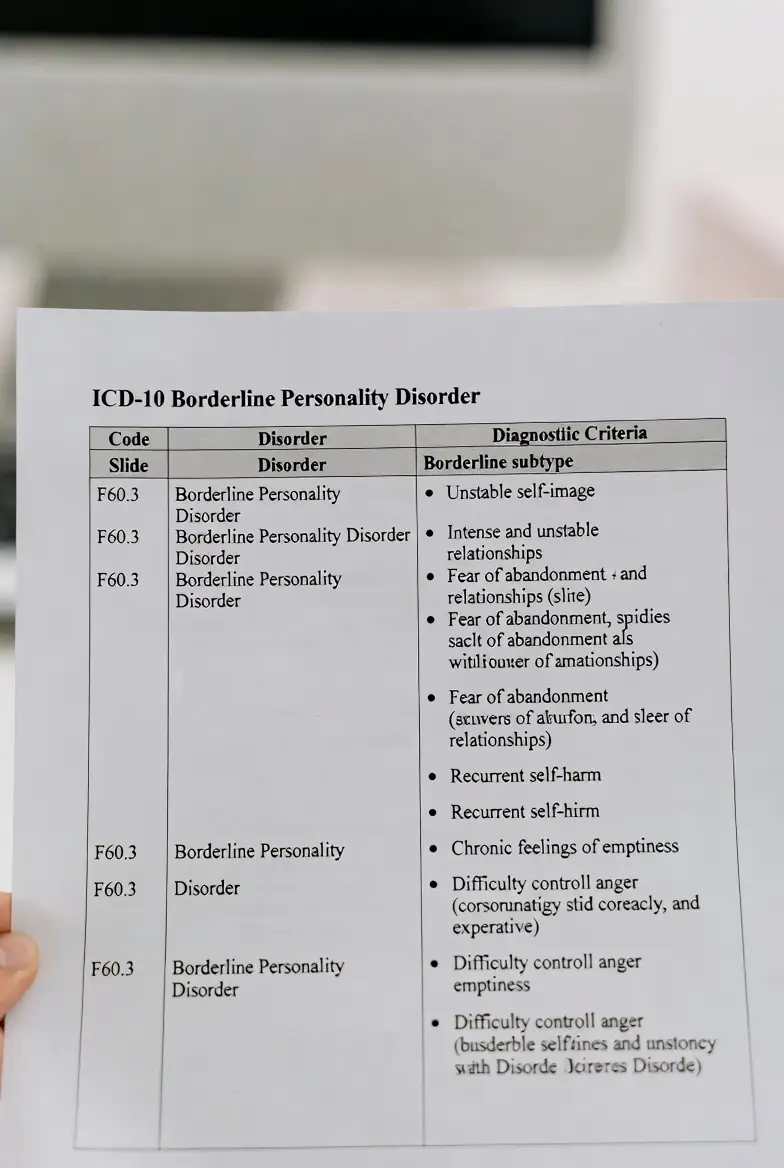
In the ICD-10, the primary code for this condition is F60.3. However, because the ICD-10 uses the EUPD classification, it is broken down further to specify the “Borderline Type.”
- F60.30 (Impulsive Type): Characterized by emotional instability and lack of impulse control.
- F60.31 (Borderline Type): Specifically includes the features most associated with BPD, such as disturbances in self-image, chronic emptiness, and intense, unstable relationships.
When a clinician enters the ICD-10 code for borderline personality disorder, unspecified, they are often referring to F60.3, signaling that the patient meets the general criteria for emotional instability without further subtyping. Understanding the F60 3 ICD-10 designation is crucial for ensuring that patients are directed toward evidence-based treatments like Dialectical Behavior Therapy (DBT).
Borderline Personality Disorder ICD-10-CM Coding
In the United States, a modified version of the ICD-10 is used, known as the borderline personality disorder ICD-10-CM (Clinical Modification). While the global ICD-10 provides a general framework, the “CM” version is maintained by the CDC and CMS to provide greater detail for clinical use and insurance reimbursement within the American healthcare system.
The borderline personality disorder ICD-10-CM code is still F60.3. While the name remains “Borderline Personality Disorder,” the coding logic ensures that it aligns with the billing requirements of U.S. hospitals. Proper documentation of this code is essential because it justifies the necessity of specialized psychiatric care and allows for the tracking of the disorder’s prevalence across the country.
ICD-10 Diagnostic Criteria for Borderline Personality Disorder
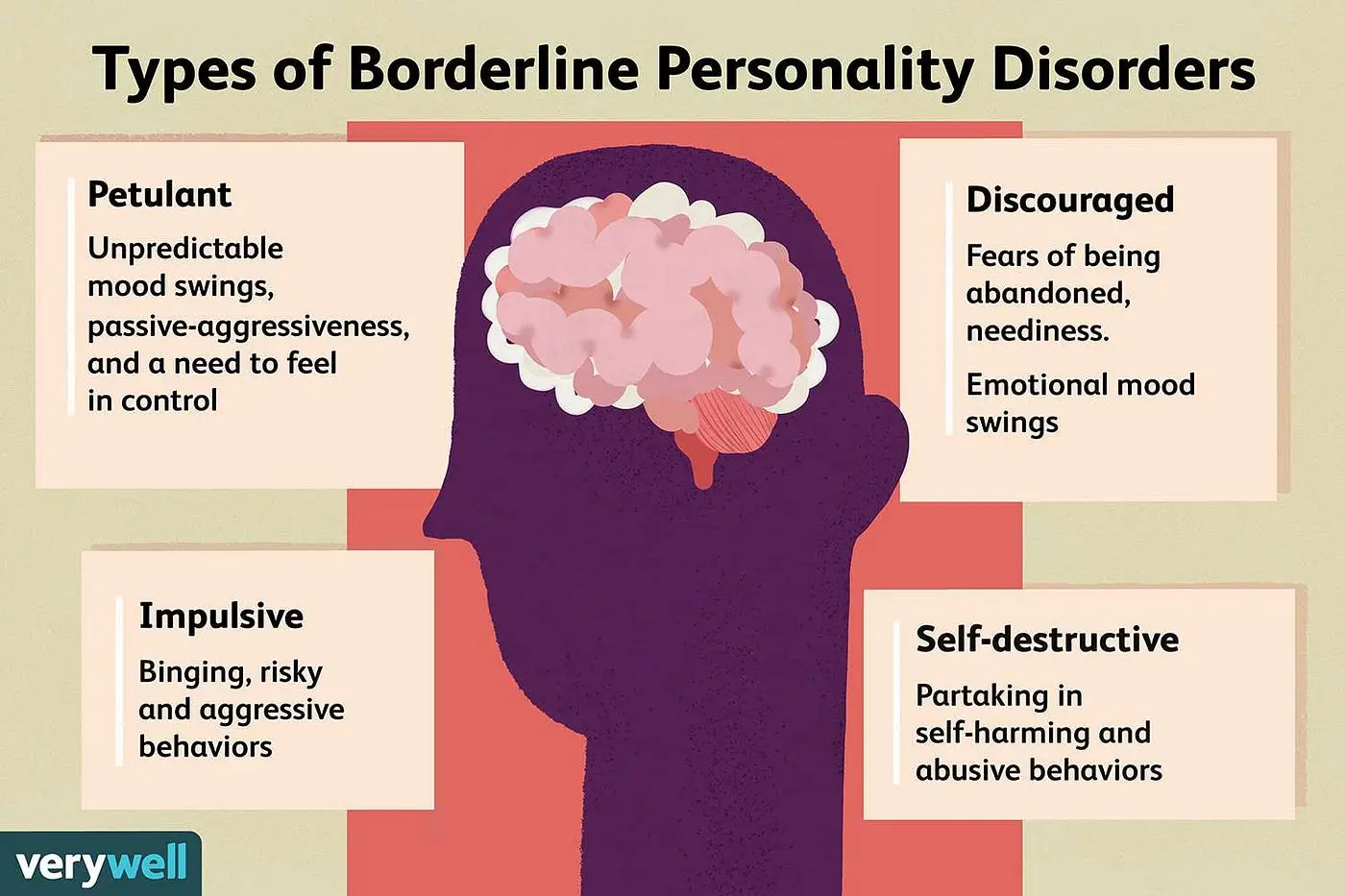
What are the diagnostic criteria for borderline personality disorder? While the ICD-10 and the DSM-5 are very similar, the ICD-10 focuses heavily on the “Emotionally Unstable” aspect of the condition.
Core ICD-10 Criteria
For a diagnosis under the borderline personality disorder ICD 10 criteria, the patient must first meet the general criteria for a personality disorder (pervasive, long-standing, and causing distress) and then show several specific traits of the “Borderline Type,” including:
- Disturbances in Self-Image: Significant uncertainty about identity, goals, and internal preferences.
- Intense and Unstable Relationships: A pattern of being in high-conflict relationships that often end in emotional crisis.
- Frantic Efforts to Avoid Abandonment: Real or imagined fears of being left alone.
- Self-Harm or Suicidal Threats: Recurrent acts of self-damage as a means of emotional regulation.
- Chronic Feelings of Emptiness: A persistent sense of lack or “nothingness” inside.
Unlike the DSM-5, which requires meeting 5 out of 9 symptoms, the ICD-10 provides a descriptive clinical profile that emphasizes the “unstable” nature of the patient’s affects and self-concept.
Borderline Personality Disorder Symptoms According to ICD-10
The borderline personality disorder symptoms described in the ICD manual are more than just behaviors; they are a window into the patient’s internal experience.
Emotional Instability
This is the hallmark symptom. Borderline personality disorder ICD 10 symptoms include “marked mood reactivity.” This means that an individual’s mood can shift from intense euphoria to crushing despair in a matter of minutes, usually triggered by an external event that others might perceive as minor.
Impulsivity and Behavior
The ICD-10 highlights a tendency to act without considering consequences. This manifests as:
- Sudden outbursts of anger.
- Impulsive spending or substance use.
- Self-destructive behaviors are used to “feel something” or to stop emotional pain.
Identity and Connection
The symptoms of borderline personality disorder also involve a “shifting sense of self.” A person may radically change their career path, religious beliefs, or even their sexual orientation in an attempt to find a stable identity. This internal instability makes maintaining long-term, peaceful relationships nearly impossible without professional intervention.
What Is a BPD Episode Called?
In the clinical community, there is often discussion about “episodes” of BPD. What is a BPD episode called? Most clinicians refer to these periods as emotional dysregulation episodes or “BPD flares.”
Unlike a “manic episode” in bipolar disorder, which can last for weeks, a BPD episode is typically short-lived but incredibly intense. These are often triggered by a specific interpersonal stressor, such as a perceived snub from a friend. During an episode, the individual may experience “splitting” (seeing someone as all good or all bad), intense rage, or a total emotional shutdown. Understanding that these are dysregulation episodes rather than permanent state changes is a key part of the therapeutic process.
How Borderline Personality Disorder Is Diagnosed
Determining a clinical diagnosis involves more than just checking boxes on a list. How is borderline personality disorder (BPD) diagnosed? It requires a longitudinal assessment of a person’s life patterns, typically conducted by a psychiatrist or a clinical psychologist.
The Diagnostic Process
Clinicians utilizing the borderline personality disorder ICD 10 framework focus on three specific areas during the assessment:
- The Clinical Interview: A deep dive into the patient’s history of relationships, self-harm, and emotional triggers.
- Duration of Symptoms: Because BPD is a personality disorder, the symptoms must be persistent (usually since adolescence) rather than a temporary reaction to a specific life event.
- Differential Diagnosis: The clinician must rule out other conditions that look like BPD, such as PTSD, ADHD, or Bipolar Disorder.
Using the ICD-10 vs DSM-5 comparison, we see that while the language differs slightly, the goal is the same: to identify a pervasive pattern of instability that interferes with the patient’s ability to function.
ICD-10 vs DSM-5 Code for Borderline Personality Disorder
There is often confusion between the codes used in the two primary diagnostic manuals. While both are used by clinicians, they serve slightly different purposes in the medical ecosystem.
Coding Distinctions
The DSM-5 code for borderline personality disorder is technically the same as the ICD code (301.83), as the DSM-5 was designed to map directly to the ICD-10 for insurance and billing purposes.
| Feature | ICD-10 (Global) | DSM-5 (U.S. Standard) |
| Primary Name | Emotionally Unstable Personality Disorder | Borderline Personality Disorder |
| Code | F60.3 | 301.83 (maps to F60.3) |
| Focus | Affective (Emotional) Instability | Behavioral & Interpersonal Patterns |
Clinicians often use the DSM-5 for the “clinical description” (the nuances of the symptoms) while using the borderline personality disorder ICD 10 code for the “documentation” (billing the insurance company).
Borderline Personality Disorder ICD-11: What Changed?
The world of diagnostics moved into a new era with the release of the borderline personality disorder ICD-11. This updated version represents a radical departure from the “categorical” approach of the ICD-10.
The Dimensional Model
In the ICD-11, the old categories (like F60.3) have been largely replaced. Instead of having distinct “boxes” for different personality disorders, the ICD-11 uses a dimensional model.
- General Personality Disorder: First, the clinician determines the severity (Mild, Moderate, or Severe).
- Trait Domains: Then, they assess the person across five trait domains: Negative Affectivity, Detachment, Dissociality, Disinhibition, and Anankastia.
- The Borderline Pattern: The ICD-11 kept “Borderline” as a specific qualifier because of its clinical importance.
This change reduces stigma and acknowledges that personality exists on a spectrum rather than as a “yes/no” diagnosis.
Borderline Personality Disorder Medication Options
A common question for those diagnosed is: “What is the borderline personality disorder medication?” It is important to clarify that there is no FDA-approved medication specifically for BPD itself.
Symptom-Targeted Pharmacology
Because BPD is a disorder of personality and behavioral patterns, the “cure” is therapy (specifically DBT). However, doctors often use medications to manage specific symptoms:
- Antipsychotics: In low doses, these can help with intense anger or paranoid thoughts.
- Mood Stabilizers: These may help reduce the “peaks and valleys” of emotional reactivity.
- Antidepressants: Often prescribed if the patient also suffers from Major Depressive Disorder, though they are often less effective for BPD-related “emptiness.”
The gold standard remains a combination of specialized therapy with medication used as a secondary support system.
Difference Between Borderline Personality Disorder and Bipolar Disorder
Perhaps the most common misdiagnosis in psychiatry is confusing BPD with Bipolar Disorder. What is the difference between bipolar and BPD? While they both involve “mood swings,” the mechanisms are entirely different.
Bipolar vs. BPD Comparison
- Triggers: BPD shifts are almost always “reactive” to an interpersonal event (like a text not being returned). Bipolar shifts (mania or depression) are often “autonomous,” occurring without a specific external trigger.
- Duration: A BPD “episode” of rage or sadness may last two hours. A Bipolar manic or depressive episode under bipolar disorder ICD 10 or bipolar affective disorder ICD 10 lasts for days or weeks.
- Identity: People with BPD struggle with a chronic lack of a sense of self. People with bipolar disorder usually have a stable identity between episodes.
[Image comparing the mood cycles of Borderline Personality Disorder and Bipolar Disorder]
Differential Diagnoses and Related ICD-10 Codes
Because BPD is so complex, clinicians must look at a variety of “look-alike” conditions. Accuracy in the borderline personality disorder ICD-10-CM coding depends on ruling these out:
- ADHD (ICD-10 F90.x): Shared impulsivity, but BPD includes the fear of abandonment.
- Major Depressive Disorder (ICD-10 F32.x): Shared sadness, but BPD includes the “splitting” of relationships.
- Schizoaffective Disorder (ICD-10 F25.x): Shared paranoia, but BPD paranoia is usually brief and stress-related.
- Adjustment Disorder (ICD-10 F43.2): Shared emotional reaction to stress, but BPD is a lifelong pattern, not a reaction to a single event.
Bronchopulmonary Dysplasia ICD-10 vs. Borderline Personality Disorder
It is worth noting a frequent point of confusion in medical coding searches. The acronym “BPD” is also used for Bronchopulmonary Dysplasia, a chronic lung disease found in infants.
When searching for the bronchopulmonary dysplasia ICD-10 code (which is P27.1), users often land on psychiatric pages. If you are looking for mental health information, ensure you are using the F60.3 code. If you are looking for neonatal lung health, you are in the “P” section of the ICD-10. This is a classic example of why full clinical names are preferred over acronyms in medical documentation.
The Strategic Importance of Accurate BPD Diagnosis
For the patient, receiving a diagnosis under the borderline personality disorder ICD 10 criteria is often a double-edged sword. On one hand, it can feel like a label that carries social stigma; on the other, it provides a “name for the monster.” Without a specific clinical label like F60.3, patients are often left drifting through the medical system, receiving treatments for depression or anxiety that fail to touch the core of their interpersonal and identity-based struggles.
The Role of Longitudinal Observation
One of the most significant aspects of the borderline personality disorder ICD 10 CM guidelines is the requirement for a “pervasive pattern.” This means that a diagnosis should rarely be made during a single crisis or hospital visit. Clinicians are encouraged to look at the patient’s history over at least one year.
- Is the behavior consistent? Does the patient struggle with relationships only when using substances, or is it a baseline trait?
- Is it cross-contextual? Does the instability happen at work, at school, and at home?
By adhering to these rigorous standards, the ICD system ensures that the diagnosis is stable and that the subsequent treatment plan—whether it involves borderline personality disorder medication for symptom management or intensive psychotherapy—is built on a solid foundation.
Frequently Asked Questions
What is the ICD 10 code for borderline personality disorder?
The official global code is F60.3. In the United States, under the ICD-10-CM system, it is also documented as F60.3.
What are the diagnostic criteria for borderline personality disorder?
According to the ICD-10, it involves a pervasive pattern of emotional instability, disturbances in self-image, intense and unstable relationships, and a tendency toward self-harm or impulsive behavior.
What is another name for borderline personality disorder?
In many international clinical settings, it is referred to as Emotionally Unstable Personality Disorder (EUPD).
Is BPD in ICD-11?
Yes, but the classification has changed. The ICD-11 uses a dimensional model where BPD is categorized as a “Personality Disorder” with a “Borderline Pattern” qualifier.
How is BPD different from bipolar disorder?
The primary difference is the duration and triggers of mood shifts. BPD shifts are usually triggered by interpersonal events and last hours, while Bipolar shifts are often internal/biological and last days or weeks.
Conclusion
Understanding the nuances of the borderline personality disorder ICD 10 and the borderline personality disorder ICD-10-CM is more than just an academic exercise. For the clinician, these codes represent the gateway to evidence-based care and proper healthcare resource allocation. For the patient, they represent the first step in a journey toward self-awareness and recovery.
As we move further into the era of the borderline personality disorder ICD-11, the focus is shifting away from rigid “boxes” and toward a more compassionate, dimensional understanding of human personality. However, the core goal remains the same: identifying those who struggle with profound emotional instability and providing them with the tools—be it through borderline personality disorder medication for symptoms or DBT for life skills—to build a stable, fulfilling life.
Accurate diagnosis is the bridge between suffering and support. By utilizing the global standards of the ICD system, we ensure that no one struggling with BPD has to navigate their emotional storm without a map.
To provide the most authoritative clinical references for your article on Borderline Personality Disorder (BPD) and its coding in the ICD-10 and ICD-11, use the following peer-reviewed and official sources. These references cover the diagnostic criteria, the shift to dimensional modeling, and differential diagnosis.
Authoritative References
1. World Health Organization (WHO) – ICD-10 Clinical Descriptions
2. Bach & First (2018) –Application of ICD-11 Classification
3. Swales (2022) – Transforming Conceptualisations in ICD-11
4. Feichtinger et al. (2024) – BPD vs. Bipolar 1 Differential Diagnosis
5. Ekselius (2018) –Personality Disorder Clinical Overview

Related Posts






Subscribe to Our Newsletter
Get mental health tips, updates, and resources delivered to your inbox.
MORE from Author
Read More Watching someone you care about struggle with bipolar depression and anxiety can be heartbreaking. You may notice that they withdraw…
 In my practice as a clinical psychologist, I often observe that the difference between a patient who crumbles under pressure…
 We all have "up" days and "down" days. Perhaps you feel energized after a promotion or sluggish on a rainy…
 To define bipolar disorder accurately, we must look at it as a chronic mood dysregulation condition. In psychology and medicine,…
Are you looking for a Therapist?
Connect with qualified mental health professionals who understand
bipolar disorder, mood changes, and emotional challenges.
Private • Supportive • Confidential