
OCD vs Autism: Navigating the Complexities of Differential Diagnosis

Medically reviewed by Laura Athey Updated Date: March 30, 2026

At first glance, Obsessive-Compulsive Disorder (OCD) and Autism Spectrum Disorder (ASD) appear to share a significant amount of “behavioral real estate.” Both can involve rigid routines, a powerful need for symmetry, repetitive hand movements, and an intense distress when a plan changes unexpectedly. Consequently, the question of ocd vs autism has become one of the most frequent points of confusion for adults seeking late-stage answers and parents navigating early childhood development.
The confusion is understandable. When a child lines up their toy cars with mathematical precision, are they engaging in an autistic “systematizing” trait, or are they performing an OCD compulsion to ward off a sense of impending doom? When an adult cannot leave the house without checking the stove ten times, is it a sensory-driven ritual or a clinical obsession?
The difference between ocd and autism is often found not in what a person is doing, but why they are doing it. In this guide, we will untangle these two distinct yet frequently overlapping paths. It is important to normalize this self-questioning; our understanding of neurodivergence is evolving, and it is very common to ask, can ocd be mistaken for autism? The answer is a resounding yes—but getting the right label is the first step toward finding the right support.
What Is OCD? (Clinical Overview)
To understand the comparison, we must first establish a clear information on ocd disorder. In the realm of psychology ocd is classified as a mental health condition characterized by a cycle of obsessions and compulsions.
Obsessions vs. Compulsions
- Obsessions: These are intrusive, unwanted thoughts, images, or urges that trigger intensely distressing feelings. They are “ego-dystonic,” meaning they go against the person’s actual values and desires.
- Compulsions: These are repetitive behaviors or mental acts that a person feels driven to perform to “neutralize” the anxiety caused by the obsession.
OCD patient information typically highlights that these loops are anxiety-driven. A specific subtype known as “Just Right” OCD involves a persistent feeling that something is incomplete or “off,” leading to repetitive tapping, arranging, or checking until a sense of internal “click” or relief is achieved. What are some of the symptoms of ocd? They include an intolerance of uncertainty, excessive hand-washing, mental reviewing of past events, and a crippling fear of being responsible for harm.
What Is Autism Spectrum Disorder?
Unlike OCD, which is an anxiety-based condition that can develop at any point in life, Autism is a neurodevelopmental condition. This means it is a fundamental way the brain is wired from birth, affecting how a person perceives the world and interacts with others.
Core Traits and Sensory Processing
The similarities between autism and ocd often mask the core diagnostic traits of ASD:
- Social Communication: Differences in reading non-verbal cues, maintaining “typical” eye contact, or navigating the unwritten rules of small talk.
- Sensory Processing: Heightened or lowered sensitivity to light, sound, texture, and smell.
- Special Interests: Intense, focused interests that provide joy and regulation.
When discussing autism vs ocd in adults, it is vital to recognize that autistic behaviors are often “ego-syntonic”—meaning they feel natural, helpful, or even pleasurable to the individual. For example, an autistic person might flap their hands (stimming) because it feels good and regulates their nervous system, whereas an OCD patient might tap their desk because they feel they must do it to prevent a catastrophe. This distinction is key even in cases of high functioning autism and ocd.
In my clinical experience, the ‘Gold Standard’ for differentiating these two lies in the ‘Relief vs. Regulation’ test. When an OCD patient performs a compulsion, they feel a temporary drop in anxiety—a sense of ‘phew, I’m safe for now.’ It is an escape from a nightmare.
When an autistic person engages in repetitive behavior or sticks to a routine, they are often seeking ‘Regulation.’ It provides a sense of predictability and comfort in an overwhelming world. If the behavior feels like a ‘scary chore,’ we look toward OCD. If it feels like a ‘necessary anchor,’ we look toward Autism. Understanding this internal ‘why’ is the most compassionate way to begin the diagnostic journey.
OCD vs Autism: Core Differences at a Glance
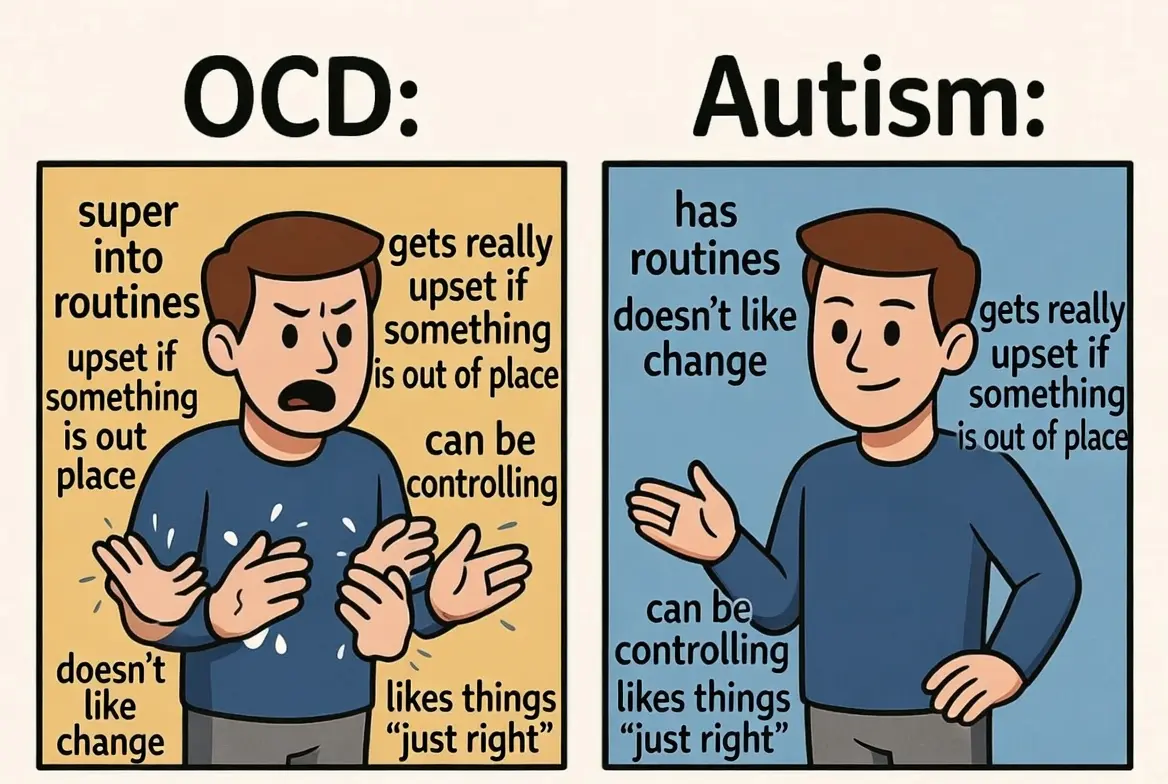
The following table provides a quick-reference guide to the ocd vs autism symptoms and the motivations behind ocd vs autism repetitive behaviors.
| Feature | OCD (Obsessive-Compulsive Disorder) | ASD (Autism Spectrum Disorder) |
| Primary Motivation | To reduce anxiety or prevent a “bad thing.” | To regulate sensory input or find comfort. |
| Internal Feeling | Distress, fear, “I have to do this or else.” | Contentment, focus, “This makes sense to me.” |
| Flexibility | Rigidly follows rituals to avoid panic. | Rigidly follows routines to maintain order. |
| Social Aspect | Usually no inherent deficit in social “cues.” | Inherent differences in social communication. |
| Relationship to Thought | Intrusive thoughts are unwanted/scary. | Repetitive thoughts are often related to interests. |
Overlap Between OCD and Autism (Why It’s Tricky)
The overlap between autism and ocd is where the diagnostic waters get muddy. Research suggests that as many as 37% of autistic individuals also meet the criteria for OCD. This high rate of co-occurrence is often due to an intolerance of uncertainty, a trait shared by both conditions.
The “Just Right” Overlap
In just right ocd vs autism, the behaviors look identical. An autistic person might want their books alphabetized because it looks “correct” and reduces visual “noise” (sensory regulation). An OCD patient might alphabetize their books because they feel a sense of “impending doom” if the order is broken (anxiety relief).
Both groups rely on routines and rigidity to survive a world that feels unpredictable. Because of these similarities between autism and ocd, many people go years with the wrong diagnosis—or with only half of the picture.
OCD vs Autism in Adults (Late Diagnosis Focus)
For those searching for ocd vs autism in adults, the journey often begins after a lifetime of feeling “different.” Many adults have been treated for OCD for decades, only to realize that their “compulsions” were actually autistic coping mechanisms.
Masking and Burnout
In autism vs ocd in adults, we must consider “masking”—the exhausting process of mimicking neurotypical behavior to fit in. An adult might develop “OCD-like” rituals to manage the extreme anxiety caused by the effort of masking.
Misdiagnosis Monday: ocd vs autism is a common theme in neurodivergent communities, where people share how they were mislabeled because clinicians focused on their outward “rigidity” rather than their internal “sensory overwhelm.” If your “OCD” doesn’t respond to standard treatments, it may be because the root is actually an autistic need for environmental control.
In this second section, we explore how gender, age, and co-occurring conditions like ADHD further complicate the diagnostic picture. We will also address why the “typical” presentation of these disorders often misses the reality of neurodivergent lived experience.
OCD vs Autism in Women
The discussion surrounding ocd vs autism in women is currently at the forefront of neurodivergent advocacy. Historically, medical research has been based on male-centric “externalizing” behaviors. Women, however, tend to “internalize” their symptoms, leading to a high rate of misdiagnosis.
Gender Bias and Internalized Masking
In autism and ocd in women, the symptoms often look like “perfectionism” or “extreme anxiety.”
- The “Social Secretary” Trap: An autistic woman might use rigid scheduling and social rituals to survive the workplace. This can be mistaken for OCD-related checking or ordering.
- Internalized Rituals: While a man might externally arrange objects, a woman might engage in “mental compulsions” (mental reviewing or counting) to mask her social confusion.
Searching ocd vs autism reddit reveals thousands of stories from women who were diagnosed with “anxious-avoidant personality disorder” or “severe OCD” for years before discovering their autism. The ocd vs autism in women reddit community highlights that for many, their “obsessions” were actually intense autistic special interests, and their “compulsions” were sensory-seeking behaviors disguised as social compliance.
OCD vs Autism in Children & Toddlers
For parents, the stakes are high in the ocd vs autism in children debate. Early intervention is key, but the intervention for OCD (challenging the fear) is the opposite of the intervention for Autism (accommodating the need).
Developmental Red Flags by Age
- Toddler OCD vs Autism: It is very rare for a toddler to have OCD. If a child under 4 is obsessed with symmetry, lining things up, or following strict routines, it is statistically more likely to be an autistic trait.
- Red Flags for Autism: Delayed speech, lack of “joint attention” (not pointing at things to show you), and sensory sensitivities.
- Red Flags for OCD: A sudden onset of “fear-based” rituals (e.g., “If I don’t touch the doorframe, mommy will get sick”).
When evaluating ocd vs autism in toddlers, clinicians look for the “fear factor.” An autistic child lines up blocks because it is visually satisfying; a child with early-onset OCD lines up blocks because they feel a “threat” if they don’t. If you are unsure, it is time to seek an evaluation from a neuro-affirming specialist.
OCD vs Autism vs ADHD (Triple Differential Diagnosis)
The “Triple Threat” of ocd vs autism vs adhd is a frequent reality. These three conditions exist on a genetic and neurological spectrum, and they often overlap in a way that creates “Executive Dysfunction.”
- ADHD vs OCD: ADHD is characterized by impulsivity (doing things without thinking), while OCD is compulsivity (doing things to stop thinking).
- Autism vs ADHD: Both involve “hyper-focus,” but in ADHD it is fleeting and novel, while in Autism it is deep and enduring.
- The Overlap: A person with adhd and ocd vs autism might have an autistic need for order, an ADHD inability to maintain it, and an OCD obsession with the “failure” to be organized. This creates a paralyzing internal conflict that requires a highly nuanced treatment plan.
High-Functioning Autism and OCD (Co-Occurring Conditions)

It is entirely possible—and actually common—to have a dual diagnosis. When a person has high functioning autism and ocd, the two conditions can feed into each other in a “feedback loop.”
How Symptoms Interact
For a dually diagnosed individual, an autistic special interest can become an OCD obsession. For example:
- An autistic person has a special interest in trains (Enjoyable).
- They develop an OCD obsession with train crashes (Intrusive/Fear-based).
- They feel compelled to check every bolt on a train track (Compulsion).
In these cases, how to treat ocd in autism becomes a delicate balance. You cannot simply use standard “Exposure Therapy” because the person’s nervous system is already overloaded from their autistic sensory processing. Treatment must involve sensory stabilization before tackling the OCD loops.
OCD vs Autism: Quizzes, Tests & Self-Assessment
If you have taken an ocd vs autism test online, take the results with a grain of salt. While a do i have ocd or autism quiz can be a great tool for self-reflection, they are not diagnostic.
The Ethical Framework of Self-Screening
- When Quizzes Help: They give you the vocabulary to talk to your doctor. They can highlight traits you previously thought were “just personality quirks.”
- When Quizzes Mislead: Most online tests use “Externalizing” questions (e.g., “Do you wash your hands?”). They often miss the internalized “Masking” traits common in women and “High-Functioning” adults.
If your ocd vs autism quiz shows high scores for both, it is a sign that your nervous system is seeking order and safety. The next step is a clinical interview with a professional who understands Neurodiversity-Affirming care.
In this final section, we move from diagnosis to action. Because the treatments for OCD and Autism can sometimes be at odds, understanding the correct pathway is essential for effective healing and support.
Treatment Differences: OCD vs Autism (Evidence-Based)
The most critical reason to distinguish between these two is that the “gold standard” treatment for one can be distressing or even counterproductive for the other.
Treating OCD: Exposure and Response Prevention (ERP)
In psychotherapy for ocd, the primary goal is to break the anxiety loop.
- ERP: This involves exposing the person to their obsession (e.g., touching a “dirty” surface) and preventing the compulsion (washing hands). The goal is “habituation”—learning that the anxiety will eventually go down on its own without the ritual.
- Medication: OCD and depression treatment often involves high-dose SSRIs, which help regulate the serotonin system to reduce the intensity of intrusive thoughts.
Supporting Autism: Accommodations and Sensory Regulation
For an autistic person, repetitive behaviors are often a “lifeline” rather than a “glitch.”
- Accommodations: Instead of “breaking the habit,” we modify the environment. If a student is overwhelmed by noise, we provide noise-canceling headphones rather than “exposing” them to the noise until they get used to it.
- Sensory Regulation: Focuses on “proprioceptive” and “vestibular” input to calm the nervous system.
How to treat ocd in autism: If a person has both, the clinician must use “Modified ERP.” This means proceeding much more slowly and ensuring the person’s sensory needs are met first, so the exposure doesn’t lead to an autistic meltdown or burnout.
14. Finding Professional Help (Local & Online Care)
Finding the right provider is half the battle. You need someone who is “neuro-affirming”—someone who doesn’t see autism as something to be “cured.”
What to Ask Potential Providers
When searching for an ocd specialist near me or a psychologist ocd near me, ask the following:
- “Do you have experience working with neurodivergent (autistic/ADHD) clients?”
- “Do you use a neuro-affirming approach to therapy?”
- “How do you distinguish between an autistic stim and an OCD compulsion?”
For medication management, an ocd psychiatrist near me should be aware that autistic individuals are often more sensitive to medication side effects and may require lower “start-low, go-slow” dosing strategies.
FAQ Section
Can OCD be mistaken for autism?
Yes. Because both involve “rigidity,” “repetitive behaviors,” and “intense focus,” many autistic people are misdiagnosed with OCD, especially if they are high-masking adults or women.
What is the 15-minute rule for OCD?
The 15-minute rule is a “delay tactic” used in ERP. When the urge to perform a compulsion hits, the person agrees to wait 15 minutes before doing it. This helps build “distress tolerance.” Note: This is rarely helpful for autistic stimming, as stimming is a physiological need, not a choice.
Can you have both OCD and autism?
Yes. Comorbidity is high. Approximately one-third of autistic people also have OCD. In these cases, the OCD usually latches onto autistic themes or interests.
How do professionals tell the difference?
Clinicians look at the “Affect” (emotional tone). OCD is usually accompanied by a sense of “dread” or “shame,” while autistic traits are often accompanied by a sense of “neutrality,” “relief,” or “joy.”
Autism-Related Reference Topics
To help you navigate the broader world of neurodiversity, here are some common community-related resources.
Symbols and Awareness
What color are autism awareness ribbons? Traditionally, the puzzle piece (often blue) was used. However, many in the autistic community now prefer the Infinity Symbol (usually rainbow or gold) to represent the diversity and “everlasting” nature of the autistic spectrum, moving away from the idea that autistic people are “missing a piece.”
Residential and Daycare Support
- Adult Autism Residential Programs: For adults requiring more significant support, these programs focus on “Activities of Daily Living” (ADLs) and community integration rather than “clinical treatment.”
- Daycare Autism Friendly: A high-quality daycare for autistic children will have low-stimulus environments (soft lighting, quiet corners), visual schedules, and staff trained in positive behavioral support rather than punishment-based compliance.
Summary: OCD vs Autism — What Matters Most
Navigating the landscape of ocd vs autism can feel like trying to solve a puzzle where the pieces keep changing shape. Whether you are looking for the difference between ocd and autism for yourself or your child, the most important takeaway is this: The label is a tool, not a cage.
If your “OCD” treatment feels like it’s fighting against your nature, or if your “Autism” diagnosis doesn’t explain your intrusive fears, it is worth re-evaluating. Labels should provide you with a map to better support, deeper self-compassion, and a community that understands your “internal why.”
Authoritative Clinical & Research References
- International OCD Foundation (IOCDF)
- National Autistic Society (UK)
- National Institutes of Health (NIH) / PMC
- AANE (Association for Autism and Neurodiversity)
- Psychiatry.org (American Psychiatric Association) — Understanding ASD

Related Posts





Subscribe to Our Newsletter
Get mental health tips, updates, and resources delivered to your inbox.
MORE from Author
Read More Watching someone you care about struggle with bipolar depression and anxiety can be heartbreaking. You may notice that they withdraw…
 In my practice as a clinical psychologist, I often observe that the difference between a patient who crumbles under pressure…
 We all have "up" days and "down" days. Perhaps you feel energized after a promotion or sluggish on a rainy…
 To define bipolar disorder accurately, we must look at it as a chronic mood dysregulation condition. In psychology and medicine,…
Are you looking for a Therapist?
Connect with qualified mental health professionals who understand
bipolar disorder, mood changes, and emotional challenges.
Private • Supportive • Confidential