
OCPD vs. OCD: Differences, Symptoms, Ego-Syntonic vs. Ego-Dystonic Explained

Medically reviewed by Laura Athey Updated Date: April 1, 2026

In the world of mental health, few conditions are as frequently conflated as OCD and OCPD. To the casual observer—and even to some general practitioners—the two look like variations of the same “perfectionist” theme. However, from a diagnostic and treatment perspective, the difference between OCD and OCPD is profound.
The confusion stems from the name itself. Because both involve the words “obsessive” and “compulsive,” people assume they are simply two points on the same spectrum. In reality, OCD is an anxiety-based clinical disorder, while OCPD is a personality disorder. One is a “glitch” in the brain’s alarm system; the other is a rigid, pervasive “way of being.”
The most critical concept in understanding what OCPD vs. OCD is is the distinction between ego-syntonic and ego-dystonic symptoms. This psychological boundary determines how a person views their own behavior—whether they see their thoughts as an invading enemy or a righteous philosophy for living.
What Is OCD?
To understand the OCD vs. OCPD difference, one must first understand the “cycle of anxiety” that defines OCD.
The Intrusive Thought (Obsession)
OCD begins with an obsession—an intrusive, unwanted image or thought that causes intense distress. These are ego-dystonic, meaning they are inconsistent with the person’s self-image and values.
A person who loves their family may have an intrusive thought about harming them; a person who is hygienic may have a sudden, irrational fear of “microscopic poison.”
The Ritual (Compulsion)
To alleviate the crushing anxiety of the obsession, the individual performs a compulsion. This might be physical (hand-washing, checking locks) or mental (counting, repeating phrases). The relief is temporary, creating a loop where the brain learns that the ritual is the only way to feel safe.
Distress Recognition
Most people with OCD have some level of “insight.” They know their rituals are irrational. They don’t want to wash their hands for forty minutes; they feel trapped by a brain that is screaming “Danger!” when there is none. This creates the internal agony characteristic of OCD vs. OCPD symptoms.
What Is OCPD?
While OCD is about distress, OCPD is about order. OCPD’s meaning is rooted in a personality structure that prioritizes rules, lists, and perfection above all else.
Unlike OCD, which can appear suddenly at any age, OCPD is a personality disorder. This means it is a set of traits that have stabilized over time, usually beginning in early adulthood. It isn’t an “attack” of anxiety; it is the person’s identity.
Key Traits of OCPD:
- Perfectionism that Hinders Task Completion: A person may never finish a project because the standards are so impossibly high.
- Preoccupation with Details: Focus on lists, rules, and schedules to the point where the actual point of the activity is lost.
- Excessive Devotion to Work: Neglecting social and leisure activities in favor of “being productive.”
- Moral Rigidity: Being over-conscientious and inflexible about matters of morality, ethics, or values.
- Difficulty Delegating: Refusing to let others help unless they agree to do things exactly the person’s way.
Identity Alignment (Ego-Syntonic)
The hallmark of OCPD is that the person believes their way is the right way. They don’t feel “sick”; they feel that everyone else is “lazy,” “messy,” or “unprincipled.” This lack of distress regarding their own traits makes OCPD treatment significantly more challenging than OCD.
OCPD vs. OCD
If you are trying to explain the differences between OCD and OCPD to someone else, use the “Identity vs. Intruder” analogy.
OCD is an intruder. It is a bully in the brain that says, “If you don’t do this, something terrible will happen.” The person hates the bully.
OCPD is an identity. It is a philosophy that says, “Things must be done correctly for the world to function.” The person values the philosophy.
Comparison Table: OCD vs. OCPD at a Glance
| Feature | OCD | OCPD |
| Classification | Anxiety/Obsessive-Compulsive Spectrum | Cluster C Personality Disorder |
| Experience of Symptoms | Unwanted, intrusive, and distressing. | Valued, purposeful, and justified. |
| Goal of Behavior | To reduce anxiety or prevent a “threat.” | To achieve perfection and maintain order. |
| Insight | High (usually knows thoughts are irrational). | Low (usually believes their standards are superior). |
| Social Impact | A person often hides rituals due to shame. | A person often imposes standards on others. |
In my clinical practice, I often tell patients that OCD is a “thief”—it steals your time and energy through fear. But OCPD is a “judge”—it evaluates your worth and the worth of others based on a rigid set of laws. When I treat someone with OCD, we are working together to kick the thief out of the house.
When I treat someone with OCPD, we are working to convince the judge that “perfection” is an impossible verdict and that there is beauty in the “good enough.”
Ego-Syntonic vs. Ego-Dystonic
If you are a student or a clinician looking for the ocpd vs ocd differences, you must understand the “Ego” relationship. This is the most significant clinical marker.
Ego-Dystonic (OCD)
In OCD, the thoughts are “alien” to the self. If a person has a “checking” compulsion, they might think, “I know I just locked the door, but my brain is telling me I didn’t. This is exhausting, and I hate it.” The symptom is dystonic (discordant) with who they want to be. They experience their OCD as a burden or a sickness.
Ego-Syntonic (OCD)
In OCPD, the behavior is “harmonious” with the self. If a person with OCPD spends four hours organizing their bookshelf by the Dewey Decimal System, they don’t think it’s a waste of time. They think, “This is the correct way to store books. Anyone who doesn’t do this is disorganized.” The trait is syntonic (synchronized) with their identity. They experience their OCPD as a virtue or a standard of excellence.
OCPD vs. OCD Symptoms Comparison
While the “why” differs, the “what” can look similar. Let’s break down the ocpd vs ocd symptoms by category to see how they diverge in practice.
Concentration and Focus
- OCD: Focus is stolen by “intrusive loops.” A person cannot focus on work because they are mentally reciting a prayer to prevent a car accident.
- OCPD: Focus is lost in “detail-traps.” A person cannot finish a report because they have spent three hours choosing the perfect font and margin size.
Guilt and Anxiety
- ocpd vs ocd guilt anxiety: In OCD, anxiety is the driver. The person performs a ritual to make the anxiety stop. In OCPD, anxiety is the result of a broken rule. They don’t feel anxious until they—or someone else—fails to meet their rigid standard.
Blame and Conflict
- OCDP vs. OCDCC: People with OCD usually take the blame. They feel responsible for “bad things” happening. People with OCPD often engage in blame shifting. Because they believe their way is objectively “right,” if a project fails, they blame the “incompetence” of their coworkers rather than their own rigidity.
OCPD vs. OCD Examples: Real-Life Scenarios
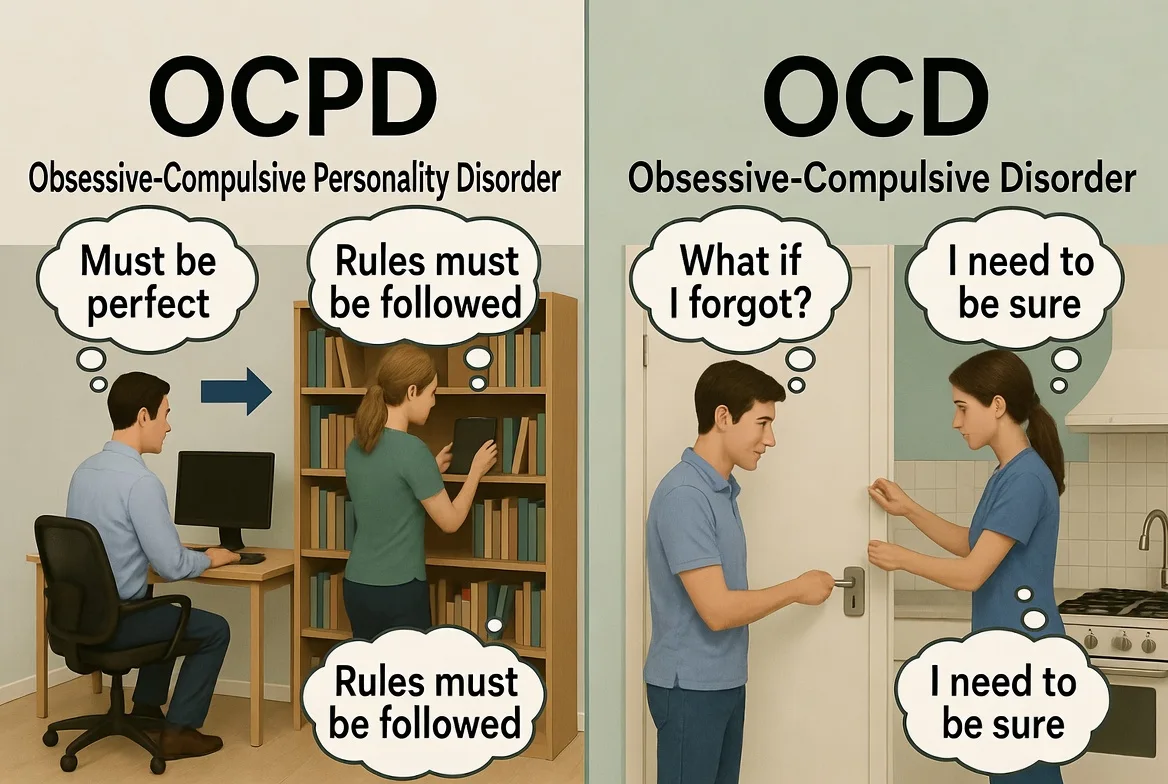
To move from theory to reality, let’s look at ocpd vs ocd examples through three common behaviors.
Scenario 1: The Kitchen Counter
- The OCD Response: Sarah cleans the counter three times with bleach. She doesn’t think it’s “good” to do this; she is terrified that if she doesn’t, her family will contract a rare disease. She cries while she scrubs.
- The OCPD Response: Mark cleans the counter because there is a “proper” way to maintain a home. He is annoyed that his wife left a crumb, seeing it as a sign of her “lack of discipline.” He feels a sense of satisfaction when the counter is perfect.
Scenario 2: Workplace Deadlines
- The OCD Response: David is late with a project because he had to restart his computer 15 times to ensure it “felt right.” He is embarrassed and fears losing his job.
- The OCPD Response: Linda is late with a project because she refused to delegate the research to her assistant, believing the assistant wouldn’t be “thorough enough.” She feels her lateness is justified by the “superior quality” of her work.
Scenario 3: Moral Rigidity
- The OCD Response: A person is plagued by intrusive “blasphemous” thoughts that go against their religious beliefs. They spend hours in confession or mental prayer to “undo” the thoughts.
- The OCPD Response: A person believes there is only one moral way to live. They are judgmental of neighbors who don’t recycle or coworkers who arrive two minutes late, viewing these as “moral failings.”
OCPD vs. OCD: Which Is Worse?
When people ask ocpd vs ocd which is worse, the answer depends on who you ask—the person with the disorder or the people living with them.
- Internal Suffering: Generally, OCD causes more immediate, acute internal suffering. The anxiety is jagged and painful.
- Relational Impact: Generally, OCPD causes more long-term relational damage. Because the person with OCPD often imposes their rigidity on others, it can lead to “relationship burnout” for partners and children who feel they can never meet the OCPD individual’s standards.
Neither is “worse” in a vacuum; both represent a significant “freezing” of the human experience—one through fear, and the other through control.
OCPD vs. OCD Test: A Self-Screening Tool
While only a licensed professional can provide a formal diagnosis, you can use this OCPD vs. OCD test as a framework for self-reflection. Read each statement and determine which column more closely aligns with your internal experience.
| Suggests OCD (Ego-Dystonic) | Suggests OCPD (Ego-Syntonic) |
| I have thoughts that I find disturbing, “crazy,” or “not like me.” | I have high standards and feel that my way of doing things is the “right” way. |
| I perform rituals (like checking or cleaning) to stop something bad from happening. | I follow strict routines and lists because they make me feel productive and organized. |
| I feel like a slave to my habits and wish I could just stop them. | I take pride in my discipline and often get frustrated with people who are “sloppy.” |
| My anxiety goes down temporarily after I complete a specific ritual. | I feel a sense of “correctness” or satisfaction when things are in their proper place. |
| I am often embarrassed by my behaviors and try to hide them from others. | I am often critical of others who don’t follow the rules or meet my standards. |
Can You Have OCD and OCPD?
A common question in clinical circles is: Can you have OCD and OCPD? The answer is yes. Research suggests that approximately 15% to 20% of individuals diagnosed with OCD also meet the full criteria for OCPD.
When these coexist, the treatment becomes significantly more complex. The person may have OCD-driven compulsions (like hand-washing to avoid germs) layered on top of an OCPD-driven personality (being morally rigid and work-obsessed). In these cases, the “judge” and the “thief” are working together, making the individual feel that their life must be both perfectly safe and perfectly ordered.
OCPD vs. OCD Treatment: Different Paths to Healing
Understanding the ocd vs ocpd treatment difference is vital because the therapy that helps one can sometimes be ineffective for the other.
OCD Treatment: ERP and SSRIs
- Exposure and Response Prevention (ERP): This is the “gold standard” for OCD. It involves exposing the person to their fear (e.g., touching a doorknob) and preventing the ritual (e.g., washing hands). This trains the brain’s alarm system.
- Medication: High doses of SSRIs (Selective Serotonin Reuptake Inhibitors) are often used to “lower the volume” of the intrusive thoughts, making ERP more manageable.
OCPD Treatment: Schema and Psychodynamic Therapy
- Schema Therapy: Since OCPD is a personality disorder, treatment focuses on “schemas”—deep-seated patterns of belief formed in childhood. It helps the person understand why they feel they must be perfect to be worthy.
- Psychodynamic Therapy: This explores the need for control. It helps the individual move from “rigid control” to “flexible functioning.”
- Insight Building: The biggest hurdle in OCPD is getting the person to realize that their “virtues” (like extreme workaholism) are actually causing harm to their relationships and mental health.
OCPD vs. ADHD: Rigidity vs. Distractibility
In recent years, the conversation around OCPD vs. ADHD has gained momentum. At first glance, they seem like opposites: ADHD is associated with forgetfulness and impulsivity, while OCPD is associated with hyper-organization and rigidity.
However, they often intersect in a compensatory way:
- The “Over-Correction”: Many adults with undiagnosed ADHD develop OCPD-like traits as a survival mechanism. Because they are afraid of forgetting things (ADHD), they become obsessed with lists and rules (OCPD).
- The Difference: In ADHD, the lack of order is a struggle of capacity (the brain can’t organize). In OCPD, the presence of order is a struggle of identity (the person feels they must organize to be a “good” person).
OCPD vs. OCD Reddit Perspective: The Lived Experience
If you browse OCPD vs. OCD Reddit threads, you’ll find that the “relational toll” is the most discussed topic.
- OCD threads are often filled with people seeking reassurance: “Does anyone else have this thought? Am I a bad person?” There is a high level of shared suffering and empathy.
- OCPD threads (often found in “spouse of” or “child of” subreddits) are filled with stories of relationship strain. Family members describe feeling like they are “walking on eggshells” or that their house feels like a “military barracks” rather than a home.
Many users on Reddit report a “misdiagnosis journey,” where they were treated for OCD for years with no success, only to realize that their perfectionism was actually ego-syntonic (OCPD) and required a different therapeutic approach.
What Is the Pops Score for OCPD?

For those looking for academic or clinical depth, you may encounter the Pops score for OCPD. This refers to the Personality Over-reliance on Problem-solving Scale (or similar clinical metric scales used in personality assessments like the MMPI or PAI).
In a clinical setting, a “Pops score” or its equivalent helps psychologists measure how much an individual relies on intellectualization and control as a defense mechanism. High scores in these areas are a “red flag” for OCPD, indicating that the person uses “logic” and “rules” to avoid dealing with uncomfortable emotions or interpersonal vulnerability.
The Bipolar Connection: Overlap, Comorbidity, and Misdiagnosis
While OCD and OCPD are distinct, they often intersect with Bipolar Disorder in ways that complicate both diagnosis and treatment. Clinical research indicates that a significant percentage of individuals with Bipolar Disorder also meet the criteria for an obsessive-compulsive spectrum condition.
Bipolar Disorder vs. OCPD: The Productivity Trap
The “ego-syntonic” nature of OCPD—where one’s rigid standards feel correct and justified—can closely mimic hypomania. During a hypomanic episode, a person may become hyper-focused on projects, work excessive hours, and demand perfection from others. The key difference lies in duration: OCPD is a stable, lifelong personality structure, whereas Bipolar productivity occurs in distinct, episodic waves.
OCD and the Bipolar Mood Cycle
For those with comorbid Bipolar and OCD, the two disorders often “feed” one another. During depressive phases, intrusive thoughts (obsessions) often become darker and more difficult to ignore. During manic phases, compulsions may become more rapid or expansive.
Why Differential Diagnosis Matters
Treating a Bipolar patient for OCD with standard SSRIs can sometimes trigger a manic switch if not balanced with a mood stabilizer. Therefore, identifying whether a patient’s “need for order” is a personality trait (OCPD), an anxiety ritual (OCD), or a symptom of a mood swing (Bipolar) is the most critical step in creating a safe and effective treatment plan.
Frequently Asked Questions
What is the difference between OCD and OCPD in simple terms?
OCD is an “intruder” in the brain—it involves unwanted, scary thoughts and rituals that a person hates doing but feels they must do to stay safe. OCPD is an “identity”—it involves a rigid personality style where the person values their rules and perfectionism, believing their way is the “correct” way to live.
Do I have OCD or OCPD?
Ask yourself: “Does my behavior feel like a choice or a curse?” If your habits feel like a necessary but unwanted “curse” to stop anxiety, it is likely OCD (Ego-dystonic). If your habits feel like a “choice” based on high standards and a desire for order, it is likely OCPD (Ego-syntonic).
What is OCPD like?
Living with OCPD feels like being the only “sane” person in a world of chaos. You may feel a constant internal pressure to be productive, a deep discomfort when rules are broken, and a belief that if you don’t control the details, everything will fall apart.
OCPD vs. OCD: Which is worse?
Neither is “worse,” but they hurt differently. OCD causes more acute internal pain and anxiety for the individual. OCPD often causes more external “friction” and relationship strain, as the individual’s rigidity can be difficult for others to live with.
Can you have OCD and OCPD?
Yes. This is a common comorbidity. In these cases, a person might suffer from specific anxiety-driven compulsions (OCD) while also possessing a general personality style characterized by perfectionism and a need for control (OCP).
What is the Pops score for OCPD?
The “Pops score” refers to clinical assessment metrics (like the Personality Over-reliance on Problem-solving Scale) used by psychologists. A high score indicates a heavy reliance on logic and rigid rules as a way to avoid emotional vulnerability—a key marker of OCPD.
Conclusion
The journey from what is OCPD vs. OCD to a place of healing begins with the “aha!” moment of differentiation. For the person with OCD, healing means learning to ignore the “false alarms” of the brain. For the person with OCPD, healing means learning that their value as a human being is not tied to their productivity or the “perfect” arrangement of their world.
Proper diagnosis is not just a label; it is the map to the correct treatment.
- If you treat OCPD with only ERP (Exposure Therapy), you may miss the deep-seated personality schemas that need addressing.
- If you treat OCD with only Insight Therapy, you may spend years talking about your childhood while your brain’s anxiety loop continues to spin.
Authoritative References
1. The Core Distinction: OCD vs. OCPD
2. Comorbidity Between Bipolar and OCD
3. Understanding Personality Disorders (Cluster C)
4. The Bipolar and OCPD Overlap
5. Treatment Guidelines: ERP and CBT

Related Posts






Subscribe to Our Newsletter
Get mental health tips, updates, and resources delivered to your inbox.
MORE from Author
Read More Watching someone you care about struggle with bipolar depression and anxiety can be heartbreaking. You may notice that they withdraw…
 In my practice as a clinical psychologist, I often observe that the difference between a patient who crumbles under pressure…
 We all have "up" days and "down" days. Perhaps you feel energized after a promotion or sluggish on a rainy…
 To define bipolar disorder accurately, we must look at it as a chronic mood dysregulation condition. In psychology and medicine,…
Are you looking for a Therapist?
Connect with qualified mental health professionals who understand
bipolar disorder, mood changes, and emotional challenges.
Private • Supportive • Confidential