
Autism Spectrum Disorder Infographic: Diagnosis, Criteria, Charts, and 2025 Statistics

Medically reviewed by Laura Athey Updated Date: April 14, 2026
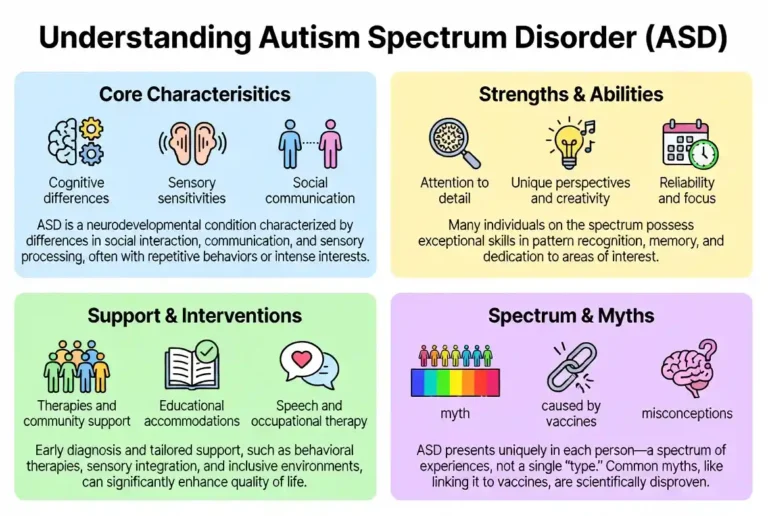
Understanding Autism Spectrum Disorder (ASD) has shifted dramatically over the last decade. We have moved away from rigid, siloed categories like “Asperger’s” and moved toward a comprehensive “spectrum” model. However, for parents and adults starting this journey, the terminology can feel like a labyrinth of clinical jargon. Autism Spectrum Disorder Infographic.
In my clinical practice, I often use an autism umbrella chart to help families visualize how various traits—from sensory processing to social communication—fit together. I recall an interview with a patient, Sarah, who sought an evaluation at age 32. She told me, “I spent my life feeling like a broken neurotypical person. When I finally saw an autism spectrum disorder infographic that explained masking, it was like someone finally handed me the manual to my own brain.”
This article serves as that manual, breaking down the DSM criteria for autism, clarifying autism eligibility criteria, and providing the latest autism statistics for 2025 in Canada.
What Is Autism Spectrum Disorder?
When we describe the main diagnostic features of autism spectrum conditions, we are looking at a neurodevelopmental difference that affects how a person perceives and socializes with others.
The Two Core ASD Domains
According to the DSM-5-TR, an individual must show persistent deficits across two primary ASD domains:
- Social Communication and Interaction: Challenges with social-emotional reciprocity, nonverbal communicative behaviors, and developing/maintaining relationships.
- Restricted, Repetitive Patterns of Behavior: Stereotyped motor movements, insistence on sameness, highly restricted interests, and sensory hyper- or hypo-reactivity.
Understanding Levels of Autism Symptoms
The term “spectrum” does not mean a straight line from “not autistic” to “very autistic.” Instead, clinicians assign levels of autism symptoms based on the amount of support required:
- Level 1: Requiring support (often previously called “high functioning”).
- Level 2: Requiring substantial support.
- Level 3: Requiring very substantial support.
These levels are not fixed; a person’s support needs can change depending on their environment, stress levels, and life stage.
DSM Criteria for Autism Spectrum Disorder
To receive a formal diagnosis, an individual must meet a specific autism criteria checklist outlined in the DSM. This ensures that the diagnosis is based on clinical evidence rather than subjective observation.
A. Social Communication and Social Interaction
The individual must show deficits in all three of the following:
- Social-Emotional Reciprocity: Difficulty with back-and-forth conversation or sharing interests/emotions.
- Nonverbal Communication: Abnormalities in eye contact, body language, or understanding gestures.
- Developing Relationships: Challenges adjusting behavior to suit social contexts or a lack of interest in peers.
B. Restricted and Repetitive Behaviors
The individual must show at least two of the following:
- Stereotyped Movements: Lining up toys, flipping objects, or repetitive speech (echolalia).
- Insistence on Sameness: Extreme distress at small changes or rigid adherence to routines.
- Fixated Interests: Intense focus on specific topics (e.g., train schedules, deep-sea biology).
- Sensory Issues: Strong aversion to certain textures or indifference to pain/temperature.
C. Onset and Impairment
Symptoms must be present in the early developmental period (though they may not fully manifest until social demands exceed limited capacities) and must cause clinically significant impairment in current functioning.
Autism Symptoms Chart: Visual Learning
Because autism is so diverse, an autism symptoms chart is often the most effective way to communicate how traits manifest across different ages.
Age-Based Presentation Table
| Age Group | Common Social Signs | Common Behavioral Signs |
| Toddlers | Limited pointing, delayed speech, and lack of “showing” behavior. | Hand-flapping, spinning, intense focus on spinning wheels. |
| School-Age | Difficulty with “unspoken” social rules, preference for solo play. | Rigidity about rules, deep knowledge of specific niche topics. |
| Adults | Exhaustion after social events, difficulty with “small talk.” | Need for strict daily routines, sensory sensitivities to office lights. |
These autism spectrum disorder charts help clinicians and parents identify that while the core neurotype remains the same, the expression of that neurotype evolves.
Understanding the Autism Spectrum Chart Models
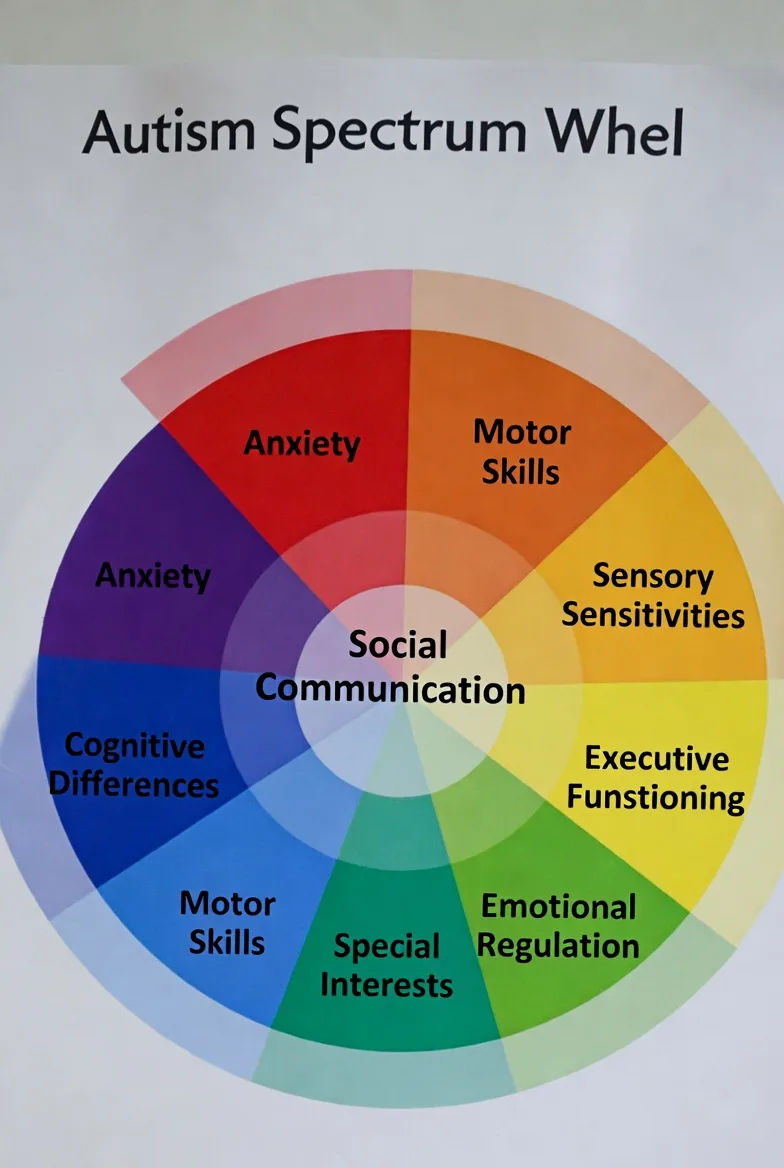
If you search for an autism spectrum disorder infographic, you will likely see three main models. Understanding which one is accurate is key to avoiding misinformation.
The Autism Umbrella Chart
This model places “Autism Spectrum Disorder” at the top of an umbrella. Beneath it are the various ways it presents—including what was formerly known as Asperger’s, PDD-NOS, and Childhood Disintegrative Disorder. It emphasizes that while the names have changed, the symptoms fall under one “umbrella.”
The Autism Spectrum Circle Chart (The Color Wheel)
This is the most scientifically accurate model. Unlike a linear scale, the autism spectrum circle chart shows various dimensions—such as sensory processing, motor skills, language, and executive function—as “spokes” on a wheel. One person might have high support needs in sensory processing but low support needs in language.
The Misleading Autism Pie Chart Spectrum
Be wary of an autism spectrum disorder pie chart or autism pie chart spectrum that suggests someone is “70% autistic.” Autism is a binary neurotype; you either are, or you aren’t. A pie chart can be useful for showing how an individual’s time is spent on certain supports, but it is not a diagnostic tool for “how much” autism someone has.
When Is Spinning a Sign of Autism?
A frequent concern for parents is: When is spinning a sign of autism? Many toddlers spin for fun as they explore their vestibular system (balance).
Clinical Significance of Spinning
Spinning becomes a diagnostic marker when it is:
- Repetitive and Persistent: Done for long periods without an obvious external trigger.
- Preferred over Social Engagement: The child would rather spin than play with others or engage in toys.
- Part of a Cluster: It occurs alongside other DSM criteria, such as lack of eye contact or delayed speech.
- Sensory-Seeking: It appears to be a way to regulate the nervous system (stimming) rather than just a game.
Autism Masking Symptoms
One of the most significant advancements in the 2025 diagnostic landscape is our understanding of autism masking symptoms. Masking is the conscious or subconscious suppression of autistic traits to “blend in.”
Common Masking Behaviors
- Scripting: Preparing sentences or “small talk” in advance.
- Suppressed Stimming: Forcing oneself to stay still even when the body feels a need to move.
- Forced Eye Contact: Mimicking the eye contact patterns of neurotypical people.
- Social Camouflaging: Observing others to learn how to laugh or react “correctly” in social situations.
Because of masking, many individuals—particularly women—are not diagnosed until adulthood. Masking is highly correlated with autistic burnout, as the cognitive load of “performing” neurotypicality is immense.
Who Can Provide a Reliable Autism Diagnosis?
As autism awareness grows, so does the influx of “quick” online assessments. However, Unlocking the Truth: Who Can Provide a Reliable Autism Diagnosis? requires looking toward licensed medical and psychological professionals.
Qualified Professionals
- Clinical Psychologists or Neuropsychologists: Specialize in the administration of standardized tools like the ADOS-2 and ADI-R.
- Developmental Pediatricians: Focus on the intersection of physical development and neurotype.
- Psychiatrists: Can diagnose and help manage co-occurring conditions like anxiety or ADHD.
Is Your Autism Provider Truly Qualified?
A “red flag” in a provider is a diagnosis based solely on a 15-minute observation. A comprehensive evaluation must include:
- A Detailed Developmental History: Interviews with parents or caregivers about early childhood.
- Standardized Testing: Objective measures of social and behavioral traits.
- Differential Diagnosis: Ensuring the symptoms aren’t better explained by ADHD, Social Anxiety, or Sensory Processing Disorder.
Are Free Autism Evaluations Reliable?
A common question for families is: Are You Missing Out on Free Autism Evaluations? The answer depends on your goal.
Screening vs. Diagnosis
- Free Online Screeners: These are “yellow lights.” They indicate you should seek further testing, but they are NOT a diagnosis.
- School-Based Evaluations: In many regions, schools provide free evaluations to determine autism eligibility criteria for an IEP (Individualized Education Program). While this allows for school support, it is often not a medical diagnosis that can be used for insurance or government disability benefits.
- Government-Funded Clinical Assessments: In Canada, provincial health systems (like OHIP in Ontario or MSP in BC) offer free clinical diagnoses, but waitlists can often exceed 18–24 months.
Autism Eligibility Criteria for School and Services
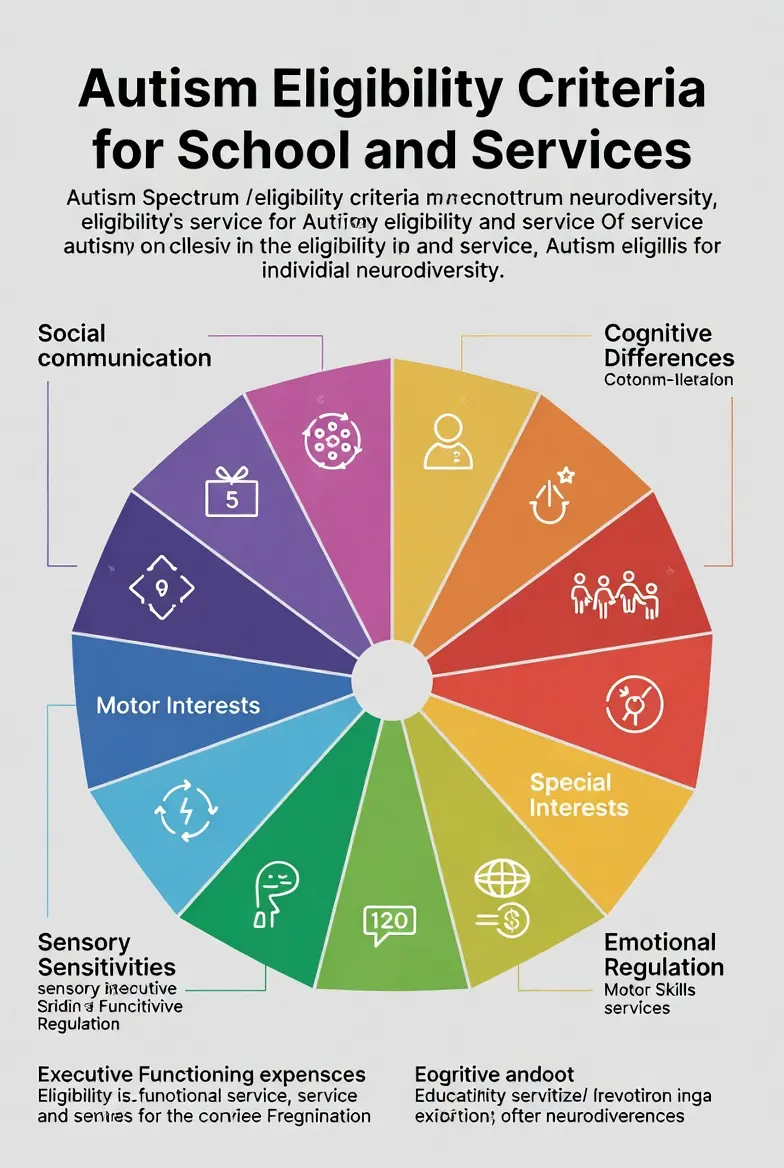
Even with a medical diagnosis, you may need to meet specific autism eligibility criteria to access government funding or school supports.
The “Functional Impact” Requirement
Diagnostic criteria focus on what traits you have; eligibility criteria focus on how those traits impact your life. To qualify for support services, you generally must prove:
- The condition is permanent.
- It significantly impacts “Activities of Daily Living” (ADLs) such as communication, self-care, or social functioning.
This distinction is why some Level 1 individuals may have a diagnosis but not qualify for certain financial “disability” benefits.
What Makes a Daycare Autism-Friendly?
For parents of newly diagnosed children, finding the right environment is crucial. What Makes a Daycare Autism Friendly? Key Features to Look For include:
- Predictable Routines: Visual schedules (pictures showing the day’s events) help reduce transition anxiety.
- Sensory Accommodations: Availability of “calm down corners,” dimmable lights, and noise-reducing headphones.
- Staff Training: Educators who understand that “behavior is communication” and use positive reinforcement rather than punishment.
- Communication Support: Familiarity with AAC (Augmentative and Alternative Communication) devices or basic sign language.
Autism, Bipolar, and the Risk of Misdiagnosis
A critical challenge in modern neurodivergent care is the significant diagnostic overlap between Autism Spectrum Disorder and Bipolar Disorder. Statistics from 2025 indicate that while approximately 5% to 8% of autistic individuals have a co-occurring bipolar diagnosis, as many as 27% exhibit “bipolar-like” symptoms such as rapid speech, irritability, and sleep disruptions.
In my clinical work, I’ve seen how autism masking symptoms can complicate this further. For high-masking individuals, the internal exhaustion of “performing” neurotypicality can lead to cycles of intense activity followed by total collapse—a pattern often misidentified as bipolar mania and depression. However, while bipolar cycles are typically driven by chemical shifts, autistic “cycles” are often tied to environmental sensory load.
Differentiating between the two requires a provider who understands that “spinning” or “info-dumping” can be a regulatory stim rather than a manic flight of ideas. Accurate diagnosis is the only way to ensure patients receive neuro-affirming support rather than inappropriate medication.
Frequently Asked Questions
What are the main diagnostic features of autism spectrum conditions?
The core features are persistent challenges in social communication and interaction, combined with restricted, repetitive patterns of behavior, interests, or activities.
What are the ASD domains?
There are two: 1) Social Communication/Interaction and 2) Restricted/Repetitive Behaviors and Sensory Interests.
What are the levels of autism symptoms?
Level 1 (Requiring support), Level 2 (Substantial support), and Level 3 (Very substantial support). These describe support needs, not “functioning.”
Is spinning always a sign of autism?
No. Many children spin for sensory play. It is considered an autism marker only when it is frequent, intense, and paired with other social and communication challenges.
What does the autism spectrum chart mean?
It means that autism is not a single point but a collection of different traits. The “circle” or “color wheel” chart shows that an individual can have strengths in one area (like logic) while needing high support in another (like sensory processing).
Conclusion
Receiving an autism spectrum disorder diagnosis is often a moment of profound clarity. Whether you are looking at an autism spectrum disorder infographic for your child or reviewing DSM criteria for autism for yourself, remember that a diagnosis is a tool for understanding, not a limitation on potential.
By utilizing the autism spectrum circle chart to identify specific support needs and staying informed on autism statistics 2025 Canada, families can move from a state of confusion to one of empowered advocacy.
References
- Public Health Agency of Canada: Autism Spectrum Disorder Prevalence Report
- American Psychiatric Association: DSM-5-TR Fact Sheets
- Autism Canada: Diagnostic and Support Resources
- Autism Ontario: Understanding the ASD Diagnosis

Related Posts




Subscribe to Our Newsletter
Get mental health tips, updates, and resources delivered to your inbox.
MORE from Author
Read More Watching someone you care about struggle with bipolar depression and anxiety can be heartbreaking. You may notice that they withdraw…
 In my practice as a clinical psychologist, I often observe that the difference between a patient who crumbles under pressure…
 We all have "up" days and "down" days. Perhaps you feel energized after a promotion or sluggish on a rainy…
 To define bipolar disorder accurately, we must look at it as a chronic mood dysregulation condition. In psychology and medicine,…
Are you looking for a Therapist?
Connect with qualified mental health professionals who understand
bipolar disorder, mood changes, and emotional challenges.
Private • Supportive • Confidential