
Post-Traumatic Stress Disorder (PTSD): Symptoms, Causes, ICD-10 Codes, and Treatments

Medically reviewed by Laura Athey Updated Date: April 30, 2026

In my clinical practice, I often describe post-traumatic stress disorder (PTSD) not merely as a reaction to a bad memory but as a profound physiological “re-wiring” of the brain’s alarm system. When an individual experiences a life-threatening or deeply distressing event, the brain’s primary goal is survival. However, for those who develop PTSD, the “survival mode” never switches off.
What is Post-Traumatic Stress Disorder?
It is a trauma- and stressor-related disorder that can develop after exposure to an event involving actual or threatened death, serious injury, or sexual violence. Clinically, PTSD is more than occasional stress—patients often report persistent hypervigilance, intrusive flashbacks, and emotional numbness, which can severely disrupt daily life.
From a diagnostic perspective, we look to the ICD-10 (International Classification of Diseases) and the DSM-5 (Diagnostic and Statistical Manual of Mental Disorders) to provide a framework for care. In the ICD-10, the primary code is F43.1, and understanding these classifications is essential for ensuring patients receive the specific, evidence-based interventions they require.
Whether the trauma is a single acute event or the result of prolonged, repeated exposure—often referred to as complex post-traumatic stress disorder (C-PTSD)—the journey to recovery begins with an authoritative and compassionate diagnosis.
PTSD Overview and Types
Understanding the post-traumatic stress disorder definition requires a nuanced look at how different types of trauma affect the psyche. While the core features of the disorder remain consistent, the duration and nature of the trauma lead to different clinical presentations.
PTSD vs. Complex PTSD (C-PTSD)
In my practice, the distinction between “classic” PTSD and complex post-traumatic stress disorder is one of the most critical assessments I make.
Standard PTSD: Typically arises from a single, discrete traumatic event, such as a car accident, a natural disaster, or a specific instance of assault.
Complex PTSD (C-PTSD): Usually results from “Type II” trauma—prolonged, repeated exposure to traumatic circumstances from which escape is difficult or impossible. Examples include childhood abuse, domestic captivity, or living in a war zone.
In practice, patients with complex PTSD often struggle more with emotional dysregulation and interpersonal relationships compared to classic PTSD. They may experience “emotional flashbacks,” where they feel the intense shame or terror of the past without a specific visual memory.
ICD-10 Subcodes for Clinical Specification
For billing, research, and treatment planning, we use specific subcodes to define the “flavor” of the disorder:
- F43.10 – PTSD, unspecified: Used when the diagnosis is clear but the specific duration or severity isn’t yet documented.
- F43.11 – PTSD, acute: Symptoms have lasted less than three months.
- F43.12 – PTSD, chronic: Symptoms have persisted for three months or longer.
Recognizing these types allows us to tailor the intensity of the intervention. A patient with acute PTSD may benefit from immediate stabilization, while a patient with chronic C-PTSD often requires a longer-term approach focused on rebuilding a sense of safety and self-worth.
PTSD Causes and Risk Factors
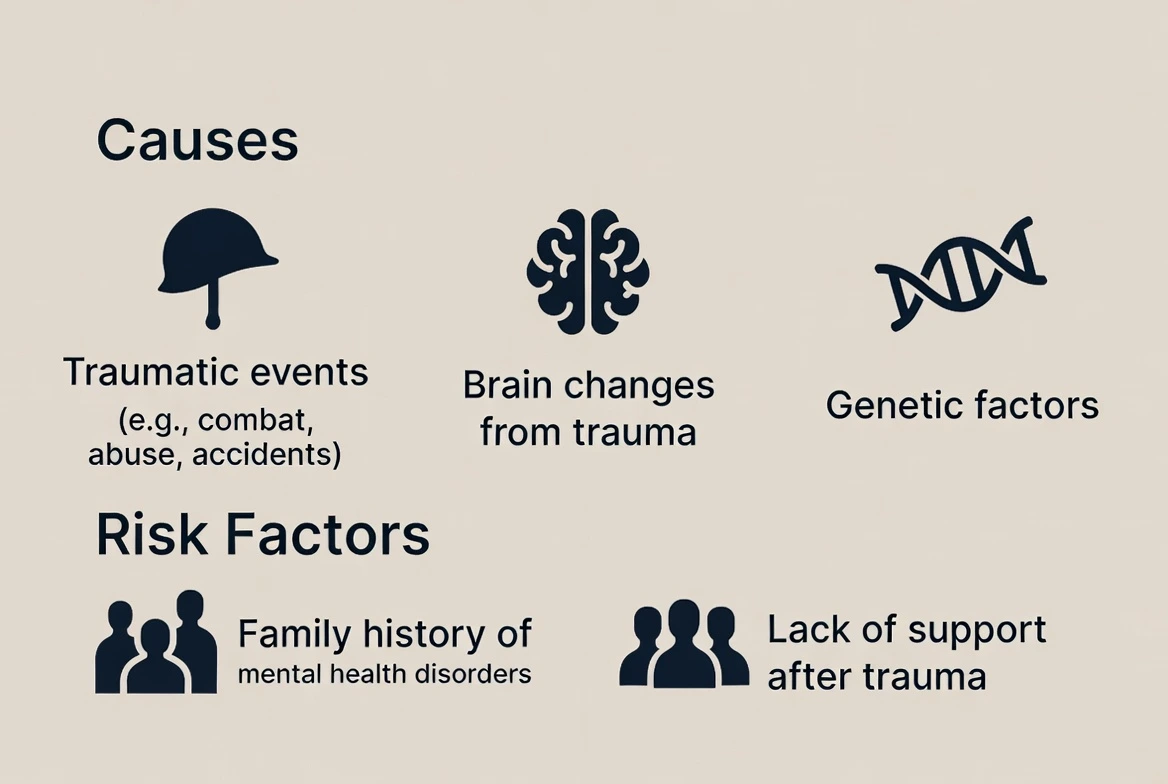
A frequent question in my office is, “What causes post-traumatic stress disorder? Why do two people experience the same event, but only one develops PTSD?” The answer lies in the complex interplay of biology, psychology, and environment.
The Traumatic Catalyst
Can a traumatic event cause PTSD? Absolutely, but the “trauma” is defined by the individual’s subjective experience of helplessness and horror. Common catalysts include:
- Combat exposure and military conflict.
- Physical or sexual assault.
- Childhood neglect or maltreatment.
- Accidents, medical emergencies, or natural disasters.
Risk and Resilience Factors
Beyond the event itself, several factors influence whether the brain’s “emergency response” becomes “stuck.”
- Biological Vulnerability: Genetics play a role in how our HPA axis (the body’s stress response system) functions. Some individuals have a more sensitive “tripwire” for cortisol and adrenaline.
- Previous Trauma: Earlier life stressors can “prime” the nervous system, making it more susceptible to PTSD after a subsequent event.
- Social Support: This is perhaps the most significant environmental factor. A lack of supportive resources immediately following a trauma significantly increases the risk of chronicity.
In my clinical experience, understanding post-traumatic stress disorder triggers helps tailor therapy. However, I also emphasize the concept of post-traumatic growth. Many patients eventually find that their recovery process leads to increased personal strength, deeper relationships, and a revised appreciation for life.
PTSD Symptoms (Main Topic)
When we discuss post-traumatic stress disorder symptoms, we are looking at a constellation of reactions that occur when the brain fails to process a memory correctly. In a healthy brain, memories are “filed away” in the hippocampus. In PTSD, the memory remains “live” and “hot,” stored in the amygdala, as if the event were still happening.
The post-traumatic stress disorder symptoms, according to DSM-5, include four primary clusters. To understand the “why” behind these symptoms, we must look at the neurobiology of the “survival brain.”
A. Intrusive Memories (The “Reliving” Cluster)
These are the hallmark signs of post-traumatic stress disorder. They include involuntary flashbacks, where the person feels they are back in the event, and distressing nightmares.
- The “Why”: Because the memory was never properly integrated, any sensory input—a smell, a sound, a certain light—can trigger the amygdala to fire as if the danger were immediate. The brain is attempting to “re-process” the event, but gets stuck in a loop of terror.
B. Avoidance
Patients go to great lengths to avoid people, places, or thoughts that remind them of the trauma.
- The “Why”: Avoidance is a primary defense mechanism. It is an attempt to keep the “hot” memory from being triggered. However, in the long term, avoidance prevents neuroplasticity—the brain never learns that the current environment is actually safe.
C. Negative Alterations in Cognition and Mood
This cluster includes persistent negative beliefs about oneself (“I am bad,” “The world is dangerous”), emotional numbness, and difficulty feeling positive emotions.
- The “Why”: This is often a result of “dissociation.” When the pain is too high, the brain “shuts down” the emotional centers to protect the individual. Additionally, chronic stress depletes neurotransmitters like serotonin and dopamine, leading to a state that mimics clinical depression.
D. Hyperarousal and Reactivity (The “On-Edge” Cluster)
Symptoms include being easily startled, feeling “keyed up” or hypervigilant, irritability, and severe sleep disturbances.
- The “Why”: The brain’s “prefrontal cortex” (the logical center) has been overridden by the “amygdala” (the alarm center). The person is in a state of constant executive function depletion because their brain is spending all its energy scanning the horizon for a threat that isn’t there.
A nuance only a practicing psychologist would know is how sleep hygiene and circadian rhythms can make or break PTSD treatment.
The Insight: I once treated a veteran, “David,” whose post-traumatic stress disorder symptoms in adults were severely exacerbated by his night terrors. He began staying awake to avoid the nightmares, which completely disrupted his internal clock.
This sleep deprivation weakened his prefrontal cortex—the very part of the brain we needed to “tame” his amygdala during therapy. By using Prazosin (a medication for nightmares)
and establishing a strict sleep routine, we stabilized his biology first. Only then was he able to engage in the heavy lifting of trauma-processing therapy. Without sleep, the brain lacks the “fuel” for recovery.
PTSD Diagnosis and ICD-10 Codes
Arriving at a formal diagnosis involves a careful assessment of symptoms against the post-traumatic stress disorder ICD-10 framework. For clinicians, the move from a general observation to a specific code is essential for insurance and disability documentation.
The Coding Hierarchy
- F43.10 – Post-traumatic stress disorder, unspecified: Used when the specific timeline or symptoms are still being evaluated.
- F43.11 – Post-traumatic stress disorder, acute: Symptoms have been present for at least one month but less than three.
- F43.12 – Post-traumatic stress disorder, chronic: Symptoms have persisted for more than three months, which is the most common code for long-term disability support.
Accurate coding ensures patients can access the specialized care they need, such as EMDR or high-intensity outpatient programs. While the DSM-5 is our primary tool for clinical depth, the ICD-10 is the language of the broader healthcare system.
PTSD Treatment Options
In my experience, the most successful post-traumatic stress disorder treatment plans are those that integrate biological stabilization with psychological processing. I often tell my patients that medication provides the “floor”—a stable base that prevents them from sinking too deep—while therapy provides the “ladder” out of the trauma.
Evidence-Based Psychotherapy
The “gold standard” for treating PTSD is trauma-focused psychotherapy. These treatments are specifically designed to help the brain move traumatic memories from the “alarm center” (the amygdala) to the “filing cabinet” (the hippocampus).
- Cognitive Behavioral Therapy (CBT) & Cognitive Processing Therapy (CPT): These focus on identifying “stuck points”—distorted beliefs like “it was my fault” or “the world is 100% dangerous”—and reframing them through logic and evidence.
- Prolonged Exposure (PE): This involves safely and gradually facing trauma-related memories and situations that the patient has been avoiding. This promotes neuroplasticity, as the brain slowly learns that these triggers no longer signal actual danger.
- Eye Movement Desensitization and Reprocessing (EMDR): This unique therapy uses bilateral stimulation (like eye movements or taps) to help the brain process traumatic material. I have found this particularly helpful for patients who find it too distressing to talk through their trauma in great detail.
Pharmacotherapy and Symptom Management
While PTSD treatment options should prioritize therapy, medications are vital for managing the physiological “storms” of the disorder.
- SSRIs/SNRIs: Medications like Sertraline (Zoloft) and Venlafaxine (Effexor) are often first-line choices to help regulate mood and reduce the baseline of anxiety.
- Prazosin: This is a specific alpha-1 blocker often used off-label for trauma-related nightmares. By lowering the “adrenaline” response in the brain during sleep, it allows for a more restorative rest, which is crucial for daytime therapeutic work.
Acute vs. Chronic PTSD
A critical part of my diagnostic process is determining the “age” of the trauma response. The distinction between post-traumatic stress disorder, acute and chronic, isn’t just about time—it’s about how deeply the trauma has integrated into the patient’s identity.
| Type | ICD-10 Code | Duration | Clinical Focus |
|---|---|---|---|
| Acute PTSD | F43.11 | 1 to 3 months | Stabilization, prevention of “consolidation.” |
| Chronic PTSD | F43.12 | 3+ months | Trauma processing, identity rebuilding. |
| Unspecified | F43.10 | Unknown | Initial assessment and crisis management. |
In the acute phase (F43.11), our goal is to provide “Psychological First Aid” to prevent the symptoms from hardening into a chronic condition. For chronic post-traumatic stress disorder (F43.12), the work often shifts toward addressing secondary issues like depression, substance use, or the feeling of a “foreshortened future”—the sense that one will not live a long or normal life.
PTSD in Daily Life and Functioning

When PTSD is triggered, it isn’t just a mental event; it is a full-body takeover. I have seen patients who are high-functioning executives suddenly unable to enter a boardroom because a certain scent reminded them of a childhood trauma.
The behavioral symptoms of PTSD often manifest as:
- Occupational Struggles: Difficulty concentrating (executive function depletion) leads to poor performance or frequent job changes.
- Relationship Strain: The “emotional numbness” of PTSD can make a person seem cold or distant to loved ones, leading to a cycle of isolation.
- Health Comorbidities: Chronic hyperarousal puts immense strain on the cardiovascular and gastrointestinal systems.
In my practice, helping patients identify their unique triggers—whether it’s a specific tone of voice or a crowded room—is the first step in reclaiming their daily functioning. We work on “grounding techniques” to bring the brain back from a flashback into the safety of the present moment.
PTSD in Special Populations
Trauma does not occur in a vacuum; it is shaped by culture and vocation.
- Veterans and First Responders: These populations often face “moral injury”—a deep sense of guilt or shame regarding actions taken or witnessed. Specialized care at VA facilities often focuses on these unique ethical burdens.
- Spanish-Speaking Populations: Access to bilingual and bicultural care is a significant barrier. In my experience, “cultural competency” means more than just translating words; it means understanding concepts like familismo (the importance of family) and how they influence a patient’s willingness to seek help.
- Complex PTSD (C-PTSD): For those who survived years of systemic abuse, the “self” itself may feel fractured. These patients require a “phase-based” approach, focusing first on safety and stabilization before even touching the trauma memories.
Frequently Asked Questions
What is the primary difference between PTSD and acute stress disorder?
Acute Stress Disorder occurs within the first month after a trauma. If symptoms persist beyond one month, the diagnosis typically shifts to PTSD.
Can PTSD be cured?
While the memory of the trauma remains, we can “de-fang” the memory so it no longer triggers a physiological panic. Many patients reach a state of “functional remission” where PTSD no longer dictates their life choices.
How is PTSD documented for insurance?
Insurers require a specific post-traumatic stress disorder ICD-10 code (such as F43.12) along with documentation of functional impairment, such as its impact on your ability to work or maintain relationships.
Conclusion
Recovery from post-traumatic stress disorder is not about forgetting what happened; it is about teaching the brain that the danger has passed. Whether you are dealing with acute or chronic PTSD, the combination of accurate ICD-10 coding, evidence-based therapy, and biological support offers a clear path toward healing.
If you recognize these PTSD symptoms in yourself or a loved one, please know that the “alarm” in your brain can be turned down. You do not have to live in a permanent state of survival.
References & Resources
- U.S. Dept. of Veterans Affairs: National Center for PTSD
- World Health Organization: ICD-10 F43 Resource Page
- NIMH: Post-Traumatic Stress Disorder Information
- Bipolar Lives: Expert Psychological Resources

Related Posts





Subscribe to Our Newsletter
Get mental health tips, updates, and resources delivered to your inbox.
MORE from Author
Read More Watching someone you care about struggle with bipolar depression and anxiety can be heartbreaking. You may notice that they withdraw…
 In my practice as a clinical psychologist, I often observe that the difference between a patient who crumbles under pressure…
 We all have "up" days and "down" days. Perhaps you feel energized after a promotion or sluggish on a rainy…
 To define bipolar disorder accurately, we must look at it as a chronic mood dysregulation condition. In psychology and medicine,…
Are you looking for a Therapist?
Connect with qualified mental health professionals who understand
bipolar disorder, mood changes, and emotional challenges.
Private • Supportive • Confidential