
Radical Acceptance in DBT: Definition, Worksheets, Step-by-Step Practice & Real-Life Examples
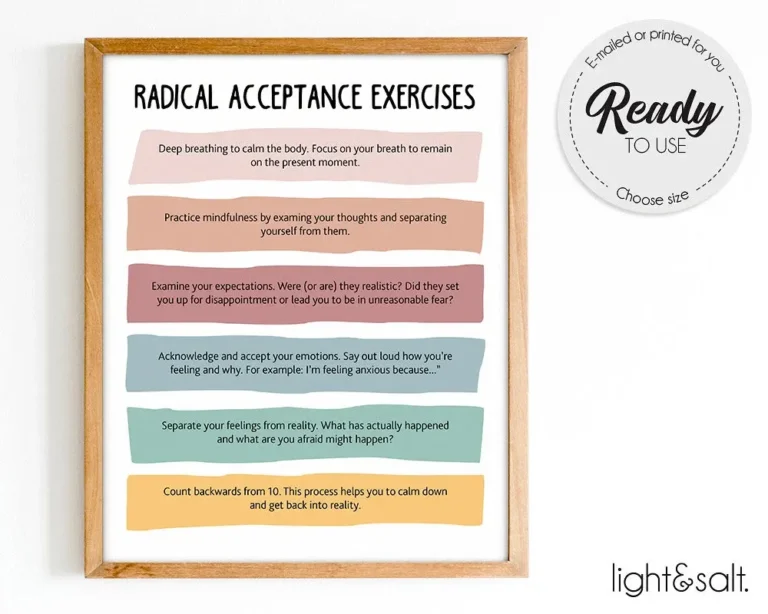
In my practice, I often sit with individuals who feel as though they are fighting a war against their own history. They are exhausted from the struggle of wishing things were different, often saying, “It shouldn’t be this way” or “Why did this happen to me?” This internal resistance is what we call “suffering.”
While pain is a natural part of the human experience—especially when navigating the complexities of a mood disorder—suffering is what happens when we refuse to accept that pain. Radical acceptance DBT is the clinical “circuit breaker” for this cycle. It is the brave act of completely and totally accepting reality as it is, without trying to fight it or hide from it.
What Is Radical Acceptance in DBT?
Radical acceptance dbt definition, is the skill of fully acknowledging reality as it is in the present moment—without judgment, resistance, or avoidance—in order to reduce unnecessary emotional suffering. The word “radical” is used because this acceptance is not partial; it is total. It is accepting something with your mind, your heart, and your body.
In the framework of Dialectical Behavior Therapy (DBT), this skill lives within the Distress Tolerance module. It is a “Crisis Survival” skill because it is used when you are facing a situation that you cannot change immediately.
If you are stuck in a massive traffic jam and you are already late for a doctor’s appointment, you have two choices: you can scream at the steering wheel and spike your cortisol (suffering), or you can radically accept that you are stuck (pain). The traffic doesn’t move either way, but the second option leaves you with more emotional energy to handle the consequences.
What Is Dialectical Behavior Therapy (DBT)?
Before we dive deeper into the radical acceptance DBT skill, it helps to understand the “D” in DBT. “Dialectical” refers to the idea that two seemingly opposite things can both be true at the same time. In therapy, the core dialectic is Acceptance and Change.
Dr. Marsha Linehan developed DBT originally for Borderline Personality Disorder, but it has become a gold standard for treating Bipolar Disorder because it provides concrete tools for emotional regulation. The program is traditionally broken down into four main modules:
- Mindfulness: The foundation of all skills; being aware of the present moment.
- Distress Tolerance: How to survive a crisis without making it worse (where Radical Acceptance lives).
- Emotion Regulation: How to decrease the frequency and intensity of emotional waves.
- Interpersonal Effectiveness: How to ask for what you need and say “no” while maintaining self-respect.
Is Radical Acceptance CBT or DBT?

A common question I hear from patients is, “Is radical acceptance CBT or DBT?” While there is significant overlap in modern psychotherapy, Radical Acceptance is formally a DBT concept.
Cognitive Behavioral Therapy (CBT) often focuses on “Cognitive Restructuring”—the process of challenging and changing your thoughts to change your mood. In contrast, DBT focuses on accepting the thought or the reality as it is before moving toward change. Think of it this way: CBT asks, “Is this thought true?” while DBT says, “This is happening; now, how do I tolerate it?” Both are effective, but Radical Acceptance is specifically designed for situations where “thinking your way out” is no longer an option.
Radical Acceptance DBT Concept Explained Deeply
To truly understand what radical acceptance is in DBT, we have to look at the biology of resistance. When we refuse to accept a painful reality, our brain stays in a state of high arousal. Our amygdala—the alarm center—continues to fire because it perceives “reality” as a threat that must be fought. This chronic stress suppresses Executive Function, making it nearly impossible to make wise decisions.
The Equation of Suffering
I often teach my patients this formula: Pain x Resistance = Suffering. * Pain is unavoidable. Losing a job, experiencing a depressive episode, or losing a loved one is painful.
- Resistance is the “Why me?” or the “This can’t be happening.”
- Suffering is the result of multiplying that pain by your refusal to let it be.
By practicing radical acceptance DBT concept strategies, you bring the “Resistance” factor down to zero. The pain remains, but the suffering vanishes. This creates a “clear space” in your mind.
In my practice, I often observe that the hardest thing for a patient to radically accept is a Bipolar Disorder diagnosis itself. I’ve had patients spend years—and thousands of dollars—trying to prove they don’t have it, often stopping medication as soon as they feel “normal.” This resistance leads to repeated hospitalizations and broken relationships. I tell them: “Accepting you have Bipolar doesn’t mean you like it. It doesn’t mean you are ‘crazy.’ It just means you finally have the right map for the territory.” Once they accept the diagnosis, the real healing begins because they stop fighting the map and start walking the path.
Radical Acceptance vs. Self-Acceptance
While related, self acceptance dbt and radical acceptance serve different functions. Radical acceptance is broad; it applies to external events (the weather, a breakup, a tragedy) and internal events (a feeling of intense anger or a manic urge). Self-acceptance is specifically about accepting your own character, history, and flaws. You use radical acceptance as a tool to achieve self-acceptance.
Radical Acceptance DBT Examples in Real Life
To make this concrete, let’s look at how this skill applies to different life scenarios. These radical acceptance DBT examples show the shift from “Willful Resistance” to “Willing Acceptance.”
| The Situation | The Resistance (Suffering) | Radical Acceptance (Peace) |
| A Breakup | “They shouldn’t have left. I’ll never find someone else. This is unfair!” | “We are no longer together. It is deeply painful, but this is the current reality.” |
| Bipolar Episode | “I can’t believe I’m depressed again. I’m a failure. I shouldn’t be this way.” | “A depressive episode is happening right now. I will follow my treatment plan.” |
| A Mistake at Work | “I am so stupid. I wish I could turn back time. I’m going to get fired.” | “I made a mistake. It is done. Now, what is the next most effective step?” |
| Chronic Pain | “Why do I have to hurt? I can’t live like this. Life is over.” | “I have pain in my body today. I will do what I can to manage it, but it is here.” |
A Case From My Clinical Practice: “James” and the Lost Promotion
I once worked with a patient named James who had worked for three years toward a senior management role. When he was passed over for a younger colleague, he became consumed by bitterness. He stopped sleeping (a dangerous trigger for his Bipolar I) and spent his days ruminating on the “injustice.”
James was stuck in resistance. During our sessions, we worked on a radical acceptance dbt worksheet. We identified that his refusal to accept reality was causing more damage to his mental health than the lost promotion itself.
The breakthrough came when James used the “Turning the Mind” skill. Every time he felt the “It’s not fair” thought, he would visualize a fork in the road. One path was “Bitter Resistance,” and the other was “Radical Acceptance.” He chose the second path—not because he was happy about the job, but because he was tired of suffering. This shift allowed his Circadian Rhythms to stabilize as his stress decreased, and he was eventually able to find a better position at a different firm. He survived the crisis because he stopped fighting the past.
How to Practice Radical Acceptance: Step-by-Step
Learning how to practice radical acceptance in DBT is a process of retraining your brain. It is not a “one-and-done” event; it is a daily practice of Neuroplasticity.
Step 1: Observe Resistance
Notice when you are fighting reality. Watch for “red flag” phrases like “It shouldn’t be this way,” “Why me?” or “I can’t stand this.” Feel the tension in your body.
Step 2: Acknowledge Reality
State the facts of the situation clearly and neutrally. For example: “I am in the hospital for a manic episode.” Do not add “and it’s because I’m a loser.” Just the facts.
Step 3: “Turning the Mind”
This is the core turning the mind DBT skill. You must make an active inner choice to accept. You might have to do this 100 times in a single hour when the pain is fresh.
Step 4: Use Willingness Over Willfulness
Willfulness is trying to force your will on the world. Willingness is being open to the world as it is. Relax your body, use “half-smile” or “willing hands” (palms up) to signal to your brain that you are not in a fight.
Step 5: Practice Daily
Start small. Radically accept that the milk is expired or that it’s raining. This builds the “muscle” you will need for the bigger life crises.
Radical Acceptance Worksheet & PDF Resources
In my clinical experience, the most difficult part of practicing radical acceptance step by step is the “forgetting factor.” When emotions run high, our memory for therapeutic tools often runs low. This is why I provide my patients with a radical acceptance dbt worksheet to keep in their “mental health first aid kit.”
A high-quality radical acceptance DBT worksheet pdf should help you bridge the gap between “knowing” the skill and “living” it. It functions as a roadmap for your Executive Function when your “Emotional Mind” is trying to take the wheel. Your toolkit should include:
- The Reality Script: A place to write down the cold, hard facts of your situation without any “flavoring” (no judgments, no “shoulds”).
- Resistance Identification Grid: A table to list what you are currently fighting and what that fight is costing you in terms of energy and sleep.
- Radical Acceptance Cheat Sheet: A one-page summary of DBT radical acceptance prompts to use during a crisis.
- Turning the Mind Log: A tracker to note how many times you had to “re-accept” a difficult reality in a single day.
By using a radical acceptance DBT skill pdf, you transform an abstract concept into a tangible practice. You can download these resources below to begin building your own resilience.
Radical Acceptance Group Activity (Therapist-Focused)

For those in a radical acceptance DBT group activity, the focus is often on shared humanity. We find that we are not alone in our resistance. One of my favorite activities involves the “Stone of Reality.”
Each participant holds a heavy stone and describes a reality they are fighting. As they speak, they notice the physical strain in their arm. We then practice the radical acceptance DBT concept by “setting the stone down.” We don’t throw it away—the reality is still in the room—but we stop carrying the weight of the resistance. This visual and tactile experience helps cement the idea that acceptance is an act of self-compassion.
Radical Acceptance Meditation
Many people search for a meditation for radical acceptance worksheet to help them find a sense of peace. This isn’t a typical “relaxation” meditation; it is a “willingness” meditation.
I often guide my patients through a “Body Scan for Resistance.” We sit quietly and scan the body for tightness—the jaw, the shoulders, the gut. We breathe into that tightness and say silently, “In this moment, I accept this sensation. In this moment, I accept this reality.” This practice helps develop self acceptance dbt by showing us that we can hold space for pain without being consumed by it. You can find many excellent radical acceptance DBT YouTube videos or radical acceptance DBT video guides that lead you through this specific process.
Frequently Asked Questions
Does radical acceptance mean I have to like what happened?
No. This is the most common misconception. Acceptance is not approval. You can radically accept that you have a chronic illness while still hating the fact that you have it. Acceptance simply means you stop trying to argue with the fact that it exists.
How is radical acceptance used for bipolar disorder?
It is vital to accept the “limitations” that come with the condition. This might mean radically accepting that you need eight hours of sleep or that you cannot use alcohol safely. When you accept these facts, you stop being a “victim” of your diagnosis and start being a manager of your health.
Can I use radical acceptance in an abusive relationship?
Actually, this is a “safety first” situation. You radically accept the fact that the person is being abusive, which allows you to move out of denial and into a safety plan. You do NOT accept that the abuse is “okay” or that you should stay.
What is the 24-hour rule for radical acceptance?
If a reality is too painful to accept all at once, commit to accepting it for just 24 hours. Tell yourself, “For the next day, I will stop fighting this.” Often, once the “fight” stops for a day, the mind realizes it is safe enough to continue accepting.
Conclusion
While radical acceptance DBT is a life-changing tool, it must be used with clinical wisdom. If you are in the middle of a high-energy manic episode or a life-threatening depressive “pit,” you may not have the cognitive resources to practice this alone.
Radical acceptance is not a replacement for mood stabilizers or professional therapy. It is a behavioral skill that supports your medical treatment. If you find that practicing acceptance is making you feel “hopeless” rather than “peaceful,” please reach out to your psychiatrist or therapist.
True radical acceptance DBT should feel like a “letting go,” not a “giving up.” It is the moment you stop swimming against the current so you can finally see the shore. By choosing willingness over willfulness, you are reclaiming your power from the past and placing it firmly in the present.
References:
Related Posts





Subscribe to Our Newsletter
Get mental health tips, updates, and resources delivered to your inbox.
MORE from Author
Read More In my practice as a clinical psychologist, I often observe that the difference between a patient who crumbles under pressure…
- We all have "up" days and "down" days. Perhaps you feel energized after a promotion or sluggish on a rainy…


 To define bipolar disorder accurately, we must look at it as a chronic mood dysregulation condition. In psychology and medicine,…
 To answer whether bipolar fits the bill, we first have to define what a neurodivergent person actually is. The term…

Are you looking for a Therapist?
Connect with qualified mental health professionals who understand
bipolar disorder, mood changes, and emotional challenges.
Private • Supportive • Confidential