
Self-Soothing Skills: DBT Techniques, Adult Coping Tools, and When Babies Develop Self-Soothing

Have you ever felt so overwhelmed that your chest tightened, your thoughts raced, and you felt like you were losing your grip? In my practice, I often observe patients reaching a “breaking point” where their emotions feel less like a mood and more like a physical assault. Whether you are navigating the high-voltage energy of bipolar mania or the heavy, suffocating blanket of depression, learning how to calm your own nervous system is a vital survival skill.
But what are self-soothing skills, exactly? Most of us weren’t taught how to do this as children; we were simply told to “calm down” without being given the manual. Understanding the self-soothing meaning starts with recognizing that your body has a built-in “off switch” for stress—you just need to learn how to flip it.
What Is Self-Soothing & How Does It Work?
The term self-soothing refers to any intentional action taken to regulate emotional distress by calming the nervous system. From a neurobiological perspective, self-soothing is the process of moving the body from a “fight or flight” state (sympathetic nervous system) to a “rest and digest” state (parasympathetic nervous system).
When you experience a trigger—perhaps a stressful email or a sudden mood shift—your adrenal glands flood your system with cortisol and adrenaline. This is your body’s way of preparing for a threat. However, in modern life, and especially with mood disorders, this alarm system often goes off when there is no physical danger.
Self-soothing skills act as a “top-down” and “bottom-up” intervention. By using sensory or cognitive tools, you signal to your brain’s amygdala that the threat has passed. This reduces your heart rate, slows your breathing, and allows your Executive Function to come back online so you can think clearly again.
Is Self-Soothing a DBT Skill?
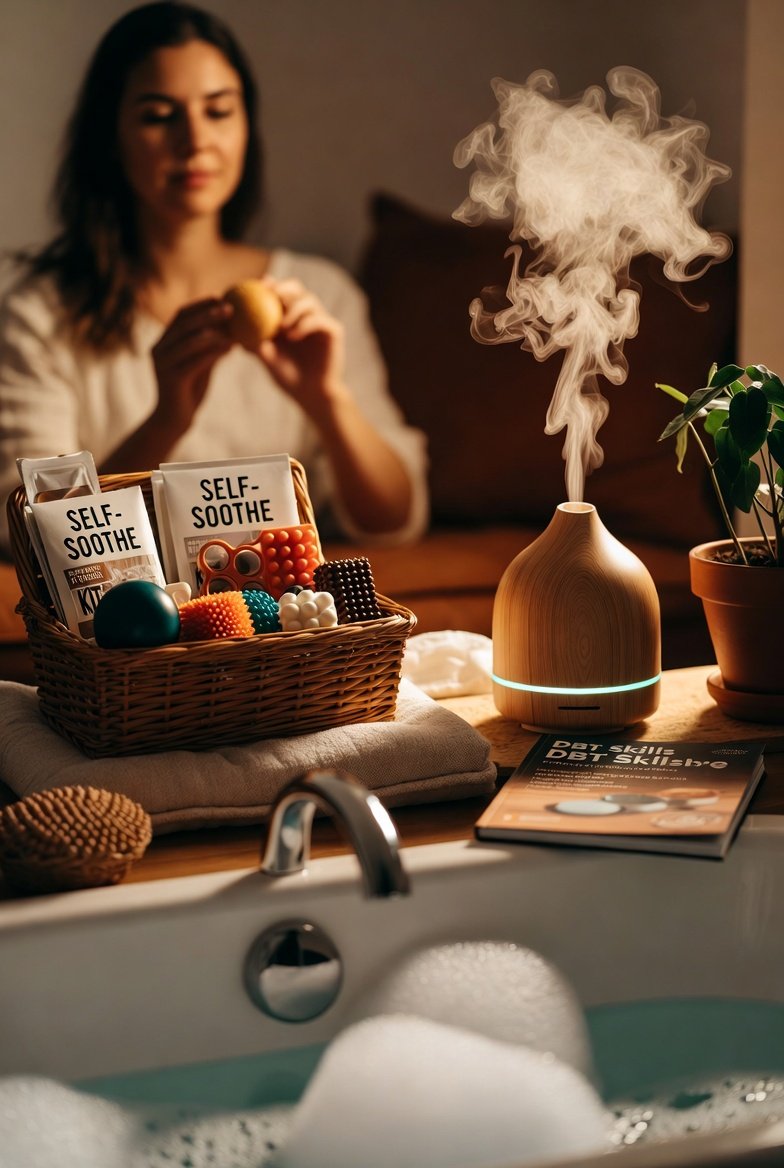
Yes, absolutely. Self-soothing skills DBT are a fundamental component of the Distress Tolerance module developed by Dr. Marsha Linehan. While many therapies focus on changing a situation, DBT recognizes that sometimes you just have to survive the moment without making it worse.
In the DBT framework, self-soothing is specifically categorized under “Crisis Survival Strategies.” It is distinct from problem-solving. If your house is on fire, you don’t sit down to meditate; you get out. But if you are safe and your brain feels like it’s on fire, self-soothing is the fire extinguisher.
What are the 6 DBT Skills?
While DBT is traditionally taught in four main modules, many modern clinical applications break them down into six specific skill sets to improve comprehension:
| DBT Skill Set | Clinical Purpose | Example |
| Mindfulness | Developing present-moment awareness. | Noticing a “racing heart” without judgment. |
| Distress Tolerance | Surviving a crisis without impulsive acts. | Using the ACCEPTS distraction method. |
| Self-Soothing | Calming the nervous system via the 5 senses. | Listening to ambient rain sounds. |
| Emotion Regulation | Reducing vulnerability to “Emotional Mind.” | Maintaining a steady Circadian Rhythm. |
| Interpersonal Effectiveness | Navigating relationships and setting boundaries. | Using the “DEAR MAN” technique. |
| Walking the Middle Path | Balancing extremes (Validation + Change). | Acknowledging a feeling while choosing a new action. |
DBT Self-Soothing Skills Explained: The Five Senses
In my work with bipolar disorder, I find that patients often struggle with “abstract” coping. When you are in a manic or depressive tailspin, you need something concrete. The dbt self soothing skills utilize the five senses because sensory input is the fastest way to bypass a ruminating mind and talk directly to the nervous system.
Vision
Focus on something pleasing to the eye. This might involve looking at a photo of a loved one, watching a lava lamp, or simply sitting in a park and counting the different shades of green in the trees.
Hearing
Sound has a profound impact on the brain’s arousal levels. I often suggest a “soothing playlist.” For some, this is classical music; for others, it is white noise or a guided meditation.
Smell
The olfactory bulb is directly connected to the limbic system (the brain’s emotional center). Using lavender oil, smelling fresh coffee, or even the scent of clean laundry can trigger an immediate “grounding” effect.
Taste
This isn’t about “stress eating.” It is about mindful tasting. Slowly sipping a warm cup of herbal tea or noticing the sharp burst of a peppermint can pull you out of a dissociative state.
Touch
The skin is the body’s largest organ. A weighted blanket, a soft sweater, or holding a smooth “fidget stone” provides tactile feedback that helps the brain feel “contained” and safe.
In my clinical practice, I have noted a specific nuance regarding the “Touch” sense that many patients overlook. While soft textures are great for depression, they often aren’t “loud” enough for a manic or high-anxiety crisis.
In those moments, I recommend the “Ice Dive.” Splashing ice-cold water on your face for 15 seconds triggers the Mammalian Dive Reflex. This immediately drops your heart rate and forces your nervous system to reset. It’s an aggressive form of self-soothing that works when “soft” techniques fail.
Self-Soothing Skills for Adults
Many people ask, “How do I teach myself to self-soothe as an adult? It feels embarrassing to some, but it shouldn’t. Most adults who struggle with emotional regulation missed out on “co-regulation” as children—meaning they didn’t have a caregiver help them move from upset to calm.
To improve self-soothing skills for adults, you must first build awareness of your “baseline.” If you only try to self-soothe when you are at a 10/10 on the distress scale, you will likely fail. You must practice when you are at a 3 or 4.
How Can Adults Improve Self-Soothing Skills?
- Create a “Soothe Kit”: Keep a small bag with an essential oil roller, a textured coin, and a pair of noise-canceling headphones.
- Practice Paced Breathing: Breathe in for 4 seconds, hold for 2, and breathe out for 6. The long exhale is the “signal” to your brain to relax.
- Use Cognitive Self-Soothe: Develop a “kind inner voice.” Instead of “I’m losing it,” try saying, “I am having a hard time, and I am doing what I can to stay safe.”
A Case From My Clinical Practice: “Elena” and the Nighttime Surge
I remember “Elena,” a patient with Bipolar II who struggled with intense “nighttime agitation.” As the sun went down, her anxiety would spike, often leading to impulsive late-night calls or self-deprecating thoughts. We realized her Circadian Rhythm was being disrupted by her emotional state, creating a vicious cycle of insomnia and mood instability.
We developed a self-soothing skills worksheet specifically for her 9:00 PM window. Instead of scrolling on her phone (which increased her arousal), Elena committed to a “Sensory Circuit.” She would put on a heavy sweatshirt (Touch), light a vanilla candle (Smell), and listen to an audiobook of a story she already knew (Hearing/Cognitive).
Within three weeks, Elena reported that her “dread” had decreased significantly. She wasn’t just “distracting” herself; she was training her brain that nighttime was a safe, regulated space. She learned to move from a state of “threat” to a state of “safety” using nothing but her own senses.
When Do Babies Develop Self-Soothing Skills?

Understanding when babies develop self-soothing skills helps us understand our own adult regulation. Self-soothing isn’t something we are born with; it is a developmental milestone.
Early forms of self-soothing, like sucking on a thumb or fist, can appear as early as 3 to 4 months. However, most babies do not develop the neurological maturity to consistently self-soothe until 6 months of age.
This process is heavily dependent on “Attachment Theory.” When a parent consistently soothes a crying infant, they are actually “loaning” the baby their own nervous system. Over time, the baby “internalizes” this calm, and their brain begins to build the neural pathways to do it themselves.
If you find it hard to soothe yourself today, it may be because those pathways weren’t fully reinforced during your self-soothing baby years. The good news? Neuroplasticity means you can still build them now.
Self-Soothing Skills for Kids, Toddlers & Infants
As a psychologist, I often have to remind parents that self-soothing skills for toddlers look very different from those of adults. While an adult might reach for a cup of tea, a toddler might reach for a “lovey” or a pacifier. This is a critical stage of development where the child moves from total dependence on a caregiver (co-regulation) to the very early stages of independence.
For self-soothing skills for infants, the process is almost entirely physical. Between 3 and 6 months, a baby might start to tuck their hands into their mouth or turn their head away from overstimulating lights.
By the time they become toddlers, we can start teaching “The Turtle Technique”—curling into a ball—or taking “balloon breaths.” If you are a parent, remember that “sleep training” is often a hot topic, but the goal is always to support the child’s nervous system without overwhelming it. If a child is in a state of “toxic stress,” they aren’t learning to soothe; they are learning to shut down. Healthy self-soothing baby habits are built on a foundation of safety.
How Self-Soothing Works: The Neuroscience Layer
Why does holding a cold stone or smelling lavender actually work? It isn’t magic; it’s biology. When you engage in self-soothing techniques, you are stimulating the Vagus Nerve. This nerve is the “superhighway” of the parasympathetic nervous system.
When you are in a bipolar high or a deep depressive low, your amygdala is overactive. By focusing on a physical sensation—like the weight of a blanket—you are sending a signal through the spinal cord to the brainstem that says, “We are physically safe.” This causes a drop in heart rate and a shift in blood flow back to the prefrontal cortex. This is why self-soothing’s meaning is so much deeper than just “feeling better.” It is about restoring the brain’s ability to govern itself.
Healthy Self-Soothing vs. Harmful Coping
In my practice, I have to be very clear about the difference between a “soothe” and a “numb.” Because many people with Bipolar Disorder feel pain so intensely, they often turn to substances, overeating, or self-harm to “soothe” the pain.
| Feature | Healthy Self-Soothing | Harmful Coping |
| Duration | Short-term bridge to calm. | Long-term avoidance or “numbing.” |
| Physical Impact | Lowers cortisol naturally. | Spikes dopamine artificially, then crashes. |
| Outcome | You feel regulated and present. | You feel “checked out” or guilty. |
| Examples | Weighted blankets, music, and tea. | Alcohol, binge eating, and skin picking. |
If you find that your “soothing” involves hiding from your life or hurting your body, it has transitioned into a harmful coping mechanism. The goal of dbt self soothing skills is to keep you present, not to help you disappear.
Frequently Asked Questions
What is the most effective self-soothing skill for anxiety?
Paced breathing is usually the fastest. By extending your exhale longer than your inhale, you manually override the “fight or flight” response in your brain.
How can I teach my toddler to self-soothe?
Model it! When you are frustrated, say out loud, “Mommy is feeling frustrated, so I am going to take three big breaths.” Use “transitional objects” like a stuffed animal to provide comfort when you aren’t there.
Is self-soothing the same as mindfulness?
Not exactly. Mindfulness is noticing the pain without judgment. Self-soothing is doing something to actively comfort the body while the pain is present.
Can adults really learn to self-soothe if they didn’t learn as kids?
Yes. Thanks to neuroplasticity, your brain can build new pathways at any age. It just takes consistent practice during “low-stress” times to make the skills available during “high-stress” times.
Conclusion
While self-soothing skills are incredibly powerful, they are not a cure-all. In the context of Bipolar I or II, there are moments when the biological “fire” is too big for a weighted blanket or a cup of tea to put out.
If you find that you are using these skills but your thoughts are still turning toward self-harm, or if your mania is preventing you from sleeping for more than 24 hours, you need to contact your clinician immediately. Self-soothing is meant to be a bridge to get you to your next appointment or to a safe baseline—it is not a replacement for medication or professional intervention.
If you are in the US and experiencing a mental health emergency, please call or text 988 for the Suicide & Crisis Lifeline. Remember, learning to soothe yourself is a profound act of self-respect. It is the way you tell your body, “I’ve got you, and we are going to be okay.”
References:
Related Posts

Subscribe to Our Newsletter
Get mental health tips, updates, and resources delivered to your inbox.
MORE from Author
Read More In my practice as a clinical psychologist, I often observe that the difference between a patient who crumbles under pressure…
- We all have "up" days and "down" days. Perhaps you feel energized after a promotion or sluggish on a rainy…


 To define bipolar disorder accurately, we must look at it as a chronic mood dysregulation condition. In psychology and medicine,…
 To answer whether bipolar fits the bill, we first have to define what a neurodivergent person actually is. The term…
Are you looking for a Therapist?
Connect with qualified mental health professionals who understand
bipolar disorder, mood changes, and emotional challenges.
Private • Supportive • Confidential