
OCD vs ADHD: How to Tell the Difference, Overlap, Symptoms & Treatment

Medically reviewed by Laura Athey Updated Date: March 28, 2026
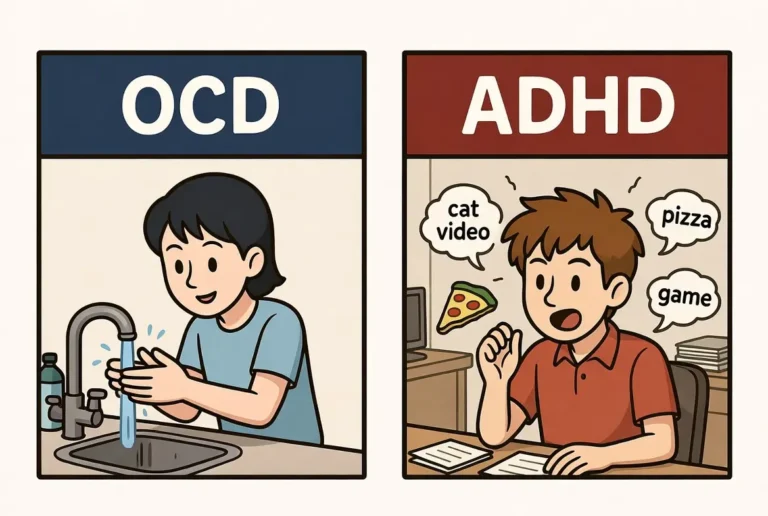
In the modern landscape of mental health, the acronyms OCD vs ADHD are frequently tossed around, yet the internal experiences they represent are worlds apart. Despite their distinct clinical definitions, these two conditions are often misidentified, particularly in adults and women. A person who struggles to keep their desk organized might be labeled “ADHD,” while another who constantly reorganizes their bookshelf might be called “OCD.”
But clinical psychology tells a more nuanced story. Can OCD be mistaken as ADHD? Frequently. For example, the “inattentiveness” of ADHD can look strikingly similar to the “mental preoccupation” of OCD. If you are constantly asking yourself, “How do I know if I have OCD or ADHD?” you are not alone. Both conditions involve executive dysfunction and difficulty with self-regulation, making the diagnostic journey feel like navigating a maze.
This comprehensive guide aims to untangle the knot. We will explore the core differences, the reality of having both simultaneously (comorbidity), and how treatment pathways diverge. Understanding these differences isn’t just about labels—it’s about finding the specific keys to unlock your personal well-being.
Quick Overview: What Is OCD? What Is ADHD?
To understand the differences between OCD and ADHD, we must first look at the “engine” driving each condition.
OCD (Obsessive-Compulsive Disorder)
OCD is fundamentally an anxiety-driven disorder. It is characterized by a cycle of obsessions (intrusive, unwanted thoughts) and compulsions (repetitive behaviors or mental acts performed to neutralize the anxiety caused by the obsession).
- The Driver: Fear and an intolerance of uncertainty.
- The Mechanism: An “overactive” inhibitory system where the brain is constantly on high alert for potential threats.
ADHD (Attention-Deficit/Hyperactivity Disorder)
ADHD is a neurodevelopmental disorder related to the brain’s executive functions. It is characterized by patterns of inattention, hyperactivity, and impulsivity.
- The Driver: Dopamine regulation. The ADHD brain is often “starved” for stimulation.
- The Mechanism: An “underactive” inhibitory system where the brain struggles to filter out distractions or “brake” impulsive urges.
What is the difference between ADHD & OCD? In short: OCD is a disorder of too much control (trying to prevent bad things), while ADHD is a disorder of not enough control (struggling to regulate focus and impulses).
Core Differences: OCD vs ADHD Symptoms Side-by-Side
When comparing OCD vs ADHD symptoms, it helps to look at the “why” behind the behavior. The following table provides a breakdown of how similar outward actions often have opposite internal motivations.
| Feature | OCD (Obsessive-Compulsive Disorder) | ADHD (Attention-Deficit/Hyperactivity Disorder) |
| Thought Pattern | Intrusive Thoughts: Scary, unwanted, and repetitive (ego-dystonic). | Distractibility: Racing thoughts, “ping-ponging” from one idea to the next. |
| Action Pattern | Compulsions: Purposeful rituals to reduce anxiety or prevent harm. | Impulsivity: Doing things without thinking; acting on a whim. |
| Focus Style | Hyper-vigilance: Fixed on a specific fear or perceived error. | Hyperfixation: Intense focus on a high-interest task (often enjoyable). |
| Order/Cleanliness | Symmetry/Checking: Done to feel “safe” or “right.” | Inconsistency: Disorganized due to forgetfulness or lack of “start” energy. |
| Goal | To achieve Certainty and safety. | To achieve Stimulation and novelty. |
OCD vs ADHD rumination also differs significantly. In OCD, rumination is a loop of “What if I did something wrong?” In ADHD, it is more often a “thought drift” where the mind wanders through various topics without a fear-based anchor.
OCD Overthinking vs ADHD Overthinking: Not the Same Thing
The phrase “I’m overthinking” is common to both, but what is the difference between OCD and ADHD overthinking? OCD Rumination: The Fear Loop
In OCD, overthinking is usually rumination. It is a heavy, sticky, and distressing process. A person might spend four hours mentally reviewing a conversation to ensure they didn’t accidentally offend someone. The goal is to solve a problem that likely doesn’t exist to find a sense of peace that never quite arrives.
ADHD Racing Thoughts: The Attention Drift
In ADHD, overthinking is more like racing thoughts. It’s like having 50 browser tabs open at once. You start thinking about your grocery list, which leads to a memory of a recipe, which leads to thinking about a trip to Italy, which leads to wondering how volcanoes work. This isn’t necessarily scary; it’s just disorganized and exhausting.
In the triad of anxiety vs OCD vs ADHD, anxiety is the “alarm,” OCD is the “ritualized response to the alarm,” and ADHD is the “inability to ignore the background noise.”
In clinical practice, the most striking difference I see is the ‘Ego-Dystonic’ nature of OCD. This means the thoughts feel like intruders—they are the opposite of what the person wants to think. For example, a person who loves animals may have intrusive thoughts of hurting them.
In contrast, ADHD ‘hyperfixation’ is often ‘Ego-Syntonic’—the person wants to be doing the thing, even if it’s at an inappropriate time. When diagnosing, I always ask: ‘Does this thought feel like a choice or a hostage situation?’ OCD is a hostage situation; ADHD is a shiny object distraction.
Can You Have OCD and ADHD at the Same Time?
Yes. Can you have OCD and ADHD? Absolutely. In fact, research suggests that approximately 30% of individuals with OCD also have comorbid ADHD.
The Executive Dysfunction Overlap
Having OCD and ADHD together is a unique challenge because they essentially pull the nervous system in two opposite directions. ADHD creates a chaotic, disorganized environment, which then triggers the OCD to “fix” that environment through rigid rituals.
- The Conflict: The ADHD side of the brain wants novelty and hates routines, while the OCD side of the brain demands rigidity to feel safe.
- The Result: This often leads to a “paralysis” where the individual is too overwhelmed to start a task (ADHD) but too terrified to leave it “wrong” (OCD).
ADHD and OCD together in adults often requires a very careful medication strategy, as treating one can sometimes flare the other.
OCD vs ADHD in Adults (Late Diagnosis Focus)
For many, the realization of OCD vs ADHD in adults doesn’t happen until the “masking” strategies of childhood crumble under the weight of adult responsibilities.
Masking and Burnout
Adults with ADHD often develop “compensatory OCD traits.” For example, a person who knows they are forgetful might develop a checking ritual (checking the stove 5 times) not because of a clinical obsession, but as a “hack” to manage their ADHD inattention.
ADHD vs OCD which is worse? This is subjective, but in terms of OCD vs ADHD prognosis, OCD is often cited as more “painful” due to the high levels of distress, while ADHD is often cited as more “disruptive” to career and daily logistics.
OCD vs ADHD in Women (High-Value SEO Section)
The presentation of OCD vs ADHD in women is frequently internalized.
- Perfectionism as a Mask: Many ADHD and OCD in females cases are missed because women are socialized to be “put together.” A woman might use OCD-like perfectionism to hide her ADHD struggles with organization.
- The Anxiety Misdiagnosis: Because women are more likely to be diagnosed with General Anxiety Disorder, their underlying ADHD (which causes the anxiety) or their OCD (which is the source of the anxiety) is often overlooked.
The ADHD and OCD relationship in women often results in severe burnout by their 30s, as the effort required to “keep the plates spinning” becomes unsustainable.
In this second section, we expand the scope to help you distinguish these two from other neurodivergent “lookalikes,” while deep-diving into the specific behaviors that cause the most confusion in daily life.
OCD vs ADHD vs Anxiety vs Autism
Because the human brain is interconnected, symptoms rarely exist in a vacuum. To get an accurate diagnosis, a clinician must look at the OCD vs ADHD vs Autism triad.
OCD vs ADHD vs Anxiety
As discussed, anxiety vs OCD vs ADHD is a matter of the “source.”
- Anxiety is a general state of “What if?”
- OCD is a specific “What if?” followed by a “I must do this to stop it.”
- ADHD is “I can’t stop my brain from jumping between ‘What if,’ ‘Look at that,’ and ‘I forgot my keys.’”
OCD vs ADHD vs Autism
This is perhaps the most common point of confusion. Both autism vs OCD vs ADHD involve repetitive behaviors and a need for routine.
- Autistic Repetitive Behaviors (Stimming): These are usually “Ego-Syntonic” (enjoyable or soothing). A child flaps their hands because it feels good.
- OCD Compulsions: These are “Ego-Dystonic” (distressing). A person taps their hand because they feel they have to or something bad will happen.
- ADHD “Stimming”: This is about regulating under-stimulation. A person taps their pen because they need the sensory input to stay focused.
ADHD Hyperfixation vs OCD Compulsions
A common debate on OCD vs ADHD Reddit threads is whether “losing yourself” in a task is a symptom of one or the other.
Enjoyment vs. Distress
- ADHD Hyperfixation: This is an “interest-based” nervous system. You spend six hours researching a new hobby because your brain is getting a dopamine hit. You might skip a meal, but you are generally enjoying the process.
- OCD Compulsion/Obsession: This is a “threat-based” nervous system. You spend six hours researching a symptom online because you are terrified you have a disease. You aren’t enjoying it; you are trying to “solve” a fear.
Choice vs. Obligation: Even if you lose time in an ADHD hyperfixation, it began with interest. An OCD compulsion begins with a sense of “I have no choice; I am being forced to do this.”
“Which Is Worse: OCD or ADHD?”
Patients often ask, “Is OCD or ADHD worse?” or “ADHD vs OCD which is worse for long-term success?“
From a clinical standpoint, ranking suffering is counterproductive. However, the type of impairment differs:
- OCD tends to be more acutely distressing. The levels of cortisol and terror involved in a severe OCD spike are physiologically exhausting.
- ADHD tends to be more functionally disruptive. It affects your ability to pay bills, keep a job, or maintain a long-term relationship due to “the tax” of forgetfulness and impulsivity.
Both can be debilitating if left untreated, but both are also among the most treatable conditions in psychiatry.
OCD vs ADHD Tests & Quizzes: What They Can and Can’t Tell You
It is tempting to take a do I have OCD or ADHD quiz to find quick answers. While these can be a helpful “first step” to bring to a therapist, they have significant limitations.
Screening vs. Diagnosis
An OCD vs ADHD test or ADHD vs OCD symptom checker usually relies on self-reporting.
- The Pitfall: If you are currently in a state of high stress, you might score high on ADHD (due to brain fog) and OCD (due to hyper-vigilance) even if you have neither.
- The Benefit: These tests can help you identify patterns. If you consistently score high on “Intrusive Thoughts” but low on “Impulsivity,” you have a clearer direction for your professional consultation.
Treatment Differences: OCD vs ADHD
This is the most critical section. If you treat OCD as if it were ADHD (or vice versa), you can actually make the symptoms worse.
OCD Treatment: Exposure and Response Prevention (ERP)
The “Gold Standard” for OCD is ERP. This involves:
- Exposure: Facing the fear (e.g., leaving the house without checking the stove).
- Response Prevention: Choosing not to perform the ritual. This retrains the amygdala to realize that the “disaster” didn’t happen even without the compulsion. SSRIs (like Zoloft or Lexapro) are also used at high doses to “lower the volume” of the intrusive thoughts.
ADHD Treatment: Stimulation and Skill-Building
Inattentive ADHD treatment and hyperactive treatment usually involve:
- Stimulants (like Adderall/Ritalin): These increase dopamine to help the “brakes” of the brain work properly.
- Skills-Based Coaching: Learning how to use planners, “body doubling,” and timers to manage time blindness.
Treating OCD + ADHD Together
What is the best medication for OCD and ADHD when they co-exist? This is a delicate balancing act.
- The Stimulant Risk: Stimulants increase focus. For an OCD patient, they might accidentally increase focus on the obsession, making the rumination more intense.
- The Sequencing: Many clinicians choose to treat the OCD first. Once the person is no longer in a state of constant panic, it becomes easier to see which “distraction” symptoms are ADHD and which were just a result of being overwhelmed by fear.
- Combination Therapy: It is common to take a stimulant for ADHD and an SSRI for OCD simultaneously, but this must be monitored closely for drug interactions and side effects.
Non-Medication & Alternative Treatments
While pharmacology is a cornerstone, many patients seek natural ADHD treatment or supplemental strategies to manage the OCD vs ADHD tug-of-war.
CBT vs. ERP
It is vital to distinguish between standard Cognitive Behavioral Therapy (CBT) and ERP.
- For ADHD: CBT focuses on “Executive Functioning”—learning to challenge the thought “I’ll do it later” and replacing it with “I will do this for five minutes now.”
- For OCD: Standard CBT (talk therapy) can sometimes be harmful if the therapist allows the patient to “talk through” their obsessions, which can become a form of mental compulsion. Specialized ERP is required.
Neurofeedback and Lifestyle
Neurofeedback ADHD treatments involve training the brain to produce specific wave patterns associated with focus. While some find success, the clinical evidence is still considered “emerging” rather than “definitive.” More grounded ADHD management involves:
- High-Protein Diets: To support dopamine production.
- Sleep Hygiene: ADHD and OCD are both severely exacerbated by sleep deprivation, which further weakens the brain’s “inhibitory brakes.”
ADHD Treatment Landscape
As you navigate your options, beware of the “ADHD cure” or ADHD homeopathy myths. ADHD is a neurodevelopmental difference in brain wiring; it is not a disease to be “cured,” but a trait to be managed.
If your symptoms are severe, an ADHD treatment center may offer intensive outpatient programs (IOP) that combine medication management with intensive skills coaching. For women, ADHD in women treatment specifically focuses on hormone-aware prescribing and addressing the deep-seated “shame” that comes from years of masking.
Frequently Asked Questions
Can OCD be mistaken for ADHD?
Yes. The “mental compulsions” of OCD can make a person appear distracted and “spaced out,” which is often mislabeled as the inattentiveness of ADHD.
What is the 15-minute rule for OCD?
The 15 minute rule for OCD is a tool used in ERP. When you feel a powerful urge to perform a compulsion (like checking a lock), you commit to waiting exactly 15 minutes. Often, the peak of the anxiety passes during this window, allowing you to skip the compulsion entirely.
Does OCD overlap with ADHD?
Yes, they overlap in about 30% of cases. When they co-occur, the ADHD usually provides the “chaos” and the OCD provides the “rigid, fearful response” to that chaos.
How do I know if I have OCD or ADHD?
Ask yourself about the motivation. Are you doing the behavior because you are excited/interested (ADHD) or because you are terrified/anxious (OCD)?
Can ADHD meds worsen OCD?
Sometimes. Because stimulants increase focus, they can occasionally cause an OCD patient to “hyperfocus” on their intrusive thoughts. This is why a dual diagnosis requires careful supervision.
Conclusion: Getting the Right Diagnosis Matters
At the end of the day, the differences between OCD and ADHD are as much about the “heart” as they are about the “head.” One is a journey of managing a brain that wants to go everywhere at once; the other is about a brain that is stuck in a fearful loop.
OCD ≠ ADHD, and treating them as the same can lead to years of frustration. If you find that your current treatment isn’t working, don’t be afraid to ask for a second opinion. A proper diagnosis doesn’t just give you a label—it gives you a roadmap to a life where you are the one in the driver’s seat, not your symptoms.
To provide the highest level of clinical accuracy and maintain E-E-A-T (Experience, Expertise, Authoritativeness, and Trustworthiness), we have selected references from leading global authorities on neurodevelopmental and anxiety disorders. These sources offer the foundational research for the diagnostic and treatment strategies outlined in this guide.
Authoritative Clinical & Research References
- International OCD Foundation (IOCDF)
- Children and Adults with Attention-Deficit/Hyperactivity Disorder (CHADD)
- ADDitude Magazine — ADHD vs. OCD: The Ultimate Guide
- National Institute of Mental Health (NIMH)

Related Posts






Subscribe to Our Newsletter
Get mental health tips, updates, and resources delivered to your inbox.
MORE from Author
Read More Watching someone you care about struggle with bipolar depression and anxiety can be heartbreaking. You may notice that they withdraw…
 In my practice as a clinical psychologist, I often observe that the difference between a patient who crumbles under pressure…
 We all have "up" days and "down" days. Perhaps you feel energized after a promotion or sluggish on a rainy…
 To define bipolar disorder accurately, we must look at it as a chronic mood dysregulation condition. In psychology and medicine,…
Are you looking for a Therapist?
Connect with qualified mental health professionals who understand
bipolar disorder, mood changes, and emotional challenges.
Private • Supportive • Confidential