
ADHD and Autism Overlap: Symptoms, Differences, ADHD in Adults & How to Tell If You Have Both

Medically reviewed by Laura Athey Updated Date: April 3, 2026
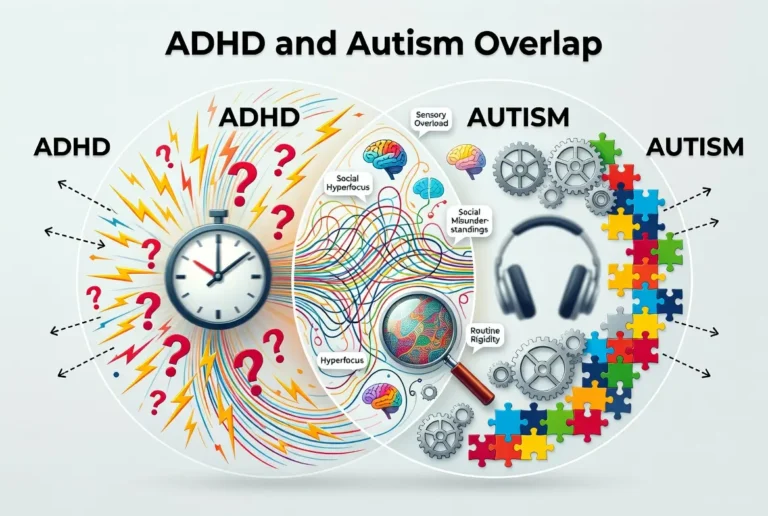
For decades, the medical community viewed Attention-Deficit/Hyperactivity Disorder (ADHD) and Autism Spectrum Disorder (ASD) as two entirely separate lanes. In fact, until the publication of the DSM-5 in 2013, clinicians were actually prohibited from diagnosing a child with both. Today, we know better. Not only can adhd and autism overlap, but they do so with startling frequency.
What is the overlap between ADHD and autism spectrum disorder? It is a co-occurrence of neurodevelopmental traits that affect executive function, social communication, and sensory processing. This combination has birthed the popular informal term “AuDHD,” a portmanteau used by the neurodivergent community to describe the unique internal tug-of-war that happens when one brain houses both profiles.
While they are distinct diagnoses, there is a profound connection between autism and ADHD. They share genetic markers and impact similar regions of the brain. Understanding this overlap is the key to moving past “blanket” treatments and toward support that respects the complexity of a dual-diagnosis brain. Whether you are wondering “do adhd and autism overlap” in your own life or seeking clarity for a loved one, this guide explores the symptoms, percentages, and diagnostic nuances of the AuDHD experience.
Is ADHD on the Autism Spectrum?
A common point of confusion for those new to neurodiversity is the question: Is ADHD on the autism spectrum? The short answer is no. ADHD and Autism are distinct neurodevelopmental conditions. However, the confusion is understandable. Both fall under the broader umbrella of neurodivergence, and both involve differences in brain “wiring.”
ADHD versus Autism: Clarifying the Difference
When comparing adhd vs autism, it is helpful to look at their core definitions:
- ADHD is primarily a disorder of regulation—regulating attention, impulses, and energy levels.
- Autism is primarily a disorder of social communication and sensory processing, characterized by a need for sameness and specific interests.
Historically, the diagnosis of Asperger’s (now absorbed into the ASD diagnosis) was often confused with high functioning autism vs adhd because both can involve high intelligence paired with social “clumsiness.” Furthermore, severe adhd vs autism can look similar in young children who exhibit intense “stimming” or repetitive behaviors. Despite these similarities, they remain separate clinical entities.
ADHD vs Autism Comparison Chart
| Feature | ADHD | Autism (ASD) |
| Focus | Difficulty sustaining or shifting focus. | Intense, deep focus on specific interests. |
| Social | May miss cues due to impulsivity or inattention. | May struggle to interpret social “rules” or non-verbal cues. |
| Routine | Often struggles with routine (desires novelty). | Often relies on routine (desires predictability). |
| Physical | Fidgeting, restlessness, or “driven by a motor.” | Repetitive movements (stimming) for regulation. |
ADHD and Autism Overlap Symptoms
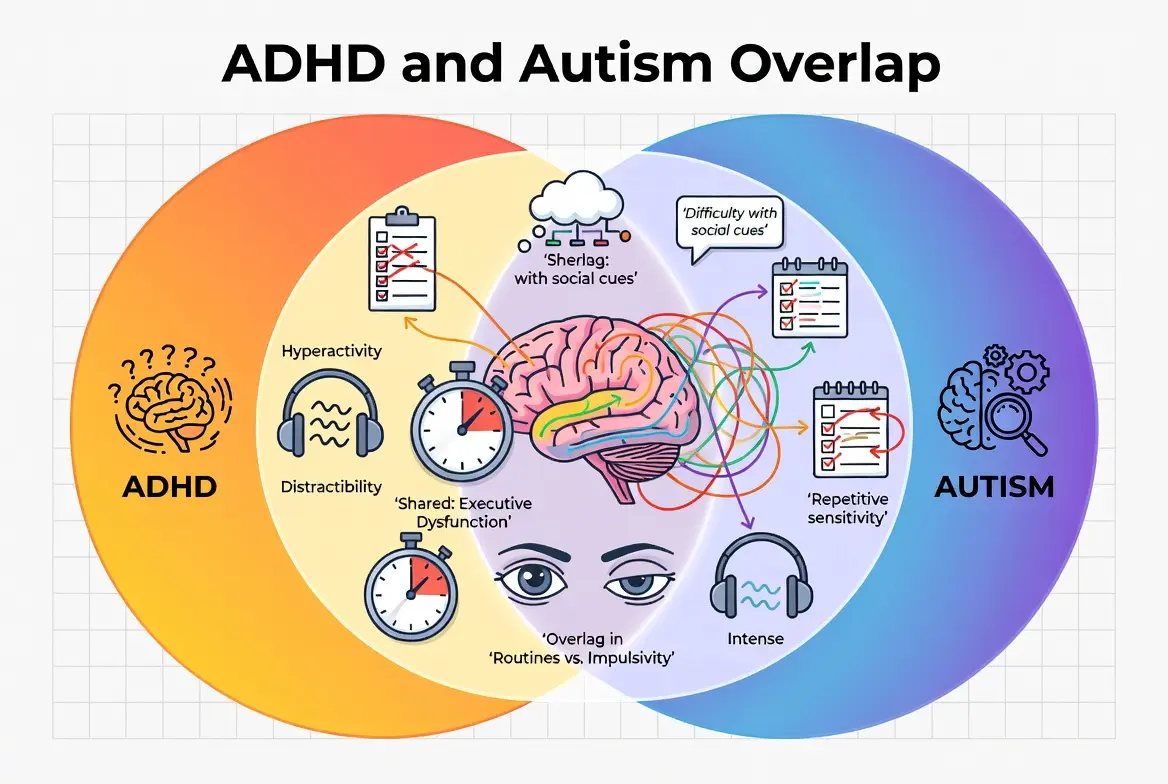
When a person has autism and adhd together, the symptoms don’t just sit side-by-side; they interact. This creates a specific set of traits of adhd and autism that can feel contradictory—like having one foot on the gas (ADHD) and one foot on the brake (Autism).
Common symptoms of adhd and autism overlap:
- Executive Dysfunction: This is the biggest “shared” symptom. Both profiles struggle with planning, starting tasks, and working memory.
- Sensory Sensitivity: While traditionally an autism trait, many with ADHD also experience sensory overload. In the overlap, this is often intensified.
- Social Challenges: The ADHD person might talk over people; the Autistic person might not know when it’s their turn to talk. Together, social interactions can feel exhausting.
- Emotional Regulation: Both groups experience emotions intensely. In adhd and autism overlap, this often manifests as “meltdowns” (autistic) or “rejection sensitive dysphoria” (ADHD).
The AuDHD Infographic: A Visual Summary
Imagine an infographic where two circles—ADHD and Autism—intersect.
- The ADHD side: Impulsivity, novelty-seeking, dopamine chasing.
- The Autism side: Pattern recognition, need for structure, sensory avoidant.
- The Overlap: Hyperfocus, stimming for regulation, social exhaustion, and “burnt out” executive function.
This adhd and autism overlap picture highlights why diagnosis is so difficult: the ADHD “chasing” of new things can sometimes mask the Autistic “need” for routine, leading to a person who feels perpetually unsettled and misunderstood.
In clinical practice, I often describe the AuDHD experience as an ‘Internal Paradox.’ My AuDHD patients often feel a deep, Autistic need for a strict schedule to feel safe, but their ADHD brain finds following a schedule physically painful or boring.
This creates a ‘stalemate’ where the person is paralyzed—too anxious to act without a plan, but too distracted to stick to the plan they made. Recognizing this overlap is crucial because treating only the ADHD with stimulants can sometimes make the Autistic sensory sensitivities feel ‘louder,’ while focusing only on Autism can leave the ADHD restlessness unaddressed.
ADHD and Autism Overlap Percentage
How common is it to have both? The adhd and autism overlap percentage is remarkably high, suggesting a shared genetic foundation.
- Autism to ADHD: Research indicates that roughly 30% to 50% of autistic individuals also meet the diagnostic criteria for ADHD.
- ADHD to Autism: Conversely, about 20% to 30% of people diagnosed with ADHD also meet the criteria for being on the autism spectrum.
Why do adhd and autism overlap?
The why does adhd and autism overlap question is currently being answered by neuro-genetics. Both conditions share common variations in dopamine pathways—the brain’s reward system. Additionally, they both impact the Default Mode Network (DMN) and executive function networks in the prefrontal cortex. Essentially, they are different expressions of the same “broad neurodevelopmental phenotype.”
ADHD and Autism Overlap in Children
In children, identifying the ADHD and autism overlap is vital for school support. Do autism and adhd overlap in early development? Yes, and it often appears as a child who is “doubly” out of sync with their peers.
- The School Struggle: A child might be brilliant at math (Autistic pattern recognition) but unable to sit in their chair or finish a worksheet (ADHD inattention).
- Social Development: These children often want to make friends but don’t know how to initiate (Autism), and when they do, they may be too “intense” or impulsive (ADHD), leading to social rejection and early-onset anxiety.
In this second section, we move into the complexities of “masking”—the social camouflage that often keeps the ADHD and autism overlap hidden until adulthood, particularly in women.
ADHD and Autism Overlap in Adults
For many, the realization of having both autism and adhd doesn’t happen in a pediatrician’s office, but rather in an adult therapist’s office after a lifetime of feeling “different.” Autism and ADHD together in adults often creates a profile of the “high-achieving but exhausted” individual.
The “Burnout” Cycle
The most common hallmark of ADHD and autism overlap adults symptoms is a cycle of intense productivity followed by total collapse.
- The ADHD Side: Drives the person to take on multiple projects, seek novelty, and work in high-pressure bursts.
- The Autism Side: Becomes overwhelmed by the sensory input, social demands, and lack of routine that the ADHD side created.
The result is “Autistic Burnout,” which in high functioning autism and ADHD in adults is often misdiagnosed as clinical depression. Adults may find they have “career instability” because they are brilliant at the work (Autism) but struggle with the administrative demands or office politics (ADHD).
ADHD and Autism Overlap in Females
The ADHD and autism overlap in females is one of the most underdiagnosed areas in neurodiversity. Historically, diagnostic criteria were based on “hyperactive boys,” causing ADHD and autism overlap in women to be overlooked for decades.
Social Masking and Internalization
Women are often socialized to be “helpers” and “people pleasers,” leading to intense social masking. A woman might spend all day forcing eye contact and suppressing fidgets, only to return home to a state of complete sensory shutdown.
- Anxiety Misdiagnosis: Because they are so good at hiding their traits, they are often diagnosed with General Anxiety Disorder or Borderline Personality Disorder before their neurodivergence is recognized.
- The Reddit Community Perspective: If you search adhd and autism overlap reddit, you will find thousands of women describing the “relief” of a late diagnosis. Lived experiences frequently highlight that the ADHD made them “sociable enough” to hide their autism, while the autism made their ADHD look “less chaotic” than the stereotype.
How Do I Tell If I Have AuDHD?
If you are reading this and thinking, “this sounds exactly like me,” you are likely asking: How do I tell if I have AuDHD? While the internet is full of “Do I have autism and ADHD quizzes,” these are only starting points.
The Self-Screening Process
Identifying adhd and autism overlap symptoms in yourself involves looking for the “conflict” between your needs:
- Do you crave novelty but get distressed by change?
- Do you stim (repetitive movements) but find your stims change frequently?
- Do you find that ADHD medication makes your sensory issues “worse” or more noticeable?
Is Free ADHD Testing Really Effective?
While an adhd and autism overlap test online can validate your feelings, it is not a clinical diagnosis. Free tests often fall for common pitfalls, such as failing to distinguish between trauma responses and neurodivergence. A formal assessment by a neuro-affirming clinician is the only way to confirm a dual diagnosis.
ADHD vs Autism: Key Differences
While we have focused on how they overlap, understanding how autism and adhd overlap and differences interact is vital.
Developmental Trajectories
- ADHD: Often characterized by a “delay” in executive function. The brain’s “CEO” is simply developing on a different timeline.
- Autism: Characterized by a “different” developmental path entirely, particularly in how the brain processes social and sensory information from birth.
Social Cognition vs. Impulsivity
How do adhd and autism overlap in social settings? An ADHD person might miss a social cue because they were distracted by a bird outside the window. An Autistic person might see the cue but not have the “internal dictionary” to translate what it means. When you have both, you might miss the cue and not know what it means even if you saw it.
| Feature | ADHD Driven | Autism Driven |
| Eye Contact | Avoidant because it’s “too much” to focus on. | Avoidant because it’s “too much” sensory input. |
| Talking | Interrupting because of impulsivity. | Monologuing because of an intense interest. |
| Stimming | Moving to stay awake/alert. | Moving to calm the nervous system. |
ADHD and Autism Overlap Treatment

Treating adhd and autism overlap treatment requires a multidisciplinary, “buffet-style” approach. What works for ADHD might be detrimental to Autism, and vice-versa.
The Medical and Behavioral Mix
- ADHD Medication: Stimulants can be life-changing for the ADHD side, but clinicians must monitor for increased “autistic rigidity” or sensory meltdowns as the ADHD “fog” clears.
- Occupational Therapy (OT): Highly effective for sensory processing and “bottom-up” regulation.
- Neurofeedback for ADHD: Some studies show this helps with impulse control without the “crash” associated with medication.
- Specialized Professionals: It is essential to work with an ADHD specialist or psychiatrist adhd near me who understands neuro-affirming care. An adhd psychology approach that tries to “train away” autistic traits will only lead to further burnout.
In this final section, we move beyond the clinical data and into the nuances of neurodivergent social life, practical time-management strategies, and a comprehensive breakdown of the most frequently asked questions.
Social Compatibility: Do People with ADHD and Autism Get Along?
A common question in neurodivergent circles is: Do people with ADHD and autism get along? The answer is often a resounding “yes,” but with caveats. This is sometimes called “Double Empathy” in action.
- Shared Communication Styles: Both groups often prefer “info-dumping” (sharing deep knowledge) and direct communication over “small talk.” This creates a shared language that can feel much easier than navigating neurotypical social “rules.”
- The Chaos vs. Order Conflict: Compatibility can be strained when the ADHD person’s “organized chaos” triggers the Autistic person’s need for “order and predictability.”
- Individual Variability: In AuDHD relationships, partners often report that they understand each other’s need for “recharge time” or sensory breaks, leading to deep, empathetic bonds.
The “10 3 Rule” for ADHD
In the search for productivity hacks, the 10 3 rule for ADHD has gained popularity on social media. It is important to clarify: What is the 10 3 rule for ADHD?
This is a behavioral time-management technique, not a diagnostic rule.
- The Method: Work for 10 minutes and take a 3-minute break.
- Why it works for AuDHD: The 10-minute window is short enough to not “scare” the ADHD brain (avoiding task paralysis), while the predictable 3-minute break satisfies the Autistic need for routine and sensory “reset.”
- Not Evidence-Based: While many find it helpful, it is a tool, not a clinical treatment. It’s a “sprint” method designed to overcome the executive dysfunction bottleneck.
FAQ Section
What is the overlap between ADHD and autism spectrum disorder?
The adhd and autism overlap refers to the co-occurrence of both conditions in one individual. It involves shared struggles with executive function and sensory processing while combining ADHD’s impulsivity with Autism’s social and routine-based differences.
Is ADHD on the autism spectrum?
No. ADHD is not on the autism spectrum. They are separate neurodevelopmental conditions. However, they share many genetic traits and are both forms of neurodivergence.
Are ADHD and autism the same?
No. They are distinct. ADHD is primarily about the regulation of attention and energy, while Autism is primarily about social communication and sensory experience.
Do autistic people with ADHD have a different diagnosis?
Clinically, they receive two diagnoses: ASD and ADHD. Informally, the community often uses the term “AuDHD” to describe this specific dual-profile.
How do I tell if I have AuDHD?
Look for “internal contradictions”—for example, needing a strict routine to feel safe (Autism) but being unable to stick to one because you crave novelty and distraction (ADHD). A professional clinical assessment is required for confirmation.
What symptoms overlap between ADHD and autism?
The primary adhd and autism overlap symptoms include executive dysfunction (problems with planning/organizing), sensory sensitivities, emotional dysregulation, and challenges with social nuances.
What percentage of people have both?
Research suggests an adhd and autism overlap percentage of 30–50% for autistic people also having ADHD, and 20–30% for those with ADHD also meeting the criteria for autism.
What is the 10 3 rule for ADHD?
The 10 3 rule is a productivity strategy where you work for 10 minutes and break for 3 minutes. It helps manage the task initiation struggles common in ADHD and AuDHD profiles.
Conclusion: Embracing the AuDHD Identity
Understanding the ADHD and autism overlap is about more than just checking boxes on a diagnostic list. It is about recognizing that your brain has a unique set of operating instructions.
If you have spent your life feeling like you are “too much” for some and “not enough” for others—too impulsive for the autistic community but too rigid for the ADHD community—know that you are likely navigating the complex middle ground of AuDHD.
Proper support starts with a neuro-affirming approach. Whether you are seeking a psychiatrist adhd near me or exploring adhd psychology resources, ensure they see you as a whole person, not just a collection of symptoms. By honoring both the need for novelty and the need for safety, you can stop fighting your brain and start building a life that actually fits it.
To maintain the highest level of clinical and neuro-affirming integrity for this pillar page on the ADHD and Autism overlap, the following authoritative references have been selected. These sources represent the current scientific consensus on dual diagnosis, genetic shared risk, and the “AuDHD” profile.
Authoritative Clinical & Research References
- The Lancet Psychiatry — “The Comorbidity of ADHD and Autism Spectrum Disorder”
- CHADD (Children and Adults with Attention-Deficit/Hyperactivity Disorder) — ADHD and ASD
- The Autistic Self Advocacy Network (ASAN)
- Nature Genetics — “Shared Heritability Between Autism and ADHD”

Related Posts






Subscribe to Our Newsletter
Get mental health tips, updates, and resources delivered to your inbox.
MORE from Author
Read More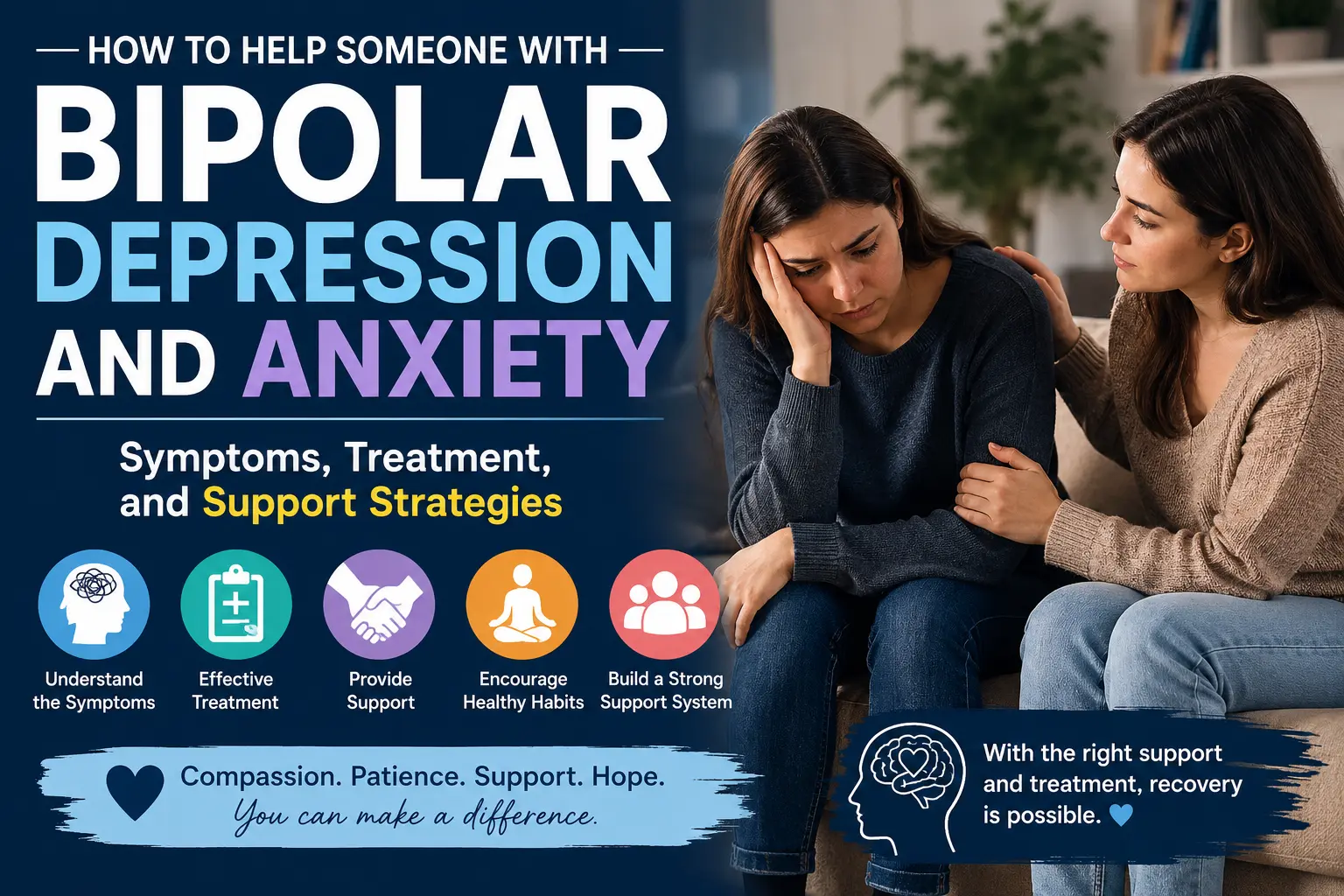 Watching someone you care about struggle with bipolar depression and anxiety can be heartbreaking. You may notice that they withdraw…
 In my practice as a clinical psychologist, I often observe that the difference between a patient who crumbles under pressure…
 We all have "up" days and "down" days. Perhaps you feel energized after a promotion or sluggish on a rainy…
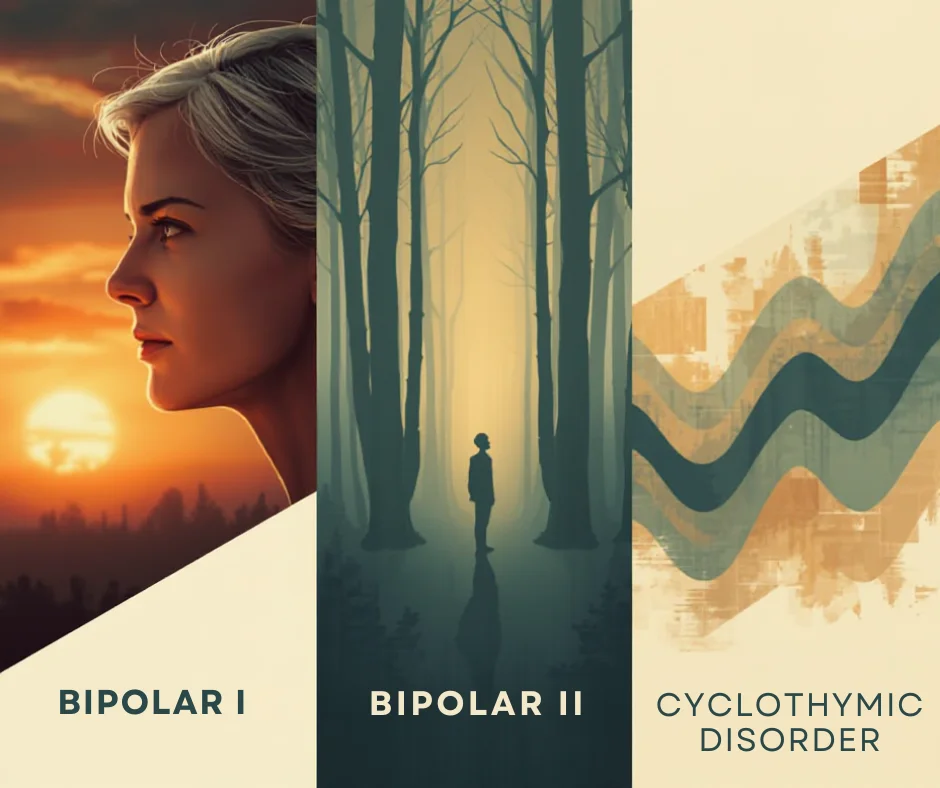 To define bipolar disorder accurately, we must look at it as a chronic mood dysregulation condition. In psychology and medicine,…
Are you looking for a Therapist?
Connect with qualified mental health professionals who understand
bipolar disorder, mood changes, and emotional challenges.
Private • Supportive • Confidential