
Autism vs ADHD Venn Diagram: Similarities, Differences & Overlap Explained

Medically reviewed by Laura Athey Updated Date: April 10, 2026
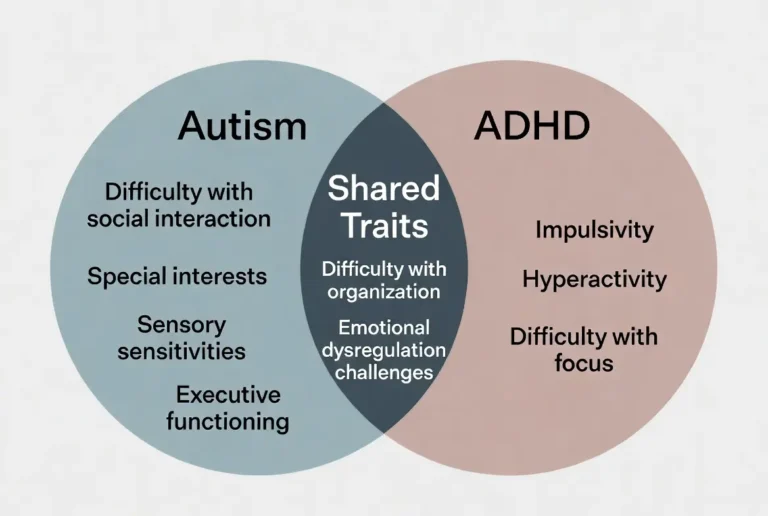
To truly understand the neurodivergent experience, we must move beyond rigid diagnostic silos. The autism vs adhd venn diagram serves as a vital tool for adults and clinicians to visualize why these two conditions are so frequently confused.
Autism and ADHD overlap in executive function difficulties, sensory sensitivity, and emotional regulation, but differ in core social communication patterns and repetitive behaviors. While ADHD focuses on the regulation of attention and impulses, Autism focuses on the processing of social data and environmental predictability.
The Circles Explained
- The ADHD Circle (Left): Characterized by high impulsivity, “time blindness,” novelty-seeking, and external distractibility.
- The Autism Circle (Right): Characterized by a need for sameness, literal interpretation of language, specialized deep interests, and social communication differences.
- The Overlap (Center): This is often referred to informally as “AuDHD.” Here, we find the shared struggles that make both conditions part of the broader neurodevelopmental family.
What Traits Do Autism and ADHD Have in Common?
When people ask, “What traits do autism and ADHD have in common?“, they are usually noticing the “internal chaos” that both conditions create. While the reasons behind the behaviors might differ, the outward presentation often looks remarkably similar.
The Core Overlap Cluster
- Executive Dysfunction: This is the most significant overlap. Both groups struggle with the brain’s “operating system”—planning, starting tasks, and working memory.
- Sensory Sensitivities: Whether it’s the hum of a refrigerator or the texture of a shirt, both ADHD and autistic individuals often experience a “hypersensitive” nervous system.
- Hyperfocus: While ADHD is often called a “lack” of attention, it is actually a difficulty regulating attention. Both groups can become intensely absorbed in a task to the exclusion of all else.
- Emotional Dysregulation: “Big feelings” are common. Small setbacks can feel like catastrophes due to how the brain processes dopamine and emotional signals.
- Social Challenges: Both may feel like they are “missing the manual” for social interaction, though ADHDers often miss cues due to inattention, while autistics may not instinctively “code” those cues.
Comparison of Shared Traits
| Shared Trait | Appearance in ADHD | Appearance in Autism |
| Hyperfocus | Driven by novelty and dopamine hits. | Driven by deep interest and systemization. |
| Sensory Issues | Often “sensory seeking” (movement/noise). | Often “sensory avoiding” (overload). |
| Social Struggles | Interrupting or losing track of the convo. | Literal thinking or missing non-verbal cues. |
| Executive Function | Forgetting chores or losing keys. | Difficulty switching from one task to a new one. |
What Are the Similarities and Differences Between ADHD and Autism?
Understanding the difference between ADHD and autism in adults requires looking past the “what” and into the “why.” A behavior that looks like a lack of focus might actually be a sensory shutdown.
The Clinical Comparison Table
| Feature | ADHD | Autism Spectrum Disorder (ASD) |
| Core Deficit | Attention and Impulse Regulation | Social Communication & Sameness |
| Eye Contact | May drift because they are distracted. | May feel intense, painful, or unnecessary. |
| Repetitive Behaviors | Fidgeting to stay “awake” or alert. | “Stimming” to regulate or self-soothe. |
| Change in Routine | Often welcomed as “novelty” or newness. | Often causes significant distress or meltdown. |
| Social Cues | Noticed but ignored or interrupted. | Not instinctively “read” or understood. |
| Onset | Usually noticed as “disruption” in school. | Noticed as “difference” in early play. |
Internal vs. External Drivers
In adults, ADHD versus autism often boils down to the “need for novelty” vs. the “need for predictability.” An ADHDer might thrive in a chaotic, fast-paced job because it provides constant dopamine. An autistic person might find that same environment a source of literal physical pain due to the lack of structure.
In my practice, I find that the most exhausted patients are those in the ‘overlap.’ When you have both ADHD and Autism, you are living in a constant state of cognitive friction. Your ADHD side craves novelty and change, while your Autistic side is terrified of it and needs a strict routine.
This ‘AuDHD’ tug-of-war is a major contributor to adult burnout. Recognizing that you aren’t ‘lazy’ but are actually managing two competing operating systems is usually the first step toward healing.
Autism vs ADHD vs Asperger’s
There is often confusion surrounding the term Asperger’s. Clinically, Asperger’s Syndrome was removed from the DSM-5 in 2013 and is now part of Autism Spectrum Disorder (ASD) Level 1.
- Asperger’s vs. ADHD: Historically, Asperger’s was used for autistic people with high verbal intelligence and no “speech delay.” Many people with this profile were misdiagnosed with ADHD alone because their “hyperactive mind” was more visible than their social struggle.
- High Functioning Autism: This is a non-clinical term used for those who can “mask” their traits effectively. In this group, the autism vs adhd vs aspergers debate is common because symptoms are subtle.
- Severe ADHD vs. Autism: Severe ADHD can look like autism because the level of impulsivity and distractibility can make social interaction nearly impossible, mimicking the “withdrawal” seen in autism.
How Do I Know If It’s ADHD, Autism, or Both?
If you are staring at a neurodiversity venn diagram and thinking, “I’m in the middle,” you aren’t alone. How do I know if it’s ADHD, autism, or both? ### The “Both” (AuDHD) Checklist:
- The Routine Paradox: You create detailed schedules (Autism) but forget they exist five minutes later (ADHD).
- Social Duality: You are an extrovert who loves talking (ADHD) but you constantly realize you’ve offended people or “missed the vibe” (Autism).
- Sensory Seeking & Avoiding: You need a weighted blanket to sleep (Autism) but you can’t stand the silence and need a fan or white noise (ADHD).
- Intellectual Depth vs. Breadth: You have 50 hobbies you’ve tried once (ADHD) but 2 topics you know everything about (Autism).
Next Step: If this resonates, a formal evaluation should not ask “Which one is it?” but rather “How do these two interact in your brain?”
Is There a Genetic Overlap Between ADHD and Autism?
The question “Is there a genetic overlap between ADHD and autism?” has been answered with a resounding “Yes” by modern science.
- Shared Heritability: Research suggests these conditions share 50–70% of their genetic risk factors. This is why it is so common to find an autistic child with an ADHD parent, or vice versa.
- Neurodevelopmental Pathways: Both conditions involve differences in “synaptic pruning”—the process by which the brain cleans up unused connections. In both Autism and ADHD, the brain keeps more connections than a neurotypical brain, leading to the “noisy” or “intense” internal experience both groups describe.
How Often Is ADHD Misdiagnosed as Autism?
The phenomenon of Misdiagnosis Monday (a common social media trend) highlights a real clinical issue: How often is ADHD misdiagnosed as autism?
- The Overlap Trap: Because both cause social friction and executive dysfunction, a clinician who isn’t an expert might see “poor eye contact” and jump to autism, when the patient was actually just distracted by a bird outside (ADHD).
- Masking in Girls: Girls are often late-diagnosed because they “mask.” An autistic girl might use her ADHD-like talkativeness to hide her social confusion, leading to an ADHD-only diagnosis that misses her core autistic needs.
In this second section, we expand the Venn diagram to include other common “neighbors” of Autism and ADHD, such as OCD and Giftedness. We also provide practical clinical insights and the specific habits that signal it might be time for a professional evaluation.
Can You Have ADHD, Autism, and OCD at the Same Time?
When navigating neurodivergence, we often find that the Venn diagram isn’t just two circles—it’s a complex web. The OCD, Autism, and ADHD Venn diagram is a frequent area of study because all three involve “repetitive” or “rigid” behaviors.
Comorbidity vs. Overlap
- OCD and Autism: Both involve a need for sameness and routine. However, in OCD, the routine is driven by anxiety and intrusive thoughts (e.g., “If I don’t tap this, something bad will happen”). In Autism, the routine is driven by sensory comfort and predictability.
- ADHD and OCD: This is often called “the messy OCD.” A person may have intrusive thoughts about perfection but lack the executive function to stay organized, leading to intense internal distress.
- The “Triple Hit”: It is entirely possible to have all three. This often presents as a person who is highly impulsive (ADHD) but then becomes intensely anxious or “stuck” on a specific thought or action (OCD) while feeling socially alienated (Autism).
Giftedness & Neurodiversity Venn Diagram
The concept of Twice-Exceptional (2e) individuals is crucial here. A gifted autism adhd venn diagram helps explain why high IQ can sometimes mask underlying neurodivergence.
The 2e Experience
“Giftedness” is not just being smart; it is a brain that processes information at a much faster rate than peers.
- Masking: A gifted child might use their high intelligence to compensate for ADHD-led forgetfulness or to “solve” social cues logically rather than intuitively (Autism).
- Asynchronous Development: This is where a person’s intellectual ability far outpaces their emotional or social development.
- Cognitive Overexcitabilities: Gifted individuals often share the same sensory sensitivities found in the autism venn diagram, such as being physically pained by loud noises or intense lights.
What Is Giftedness & How Does It Affect Autism & OCD?
Giftedness acts as an amplifier. If a gifted person is also autistic, their “Special Interest” might look like world-class expertise at a young age. However, this same giftedness can lead to a specific type of OCD focused on “existential dread” or “moral scrupulosity” because the brain is capable of imagining complex, terrifying scenarios that a typical brain might ignore.
Should I Include Autism Screeners in My ADHD Assessments?
If you are an adult seeking a diagnosis, the answer is a clinical yes. Because the difference between ADHD and autism in adults is so subtle, a “single-target” assessment often misses the full picture.
Clinical Best Practices
When looking for an adhd specialist, ensure they use multi-dimensional tools:
- ADOS-2: The gold standard for observing social communication.
- Conners Scales: Primarily for ADHD symptoms and executive function.
- SRS-2 (Social Responsiveness Scale): Helps identify the subtle social “nuance” differences that distinguish Autism from ADHD-led social impulsivity.
What Is 90% of Autism Caused By?
There is significant misinformation online regarding the origins of neurodivergence. To be clear: Autism is highly heritable (~70–90% genetic influence).
It is not caused by parenting styles, vaccines, or diet. It is a multifactorial condition where a combination of genetic “risk variants” affects how the brain prunes its neurons during development. This is why the genetic overlap between ADHD and autism is so high—they are different branches of the same neurodevelopmental tree.
What Is the 6-Second Rule for Autism?
If you live or work with someone on the spectrum, the 6-second rule is a game-changer for communication.
The Rule: After giving an instruction or asking a question, pause for a full 6 seconds before speaking again.
- Why it works: Autistic brains often have “longer cables.” It takes more time to process the auditory input, translate it into meaning, and formulate a physical or verbal response.
- The Benefit: It prevents “processing jams” and reduces the anxiety that leads to meltdowns or shutdowns.
ADHD Types Venn Diagram
ADHD itself isn’t a monolith. The adhd types venn diagram helps distinguish between the three presentations recognized by the DSM-5:
- Inattentive Type: “The Daydreamer.” High internal distraction, forgetfulness, and poor organization.
- Hyperactive-Impulsive Type: “The Energizer.” Physical restlessness, blurting out answers, and constant motion.
- Combined Type: A mixture of both, and the most common presentation in those who also have Autism.
Do I Have ADHD? Daily Habits & Red Flags
If you are looking at the autism adhd venn diagram and wondering where you fit, look at your “boring” daily habits. These are often more revealing than a one-time test.
- Deadline Dependence: You cannot start a task until the “panic” of a deadline sets in.
- The “Waiting Mode”: If you have an appointment at 2:00 PM, you find yourself unable to do anything else all morning.
- Task Paralysis: Looking at a messy room and feeling physically unable to move because you don’t know which object to pick up first.
- Chronic Lateness: “Time blindness” means you genuinely believe 5 minutes is enough time to shower, dress, and drive across town.
Free Online ADHD Testing – Myths & Risks
While a free online ADHD test can be a great starting point for self-discovery, they come with significant risks:
- The False Positive: Online tests often confuse general anxiety or burnout with ADHD.
- Lack of Context: A quiz cannot distinguish between “I forget my keys because I’m distracted” and “I forget my keys because I’m depressed.”
- Diagnosis vs. Screening: A screen says “You might have this.” A diagnosis from an adhd psychologist says “You have this, and here is the medical plan to help.”
Neurofeedback for ADHD – Does It Work?
Neurofeedback for ADHD is a popular alternative treatment where you “train” your brainwaves using real-time displays of brain activity.
- The Evidence: It is currently considered “possibly efficacious” but not “first-line.”
- The Verdict: It can be a helpful supplement for those who cannot tolerate medication, but it should not replace behavioral therapy or executive function coaching.
FAQ Section
What traits do autism and ADHD have in common?
The biggest overlaps are executive dysfunction (struggling to plan/start tasks), sensory sensitivities (overwhelmed by noise/light), and hyperfocus (getting lost in a task). Both can also lead to social isolation, though for different reasons.
How do I know if I have both ADHD and autism?
Look for the “Routine Paradox.” If you crave structure and routine to feel safe (Autism) but find it physically impossible to stick to a schedule and constantly crave new stimulation (ADHD), you likely sit in the middle of the Venn diagram.
Is ADHD part of autism?
No. They are separate conditions in the DSM-5. However, they are both neurodevelopmental disorders, and because they share so much genetic “DNA,” clinicians now view them as being on a similar spectrum of brain wiring.
Can gifted people have ADHD?
Yes. This is called Twice-Exceptional (2e). High intelligence can often mask ADHD symptoms in school, leading to a “late-onset” collapse in college or the workplace when the intellectual challenge no longer outweighs the executive function deficit.
Conclusion: Embracing the “And”
The autism vs adhd venn diagram shows us that human neurobiology is rarely a straight line. You don’t have to choose between being “the person who can’t focus” and “the person who struggles socially.” You can be both.
Understanding the overlap allows you to stop fighting your brain and start building a life that accommodates your unique “AuDHD” needs. Whether through medication, specialized adhd pediatrics, or simply using the 6-second rule, the goal is the same: clarity, not just a label.
Authoritative Clinical & Research References
- Nature Genetics — “Shared Heritability and Genetic Overlap Between ADHD and ASD”
- CHADD (Children and Adults with ADHD) — “ADHD and Autism Spectrum Disorder”
- Journal of the American Academy of Child & Adolescent Psychiatry — “Clinical Differentiation of ASD and ADHD”
- The National Association for Gifted Children (NAGC) — “White Paper on Twice-Exceptionality”

Related Posts





Subscribe to Our Newsletter
Get mental health tips, updates, and resources delivered to your inbox.
MORE from Author
Read More Watching someone you care about struggle with bipolar depression and anxiety can be heartbreaking. You may notice that they withdraw…
 In my practice as a clinical psychologist, I often observe that the difference between a patient who crumbles under pressure…
 We all have "up" days and "down" days. Perhaps you feel energized after a promotion or sluggish on a rainy…
 To define bipolar disorder accurately, we must look at it as a chronic mood dysregulation condition. In psychology and medicine,…
Are you looking for a Therapist?
Connect with qualified mental health professionals who understand
bipolar disorder, mood changes, and emotional challenges.
Private • Supportive • Confidential