
Where Is the Amygdala Located in the Brain? A Visual Guide to Anatomy, Function, and Brain Regions

Medically reviewed by Laura Athey Updated Date: March 27, 2026
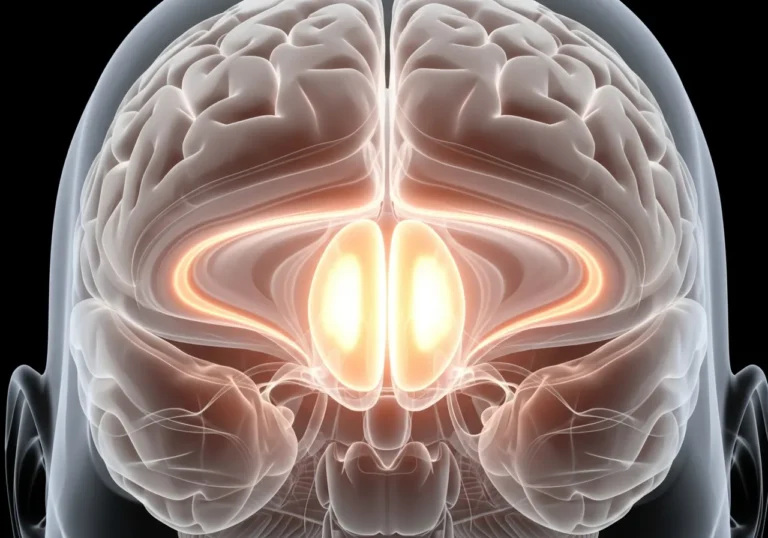
In my practice as a clinical psychologist, I often find that patients feel a profound sense of relief when they can visualize the “hardware” behind their emotional experiences.
When someone describes a sudden, paralyzing wave of panic or an inexplicable flash of rage, they are describing the activation of a structure deep within their skull. To understand these moments, we have to ask, “Where is the amygdala located in the brain?”
The amygdala is not a surface-level structure; it is tucked away, protected by layers of the cerebral cortex, reflecting its ancient and vital role in our survival. It sits deep within the temporal lobe, forming a core part of the limbic system—the brain’s emotional processing hub.
Think of it as the “smoke detector” of the brain, positioned perfectly to scan incoming sensory data and sound the alarm before your conscious mind even realizes there is a fire.
Understanding this location is the first step in moving from feeling “broken” to understanding that your brain is simply doing its job—sometimes a bit too enthusiastically.
By mapping the amygdala anatomy, we can begin to apply the principles of neuroplasticity to calm an overactive system and restore our executive function.
Where Is the Amygdala Located in the Brain?
If you were to point to the amygdala location from the outside, you would place your fingers just an inch or two behind your temples and deep toward the center of your head. Specifically, the amygdala is located in the medial temporal lobe, anterior to (in front of) the hippocampus.
One of the most important things to realize about where the amygdala is located in the human brain is that we actually have two of them. We have a left and a right amygdala, one in each hemisphere.
They are almond-shaped clusters of nuclei that communicate constantly with each other and with the rest of the brain to coordinate our emotional and physical responses to the world around us.
What Part of the Brain Is the Amygdala In?
The amygdala is a primary component of the limbic system, which is often referred to as the “mammalian brain” or the “emotional brain.” While the outer layer of your brain (the neocortex) handles complex logic and language, the limbic system—including the amygdala—is dedicated to the following:
- Emotional Processing: Identifying how we feel about a situation.
- Survival Instincts: The “Fight-or-Flight” response.
- Memory Consolidation: Deciding which events are important enough to remember.
Amygdala Anatomy: Structure and Organization
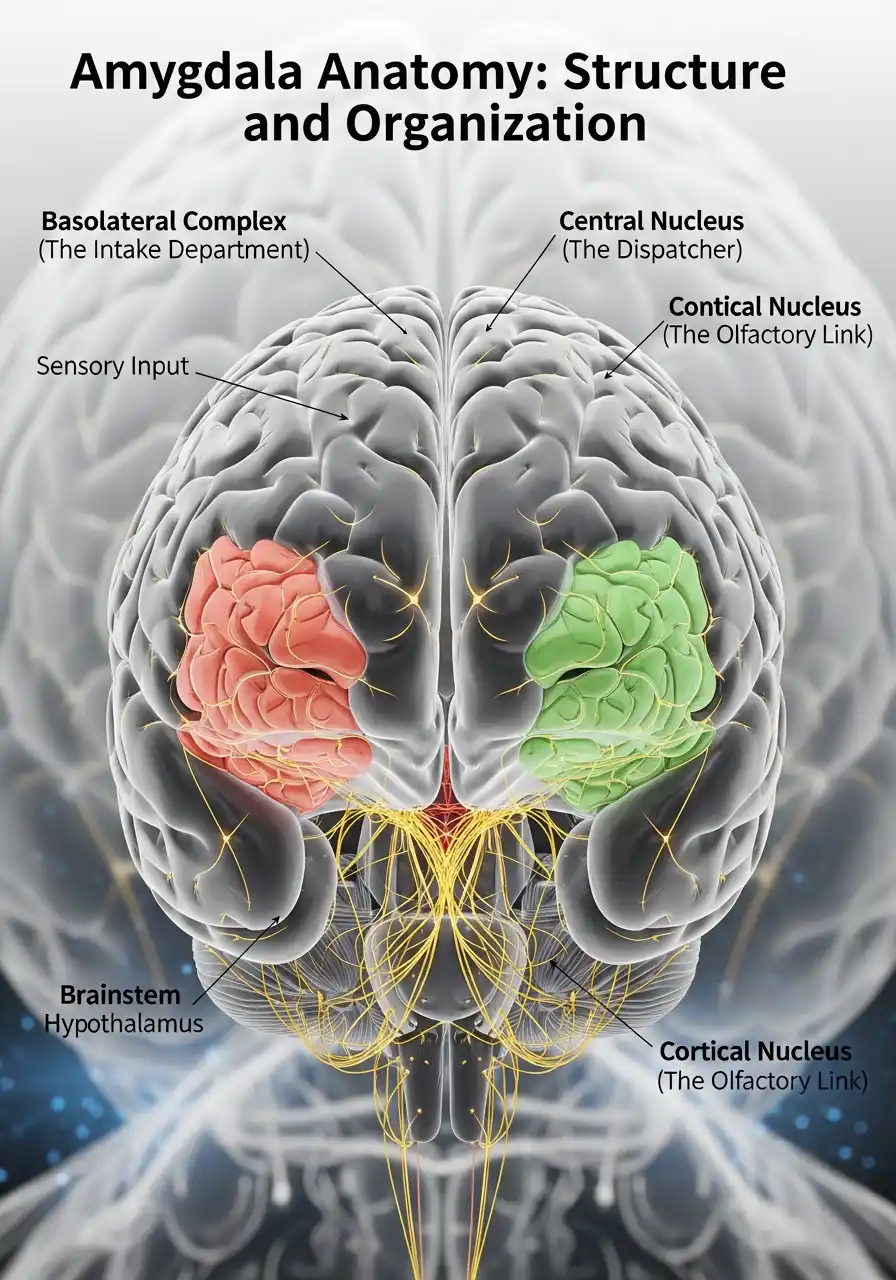
This is the main topic of our exploration, and it is where the “why” behind the biology becomes fascinating. To understand what the amygdala is, we must look at it not as a single solid mass, but as a complex “switchboard” of specialized nuclei.
The amygdala anatomy consists of several distinct groups of neurons, each with a specific job. If the amygdala were a security company, these nuclei would be the different departments:
a. The Basolateral Complex (The Intake Department)
This is the largest part of the amygdala. Its primary role is to receive sensory information—what you see, hear, and smell—and determine its emotional significance. Why does this matter?
Because this complex is highly connected to the sensory cortex. It’s the reason why a specific song or a particular scent can instantly trigger a childhood memory or a sense of dread. It “pairs” sensory data with emotional value.
b. The Central Nucleus (The Dispatcher)
Once the basolateral complex identifies a threat, the central nucleus takes over. It is the “output” station.
It sends signals to the brainstem and the hypothalamus to trigger physical changes: your heart rate increases, your pupils dilate, and your breathing quickens. This is the biological “why” behind the physical symptoms of anxiety.
c. The Cortical Nucleus (The Olfactory Link)
Interestingly, the amygdala is directly connected to our sense of smell (the olfactory system). This is an evolutionary carry-over; for our ancestors, the smell of a predator or smoke was the fastest way to detect danger. This is why smells are often our most potent emotional triggers.
| Nuclei Group | Primary Function | Clinical Relevance |
| Basolateral | Sensory Integration | Site of fear conditioning and “trauma tagging.” |
| Central | Physical Output | Triggers the physical “fight-or-flight” sensations. |
| Cortical | Olfactory Processing | Why scents trigger such intense emotional memories. |
In my clinical experience, I often observe that in patients with PTSD, the “basolateral” department has become hypersensitized—it sees threats everywhere—while the “central” department is on a hair trigger, dispatching stress hormones at the slightest provocation.
Where Is the Amygdala Located Compared to the Hippocampus?
The relationship between where the hippocampus is located in the brain and the amygdala is one of the most important “neighborhoods” in neuroscience. They sit right next to each other in the temporal lobe.
- The Amygdala (The Emotional Highlighter): It decides how important an event is based on how you feel.
- The Hippocampus (The Librarian): It indexes the facts—the who, what, when, and where.
When these two work in harmony, you have a healthy memory of a past event. For example, the hippocampus remembers you were at a birthday party, and the amygdala remembers you felt happy. However, in trauma, the amygdala can become so “loud” that it interferes with the hippocampus’s ability to index the facts correctly.
This is why traumatic memories often feel fragmented or like they are “happening right now”; the librarian was overwhelmed by the smoke detector.
A nuance I frequently share with my patients is that the amygdala is highly sensitive to circadian rhythms. When we are sleep-deprived, the functional connectivity between the prefrontal cortex (our “brakes”) and the amygdala (our “gas”) is severely weakened.
I once worked with a patient, “Mark,” who struggled with intense irritability. We discovered that his emotional “explosions” almost exclusively happened on nights he slept fewer than six hours.
By improving his sleep hygiene—regulating his light exposure and bedtime—we strengthened his brain’s ability to “talk down” the amygdala. Without adequate sleep, the amygdala remains in a state of hyper-reactivity, making emotional regulation nearly impossible.
Real-Life Examples of Amygdala Activation
I recently worked with an anonymized patient, “Sarah,” who suffered from a profound fear of dogs after a childhood bite. Whenever she saw a dog—even a small, friendly one—she would freeze, her heart would pound, and she would feel an urge to bolt.
This is a classic example of how the amygdala works. Sarah’s amygdala, located deep in her temporal lobe, had “tagged” the image of a dog as a life-threatening danger.
Because of its location and its direct line to the hypothalamus, the amygdala reacted in milliseconds—long before Sarah’s rational “Thinking Brain” could say, “Wait, that dog is on a leash and wagging its tail. “ To help Sarah, we used a specific therapeutic intervention called Exposure and Response Prevention (ERP).
By slowly and safely exposing her to dogs while practicing grounding techniques, we utilized neuroplasticity to “rewire” her amygdala. Eventually, her basolateral nuclei learned that “dog” does not always equal “danger,” and her central nucleus stopped sounding the alarm.
Where Is the Amygdala Located Compared to the Thalamus?
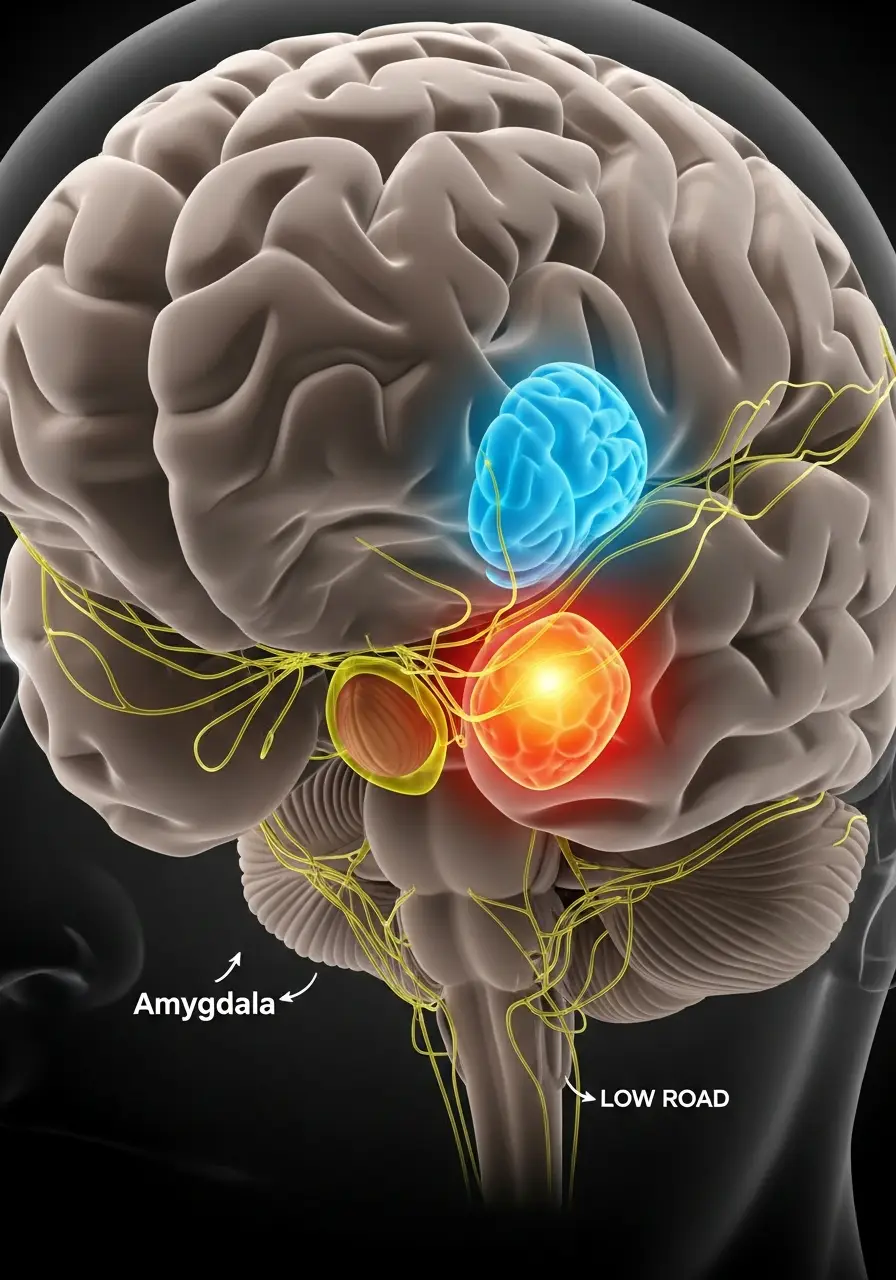
To understand the speed of our emotional reactions, we have to look at where the thalamus is located in the brain relative to the amygdala. The thalamus sits atop the brainstem and acts as the brain’s “grand central station” for sensory information.
Nearly every sight, sound, and touch you experience passes through the thalamus first. Because the amygdala is located just a short neural distance away in the temporal lobe, there is a “low road” connection between the two.
This allows the thalamus to send a “rough draft” of sensory data to the amygdala before it even reaches the visual or auditory cortex for detailed processing.
This is the biological reason behind jumping at a shadow that looks like a person; your amygdala received the signal from the thalamus and reacted before your conscious brain could finish “printing” the full image.
How to Tell If Your Amygdala Is Damaged
While most of my patients deal with an overactive system, it is clinically vital to recognize amygdala damage symptoms. Damage can occur due to focal strokes, tumors, or rare genetic conditions like Urbach-Wiethe disease.
How to tell if your amygdala is damaged often involves observing a lack of typical emotional signaling:
- The “Fearless” Affect: A person may no longer experience the physiological “alarm” of danger. They might walk into traffic or handle a venomous snake without the protective surge of adrenaline.
- Social Agnosia: Difficulty recognizing emotions in others, particularly the inability to “read” fear or untrustworthiness on a stranger’s face.
- Loss of Emotional Memory: An inability to remember the “feeling” of a past event, even if the facts (the hippocampus’s job) are still intact.
Frequently Asked Questions
Where is the amygdala located in the brain?
The amygdala is located deep within the medial temporal lobe, positioned in front of the hippocampus. We have two amygdalae, one in each hemisphere.
What part of the brain is the amygdala in?
It is part of the limbic system, which is the brain’s emotional and survival center. It is nestled under the temporal cortex.
Where is the hippocampus located?
The hippocampus is also in the temporal lobe, sitting directly behind the amygdala. They work together to link emotions to memories.
How to tell if the amygdala is damaged?
Signs include a significant lack of fear in dangerous situations, difficulty recognizing facial expressions in others, and a diminished emotional response to memories.
What drugs calm the amygdala?
Common treatments include SSRIs, which dampen overactivity over time, and beta-blockers, which manage the physical symptoms of an amygdala-triggered stress response.
Conclusion
Understanding where the amygdala is located in the brain is more than just a geography lesson in anatomy. It is an invitation to look at your emotions with curiosity rather than judgment.
By knowing that this small structure is tucked away, doing its best to protect you from ancient threats, you can begin to work with your biology rather than against it.
Whether through mindfulness, therapy, or medication, you have the power to influence your internal “smoke detector” and find your way back to a state of calm.
Authoritative References
- National Institute of Mental Health (NIMH)
- National Institutes of Health (NIH) – Brain Basics
- American Psychological Association (APA)
- Harvard Health – The Amygdala and Anxiety

Related Posts






Subscribe to Our Newsletter
Get mental health tips, updates, and resources delivered to your inbox.
MORE from Author
Read More Watching someone you care about struggle with bipolar depression and anxiety can be heartbreaking. You may notice that they withdraw…
 In my practice as a clinical psychologist, I often observe that the difference between a patient who crumbles under pressure…
 We all have "up" days and "down" days. Perhaps you feel energized after a promotion or sluggish on a rainy…
 To define bipolar disorder accurately, we must look at it as a chronic mood dysregulation condition. In psychology and medicine,…
Are you looking for a Therapist?
Connect with qualified mental health professionals who understand
bipolar disorder, mood changes, and emotional challenges.
Private • Supportive • Confidential