
Bipolar Disorder and Pregnancy: Planning, Medication Choices and Postpartum Risk

Bipolar disorder and pregnancy can go together safely. Many women with bipolar disorder have healthy pregnancies and healthy babies, and the key is planning ahead with a psychiatrist and an obstetric team. Pregnancy doesn’t protect against mood episodes. Stopping mood stabilizers suddenly greatly raises the risk of relapse, and the weeks after birth are the highest-risk time of a woman’s life for a bipolar episode, including postpartum psychosis. Some medications are safer than others in pregnancy. Valproate carries the highest risk and is generally avoided, while lamotrigine, some antipsychotics and, with careful monitoring, lithium are often options.
This step-by-step guide explains:
- the real risks of medication and of untreated bipolar disorder
- how to plan before conception
- what to expect in each trimester and at delivery
- how to prepare for the postpartum period
- breastfeeding with bipolar medication
- the questions to ask your care team
Key takeaways
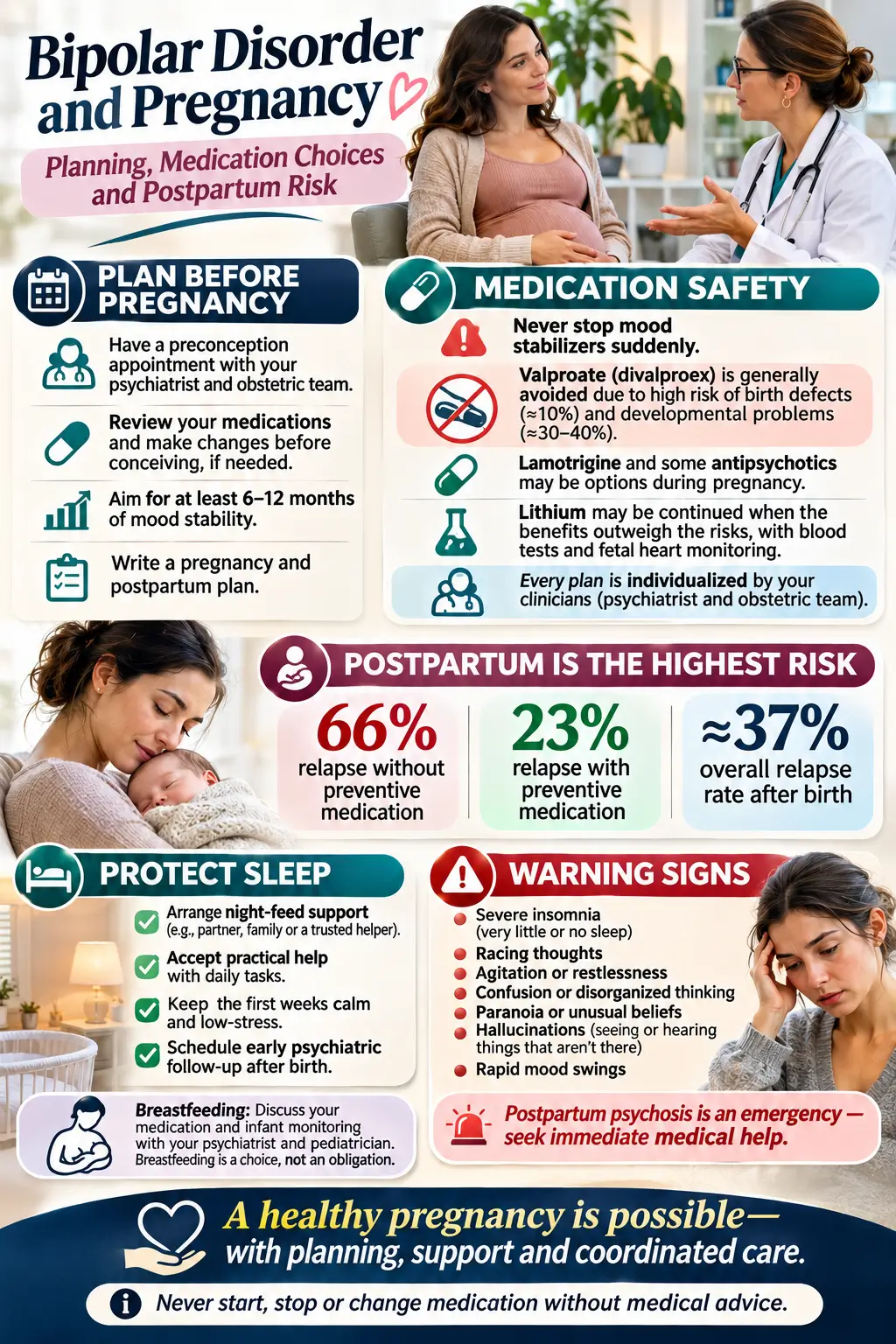
- Plan before you conceive. A pre-pregnancy review with your psychiatrist is the single most important step.
- Don’t stop medication suddenly when you find out you’re pregnant. In one study, 85.5% of women who stopped mood stabilizers relapsed during pregnancy, compared with 37% who continued.
- The postpartum period is the highest-risk time. About two in three women with bipolar disorder who took no preventive medication relapsed after birth, compared with about one in four who did.
- Valproate is linked to birth defects in about 10% of exposed babies and to developmental problems in 30–40% of children, so it’s generally avoided.
- Lithium carries a small increase in heart defects, but it’s very effective. Many women and doctors decide its benefits outweigh the risks.
- Untreated bipolar disorder also carries real risks for mother and baby. The goal is the lowest-risk plan that keeps you well, not zero medication.
Medication safety: This article is for education only. Every pregnancy plan should be made with your psychiatrist, obstetrician or midwife, and ideally a perinatal psychiatrist. Never stop or change medication without medical advice.
For background, see our guides to bipolar disorder, bipolar disorder treatment and bipolar disorder symptoms in females.
Can You Have a Healthy Pregnancy With Bipolar Disorder?
Yes. Bipolar disorder doesn’t prevent you from becoming pregnant, carrying a pregnancy or being a loving, capable parent. What it does mean is that pregnancy needs more planning and closer monitoring than usual, because:
- Hormonal, sleep and life changes can trigger mood episodes
- Some medications carry risks to a developing baby
- Stopping medication raises the risk of relapse
- The postpartum period carries a very high risk of severe episodes
With a clear plan and a coordinated team, most of these risks can be reduced substantially.
Untreated Bipolar Disorder and Pregnancy: Why “No Medication” Isn’t Risk-Free
Many women’s first instinct is to stop all medication to protect the baby. That’s understandable, but untreated bipolar disorder carries its own risks:
- High relapse rates. In a well-known study at Massachusetts General Hospital, women who stopped mood stabilizers had an 85.5% recurrence rate during pregnancy, compared with 37% for those who continued. Those who stopped spent over 40% of their pregnancy unwell, compared with under 9% for those who continued. Stopping abruptly raised the risk further.
- Effects of mood episodes on pregnancy. Mania and severe depression can lead to poor nutrition, missed prenatal care, sleep loss, substance use, risky behavior and, in severe cases, suicide. Studies have linked untreated maternal mood disorders to higher rates of preterm birth and low birth weight.
- Higher postpartum risk. Women who go into delivery unwell or untreated are more likely to have severe postpartum episodes.
The real question isn’t “medication or no medication?” It’s “which plan carries the lowest overall risk for me and my baby?” See how to deal with a bipolar person not on medication and why do people with bipolar stop taking medication?
Step 1: Plan Before Conception
Around half of pregnancies are unplanned, so if you have bipolar disorder and could become pregnant, it’s worth discussing pregnancy now, even if it isn’t on your mind.
Pre-pregnancy checklist
- Book a preconception appointment with your psychiatrist, and ideally a perinatal psychiatrist.
- Review your history — how severe your episodes have been, how quickly you relapse without medication, any past postpartum episodes, and your family history of postpartum psychosis.
- Review every medication for pregnancy safety, and switch before conception if needed. Switching mid-pregnancy is riskier.
- Aim for at least 6–12 months of stability before trying to conceive, if possible.
- Take folic acid before and during early pregnancy. If you take an anticonvulsant mood stabilizer, your doctor may recommend a higher dose.
- Review contraception until you’re ready. Carbamazepine and some other medicines can make hormonal contraceptives less effective. If you take valproate, effective contraception is essential.
- Address lifestyle factors — alcohol, smoking, cannabis, caffeine, sleep and weight.
- Involve your partner or a support person in the plan.
- Write a pregnancy and postpartum mental health plan — see the template below.
Valproate: plan the switch early
If you take valproate (divalproex) and could become pregnant, talk to your doctor now. UK regulators say valproate must not be used in women and girls who could become pregnant unless they’re on a pregnancy prevention programme and no other treatment works. Never stop valproate suddenly. Switching should be planned and gradual. See valproate.
Step 2: Understand the Medication Choices
No medication is proven 100% safe in pregnancy. But for most bipolar medications, the risks are small and well studied, and they must be weighed against the risk of relapse. Here’s what the research shows.
Bipolar medications in pregnancy at a glance
| Medication | What research shows | Typical approach |
|---|---|---|
| Lithium | Small increase in heart defects (about 2.4 vs 1.2 per 100 births in one large study), higher at higher doses; levels change during pregnancy | Often continued when it’s the most effective option, with careful monitoring and a detailed fetal heart scan |
| Lamotrigine | No increased risk of major malformations at maintenance doses in over 12,000 exposed pregnancies; levels fall during pregnancy | Commonly used, especially for bipolar depression; dose often needs adjusting |
| Atypical antipsychotics (e.g., quetiapine, aripiprazole, olanzapine) | Large studies show no meaningful increase in malformations overall; possible small risk with risperidone; watch for gestational diabetes and weight gain | Commonly used, especially for preventing mania |
| Valproate | About 10% major malformations (including spina bifida) and 30–40% neurodevelopmental problems | Avoid unless there’s truly no alternative |
| Carbamazepine | Increased risk of malformations, including neural tube defects; reduces contraceptive effectiveness | Generally avoided if alternatives exist |
| Antidepressants (SSRIs) | Generally considered relatively low-risk in pregnancy, but they can trigger mania in bipolar disorder | Only with a mood stabilizer or antipsychotic, if needed |
| Benzodiazepines | Possible newborn withdrawal or “floppy infant” effects with regular use late in pregnancy | Short-term, lowest dose, if needed |
Lithium in pregnancy
Lithium was once thought to carry a very high risk of a rare heart defect called Ebstein’s anomaly. Newer, much larger studies show the risk is far smaller than once feared:
- A 2017 New England Journal of Medicine study of over 1.3 million pregnancies found cardiac malformations in 2.41 per 100 lithium-exposed babies, compared with 1.15 per 100 unexposed babies. The risk was dose-dependent: highest above 900 mg per day, and not clearly raised at lower doses.
- A 2018 Lancet Psychiatry study pooling six international cohorts found major malformations in 7.4% of babies exposed in the first trimester, compared with 4.3% of babies whose mothers had a mood disorder but didn’t take lithium.
Because lithium is so effective at preventing relapse — especially postpartum relapse — many women and doctors decide to continue it. If you do:
- Expect more frequent blood tests. Lithium levels change as kidney function and fluid volume increase during pregnancy, then shift quickly after delivery.
- Have a detailed fetal heart scan (echocardiogram) around 18–22 weeks.
- Plan delivery with your team. Lithium may be adjusted around labor, levels are checked soon after birth, and the baby is monitored.
- Stay hydrated, especially if you have vomiting or morning sickness, and report signs of toxicity. See lithium toxicity symptoms and lithium side effects.
Lamotrigine in pregnancy
Lamotrigine has one of the most reassuring safety records of any mood stabilizer in pregnancy. Large registries haven’t found an increased risk of major malformations at maintenance doses. Its blood levels fall during pregnancy because the body clears it faster, so your doctor may need to raise the dose, then lower it after delivery. Lamotrigine is better at preventing depression than mania. See side effects of lamotrigine.
Antipsychotics in pregnancy
A 2016 JAMA Psychiatry study of over 1.3 million pregnancies found that, after accounting for other factors, atypical antipsychotics were not linked to a meaningful increase in birth defects. Risperidone was a possible exception, with a small increase. Antipsychotics such as quetiapine, aripiprazole and olanzapine are often used in pregnancy.
The main concerns are weight gain and gestational diabetes, so blood sugar is usually checked. Some newborns have temporary restlessness or feeding difficulties after late-pregnancy exposure. See bipolar medications and weight gain and mood stabilizers vs antipsychotics.
Antidepressants in pregnancy with bipolar disorder
SSRIs such as sertraline are often used in pregnancy for depression. In bipolar disorder, however, they can trigger mania or rapid cycling, so they’re generally used only alongside a mood stabilizer or antipsychotic. See manic switch.
How doctors choose
The “best” medication in pregnancy is usually the one that has kept you well, as long as it isn’t valproate. Switching to a medication you’ve never taken risks relapse and exposes the baby to two drugs instead of one. Your team will aim for:
- One medication where possible, rather than several
- The lowest effective dose
- Avoiding valproate and, ideally, carbamazepine
- Regular monitoring of mood, blood levels and the baby’s growth
Step 3: Pregnancy Care Trimester by Trimester
First trimester
- Tell your psychiatrist and obstetric provider as soon as you know you’re pregnant. Don’t stop medication on your own.
- Confirm your medication plan and folic acid dose.
- Morning sickness can affect medication absorption and lithium levels, so report persistent vomiting.
- Protect your sleep, since fatigue and nausea can disrupt routines. See bipolar sleep.
Second trimester
- Have the detailed anatomy scan, and a fetal echocardiogram if you take lithium.
- Expect blood-level checks for lithium or lamotrigine, plus a gestational diabetes test.
- Track your mood and watch for early warning signs. See early warning signs of a bipolar episode and our bipolar mood chart.
Third trimester
- Finalize your birth and postpartum mental health plan with your whole team.
- Discuss how medication will be managed around delivery, especially lithium.
- Plan sleep protection for after the birth.
- Consider pre-registering with your hospital’s perinatal mental health service.
Step 4: Labor and Delivery
- Share your mental health plan with the birth team, and make sure your psychiatric history is in your notes.
- If you take lithium, your team may adjust the dose around labor, monitor fluids and check your level soon after birth. Your baby may be checked for lithium effects.
- Ask about a private room or quieter ward and a plan to protect your sleep in the first nights.
- Long labors and sleepless nights are triggers, so request support early if you feel unwell.
Step 5: The Postpartum Period — The Highest-Risk Time
The weeks after birth are the period of highest risk for bipolar relapse.
How high is the risk?
A 2016 American Journal of Psychiatry meta-analysis of 5,700 deliveries in over 4,000 women found:
| Group | Postpartum relapse rate |
|---|---|
| All women with bipolar disorder | About 37% |
| Women not taking preventive medication during pregnancy | About 66% |
| Women taking preventive medication | About 23% |
| Severe postpartum episodes (mania, psychosis or hospitalization) in women with bipolar disorder | About 17% |
In other words, staying on preventive treatment roughly cut the risk of postpartum relapse by two-thirds.
Postpartum psychosis
Postpartum psychosis is a psychiatric emergency. In the general population it affects about 1–2 in 1,000 births, but it’s far more common in women with bipolar disorder — especially those with a personal or family history of postpartum psychosis. It usually starts within the first two weeks after birth, and sometimes within days.
Warning signs include:
- Severe insomnia or not needing sleep
- Racing thoughts and agitation
- Confusion
- Paranoia
- Hallucinations or strange beliefs, sometimes about the baby
- Rapid mood swings
It can be fully treated, but it needs immediate care. See bipolar psychosis and hallucinations vs delusions.
Postpartum depression in bipolar disorder
Bipolar depression after birth can look like postpartum depression. Signs include:
- low mood
- exhaustion beyond normal new-parent tiredness
- loss of interest (anhedonia)
- guilt
- difficulty bonding
- hopelessness
- thoughts of self-harm
It’s important that your team knows you have bipolar disorder, because antidepressants alone can trigger mania. See what is bipolar depression?, bipolar depression test and how to deal with bipolar depression.
How to reduce postpartum risk
- Continue or restart preventive medication as planned. For women who stopped during pregnancy, many guidelines suggest restarting medication immediately after delivery if relapse risk is high.
- Protect sleep above almost everything else. Arrange for a partner or support person to handle night feeds, using expressed breast milk or formula, so you get at least one solid block of sleep each night.
- Limit visitors and keep the early weeks calm.
- Have early follow-up with your psychiatrist, ideally within the first one to two weeks.
- Watch for warning signs daily, and make sure your partner knows what to look for.
- Accept practical help with meals, chores and older children.
Breastfeeding and Bipolar Medication
Many women with bipolar disorder can breastfeed. The decision depends on your medication, your baby’s health and your need for sleep:
- Lamotrigine passes into breast milk, but it’s often considered compatible with breastfeeding, with monitoring of the baby for rash or poor feeding.
- Quetiapine and olanzapine pass into milk in low amounts and are often considered options.
- Lithium passes into breast milk in significant amounts. Breastfeeding may be possible in selected cases with close monitoring of the baby (blood levels, kidney and thyroid function), but some guidelines advise against it. Decide with your psychiatrist and pediatrician.
- Valproate passes into milk in low amounts, but it’s usually avoided in women of childbearing potential for other reasons.
Breastfeeding is a choice, not an obligation. If night feeds would cost you the sleep you need to stay well, formula or partner-given expressed milk are healthy, loving options. Your mental health directly affects your baby’s wellbeing.
Your Pregnancy and Postpartum Mental Health Plan (Template)
Share this with your psychiatrist, obstetrician or midwife, partner and birth team:
- Diagnosis and history — your bipolar type, episode history, and any previous postpartum episodes or family history of postpartum psychosis
- Medication plan — what you’ll take during pregnancy, around delivery and after birth; blood-test schedule; who adjusts the doses
- Early warning signs — your personal signs of mania, depression and psychosis
- Sleep plan — who does night feeds, and how you’ll protect at least one long block of sleep
- Feeding plan — breastfeeding, expressed milk, formula or a combination
- Support network — names and numbers of your partner, family, friends and doulas
- Care team contacts — psychiatrist, obstetrician or midwife, perinatal mental health team and pediatrician
- Crisis plan — what to do and whom to call if warning signs appear; the hospital you prefer
- Follow-up — appointment dates in the first two weeks and the first three months postpartum
Build on our bipolar wellness plan template.
Will My Baby Have Bipolar Disorder?
Bipolar disorder runs in families, but most children of a parent with bipolar disorder don’t develop it. Having one parent with bipolar disorder raises a child’s lifetime risk to roughly 10%, compared with about 1–2% in the general population. Risk is higher if both parents are affected. Genes aren’t destiny: a stable, supportive home and early help when needed make a real difference. See what causes bipolar disorder in the brain and emotional dysregulation in children.
Questions to Ask Your Care Team
- Is my current medication safe to continue in pregnancy? If not, what’s the safest alternative, and when should I switch?
- What is my personal risk of relapse during pregnancy and after birth?
- How often will my blood levels and mood be checked?
- Do I need a higher dose of folic acid?
- How will medication be managed around labor and delivery?
- Can I breastfeed on my medication?
- How will we protect my sleep after the birth?
- Is there a perinatal psychiatry or mother-and-baby service near me?
- What should my partner do if they notice warning signs?
Support and Crisis Resources
- 988 Suicide & Crisis Lifeline (US): call or text 988
- National Maternal Mental Health Hotline (US): call or text 1-833-TLC-MAMA (1-833-852-6262), 24/7
- Postpartum Support International: 1-800-944-4773, including specialist support for perinatal bipolar disorder and postpartum psychosis
- Emergency: call 911 or go to the nearest emergency department for psychosis, thoughts of harming yourself or your baby, or several nights without sleep
If you are in crisis: call or text 988, or go to the nearest emergency department. Postpartum psychosis is a medical emergency — get help immediately.
Frequently Asked Questions About Bipolar Disorder and Pregnancy
Can I get pregnant if I have bipolar disorder?
Yes. Bipolar disorder doesn’t prevent pregnancy, and many women with bipolar disorder have healthy pregnancies and babies. The key is planning ahead with your psychiatrist and obstetric team: review your medications before conception, aim for a stable period first, take folic acid, and write a plan for pregnancy, delivery and the high-risk postpartum weeks.
Should I stop my bipolar medication when I find out I’m pregnant?
No — don’t stop suddenly. Abruptly stopping mood stabilizers greatly raises relapse risk; one study found 85.5% of women who stopped relapsed during pregnancy, compared with 37% who continued. Contact your psychiatrist promptly instead. Some medications, especially valproate, may need to be switched, but changes should be planned and gradual.
Which bipolar medications are safest during pregnancy?
Lamotrigine and several atypical antipsychotics, such as quetiapine and aripiprazole, have relatively reassuring safety data. Lithium carries a small, dose-related increase in heart defects but is very effective and often continued with careful monitoring. Valproate carries the highest risk and is generally avoided, and carbamazepine is usually avoided if alternatives exist.
Is lithium safe during pregnancy?
Lithium carries a small increased risk of heart defects — about 2.4 versus 1.2 per 100 births in one large study — that rises with higher doses. Because it’s highly effective at preventing relapse, especially postpartum, many women continue it with more frequent blood tests, a detailed fetal heart scan and careful planning around delivery.
What are the risks of untreated bipolar disorder in pregnancy?
Untreated bipolar disorder carries a high risk of relapse during pregnancy and after birth. Mood episodes can lead to poor nutrition, missed prenatal care, sleep loss, substance use and, in severe cases, suicide, and have been linked to preterm birth and low birth weight. The aim is the lowest-risk plan that keeps the mother well.
How common is postpartum relapse in bipolar disorder?
A large meta-analysis found that about 37% of women with bipolar disorder relapse after childbirth. The risk was about 66% for women who didn’t take preventive medication during pregnancy, compared with about 23% for those who did. About 17% had severe episodes such as mania or postpartum psychosis, making the postpartum weeks the highest-risk period.
What are the signs of postpartum psychosis?
Signs usually begin within two weeks of birth and include severe insomnia, racing thoughts, agitation, confusion, paranoia, hallucinations, unusual or frightening beliefs (sometimes about the baby) and rapid mood swings. Postpartum psychosis is a medical emergency. Call 911 or go to the nearest emergency department immediately; it’s highly treatable with prompt care.
Can I breastfeed while taking bipolar medication?
Often, yes. Lamotrigine, quetiapine and olanzapine are frequently considered compatible with breastfeeding, with monitoring of the baby. Lithium passes into milk in significant amounts and needs a careful, individual decision with your psychiatrist and pediatrician. Protecting your sleep matters too, so formula or partner-given expressed milk are healthy, loving options.
The Bottom Line on Bipolar Disorder and Pregnancy
Bipolar disorder and pregnancy require planning, but a healthy pregnancy and a healthy baby are very achievable. The most important steps are:
- reviewing medication before conception
- never stopping suddenly
- avoiding valproate
- choosing the medication that keeps you well at the lowest effective dose
- treating the postpartum period as the highest-risk time, with preventive treatment, protected sleep and early follow-up
Untreated bipolar disorder carries real risks too, so the goal is balance, not zero medication. Talk to your psychiatrist and obstetric team early, write a plan, and make sure the people around you know the warning signs. For more support, read our guides to bipolar disorder treatment, bipolar disorder medications and premenstrual exacerbation.
References
- Viguera AC, Whitfield T, Baldessarini RJ, et al. Risk of recurrence in women with bipolar disorder during pregnancy: prospective study of mood stabilizer discontinuation. American Journal of Psychiatry. 2007;164(12):1817–1824 (summary: MGH Center for Women’s Mental Health).
- Wesseloo R, Kamperman AM, Munk-Olsen T, et al. Risk of postpartum relapse in bipolar disorder and postpartum psychosis: a systematic review and meta-analysis. American Journal of Psychiatry. 2016;173(2):117–127.
- Patorno E, Huybrechts KF, Bateman BT, et al. Lithium use in pregnancy and the risk of cardiac malformations. New England Journal of Medicine. 2017;376(23):2245–2254.
- Munk-Olsen T, Liu X, Viktorin A, et al. Maternal and infant outcomes associated with lithium use in pregnancy: an international collaborative meta-analysis of six cohort studies. Lancet Psychiatry. 2018;5(8):644–652.
- Huybrechts KF, Hernández-Díaz S, Patorno E, et al. Antipsychotic use in pregnancy and the risk for congenital malformations. JAMA Psychiatry. 2016;73(9):938–946.
- UK Medicines and Healthcare products Regulatory Agency. Antiepileptic drugs in pregnancy: updated advice following comprehensive safety review. 2021 (updated 2024).
- UK Medicines and Healthcare products Regulatory Agency. Valproate medicines and serious harms in pregnancy.
- National Institute for Health and Care Excellence. Antenatal and postnatal mental health: clinical management and service guidance (CG192).
- American College of Obstetricians and Gynecologists. Treatment and management of mental health conditions during pregnancy and postpartum (Clinical Practice Guideline No. 5). 2023.
- National Institute of Mental Health. Bipolar Disorder.
- Postpartum Support International. Helpline and resources.
Subscribe to Our Newsletter
Get mental health tips, updates, and resources delivered to your inbox.
MORE from Author
Read More Bipolar disorder and pregnancy can go together safely. Many women with bipolar disorder have healthy pregnancies and healthy babies, and…
 Bipolar mania treatment aims to bring a manic episode under control quickly and safely, then prevent the next one. For…
 The history of bipolar disorder stretches back about 2,000 years. Ancient Greek physicians described mania and melancholia. Aretaeus of Cappadocia,…
 Bipolar daylight saving time questions come up twice a year for good reason. When the clocks change, your sleep, body…