
The Double Empathy Problem: A New Way to Understand Autism and Neurodivergent Communication

Medically reviewed by Laura Athey Updated Date: April 7, 2026
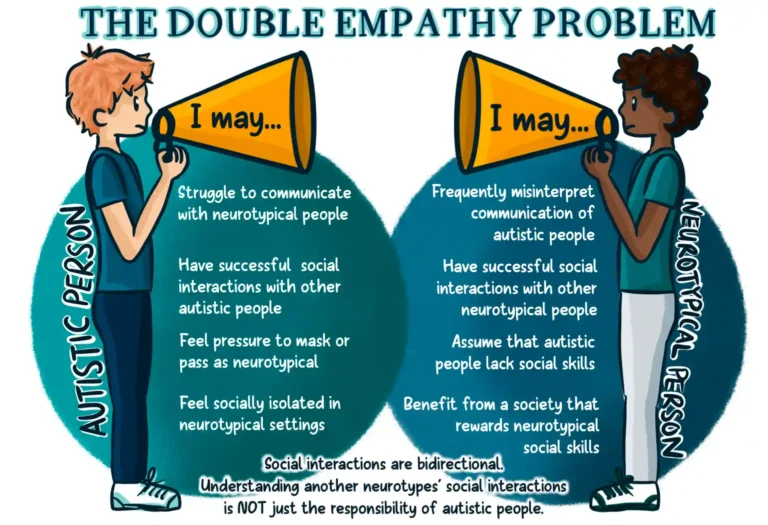
For decades, autism and neurodivergence have been framed through a one-sided lens: the idea that social difficulties stem from deficits within the individual.
This traditional view assumes neurotypical people are the standard, and autistic individuals must adapt. But what if the issue isn’t a lack of ability, but a mismatch in communication styles?
This is the foundation of the double empathy problem—a theory suggesting that misunderstandings arise mutually when people with different neurotypes interact. Communication isn’t broken on one side; it’s simply different on both.
This guide explores how this shift changes everything—from autism research to ADHD, workplaces, and education. Instead of trying to “fix” individuals, we learn to build bridges between perspectives.
As Dr. Laura Athey-Lloyd explains, recognizing this difference can be deeply validating. When we move from forcing conformity to fostering understanding, anxiety and shame decrease—and genuine connection becomes possible.
What Is the Double Empathy Problem?
To understand neurodiversity, we must first define the terms clearly. The “empathy gap” is not a void in the autistic person; it is a chasm between two different cultures of thought.
Double Empathy Problem Definition
The double empathy problem definition is relatively straightforward: It is the theory that communication breakdowns between autistic and non-autistic people occur because both parties struggle to understand the other’s lived experience. It is a mutual failure of reciprocity.
It is not that autistic people lack empathy. Rather, they have a difficult time empathizing with neurotypical social norms, and neurotypical people have a difficult time empathizing with autistic social norms. It is a “double” problem because the disconnect happens in both directions.
What Is the Double Empathy Problem in Autism?
Historically, if an autistic person didn’t make eye contact, it was viewed as a symptom of pathology. The double empathy problem in autism reframes this. It asks: Why is the neurotypical demand for eye contact considered the “correct” standard?
In this framework, an autistic person is not “socially broken.” They are simply socially different. When interacting with other autistic people, their communication is often highly effective, empathetic, and fluid. The friction only arises when they attempt to navigate a neurotypical world that refuses to meet them halfway.
Who Proposed the Double Empathy Problem?
This concept didn’t just appear out of thin air. It has a specific academic lineage that challenged the status quo of developmental psychology.
Damian Milton and the 2012 Shift
So, who proposed the double empathy problem? The theory was formally introduced by Dr. Damian Milton, an autistic sociologist and academic.
His seminal paper, often searched as the Damian Milton double empathy problem 2012 paper, was titled “On the ontological status of autism: the ‘double empathy problem’.” Before this publication, the dominant theory was “Theory of Mind” (ToM) deficits—the idea that autistic people could not understand that others had their own thoughts and feelings.
Milton flipped the script. The double empathy problem. Milton’s theory argued that while autistic people might struggle to read neurotypical minds, neurotypicals are equally terrible at reading autistic minds. The Milton 2012 double empathy problem paper remains one of the most cited works in modern neurodiversity studies because it gave academic weight to what the autistic community had known for years: We aren’t lacking empathy; we are just speaking a different emotional language.
When was the double empathy problem proposed? 2012 marks the official academic entry, though the sentiments existed in advocacy circles long before.
Double Empathy Problem Explained
To fully grasp the double empathy problem explained concepts, we need to look at the mechanics of human interaction.
Double Empathy Problem Theory
The double empathy problem theory rests on the sociological concept of “disposition.” We all have a disposition—a way of seeing the world based on our neurology, culture, and upbringing.
When two people with similar dispositions interact (e.g., two neurotypical people or two autistic people), communication flows easily. They share a “language.”
- Reciprocity: They instinctively understand turn-taking and tone.
- Context: They read between the lines similarly.
However, when two people with disparate dispositions interact (a “cross-neurological” interaction), that flow is disrupted. This is not a deficit; it is a disconnect. The double empathy problem theory posits that labeling one side as “disordered” is scientifically inaccurate and socially damaging.
Double Empathy Problem Autism Explanation
Let’s look at a practical double empathy problem autism explanation.
Imagine a conversation where an autistic person is sharing facts about their special interest (e.g., trains).
- Autistic perspective: “I am sharing information because I care about you and want to share my joy.” (Information-sharing = bonding).
- Neurotypical perspective: “They are lecturing me and ignoring my social cues to change the subject. They are being rude.” (Small talk = bonding).
Both parties are projecting their own norms onto the other. Both are failing to empathize with the other’s intent. That is the “double” nature of the problem.
Bipolar Disorder and the Double Empathy Context
While the theory originated in autism research, the “cross-neurotype” communication gap extends to other conditions, including Bipolar Disorder.
The Mania-Depression Communication Gap
The double empathy problem is highly relevant to Bipolar Disorder, particularly during mood episodes. When a person is in a hypomanic or manic state, their processing speed accelerates. They may speak rapidly (pressured speech), jump between topics (flight of ideas), and feel an intense sense of connection to the universe.
To a neurotypical observer, this communication can feel chaotic, overwhelming, or aggressive. They may withdraw, which the person with Bipolar Disorder interprets as rejection or “slowness.” Conversely, during depression, the person with Bipolar Disorder may struggle to engage with the “toxic positivity” or varying energy levels of neurotypical peers.
Just like in autism, the misunderstanding is mutual. The neurotypical person fails to understand the validity of the manic experience (viewing it only as a symptom to be suppressed), while the person with Bipolar Disorder struggles to translate their intense internal reality into a format that others can digest. Recognizing this gap can help families navigate episodes with more compassion and less judgment.
Here is Part 2 of your comprehensive pillar article. This section dives into practical examples, the connection to ADHD, current research, and community perspectives.
Double Empathy Problem Examples
To truly grasp this concept, we need to move from theory to real life. The friction usually happens in the subtle, unspoken rules of engagement.
Tone Misinterpretation
One of the most common double empathy problem examples involves tone of voice.
- The Scenario: An autistic employee asks a direct question in a meeting: “Why are we doing it this way? The other way is more efficient.”
- Neurotypical Perception: They hear the tone as challenging, rude, or insubordinate. They assume the intent is to undermine authority.
- Autistic Intent: They are genuinely curious and trying to help the team succeed. The tone is neutral or matter-of-fact, not aggressive.
- The Breakdown: The neurotypical person projects “rudeness” where none exists. The autistic person is confused why their helpful suggestion caused offense. This is a classic what is an example of the double empathy problem scenario.
Literal vs. Implied Language
- The Scenario: A partner says, “It’s getting cold in here.”
- Neurotypical Expectation: They are implying, “Please close the window.”
- Autistic Response: “Yes, it is.” (State of fact). They do not close the window.
- The Breakdown: The partner feels ignored or unloved. The autistic person feels confused when the partner gets angry later. The failure is mutual: One failed to be direct; the other failed to read the subtext.
Emotional Expression
Neurotypical people often expect empathy to look a certain way: sad faces for sad news, happy faces for happy news.
- The Scenario: A friend shares tragic news. The autistic listener’s face goes blank, or they might even nervously smile (an automatic regulation response).
- The Breakdown: The friend thinks, “They don’t care.” The autistic person feels deeply but expresses it differently, perhaps by offering a practical solution rather than a hug. The “empathy” is there; the translation is missing.
Double Empathy Problem and ADHD

While the theory originated in autism research, it has profound implications for Attention Deficit Hyperactivity Disorder (ADHD). The neurodivergent double empathy problem extends to anyone whose brain processes social information differently.
Connection to Impulsivity and Focus
What is the double empathy problem with ADHD? It often centers on conversation flow and interest-based nervous systems.
- Interrupting:
- ADHD Trait: Interrupting to share a related story (“me too!”) is often a sign of active engagement and empathy (“I relate to you!”).
- Neurotypical View: Interrupting is rude, self-centered, and shows a lack of listening.
- The Gap: The ADHDer is trying to connect; the Neurotypical feels dominated.
- Eye Contact and Focus:
- ADHD Trait: Looking away or fidgeting helps the ADHD brain focus better on the auditory input.
- Neurotypical View: “Look at me when I’m talking.” If you look away, you aren’t listening.
- The Gap: The demand for eye contact actually reduces the ADHDer’s ability to listen, creating the very disconnect the neurotypical person fears.
Research into double empathy problem ADHD interactions suggests that, much like autistic-to-autistic pairs, ADHD-to-ADHD conversations often flow rapidly and non-linearly with high mutual understanding, further validating the theory.
Double Empathy Problem Research Review
Is this just a theory, or is there proof? In the years since Milton’s 2012 double empathy problem paper, empirical studies have backed it up.
Overview of Key Studies
Double empathy problem research has shifted focus from “autistic deficits” to “dyadic interaction” (how two people interact).
- The “Telephone” Study (Crompton et al.): A study modeled after the game of “telephone” showed that information transfer between a chain of autistic people was just as accurate and effective as a chain of neurotypical people. However, when the chain mixed autistic and neurotypical people, the information quality degraded significantly. This proves the issue is the mismatch, not the autistic participants.
- Rapport Ratings: Studies show that within minutes of meeting, neurotypical people often form negative “thin slice” judgments of autistic people based on audio/visual cues, even before speaking. This supports the idea that the empathy failure often starts on the non-autistic side due to prejudice or discomfort with difference.
Deficit Model vs. Relational Model
Traditional research (The Deficit Model) asks: “What is wrong with the autistic person?” The Relational Model (Double Empathy) asks: “What is happening between these two people?”
Leading organizations like the Autistic Self Advocacy Network (ASAN) have championed this research, advocating for studies that measure mutual understanding rather than just autistic compliance. For those looking for deep dives, searching for the double empathy problem pdf often yields open-access academic papers from journals like Autism and Frontiers in Psychology.
Double Empathy Problem Criticism
No scientific theory is without critique. To be objective, we must explore the double empathy problem criticism.
Measurement Challenges
One major criticism is the difficulty of measuring “mutual empathy” in a lab setting. Empathy is subjective. Quantifying exactly how much a neurotypical person misunderstands an autistic person versus the reverse is complex. Critics argue we need more robust tools to measure these dyadic interactions.
Overgeneralization Concerns
Some researchers warn against swinging the pendulum too far. While the double empathy problem explains social disconnects, it does not erase the fact that autism comes with genuine cognitive and sensory challenges that exist independently of social interaction. Critics argue we must be careful not to claim all struggles are purely relational; some support needs are intrinsic to the disability.
Double Empathy Problem Reddit & Community Perspectives
The academic world is catching up, but the online community has been discussing this for years.
Lived Experience Themes
If you browse double empathy problem Reddit threads, you will find thousands of personal anecdotes confirming the theory.
- “The Relief”: Many late-diagnosed adults describe learning about this theory as a “lightbulb moment.” It relieves years of shame. They realize, “I wasn’t bad at socializing; I was just speaking a different language.”
- The “Autistic Radar”: Users frequently discuss how instantly comfortable they feel meeting other neurodivergent people, citing an immediate “click” that is absent with neurotypicals.
Advocacy Viewpoints
Prominent double empathy problem autistic advocate voices emphasize that this theory is a tool for social justice. It demands that neurotypical people stop positioning themselves as the “default” or “correct” communicators. It calls for equal effort. If an autistic person spends their whole life learning neurotypical social codes (masking), it is reasonable to ask neurotypicals to learn basic autistic communication norms in return.
Implications for Education
If the “problem” is a two-way street, then our schools have been fixing only one side of the road. The double empathy problem has massive implications for how we teach neurodivergent students.
What Are the Implications of the Double Empathy Problem for Education?
Currently, most “social skills training” (like Social Stories or ABA) focuses on teaching autistic children to mimic neurotypical behavior. The double empathy problem suggests this is insufficient and potentially harmful.
- Teacher Training: Educators need to learn that avoiding eye contact or stimming (self-stimulatory behavior) is not “defiant” or “disengaged.” It is often a self-regulation strategy that aids listening.
- Peer Mediation: Instead of pulling autistic kids out of class for social training, schools should implement “peer mediation” where neurotypical peers are taught how to communicate clearly, accept differences, and include autistic classmates. Research shows this is often more effective than training the autistic child alone.
- Universal Design for Learning (UDL): We must move away from a “one-size-fits-all” communication style. Allowing students to participate via text, drawing, or speech—without penalty—honors different neurotypes.
Clinical Note: Schools that adopt a neurodiversity-affirming approach see lower rates of school refusal and anxiety among autistic students. It shifts the environment from “correcting” the child to “connecting” with them.
How to Solve the Double Empathy Problem?
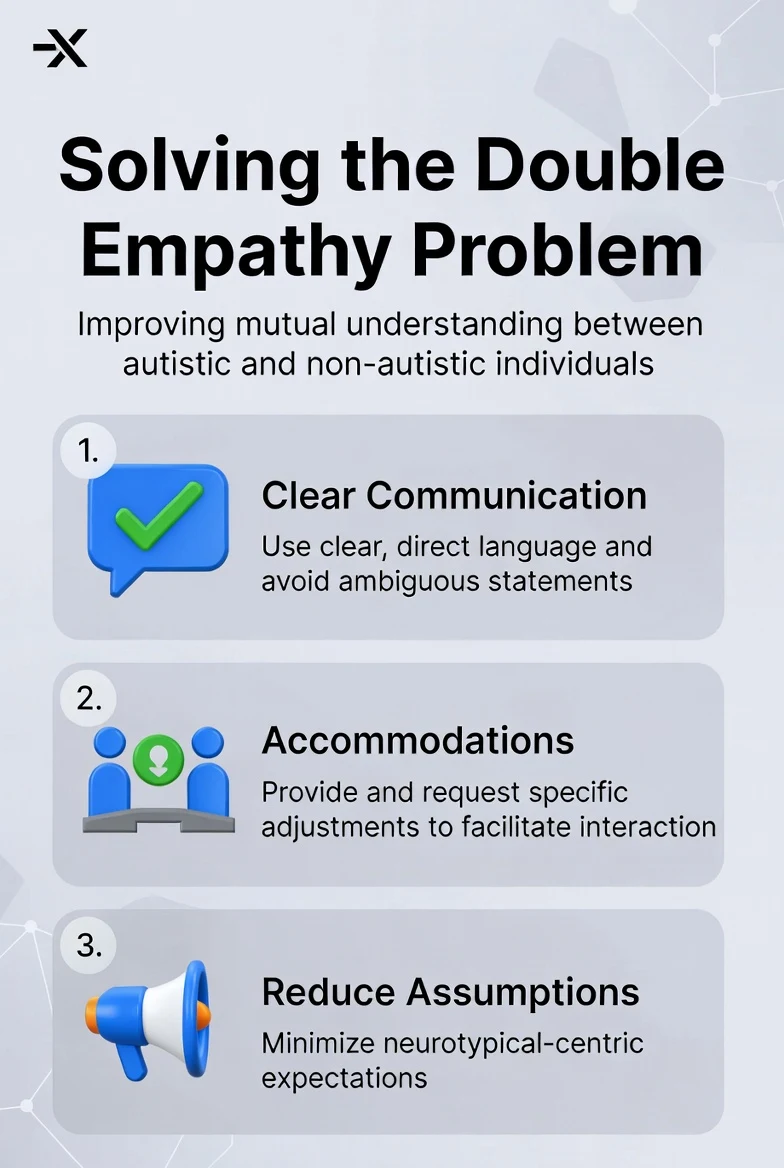
We cannot “cure” a philosophical problem, but we can bridge the gap. How to solve the double empathy problem? It requires mutual effort.
Mutual Adaptation
Both parties must move toward the middle.
- Neurotypicals: Drop the reliance on “hinting.” Be explicit. If you mean “no,” say “no,” not “maybe later.”
- Neurodivergent People: Continue to advocate for your needs. “I process information better if you write it down.”
Explicit Communication Norms
In workplaces and schools, establish “Manuals of Me.”
- “I do not interpret silence as agreement.”
- “I prefer direct feedback over the ‘compliment sandwich’.”
- “I may not look at you when I am thinking deeply.”
Perspective-Taking Training
This isn’t just for autistic people. Neurotypical people benefit immensely from training that simulates sensory overload or explains the “monotropic” (intense focus) nature of the autistic brain.
Neurodiversity Education
We must teach about different ≠ deficits. Just as we teach cultural competency, we must teach “neurological competency.”
Understanding “Double” in Other Contexts
As part of a holistic view on “doubling” efficiency, understanding, and capacity, let’s briefly address common queries where the concept of “double” causes confusion.
Can AI Really Double Your Business Efficiency?
In the context of cognitive labor, “doubling” output is a common promise. Can AI really double your business efficiency?
- The Reality: AI tools (LLMs) can drastically reduce the time spent on rote tasks (drafting emails, summarizing data).
- The Connection: Much like the double empathy problem asks us to offload the “translation” work, AI can offload the “administrative” work, freeing up human brainpower for genuine empathy and creative connection. However, AI lacks the nuance to navigate complex emotional double empathy scenarios.
Empathy Cards vs. Traditional Greeting Cards
When bridging an emotional gap, the tool matters.
- Traditional Cards: Often rely on clichés (“Get well soon!”, “Everything happens for a reason”). These can feel invalidating to someone in deep distress.
- Empathy Cards: Specifically designed (often by Emily McDowell) to acknowledge difficult truths without fixing them (“I’m so sorry you’re going through this. This sucks.”). They align perfectly with the double empathy principle: validating the reality rather than forcing a “correct” emotional response.
Frequently Asked Questions
What is the double empathy problem?
The double empathy problem is a theory proposing that communication breakdowns between autistic and non-autistic people are due to a mutual lack of understanding, rather than a deficit solely on the part of the autistic person. Both parties struggle to empathize with the other’s lived experience.
Who proposed the double empathy problem?
The theory was proposed by Dr. Damian Milton, an autistic sociologist and academic, in his influential 2012 paper.
When was the double empathy problem proposed?
Dr. Damian Milton formally introduced the concept in 2012.
What is an example of the double empathy problem?
A common example is eye contact. A neurotypical person may interpret a lack of eye contact as “dishonesty” or “disinterest,” while an autistic person may avoid eye contact to focus better on the conversation. The misunderstanding is mutual: one misinterprets the signal; the other communicates differently.
What is the double empathy problem with ADHD?
In ADHD, the double empathy problem often manifests in conversation flow. An ADHD person may interrupt to show excitement (“relational overlapping”), which a neurotypical person interprets as rude. Both fail to understand the other’s conversational style.
How to solve the double empathy problem?
You can bridge the gap through mutual adaptation: neurotypicals should use explicit, direct language and avoid subtext, while both parties should practice “perspective-taking” that acknowledges different neurological operating systems.
What are the implications of the double empathy problem for education?
It implies that social skills training should not just target autistic students. Schools must teach neurotypical peers and teachers to understand and accommodate diverse communication styles, rather than forcing autistic students to mask their traits.
Conclusion
The double empathy problem is more than just an academic theory; it is a call to action. It challenges us to stop viewing autism and neurodivergence as “broken” versions of humanity and start viewing them as equally valid variations.
For too long, the burden of communication has rested solely on the shoulders of those who find it most difficult. By acknowledging that the gap is mutual, we share the load. We move from a world of “fixing” people to a world of understanding them. Whether you are navigating a marriage, a classroom, or a workplace, remember: If you don’t understand someone, the failure isn’t just theirs. It’s yours, too. And that is a problem we can solve—together.
Authority References
- National Institute of Mental Health (NIMH)
- American Psychological Association (APA)
- Autistic Self Advocacy Network (ASAN)
- Frontiers in Psychology

Related Posts






Subscribe to Our Newsletter
Get mental health tips, updates, and resources delivered to your inbox.
MORE from Author
Read More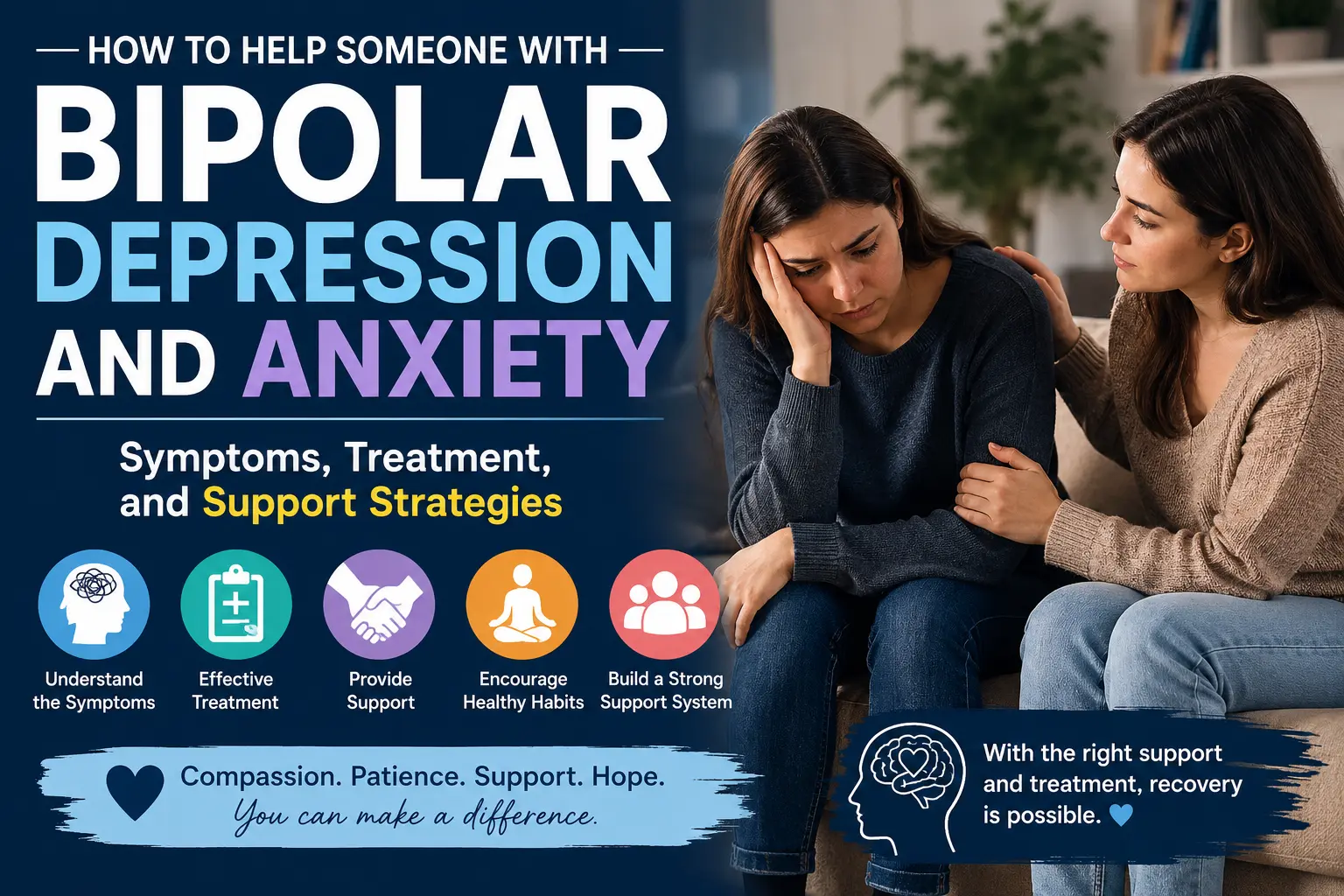 Watching someone you care about struggle with bipolar depression and anxiety can be heartbreaking. You may notice that they withdraw…
 In my practice as a clinical psychologist, I often observe that the difference between a patient who crumbles under pressure…
 We all have "up" days and "down" days. Perhaps you feel energized after a promotion or sluggish on a rainy…
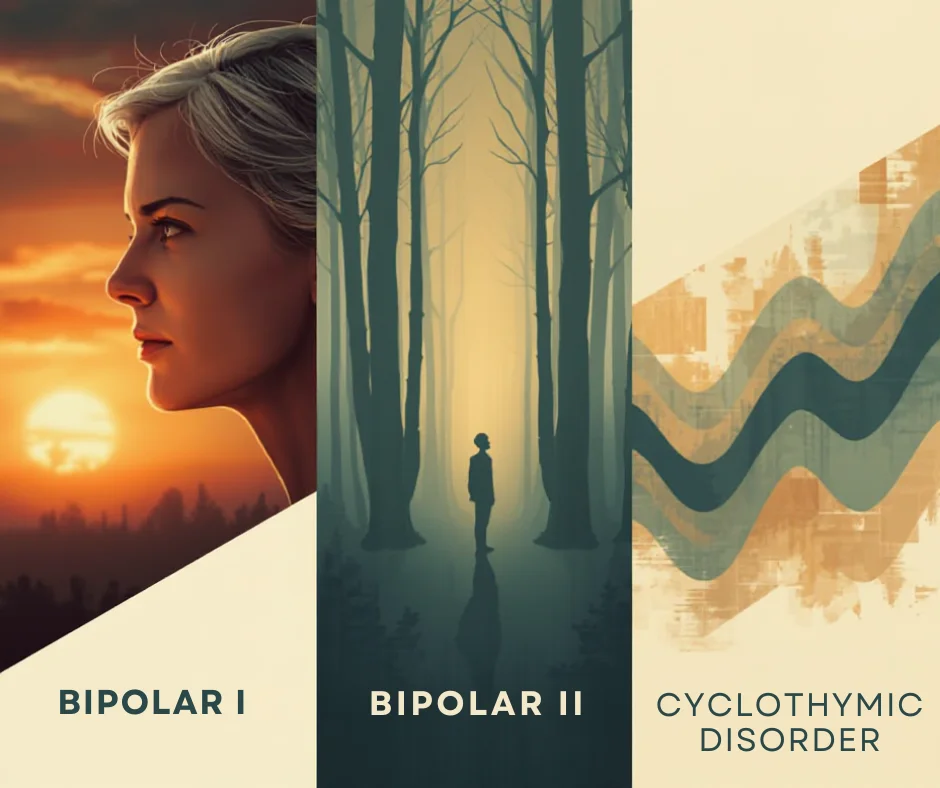 To define bipolar disorder accurately, we must look at it as a chronic mood dysregulation condition. In psychology and medicine,…
Are you looking for a Therapist?
Connect with qualified mental health professionals who understand
bipolar disorder, mood changes, and emotional challenges.
Private • Supportive • Confidential