
Bipolar Disability: Requirements, Approval Rate & Pay (2026)


Is bipolar disorder a disability? Yes — bipolar disorder can qualify as a disability under U.S. law. It is covered by the Americans with Disabilities Act (ADA) for workplace protections, and it can qualify for Social Security disability benefits (SSDI or SSI) if your symptoms are severe enough, well documented, and keep you from working despite treatment.
Qualifying for bipolar disability benefits is not easy. Most first applications for Social Security disability are denied, and mental health claims depend heavily on medical records. But many people who are denied at first are approved on appeal — especially when their treatment history, symptoms and day-to-day limitations are clearly documented.
This guide explains the bipolar disability requirements under the Social Security “Blue Book” listing 12.04, realistic approval rates, how much bipolar disability pays in 2026, how to apply step by step, how long it takes, and your rights at work. It also covers California benefits, private long-term disability insurance, VA benefits for veterans, and brief notes for readers in Canada and Australia.
Key takeaways
- Bipolar disorder can qualify for SSDI or SSI under Social Security’s listing 12.04 if symptoms seriously limit your ability to function and work despite treatment.
- In 2026, the maximum federal SSI payment is $994/month; the average SSDI disabled-worker benefit is about $1,630/month.
- Only about 36–37% of initial applications (all conditions) are approved, so appeals matter.
- Consistent treatment records and detailed descriptions of your limitations are the strongest evidence.
- The ADA protects workers with bipolar disorder and entitles them to reasonable accommodations.
- Disability benefit rules and amounts change every year — always confirm details with the official agency.
This article is general information, not legal or financial advice. For advice about your specific claim, speak with a qualified disability attorney, accredited representative or the relevant agency.
Is Bipolar Disorder a Disability?
Yes, in two different legal senses:
| Law or program | What “disability” means | What it gives you |
|---|---|---|
| Americans with Disabilities Act (ADA) | A condition that substantially limits a major life activity (such as thinking, concentrating, sleeping or interacting with others), even if it’s controlled with treatment | Protection from discrimination and the right to reasonable accommodations at work |
| Social Security (SSDI/SSI) | A medically determinable impairment that prevents you from doing substantial gainful activity and has lasted (or is expected to last) at least 12 months or result in death | Monthly cash benefits and health coverage |
Many people with bipolar disorder work successfully with treatment and are protected by the ADA without ever needing Social Security disability. Others experience frequent, severe or treatment-resistant episodes that make sustained work impossible — and may qualify for SSDI or SSI.
Is bipolar a permanent disability?
Bipolar disorder is usually a lifelong condition, but it isn’t treated as “permanent” by Social Security in the sense of never being reviewed. People receiving benefits for mental health conditions have periodic Continuing Disability Reviews (CDRs) — typically every 3 years when improvement is possible, or every 5–7 years when it isn’t expected. Benefits can stop if SSA finds your condition has medically improved and you can work.
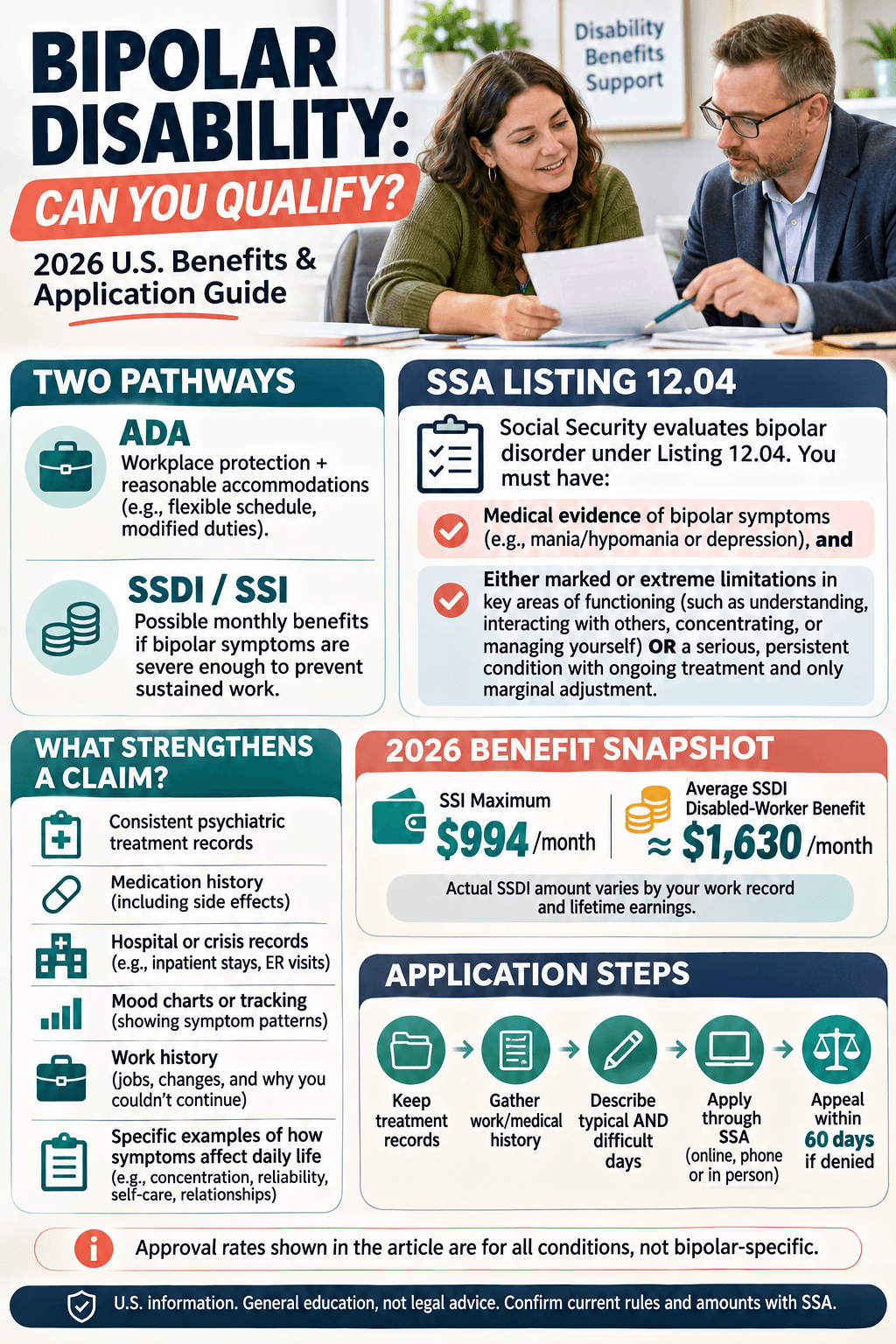
Bipolar Disability Requirements: Social Security Listing 12.04
Social Security evaluates bipolar disorder under listing 12.04, “Depressive, bipolar and related disorders,” in its Blue Book of impairments. You meet the listing if you satisfy paragraph A plus either paragraph B or paragraph C.
Paragraph A: Medical documentation of bipolar symptoms
Your records must document bipolar disorder characterized by three or more of:
- Pressured speech
- Flight of ideas
- Inflated self-esteem
- Decreased need for sleep
- Distractibility
- Involvement in activities that have a high probability of painful consequences that are not recognized
- Increase in goal-directed activity or psychomotor agitation
(Depressive disorder is documented separately by five or more of nine depressive symptoms, such as depressed mood, loss of interest, sleep and appetite changes, low energy, poor concentration and thoughts of death.)
These are essentially the symptoms of mania and hypomania. See bipolar symptoms and what is bipolar 1?.
Paragraph B: Functional limitations
You must show an extreme limitation in one, or marked limitation in two, of these areas of mental functioning:
| Area | Examples of how bipolar disorder may affect it |
|---|---|
| Understand, remember or apply information | Trouble following instructions, learning new tasks, or making work-related decisions during or after episodes |
| Interact with others | Conflicts with coworkers or supervisors, irritability, withdrawal, inappropriate behavior during mania |
| Concentrate, persist or maintain pace | Racing thoughts, distractibility, slowed thinking in depression, inability to finish tasks |
| Adapt or manage oneself | Poor hygiene during depression, impulsive spending, inability to cope with change or stress |
“Marked” means seriously limited; “extreme” means unable to function in that area independently, appropriately and effectively on a sustained basis.
Paragraph C: “Serious and persistent” bipolar disorder
If you don’t meet paragraph B, you can still meet the listing if:
- Your bipolar disorder has been medically documented for at least 2 years, and
- You rely on ongoing treatment, therapy, psychosocial support or a highly structured setting that reduces your symptoms, and
- You have only “marginal adjustment” — minimal capacity to adapt to changes in your environment or to demands not already part of daily life (for example, symptoms flare when routines change or stress increases).
If you don’t meet the listing: Residual Functional Capacity (RFC)
Many people approved for bipolar disability don’t meet the listing exactly. SSA then assesses your Residual Functional Capacity — what you can still do despite your condition — and considers your age, education and work history. A claim may succeed if evidence shows, for example, that you would:
- Miss too many days of work because of episodes or treatment
- Be off-task too often due to concentration problems
- Be unable to tolerate even routine, low-stress work or normal supervision
- Be unable to keep a regular schedule because of sleep disruption or medication side effects
Your psychiatrist’s detailed opinion on these limitations can be very important.
Bipolar Disability Symptoms: What Evidence Counts?
“Bipolar disability symptoms” aren’t a special category — SSA looks at the same symptoms clinicians do, but focuses on how they affect your ability to function over time. Helpful evidence includes:
- Psychiatric records documenting diagnosis, symptoms, mental status exams and treatment over months or years
- Hospitalizations, crisis visits and partial hospitalization programs
- Medication history — what you’ve tried, doses, side effects (such as sedation or cognitive slowing) and response
- Therapy notes and treatment plans
- Mood charts showing the frequency and length of episodes — see our bipolar mood chart and mood tracking apps
- Statements from family, friends or former employers describing your episodes and daily limitations
- Work history showing job losses, reduced hours or failed attempts to work
- Evidence of psychosis, suicide attempts or self-harm — see bipolar psychosis
- Records of cognitive problems affecting memory, attention or processing speed — see cognitive function
Consistent treatment matters. Gaps in care, or not following prescribed treatment without a good reason, can weaken a claim. If you can’t afford treatment or had side effects that made you stop, make sure this is documented.
The 5-Step Process SSA Uses to Decide Disability
| Step | Question | Notes |
|---|---|---|
| 1. Work activity | Are you working above the substantial gainful activity (SGA) level? | In 2026, SGA is $1,690/month for non-blind individuals. Earning more usually means you’re not considered disabled. |
| 2. Severity | Is your condition “severe” — significantly limiting basic work activities for at least 12 months? | |
| 3. Listing | Does your condition meet or equal listing 12.04? | If yes, you’re found disabled. |
| 4. Past work | Can you do your past relevant work? | If yes, the claim is denied. |
| 5. Other work | Can you adjust to any other work, considering your RFC, age, education and experience? | Older applicants with limited transferable skills have more favorable rules. |
Bipolar Disability Approval Rate: How Hard Is It to Get SSDI?
Social Security doesn’t publish approval rates specifically for bipolar disorder, but overall figures show why persistence matters. According to SSA’s annual statistical report, for recent application years:
| Stage | Approximate allowance rate (all conditions) |
|---|---|
| Initial application | about 36–37% |
| Reconsideration | about 13–15% |
| Hearing before an Administrative Law Judge (ALJ) | about 51–58% |
In other words, most initial claims are denied, but about half or more of claims reaching a hearing are allowed. Mental health claims can be challenging because there’s no lab test or X-ray for bipolar disorder — so the quality of your medical records and functional evidence is crucial.
Common reasons for denial include:
- Not enough medical evidence, or gaps in treatment
- SSA concluding that symptoms are controlled with medication
- SSA concluding you can do “simple, routine” work
- Earnings above the SGA limit
- Missing deadlines or paperwork
SSDI vs SSI: Which Bipolar Disability Benefit Applies to You?
| SSDI (Social Security Disability Insurance) | SSI (Supplemental Security Income) | |
|---|---|---|
| Who qualifies | People who’ve worked and paid Social Security taxes long enough (enough work credits) | People with limited income and resources, regardless of work history |
| Payment amount | Based on your lifetime earnings | Fixed federal amount, reduced by other income; some states add a supplement |
| Asset limit | None | $2,000 individual / $3,000 couple (2026) |
| Health coverage | Medicare after 24 months of SSDI entitlement | Medicaid in most states, usually right away |
| Waiting period | 5 full months after disability onset before benefits begin | No waiting period (benefits start the month after you apply, if eligible) |
Some people qualify for both (“concurrent” benefits) if their SSDI is low enough.
How Much Does Bipolar Disability Pay in 2026?
There’s no special payment rate for bipolar disorder — your benefit depends on the program and your earnings history.
| 2026 figure | Amount |
|---|---|
| SSI maximum federal payment (individual) | $994/month |
| SSI maximum federal payment (couple) | $1,491/month |
| SSDI average disabled-worker benefit | about $1,630/month |
| Maximum Social Security benefit at full retirement age (upper limit for high earners) | $4,152/month |
| Cost-of-living adjustment (COLA) for 2026 | 2.8% |
Your actual SSDI “bipolar disability check” amount appears on your Social Security Statement (my Social Security account). SSI may be reduced if you have other income or receive free housing or food support.
Back pay
If approved, you may receive back pay for the months you were eligible while your claim was pending (for SSDI, up to 12 months before your application date, after the 5-month waiting period). This can be a significant lump sum after a long appeal.
Other Bipolar Disability Benefits
- Medicaid or Medicare for medical and psychiatric care, including medications
- SNAP (food assistance)
- Housing assistance through local housing authorities, including Section 8 and supportive housing
- State supplements to SSI in some states
- Vocational rehabilitation services to help you return to work
- Ticket to Work — a free SSA program that supports people on disability benefits who want to work, with protections for your benefits while you try
- ABLE accounts — tax-advantaged savings accounts that don’t count toward SSI’s asset limit (for people whose disability began before a qualifying age)
How to Apply for Bipolar Disability: Step by Step
Step 1: Get (and stay in) consistent treatment
See a psychiatrist and/or therapist regularly. Your treatment records are the backbone of your claim. See bipolar disorder medications and the best therapy for bipolar disorder.
Step 2: Gather your records
Collect:
- Names and contact details of every doctor, therapist, hospital and clinic
- Dates of hospitalizations and crisis visits
- A list of all medications (past and present), doses and side effects
- Your work history for the past 15 years
- Any school, vocational or employer records describing problems
SSA offers a free Adult Disability Starter Kit with a checklist and worksheet.
Step 3: Apply
You can apply online at ssa.gov, by phone, or in person at a Social Security office. SSI applications may require an interview.
Step 4: Complete the Function Report carefully
The Adult Function Report asks how your condition affects daily life. Be specific and honest, and describe your worst days and typical days, not just your best:
- How often episodes happen and how long they last
- What you can’t do during depression (shower, eat regularly, leave the house)
- What happens during mania (spending, conflict, not sleeping)
- How medication side effects affect you
- Help you need from others
A family member can also complete a third-party function report.
Step 5: Ask your psychiatrist for a detailed medical source statement
A form or letter describing your diagnosis, symptoms, treatment, prognosis and specific functional limitations (for example, how many days a month you’d likely miss work) is much more useful than a note saying you’re “disabled.” Remember: SSA makes the final decision.
Step 6: Attend any consultative exam
SSA may send you to an independent examiner. Go, be honest, and bring a list of your symptoms and medications.
Step 7: If denied — appeal
You generally have 60 days (plus 5 days for mailing) to appeal each decision:
- Reconsideration — a new review of your file
- Hearing before an Administrative Law Judge — often the best chance of approval; you can testify and present new evidence
- Appeals Council review
- Federal court
Don’t start a new application instead of appealing unless advised to — appealing usually protects your earlier filing date and back pay.
How Long Does It Take to Get Disability for Bipolar Disorder?
Processing times vary by state and caseload, but expect:
- Initial decision: several months
- Reconsideration: several more months
- ALJ hearing: often a year or longer from the request, depending on your hearing office
Altogether, people who need a hearing often wait one to two years from first application. You can check current average processing times on SSA’s website.
How can I get disability for bipolar faster?
There’s no shortcut, but you can avoid delays:
- Apply as soon as you’re unable to work
- Submit complete records and keep SSA updated on new treatment
- Respond quickly to every SSA request
- Ask your doctors to send records and forms promptly
- If you’re in dire need (for example, facing eviction or unable to get food or medicine) or there’s a risk of suicide, tell SSA — such cases can be flagged for faster processing
Bipolar disorder isn’t on SSA’s Compassionate Allowances list, which fast-tracks certain severe conditions.
Do You Need a Bipolar Disability Lawyer or Advocate?
You don’t need a representative, but many people find one helpful — especially at the hearing stage, where a representative can gather evidence, prepare you to testify, and question vocational experts.
Fees are regulated by SSA. Under the standard fee agreement process, a representative can charge 25% of past-due benefits, up to a maximum of $9,200 (for favorable decisions on or after November 30, 2024), and is usually paid only if you win. Ask any representative to explain fees in writing before signing.
Free or low-cost help may also be available from legal aid organizations and state protection and advocacy agencies.
Bipolar Disability Act: Your Rights at Work Under the ADA
People sometimes search for a “bipolar disability act” — the law they usually mean is the Americans with Disabilities Act (ADA), which applies to employers with 15 or more employees. It:
- Prohibits discrimination based on a mental health condition
- Requires reasonable accommodations unless they cause undue hardship
Examples of reasonable accommodations for bipolar disorder:
- Flexible start times (helpful if medications cause morning sedation)
- A quieter workspace or permission to use headphones
- Breaks for stress management or medication
- Time off for appointments or short-term leave during an episode
- Written instructions and clear priorities
- Temporary reduced hours or remote work
Disclosure: You don’t have to disclose a diagnosis during hiring. To request accommodations, you’ll need to tell your employer you have a medical condition that requires them, and they may ask for documentation. The Family and Medical Leave Act (FMLA) may also provide up to 12 weeks of unpaid, job-protected leave for eligible employees.
Long-Term Disability Insurance and Bipolar Disorder
If you have private or employer long-term disability (LTD) insurance, check your policy carefully. Many LTD policies include a mental/nervous limitation that limits benefits for psychiatric conditions — often to 24 months — while physical conditions may be covered longer. Some policies also require you to apply for SSDI. Keep copies of everything and note claim deadlines.
Bipolar Disability in California
California offers extra support:
- SSI/SSP: California adds a State Supplementary Payment. In 2026, an aged or disabled individual living independently can receive up to $1,233.94/month ($994 SSI + $239.94 SSP).
- State Disability Insurance (SDI): Short-term benefits for workers who can’t work due to a non-work-related illness, including a mental health condition, with medical certification. SDI pays roughly 70–90% of wages, up to a maximum weekly benefit (listed by EDD as $1,765/week), for up to 52 weeks. This can help while an SSDI claim is pending.
Confirm current amounts with the California EDD and Department of Health Care Services before relying on them.
VA Disability for Bipolar Disorder (Veterans)
Veterans can receive VA disability compensation for bipolar disorder if it is service-connected — that is, it began during service, or was caused or worsened by service.
- The VA rates mental health conditions at 0%, 10%, 30%, 50%, 70% or 100%, based on how much the condition affects work and social functioning.
- Total Disability based on Individual Unemployability (TDIU) may pay at the 100% rate if service-connected conditions prevent you from keeping substantially gainful work. Schedular criteria are generally one disability rated 60% or more, or a combined 70% with at least one rated 40% or more.
- VA and Social Security benefits are separate — you can receive both.
Accredited veterans service officers (VSOs) can help for free.
Bipolar Disability Benefits in Canada and Australia
People outside the U.S. also search for bipolar disability benefits. Briefly:
- Canada: The Canada Pension Plan Disability (CPP-D) benefit is for people who’ve contributed to CPP and have a “severe and prolonged” disability. For new benefits starting in 2026, the maximum is $1,741.20/month. Provincial programs (such as ODSP in Ontario or AISH in Alberta), the Disability Tax Credit, and the federal Canada Disability Benefit may also apply.
- Australia: The Disability Support Pension (DSP) requires that a condition be fully diagnosed, treated and stabilised, and assessed under the Impairment Tables (including a table for mental health function), plus income and assets tests. Many people with bipolar disorder receive JobSeeker with medical exemptions while their DSP claim is assessed.
Rules differ significantly — check official government sites or a local advocate.
Bipolar Disability Reddit: What People Say
On Reddit and other forums, people applying for bipolar disability commonly share:
- Being denied at first and approved after a hearing
- The importance of a supportive psychiatrist and detailed records
- Frustration with long waits and complex paperwork
- Tips for describing bad days honestly in function reports
These communities can be a source of support and practical tips. But rules vary by country and state, and every case is different — use official sources and professional advice for decisions.
Living With Bipolar Disorder While Applying — and Accepting a Disability
Applying for disability can be stressful, and stress can worsen mood symptoms. Protect your stability:
- Keep your treatment going and tell your clinician the process is stressful
- Protect sleep — see bipolar and sleep
- Track early warning signs — see early warning signs of a bipolar episode
- Ask for help with paperwork from family, a social worker or an advocate
- Use stress-management tools — see stress management techniques
How to accept a disability: Many people feel grief, shame or loss of identity when they can’t work. These feelings are normal. Disability benefits are an earned insurance or a safety net — not a personal failure. Therapy, peer support groups (such as those run by DBSA or NAMI), and focusing on meaningful activities beyond paid work can help. Many people use time on benefits to stabilize and later return to work part-time or full-time. See how to deal with bipolar depression and depression and feeling alone.
Clinician’s note [REVIEWER TO WRITE in her own words, 2–4 sentences: what a helpful clinician letter for a disability claim includes (diagnosis, treatment history, specific functional limitations), and how clients can talk with their provider about it. Delete if not used.]
If you are in crisis: call or text 988 (Suicide & Crisis Lifeline, US) or go to the nearest emergency department. Outside the US, contact your local emergency number.
Frequently Asked Questions About Bipolar Disability
Can you get disability for bipolar disorder?
Yes. Bipolar disorder can qualify for SSDI or SSI if it meets Social Security’s listing 12.04 or otherwise prevents you from working, and it’s well documented.
What are the bipolar disability requirements?
Medical documentation of bipolar symptoms, plus either marked or extreme limitations in key areas of mental functioning, or a “serious and persistent” disorder documented for at least 2 years with ongoing treatment and marginal adjustment.
What is the bipolar disability approval rate?
SSA doesn’t publish bipolar-specific rates, but across all conditions only about 36–37% of initial applications are approved, while roughly half or more are allowed at the hearing stage.
How much does bipolar disability pay?
In 2026, SSI pays up to $994/month (more in some states, such as California); SSDI averages about $1,630/month and depends on your earnings history.
How long does it take to get disability for bipolar disorder?
An initial decision often takes several months; if a hearing is needed, the total wait is commonly one to two years.
Is bipolar a permanent disability?
Bipolar disorder is usually lifelong, but SSA reviews disability periodically. Benefits continue as long as you remain unable to work.
Can I work and receive bipolar disability benefits?
Limited work may be possible. SSDI has a trial work period ($1,210/month counts as a trial work month in 2026), and programs like Ticket to Work help people return to work. Earnings above SGA ($1,690/month in 2026) can affect eligibility, and SSI is reduced by earnings.
Is bipolar disorder covered by the ADA?
Yes. Bipolar disorder is generally considered a disability under the ADA, entitling workers to reasonable accommodations and protection from discrimination.
Do I need a lawyer for a bipolar disability claim?
Not required, but representation often helps, especially at hearings. Fees are capped by SSA (25% of back pay up to $9,200) and usually paid only if you win.
The Bottom Line on Bipolar Disability
Bipolar disorder can qualify as a disability — for workplace protection under the ADA and, when symptoms severely limit your ability to work, for Social Security benefits. Approval depends on strong, consistent medical evidence that shows not just your diagnosis but how bipolar disorder affects your daily functioning. Expect a long process, don’t give up after a first denial, and consider professional help with appeals. Most of all, keep your treatment and stability at the center — both for your health and for your claim.
References
- Social Security Administration. 12.00 Mental Disorders – Adult (Listing 12.04).
- Social Security Administration. 2026 Cost-of-Living Adjustment (COLA) Fact Sheet.
- Social Security Administration. Annual Statistical Report on the Social Security Disability Insurance Program, 2025 – Outcomes of Applications.
- Social Security Administration. Fee Agreements.
- California Department of Health Care Services. SSI/SSP Payment Standards Effective January 1, 2026.
- California Employment Development Department. Disability Insurance Benefit Payment Amounts.
- Government of Canada. Canada Pension Plan Maximum Benefit Amounts (2026).
- Services Australia. Disability Support Pension.
- U.S. Equal Employment Opportunity Commission. Depression, PTSD, & Other Mental Health Conditions in the Workplace: Your Legal Rights.
Related Posts




Subscribe to Our Newsletter
Get mental health tips, updates, and resources delivered to your inbox.
MORE from Author
Read More ADHD and depression often occur together, and each makes the other harder to live with. Adults with ADHD are almost…
 We all have "up" days and "down" days. Perhaps you feel energized after a promotion or sluggish on a rainy…
 To define bipolar disorder accurately, we must look at it as a chronic mood dysregulation condition. In psychology and medicine,…
Are you looking for a Therapist?
Connect with qualified mental health professionals who understand
bipolar disorder, mood changes, and emotional challenges.
Private • Supportive • Confidential