
Cognitive Function: Definition, Brain Science, Decline, and How to Improve It

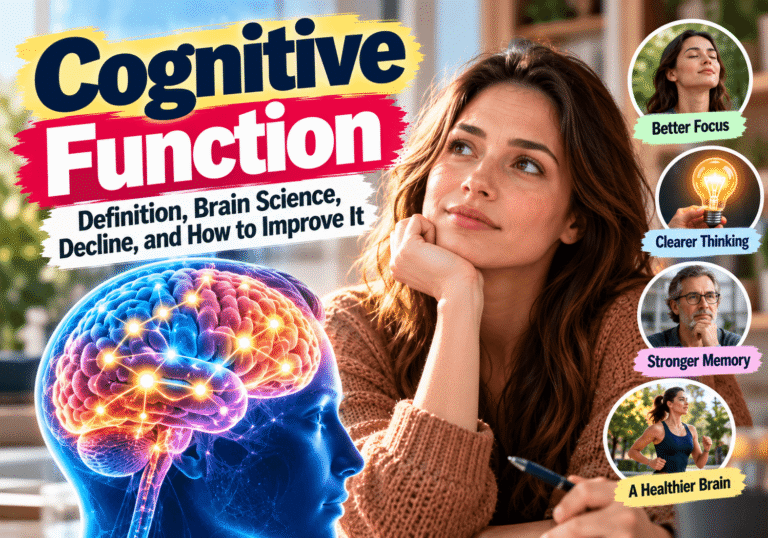
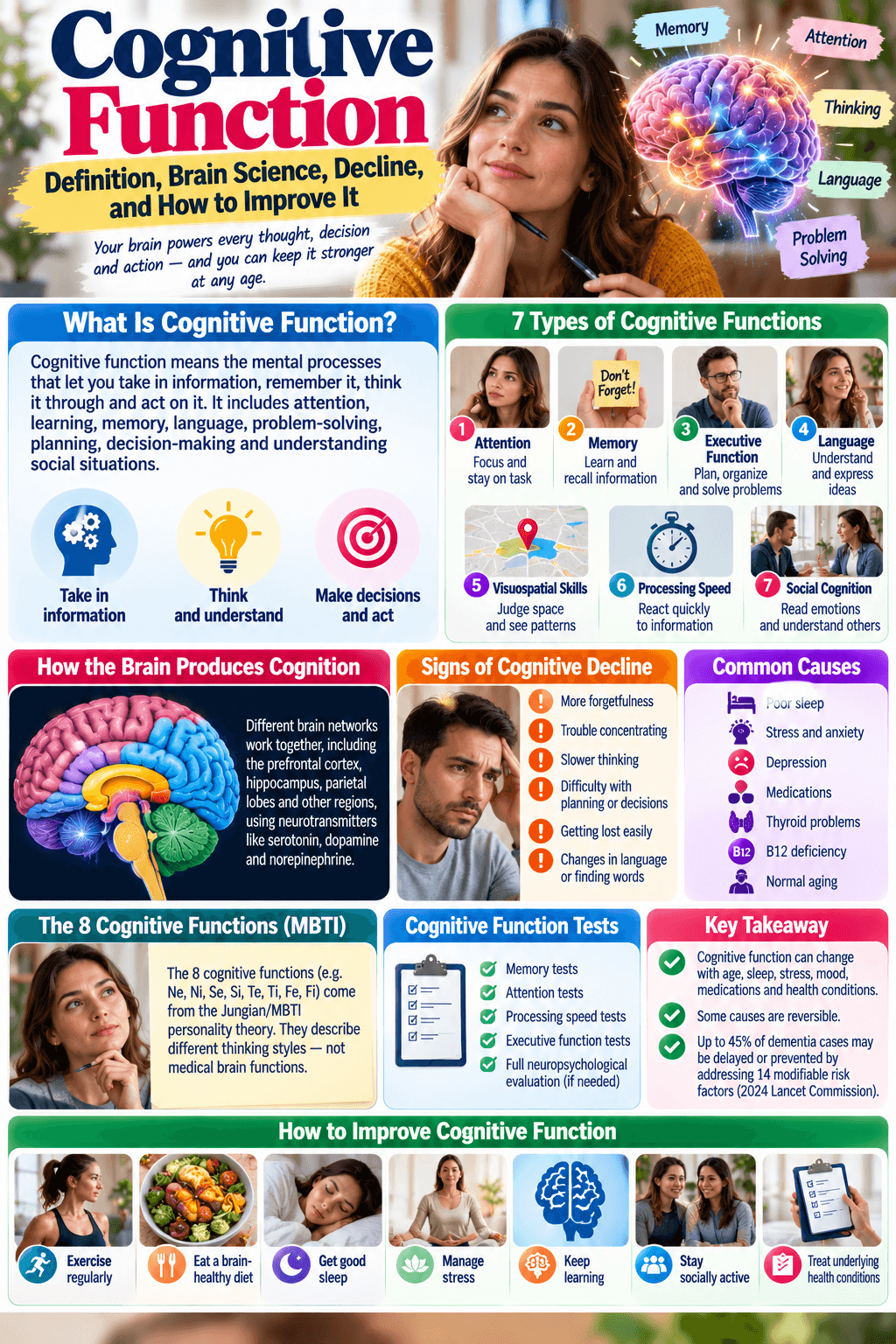
Cognitive function means the mental processes that let you take in information, remember it, think it through and act on it. It covers paying attention, learning, remembering, speaking and understanding language, solving problems, planning, making decisions and reading social situations. Every conversation, task and choice in your day depends on cognitive functioning.
Cognitive function is not fixed. It changes with age, sleep, stress, mood, medications and health conditions, including depression, ADHD and bipolar disorder. Some causes of poor cognition are reversible. And research shows lifestyle changes can protect thinking skills at any age.
This guide covers:
- the main types of cognitive function, with examples
- how the brain produces cognition
- the “8 cognitive functions” you see in MBTI
- early signs of cognitive decline
- cognitive function tests
- evidence-based ways to improve cognitive function
Key takeaways
- Cognitive function includes attention, memory, executive function, language, visuospatial skills, processing speed and social cognition.
- Some slowing with age is normal; trouble managing daily life is not.
- Depression, poor sleep, stress, medications, thyroid problems and B12 deficiency can all impair cognition, and many of these are treatable.
- The “8 cognitive functions” in MBTI are a personality theory, not medical brain functions.
- Up to 45% of dementia cases may be delayed or prevented by addressing 14 modifiable risk factors, according to the 2024 Lancet Commission.
What Is Cognitive Function? (Definition and Meaning)
Cognitive function definition: the brain’s ability to acquire, process, store and use information. The word “cognition” comes from the Latin cognoscere, “to know”.
Psychologists sometimes use cognitive functioning and cognitive abilities to mean the same thing. Common synonyms include:
- cognition
- mental function
- thinking skills
- intellectual functioning
- neurocognitive function
A cognitive process is any single mental operation, such as noticing a sound, recalling a name or weighing a choice. Cognitive function is the overall capacity built from these processes.
Types of Cognitive Functions (With Examples)
There is no single official list, but most clinicians and researchers use similar domains. The DSM-5-TR describes six neurocognitive domains, and many experts separate processing speed as a seventh.
What are the 7 cognitive abilities?
| Cognitive ability | What it does | Everyday example |
|---|---|---|
| 1. Attention | Focusing, staying focused and dividing focus | Following a conversation in a noisy café |
| 2. Memory (learning and memory) | Taking in, storing and recalling information | Remembering where you parked or what you read |
| 3. Executive function | Planning, organizing, switching tasks, controlling impulses, working memory | Planning a week of meals and shopping for them |
| 4. Language | Understanding, speaking, reading, finding words | Explaining an idea clearly; finding the right word |
| 5. Visuospatial (perceptual-motor) skills | Judging space, distance and shapes; coordinating movement | Parking a car or reading a map |
| 6. Processing speed | How quickly you take in and respond to information | Responding quickly in a fast-moving meeting |
| 7. Social cognition | Recognizing emotions, reading social cues, understanding others’ perspectives | Noticing a friend is upset even when they say “I’m fine” |
Cognitive function examples in daily life
- Working memory: keeping a phone number in mind while you dial it
- Inhibition: stopping yourself from interrupting someone
- Cognitive flexibility: switching plans when the bus is cancelled
- Reasoning and problem-solving: working out why your budget doesn’t balance
- Decision-making: comparing options and choosing one
- Sustained attention: reading a chapter without losing focus
What are the 5 cognitive functions?
Some sources group cognition into five core functions: attention, memory, language, executive function and visuospatial skills. This is simply a shorter version of the list above, with processing speed and social cognition folded into the other categories.
What Are the 8 Cognitive Functions? (MBTI vs Brain Science)
If you searched “8 cognitive functions”, “cognitive functions test” or “INFP cognitive functions”, you are probably looking for the Jungian/MBTI cognitive functions. That is a different concept.
The Myers-Briggs (MBTI) framework, based on Carl Jung’s theory of psychological types, describes eight “cognitive functions” as preferred styles of perceiving and judging:
| Function | Short name | Style |
|---|---|---|
| Extraverted Sensing | Se | Experiencing the present moment through the senses |
| Introverted Sensing | Si | Comparing the present with past experience and detail |
| Extraverted Intuition | Ne | Generating possibilities and connections |
| Introverted Intuition | Ni | Forming insights and long-range visions |
| Extraverted Thinking | Te | Organizing the outside world logically |
| Introverted Thinking | Ti | Building internal logical frameworks |
| Extraverted Feeling | Fe | Tuning in to group harmony and others’ feelings |
| Introverted Feeling | Fi | Judging by personal values |
Each MBTI type (for example, INFP or ENTJ) is said to use these functions in a set order. Online “cognitive function tests”, such as the Sakinorva test, estimate your preferences.
Important: MBTI cognitive functions describe personality preferences, not measurable brain abilities. They have limited scientific support and are not used to diagnose anything. Your memory, attention and executive function are measured with clinical tests (see below), not personality quizzes.
How the Brain Produces Cognitive Function
Cognition comes from networks across the whole brain, not single “centers”. Some regions play especially important roles:
| Brain region | Main cognitive roles |
|---|---|
| Prefrontal cortex (front of the brain) | Executive function: planning, decision-making, impulse control, working memory |
| Hippocampus (inner temporal lobe) | Forming new memories and spatial navigation |
| Temporal lobes | Language comprehension, memory, recognizing faces and objects |
| Parietal lobes | Attention, spatial awareness, integrating senses, numbers |
| Occipital lobes | Visual processing |
| Frontal language areas (Broca’s area) | Producing speech |
| Cerebellum | Coordination, and also timing and some thinking skills |
| Amygdala and limbic system | Emotion, which strongly affects attention and memory |
Brain cells communicate using chemical messengers. Acetylcholine is important for memory and attention, dopamine for motivation, reward and working memory, glutamate for learning, and serotonin and norepinephrine for mood and alertness.
Two ideas explain why cognition can change:
- Neuroplasticity. The brain keeps forming and strengthening connections throughout life, which is why learning, exercise and therapy can improve thinking.
- Cognitive reserve. Education, mentally demanding work, social life and lifelong learning seem to build a “buffer” that helps the brain cope with aging or disease.
Learn more about what happens in the brain in bipolar disorder.
Cognitive Function and Aging: What’s Normal?
Some cognitive changes are a normal part of aging:
- Processing speed slows gradually from early adulthood.
- Recalling names or words “on the tip of the tongue” gets harder.
- Multitasking takes more effort.
Other abilities stay steady or even improve:
- vocabulary
- general knowledge
- judgment drawn from experience (sometimes called crystallized intelligence)
| Normal aging | May signal a problem |
|---|---|
| Occasionally forgetting a name, then remembering later | Often forgetting recent conversations or events |
| Making an occasional bad decision | Repeatedly poor judgment, such as with money or scams |
| Missing a monthly payment once | Unable to manage bills or finances |
| Forgetting which day it is, then working it out | Losing track of the date or season |
| Sometimes struggling to find a word | Frequent trouble following or joining conversations |
| Misplacing things now and then | Losing things often and being unable to retrace steps |
Adapted from the National Institute on Aging.
What Is One of the First Signs of Cognitive Decline?
One of the most common first signs of cognitive decline is forgetting recently learned information, such as:
- conversations
- appointments
- recent events
- asking the same question again and again
Families often notice this before the person does.
Other early signs include:
- Taking longer to complete familiar tasks, like cooking a usual recipe or managing bills
- Trouble planning, organizing or following multi-step instructions
- Losing your train of thought, or struggling to follow a conversation, book or film
- Word-finding problems that are new and frequent
- Getting lost in familiar places
- Poor judgment, or new vulnerability to scams
- Withdrawing from hobbies or social activities
- Changes in mood or personality, such as apathy, irritability or anxiety
Subjective cognitive decline and mild cognitive impairment (MCI)
- Subjective cognitive decline: you notice your thinking is worse, but tests are normal. This is common, and is sometimes linked to stress, depression or poor sleep.
- Mild cognitive impairment (MCI): a measurable decline greater than expected for your age, while daily life is still largely independent. MCI becomes more common with age, affecting roughly 7% of people aged 60–64 and about 25% of those aged 80–84 (American Academy of Neurology). Some people with MCI progress to dementia; others stay stable or improve.
- Dementia (major neurocognitive disorder): cognitive decline severe enough to interfere with independence in daily life. Alzheimer’s disease is the most common cause.
If you notice changes, see a doctor. Early evaluation finds treatable causes and allows planning.
Cognitive Function Disorders and Causes of Poor Cognition
Not all thinking problems are dementia. Common causes of impaired cognitive function include:
Mental health conditions
- Depression. Slowed thinking, poor concentration and memory problems are core symptoms. In older adults, severe depression can mimic dementia. Cognition often improves with treatment. See major depressive disorder.
- Bipolar disorder (see the next section).
- ADHD. This involves lifelong differences in attention and executive function. See ADHD and depression.
- Anxiety and chronic stress. These take up working memory and attention. See stress management techniques.
- PTSD. This affects concentration and memory. See PTSD.
Medical and lifestyle causes (often reversible)
- Poor sleep, insomnia and sleep apnea
- Medication side effects, including some sleeping pills, benzodiazepines, anticholinergic drugs, opioids and some antihistamines
- Vitamin B12 deficiency and thyroid disorders
- Alcohol and substance use
- Infections (in older adults, a urinary infection can cause sudden confusion called delirium)
- Dehydration, low blood sugar, and low sodium
- Head injury, stroke, and uncontrolled blood pressure or diabetes
- Hearing and vision loss, which strain the brain and reduce stimulation
- “Brain fog” after viral illnesses, including long COVID
Sudden confusion is a medical emergency. So is new difficulty speaking, facial drooping or weakness on one side, which can be signs of stroke. Call emergency services.
Cognitive Function in Bipolar Disorder
Many people with bipolar disorder notice problems with focus, memory or planning, and research confirms this. A large meta-analysis of individual patient data found measurable differences in attention, verbal memory, processing speed and executive function even between mood episodes (euthymia), although the size of these differences varies widely from person to person.
During episodes, cognition changes more:
- Depression: slowed thinking, poor concentration, indecision. See bipolar depression.
- Mania or hypomania: distractibility, racing thoughts and impulsive decisions.
Several things help protect cognitive function in bipolar disorder:
- Stable mood. Fewer episodes are linked to better long-term cognition, so consistent treatment matters. See bipolar disorder medications.
- Sleep regularity. Sleep disruption worsens both mood and thinking. See bipolar and sleep.
- Medication review. Some medicines can cause sedation or mental slowing. Report this to your prescriber rather than stopping on your own. Thinking problems can also signal lithium levels that are too high; see lithium side effects.
- Cognitive remediation therapy, structured training in attention, memory and planning strategies, has shown benefits in research on bipolar disorder and other conditions.
Cognitive Function Tests: How Is Cognition Measured?
A cognitive function test checks how well your thinking skills are working. Common types include:
| Test | What it is | Time |
|---|---|---|
| Mini-Cog | Three-word recall plus clock drawing; a quick screen | About 3 minutes |
| MoCA (Montreal Cognitive Assessment) | Screens memory, attention, language, executive and visuospatial skills; sensitive to MCI | About 10–15 minutes |
| MMSE (Mini-Mental State Examination) | Older screening test of orientation, memory, attention and language | About 10 minutes |
| SLUMS | Screening test from Saint Louis University | About 7–10 minutes |
| Full neuropsychological assessment | Detailed testing of every cognitive domain by a neuropsychologist | Several hours |
Screening tests flag possible problems; they do not diagnose. A full evaluation may also include:
- a medical history and medication review
- blood tests (such as B12 and thyroid)
- depression screening
- sometimes brain imaging
Online “brain age” quizzes and MBTI cognitive function tests are not medical tests.
How Can I Improve My Cognitive Function?
The best evidence supports combining several healthy habits:
- The FINGER trial in Finland found that a two-year program combining diet, exercise, cognitive training and heart-health monitoring improved cognition in at-risk older adults.
- In US POINTER (2025), more than 2,000 older adults improved cognition with lifestyle programs. A structured, coached program worked better than a self-guided one.
1. Exercise regularly
Aerobic exercise (brisk walking, cycling, swimming) increases blood flow to the brain and is linked to better memory and executive function. Aim for about 150 minutes a week, plus strength training. Try our exercise plan.
2. Prioritize sleep
Sleep consolidates memory and clears waste products from the brain. Most adults need 7–9 hours. Get snoring and daytime sleepiness checked for sleep apnea. See how to fall asleep fast.
3. Treat depression, anxiety and stress
Depression is one of the most common reversible causes of poor concentration and memory. Therapy, medication when needed, and stress management can restore cognitive function.
4. Protect your heart and blood vessels
Control blood pressure, blood sugar and cholesterol, and don’t smoke. What’s good for the heart is good for the brain.
5. Eat a brain-healthy diet
Mediterranean-style eating patterns are linked to better cognitive aging: vegetables, fruit, whole grains, legumes, fish, olive oil and nuts, with less ultra-processed food. Trial results are mixed, so diet works best as part of a wider healthy lifestyle. See our bipolar diet guide.
6. Keep learning and stay mentally active
Learning new skills, such as a language, an instrument or a demanding hobby, builds cognitive reserve. “Brain training” apps mainly improve the games themselves, with limited transfer to everyday life.
7. Stay socially connected
Loneliness and isolation are linked to faster cognitive decline. Regular social contact is mental exercise too. See depression and feeling alone.
8. Correct hearing and vision loss
Using hearing aids, and treating vision problems, are among the dementia risk factors that can be modified.
9. Limit alcohol and avoid smoking
Heavy drinking damages the brain directly. Smoking harms the brain’s blood vessels.
10. Review your medications
Ask your doctor or pharmacist whether any of your medicines, especially for sleep, allergies, bladder problems or pain, might affect thinking. See sleeping pills.
What about supplements? No supplement has strong evidence for improving cognitive function in healthy people. Ginkgo biloba, for example, did not prevent dementia in a large trial. Supplements help mainly when you are deficient (for example, in vitamin B12). Talk to a doctor before taking them, especially with psychiatric medications.
Dementia risk factors you can change
The 2024 Lancet Commission identified 14 modifiable risk factors that together may account for about 45% of dementia cases:
- less education
- hearing loss
- high LDL cholesterol
- depression
- traumatic brain injury
- physical inactivity
- diabetes
- smoking
- high blood pressure
- obesity
- excessive alcohol
- social isolation
- air pollution
- untreated vision loss
When to See a Doctor About Cognitive Function
Make an appointment if:
- memory or thinking problems are getting worse, or are noticed by others
- daily tasks, work, driving or managing money are becoming harder
- problems began after a new medication, a head injury or an illness
- you also have low mood, poor sleep or high stress
Get urgent help for sudden confusion, sudden trouble speaking, facial drooping, one-sided weakness, or confusion with fever.
If you are in crisis: call or text 988 (Suicide & Crisis Lifeline, US) or go to the nearest emergency department. Outside the US, contact your local emergency number.
Frequently Asked Questions About Cognitive Function
What are cognitive functions?
Cognitive functions are the brain’s mental abilities: attention, memory, executive function, language, visuospatial skills, processing speed and social cognition.
What are the 8 cognitive functions?
In MBTI personality theory, the eight cognitive functions are Se, Si, Ne, Ni, Te, Ti, Fe and Fi. These are personality preferences, not medical measures of brain function.
What are the 7 cognitive abilities?
Attention, memory, executive function, language, visuospatial skills, processing speed and social cognition.
What are the 5 cognitive functions?
A common shorter list is attention, memory, language, executive function and visuospatial skills.
What is one of the first signs of cognitive decline?
Forgetting recently learned information, such as recent conversations or events, and repeating the same questions.
How can I improve my cognitive function?
Exercise regularly, sleep well, treat depression and stress, control blood pressure and blood sugar, eat a Mediterranean-style diet, keep learning, stay social, and correct hearing loss.
What is a cognitive function test?
A short screening test, such as the MoCA, MMSE or Mini-Cog, or a full neuropsychological assessment, that measures thinking skills like memory and attention.
Can cognitive function be restored?
Often, yes, when the cause is treatable: depression, poor sleep, medication side effects, vitamin B12 deficiency or thyroid problems. Lifestyle changes can also improve cognition at any age.
What is a cognitive process?
A single mental operation, such as perceiving, attending, remembering, reasoning or deciding, that together make up cognitive function.
The Bottom Line on Cognitive Function
Cognitive function is your brain’s toolkit for attention, memory, planning, language and social understanding. It naturally changes with age, but sudden or worsening problems are not “just aging” and deserve a medical check, especially because many causes are treatable. For people living with depression or bipolar disorder, stable mood, regular sleep and medication review are central to protecting thinking skills. And for everyone, exercise, sleep, social connection, lifelong learning and heart health remain the best-proven ways to keep the mind sharp.
References
- Livingston G, et al. Dementia prevention, intervention, and care: 2024 report of the Lancet standing Commission. Lancet. 2024.
- Petersen RC, et al. Practice guideline update summary: Mild cognitive impairment. Neurology. 2018;90(3):126–135.
- National Institute on Aging. Memory, Forgetfulness, and Aging: What’s Normal and What’s Not?
- Ngandu T, et al. A 2 year multidomain intervention of diet, exercise, cognitive training, and vascular risk monitoring versus control to prevent cognitive decline in at-risk elderly people (FINGER). Lancet. 2015;385(9984):2255–2263.
- Alzheimer’s Association. U.S. POINTER Study Results. 2025.
- Bourne C, et al. Neuropsychological testing of cognitive impairment in euthymic bipolar disorder: an individual patient data meta-analysis. Acta Psychiatr Scand. 2013;128(3):149–162.
- American Psychiatric Association. Diagnostic and Statistical Manual of Mental Disorders, 5th ed., Text Revision (DSM-5-TR). 2022. (Neurocognitive disorders: cognitive domains.)
Related Posts



Subscribe to Our Newsletter
Get mental health tips, updates, and resources delivered to your inbox.
MORE from Author
Read More ADHD and depression often occur together, and each makes the other harder to live with. Adults with ADHD are almost…
 We all have "up" days and "down" days. Perhaps you feel energized after a promotion or sluggish on a rainy…
 To define bipolar disorder accurately, we must look at it as a chronic mood dysregulation condition. In psychology and medicine,…
Are you looking for a Therapist?
Connect with qualified mental health professionals who understand
bipolar disorder, mood changes, and emotional challenges.
Private • Supportive • Confidential