
What Is Caplyta Used For? Approved Uses, Mental Health Benefits & What to Expect

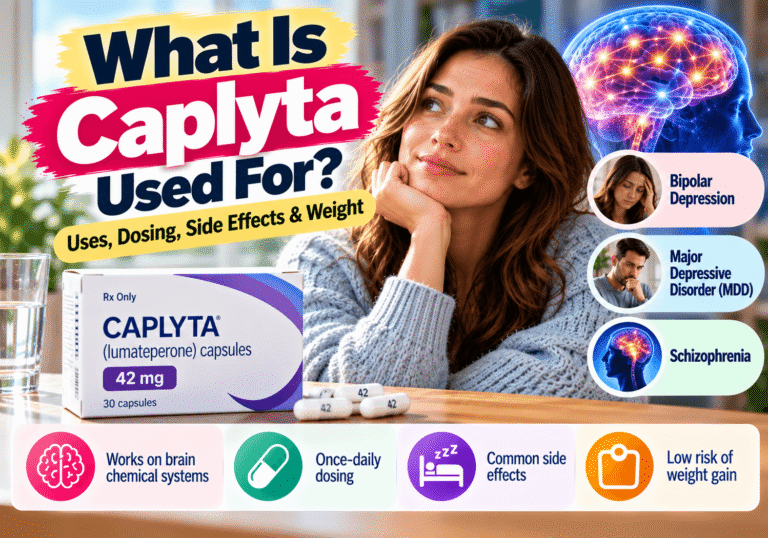
What is Caplyta used for? Caplyta (lumateperone) is a prescription medicine approved by the FDA for three uses in adults:
- Depressive episodes of bipolar I and bipolar II disorder (bipolar depression), alone or added to lithium or valproate
- Major depressive disorder (MDD), added to an antidepressant when the antidepressant alone isn’t enough (approved November 2025)
- Schizophrenia
Caplyta is an atypical (second-generation) antipsychotic, but in mental health care today it is used mostly for depression, especially bipolar depression. It is one of very few medicines approved for bipolar II depression. It has a reputation for a low risk of weight gain and few movement side effects.
This guide covers:
- what Caplyta is used for, and how it works
- what makes it different
- how it may make you feel
- 42 mg, 21 mg and 10.5 mg dosing
- side effects, weight and sleep
- alternatives, and what patients report
Key takeaways
- Caplyta (lumateperone) is FDA-approved for bipolar I and II depression, add-on treatment of MDD, and schizophrenia, in adults only.
- It is an atypical antipsychotic, not a classic mood stabilizer. It is not approved to treat mania or to prevent future episodes.
- The usual dose is 42 mg once daily, with no titration needed. The 21 mg and 10.5 mg capsules are for people with liver problems or who take certain interacting drugs.
- The most common side effects are sleepiness, dizziness, nausea and dry mouth.
- In clinical trials, weight and metabolic changes were similar to placebo.
- It is not a diabetes drug, a weight-loss drug or a sleeping pill.
What Is Caplyta (Lumateperone)?
Caplyta is the brand name of lumateperone, an oral capsule taken once a day. It was developed by Intra-Cellular Therapies, now part of Johnson & Johnson. The FDA approved it for schizophrenia in 2019, for bipolar depression in December 2021, and as an add-on treatment for major depressive disorder in November 2025.
| Fact | Details |
|---|---|
| Generic name | Lumateperone (as lumateperone tosylate) |
| Brand name | Caplyta |
| Drug class | Atypical (second-generation) antipsychotic |
| Form | Capsules: 42 mg, 21 mg, 10.5 mg |
| How it’s taken | Once daily, with or without food |
| Who it’s approved for | Adults (18+) |
Is Caplyta an antipsychotic?
Yes. Caplyta is classified as an atypical antipsychotic, like quetiapine (Seroquel), lurasidone (Latuda), cariprazine (Vraylar) and aripiprazole (Abilify). The word “antipsychotic” surprises many people who are prescribed it for depression. Several drugs in this class are approved for depression because of how they act on serotonin and dopamine. Being prescribed Caplyta does not mean your doctor thinks you have psychosis.
What Is Caplyta Used For in Mental Health?
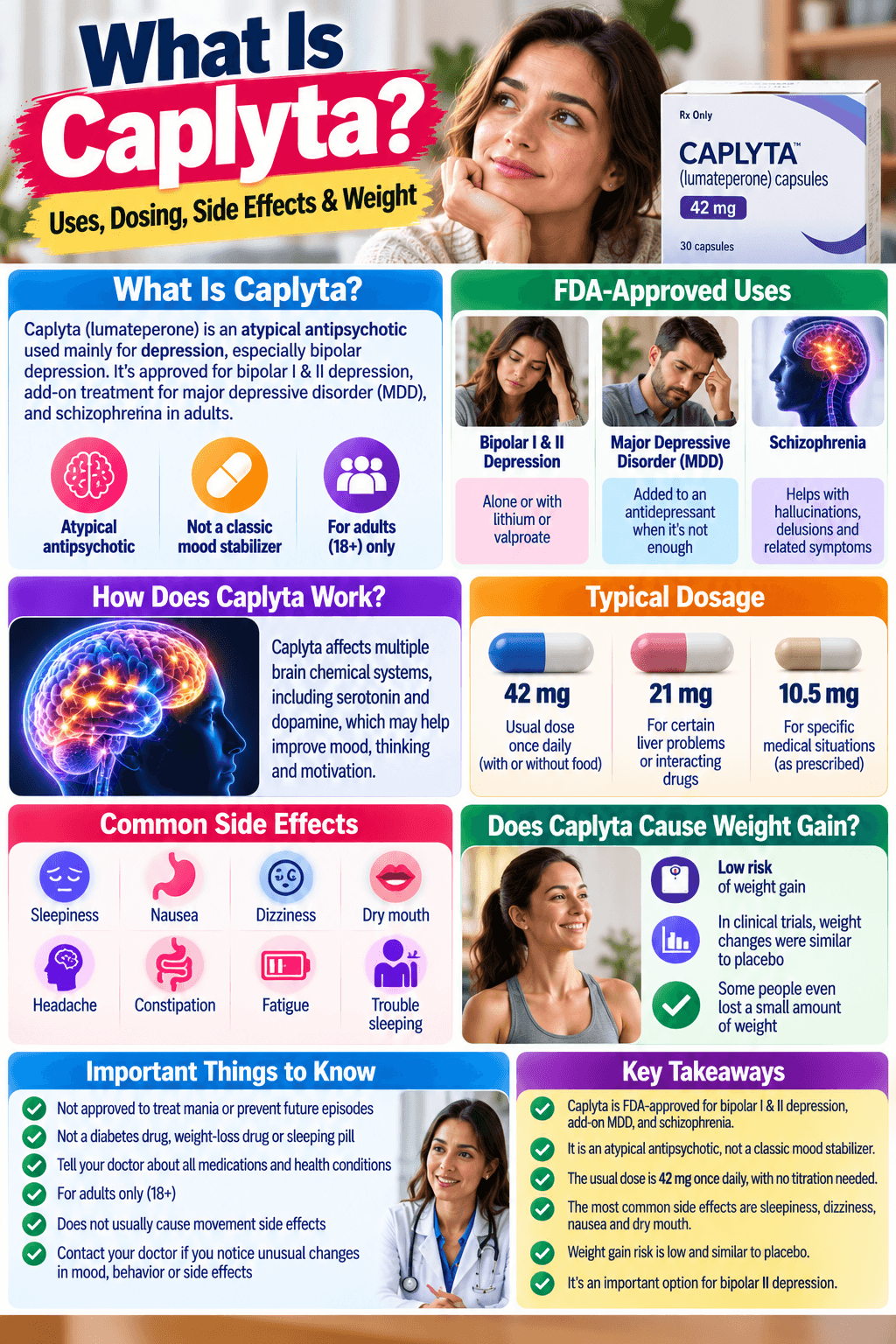
1. Caplyta for bipolar depression (bipolar I and bipolar II)
This is the most common reason Caplyta is prescribed. Bipolar depression is often the longest-lasting and most disabling part of bipolar disorder, and it has fewer approved treatments than mania. Standard antidepressants used on their own can trigger mania or rapid cycling in some people.
Caplyta is approved for depressive episodes in bipolar I and bipolar II disorder:
- on its own (monotherapy), or
- added to lithium or valproate (adjunctive therapy)
In a key 6-week trial of 381 adults with bipolar I or II depression (Calabrese et al., American Journal of Psychiatry, 2021), Caplyta 42 mg reduced depression scores (MADRS) by an average of 4.6 points more than placebo. It also improved overall illness severity.
Caplyta for bipolar 2
People searching “Caplyta for bipolar 2” should know that Caplyta is one of only two medicines FDA-approved for bipolar II depression; the other is quetiapine. Lurasidone (Latuda) and cariprazine (Vraylar) are approved only for bipolar I depression. That makes Caplyta an important option for bipolar type 2, where depression dominates. See bipolar 2 criteria and is bipolar 1 or bipolar 2 worse?.
2. Caplyta for depression (major depressive disorder)
Does Caplyta treat depression? Yes, in two ways:
- Bipolar depression, as above.
- Major depressive disorder (unipolar depression), as an add-on to an antidepressant. In two 6-week trials of adults who hadn’t responded well to their antidepressant, adding Caplyta 42 mg improved depression scores more than adding placebo, by about 4.5–4.9 points on the MADRS. Benefits appeared as early as weeks 1–2.
Caplyta is not approved as a stand-alone treatment for unipolar depression. See major depressive disorder and MDD medications.
3. Caplyta for schizophrenia
Caplyta treats schizophrenia in adults: positive symptoms such as hallucinations, delusions and disorganized thinking, plus related symptoms. In longer-term open-label schizophrenia studies, many patients who switched to Caplyta lost a small amount of weight on average. See also schizoaffective disorder.
What diagnosis is Caplyta used for? Summary
| Diagnosis | Approved? | How it’s used |
|---|---|---|
| Bipolar I depression | Yes | Alone or with lithium/valproate |
| Bipolar II depression | Yes | Alone or with lithium/valproate |
| Major depressive disorder | Yes (since Nov 2025) | Added to an antidepressant |
| Schizophrenia | Yes | Alone |
| Mania / acute manic episodes | No | Not studied for this use |
| Long-term bipolar maintenance | No | Not established |
| Anxiety, insomnia, PTSD, other | No | Off-label only, with limited evidence |
| Children and teens | No | Not approved under 18 |
What is Caplyta used for off-label?
Doctors sometimes prescribe medicines “off-label” for unapproved uses. Caplyta is occasionally tried for:
- depression with mixed features, which has been studied in research
- anxiety alongside mood disorders
- treatment-resistant mood symptoms
Evidence for these uses is limited, so off-label prescribing should be a careful, informed decision between you and your psychiatrist.
Is Caplyta used for diabetes or weight loss?
No. Caplyta is not a diabetes medicine or a weight-loss drug. People search these terms because Caplyta is known for not causing much weight gain or blood sugar change compared with other antipsychotics. Like all drugs in its class, its label still warns about possible increases in blood sugar and cholesterol, so doctors monitor these.
Is Caplyta a Mood Stabilizer or an Antipsychotic?
Caplyta is an antipsychotic, not a mood stabilizer in the classic sense. Mood stabilizers such as lithium, lamotrigine and valproate are used to prevent future episodes. Caplyta is approved to treat bipolar depression episodes. It is not approved to treat mania or for long-term prevention. Many people with bipolar disorder take Caplyta together with a mood stabilizer.
Read more in is Caplyta a mood stabilizer? and mood stabilizers vs antipsychotics.
How Does Caplyta Work?
The FDA label says the exact mechanism is unknown. Its effects are thought to come from a combination of:
- Strong blocking of serotonin 5-HT2A receptors. This is linked to effects on mood and sleep, and to a lower risk of movement side effects.
- Dopamine D2 modulation. Caplyta acts as a partial agonist at presynaptic D2 receptors and an antagonist at postsynaptic ones. It occupies fewer D2 receptors at its usual dose than many antipsychotics, which may explain the low rates of stiffness, restlessness and prolactin increase.
- Serotonin reuptake inhibition (moderate), which may add to its antidepressant effect.
- Indirect effects on glutamate (seen in laboratory studies), which researchers are still exploring.
What makes Caplyta special?
- Approved for bipolar II depression, which few drugs are
- No titration: you start at the effective dose (42 mg)
- Weight and metabolic changes similar to placebo in clinical trials
- Low rates of movement side effects (EPS and akathisia) in trials
- A single dose for every approved use, which makes it simple to take
- Approved for both bipolar and unipolar depression (as an add-on for MDD)
No medicine works for everyone, and Caplyta has not been compared head-to-head with most alternatives.
Caplyta Dosing: 42 mg, 21 mg and 10.5 mg
| Capsule | Who it’s for |
|---|---|
| 42 mg | The standard dose for all approved uses: schizophrenia, bipolar depression and add-on MDD. Taken once daily, no titration needed. |
| 21 mg | People with moderate or severe liver impairment (Child-Pugh B or C), or taking moderate CYP3A4 inhibitors (for example some antifungals, diltiazem or erythromycin) |
| 10.5 mg | People taking strong CYP3A4 inhibitors (for example certain antifungals, some HIV medicines, clarithromycin) |
What is Caplyta 42 mg used for? It is the usual treatment dose for bipolar I and II depression, add-on treatment of MDD, and schizophrenia.
What is Caplyta 21 mg or 10.5 mg used for? These lower doses are not “starter” doses. They exist so people with liver problems, or who take interacting medicines, get a safe amount of the drug.
CYP3A4 inducers (such as rifampin, carbamazepine and St. John’s wort) can make Caplyta much less effective, and should be avoided with it.
Many people take Caplyta in the evening because of drowsiness. Follow your prescriber’s advice, and tell them about every medicine and supplement you take.
How Long Does It Take for Caplyta to Work?
- Weeks 1–2: Some people notice better sleep or early mood changes. In trials, improvement over placebo appeared as early as week 1 in some studies.
- Weeks 4–6: Clinical trials measured their main results at 6 weeks, which is a fair time to judge whether it’s helping.
Take it every day. If you notice no benefit after about 6 weeks, or side effects are a problem, talk to your prescriber rather than stopping on your own.
How Does Caplyta Make You Feel?
Experiences vary, but people commonly describe:
- Drowsiness or sedation, especially in the first weeks. Taking it in the evening helps many people.
- Feeling calmer and sleeping more deeply
- Gradual lifting of depression over several weeks: more energy, interest and motivation
- Dizziness or lightheadedness, especially when standing up quickly
- Less often: nausea, dry mouth, headache
Because Caplyta tends to cause fewer movement and weight side effects, some people who switch from other antipsychotics say they feel “less weighed down”. Others find the sleepiness hard to tolerate. Tell your prescriber how it affects you.
Can Caplyta Help You Sleep?
Caplyta often causes sleepiness, which is its most common side effect, so many people sleep better when they take it at night. For people with bipolar disorder, steadier sleep can support mood stability; see bipolar and sleep.
However, Caplyta is not approved as a sleep medicine and shouldn’t be used just for insomnia. Better sleep is usually a side benefit of treating depression. Avoid driving or operating machinery until you know how it affects you, and avoid alcohol, which increases sedation.
Caplyta Side Effects
Common side effects (from the FDA label)
| Side effect | Bipolar depression (alone) | MDD (add-on) | Schizophrenia |
|---|---|---|---|
| Sleepiness/sedation | 13% (placebo 3%) | 12% (2%) | 24% (10%) |
| Dizziness | 8% (4%) | 17% (5%) | 5% (3%) |
| Nausea | 8% (3%) | 9% (4%) | 9% (5%) |
| Dry mouth | 5% (1%) | 13% (3%) | 6% (2%) |
| Headache | 14% (8%) | 19% (13%) | — |
| Fatigue | — | 8% (2%) | — |
Many of these ease after the first few weeks.
Serious side effects and warnings
- Boxed warning: increased risk of death in elderly people with dementia-related psychosis. Caplyta is not approved for this.
- Boxed warning: suicidal thoughts and behaviors in children, teens and young adults (under 25). This applies because Caplyta treats depression. Watch for new or worsening suicidal thoughts, especially early in treatment.
- Neuroleptic malignant syndrome (NMS): high fever, stiff muscles, confusion, sweating. Seek emergency care.
- Tardive dyskinesia: involuntary movements, usually of the face and tongue. The risk is lower than with older drugs but not zero. See tardive dyskinesia and bipolar disorder.
- Metabolic changes: blood sugar, cholesterol and weight should be monitored.
- Low blood pressure on standing and fainting, and falls, especially in older adults.
- Low white blood cell counts, seizures, trouble regulating body temperature, and difficulty swallowing (rare).
Does Caplyta cause weight gain?
Usually not much. In placebo-controlled trials, weight gain and changes in blood sugar and cholesterol were similar to placebo:
- In 6-month open-label studies for bipolar depression and MDD, average weight was essentially unchanged.
- In a 1-year schizophrenia study, patients lost about 3 kg on average, partly because many switched from drugs that cause more weight gain.
Individual results vary, and a small number of people do gain weight. Compare: does quetiapine cause weight gain?, does Abilify cause weight gain? and bipolar medications and weight gain.
Does Caplyta cause weight loss?
It is not a weight-loss drug. Some people lose weight after switching from medicines like olanzapine or quetiapine, mainly because the previous drug’s effect on appetite wears off.
Caplyta Alternatives
The right alternative depends on your diagnosis, history and side-effect concerns. Options your prescriber might discuss:
| Condition | Other FDA-approved options |
|---|---|
| Bipolar I depression | Quetiapine (Seroquel), lurasidone (Latuda), cariprazine (Vraylar), olanzapine-fluoxetine (Symbyax) |
| Bipolar II depression | Quetiapine |
| Bipolar maintenance | Lithium, lamotrigine, some antipsychotics |
| MDD (add-on) | Aripiprazole, brexpiprazole, quetiapine XR, cariprazine |
See bipolar disorder medications, what is quetiapine? and best medication for bipolar depression and anxiety.
Never switch or stop medicines without your prescriber. Stopping suddenly can lead to relapse.
Caplyta Reviews: What Patients Report
Online Caplyta reviews and patient forums tend to share a few themes:
- Positive: improved mood in bipolar II depression, little or no weight gain, few movement side effects, simple once-daily dosing
- Negative: drowsiness or “heavy” mornings, dizziness, nausea, cost and insurance hurdles, and for some people, no meaningful benefit
Online reviews are not representative; people with very good or very bad experiences post most. Use them to prepare questions for your doctor, not to decide your treatment.
Who Should Not Take Caplyta?
Tell your doctor if you:
- are allergic to lumateperone
- have liver disease, heart disease, low blood pressure, diabetes, seizures or a low white blood cell count
- are older and have dementia
- are pregnant, planning pregnancy or breastfeeding. Babies exposed in late pregnancy can have movement or withdrawal symptoms; a pregnancy registry exists.
- take any medicines that affect CYP3A4
Caplyta is not approved for children or teens.
Watch for signs of mania or hypomania, such as racing thoughts, little need for sleep or unusual energy, and report them promptly. See signs of hypomania vs normal happiness.
If you are in crisis: call or text 988 (Suicide & Crisis Lifeline, US) or go to the nearest emergency department. Outside the US, contact your local emergency number.
Frequently Asked Questions About What Caplyta Is Used For
What is Caplyta mainly used for?
Mainly for bipolar depression, in both bipolar I and bipolar II disorder. It is also approved as an add-on treatment for major depressive disorder and for schizophrenia in adults.
What is Caplyta used for in mental health?
Bipolar I and II depression, add-on treatment of major depressive disorder, and schizophrenia.
Is Caplyta an antipsychotic?
Yes, it is an atypical (second-generation) antipsychotic, though it is mostly prescribed for depression.
Is Caplyta a mood stabilizer?
Not in the classic sense. It treats bipolar depression episodes but isn’t approved to treat mania or prevent future episodes. It is often taken alongside a mood stabilizer.
Does Caplyta treat depression?
Yes: bipolar depression (alone or with lithium/valproate) and major depressive disorder (added to an antidepressant).
Is Caplyta good for bipolar 2?
It is FDA-approved for bipolar II depression and is one of only two drugs with this approval, along with quetiapine.
What is Caplyta 42 mg used for?
42 mg is the standard daily dose for all approved uses.
What is Caplyta 21 mg or 10.5 mg used for?
Lower doses for people with moderate-to-severe liver impairment (21 mg) or who take moderate (21 mg) or strong (10.5 mg) CYP3A4 inhibitors.
Does Caplyta cause weight gain?
In clinical trials, weight gain was similar to placebo, making it one of the more weight-friendly antipsychotics.
Can Caplyta help you sleep?
It often causes drowsiness, so many people take it at night, but it’s not approved as a sleep aid.
How long does Caplyta take to work?
Some people notice changes in 1–2 weeks; trials measured full results at 6 weeks.
The Bottom Line: What Is Caplyta Used For?
Caplyta (lumateperone) is a once-daily atypical antipsychotic used mainly to treat bipolar I and bipolar II depression. It is also approved as an add-on for major depressive disorder and for schizophrenia. Its key strengths are a simple 42 mg dose, low rates of weight gain and movement side effects in trials, and approval for bipolar II. It is not a classic mood stabilizer, a sleeping pill or a weight-loss drug. Like every psychiatric medicine, it works best as part of a full plan that includes therapy, steady sleep and regular follow-up with your prescriber.
References
- U.S. Food and Drug Administration. Caplyta (lumateperone) Prescribing Information. Revised 2026.
- Calabrese JR, et al. Efficacy and safety of lumateperone for major depressive episodes associated with bipolar I or bipolar II disorder: a phase 3 randomized placebo-controlled trial. American Journal of Psychiatry. 2021;178(12):1098–1106.
- Johnson & Johnson. FDA approval of Caplyta (lumateperone) for adjunctive treatment of major depressive disorder. November 2025.
- Psychiatric News. Caplyta approved for bipolar depression. 2021.
- Drugs.com. Caplyta: Package Insert / Prescribing Information.
Related Posts



Subscribe to Our Newsletter
Get mental health tips, updates, and resources delivered to your inbox.
MORE from Author
Read More ADHD and depression often occur together, and each makes the other harder to live with. Adults with ADHD are almost…
 We all have "up" days and "down" days. Perhaps you feel energized after a promotion or sluggish on a rainy…
 To define bipolar disorder accurately, we must look at it as a chronic mood dysregulation condition. In psychology and medicine,…
Are you looking for a Therapist?
Connect with qualified mental health professionals who understand
bipolar disorder, mood changes, and emotional challenges.
Private • Supportive • Confidential