
Bipolar vs Autism in Females: Symptoms, Misdiagnosis, and How Doctors Tell the Difference

Medically reviewed by Laura Athey Updated Date: April 3, 2026

For many women navigating the mental health system, the road to an accurate diagnosis is often paved with confusion and redirection. One of the most common diagnostic hurdles is the intersection of bipolar vs autism in females. Historically, women have been significantly more likely to receive a mood disorder diagnosis, such as Bipolar II or Borderline Personality Disorder, when their underlying neurobiology is actually rooted in the autism spectrum.
Autism misdiagnosed as bipolar occurs because the outward presentations—emotional dysregulation, periods of intense energy, and social difficulties—can appear remarkably similar to the untrained eye. When a woman experiences an “autistic meltdown” or “sensory overload,” it may be mistaken for a manic episode. Conversely, the deep withdrawal of “autistic burnout” can be easily labeled as clinical depression.
Understanding the autism vs bipolar disorder distinction is not just a matter of semantics; it dictates everything from medication management to therapeutic approach. While bipolar disorder is a mood disorder characterized by distinct episodes, autism is a lifelong neurodevelopmental condition. This article will provide a deep dive into how these two conditions manifest in women, why autism misdiagnosis as bipolar is so prevalent, and the clinical markers doctors use to tell the difference.
What Is Bipolar Disorder & Autism Spectrum Disorder?
To understand the overlap, we must first define the core characteristics of each condition. While both involve the brain, they reside in different clinical categories.
A. Bipolar Disorder Overview
Bipolar disorder is primarily a mood disorder. It is characterized by significant fluctuations in energy, mood, and activity levels. These aren’t just “mood swings”; they are sustained periods of altered states.
- Bipolar I: Defined by manic episodes that last at least seven days or are severe enough to require hospitalization. Depressive episodes usually occur as well.
- Bipolar II: Characterized by a pattern of depressive episodes and hypomanic episodes (a less severe form of mania).
- What Is the Difference Between Bipolar 1 and 2? The primary difference lies in the intensity of the “up” state. Bipolar 1 involves full-blown mania (often with psychosis), while Bipolar 2 involves hypomania and often more frequent, debilitating depression.
Are people with bipolar neurodivergent? Yes. Under the modern definition of neurodiversity, bipolar disorder is considered a form of neurodivergence because it represents a biological difference in how the brain processes mood and energy.
B. Autism Spectrum Disorder Overview
Autism Spectrum Disorder (ASD) is a neurodevelopmental condition. It is not something that “flares up” in episodes; it is the fundamental way an individual’s brain is wired from birth.
- Core Traits: Social communication differences, sensory processing sensitivities, and a preference for routine or “repetitive” behaviors.
- Lifelong Nature: Unlike bipolar episodes, which have a beginning and an end, autistic traits are consistent throughout the lifespan, though they may be “masked” in social settings.
Bipolar vs Autism Symptoms in Females
The challenge in differentiating bipolar vs autism symptoms in women often lies in the “Internalized” nature of female presentations. While men may externalize their struggles through hyperactivity or aggression, women are socialized to internalize their distress.
Female Autistic Traits vs. Bipolar Indicators
In women, autism in women symptoms often involve high levels of social mimicry (masking). This can make the social communication deficit hard to spot, leaving only the “emotional” symptoms visible.
Comparison Table: Feature by Feature
| Feature | Bipolar Disorder (Female) | Autism in Females (ASD) |
| Mood Shifts | Episodic: Clear “highs” and “lows” lasting days or weeks. | Context-driven: Meltdowns or shutdowns triggered by sensory or social overload. |
| Social Behavior | Changes during episodes (hyper-social in mania, withdrawn in depression). | Lifelong patterns: Constant effort required to navigate social “rules.” |
| Energy Levels | Manic spikes: Reduced need for sleep, racing thoughts. | Consistent hyperfocus: High energy directed at a specific interest. |
| Sleep | Decreased need for sleep during mania without feeling tired. | Sensory-driven disruption (difficulty “turning off” the brain). |
| Impulsivity | Driven by elevated mood or “grandiosity.” | Driven by sensory seeking or executive function gaps. |
The “Hypomania” Autism Confusion
A common area of overlap is hypomania autism. When an autistic woman enters a state of “hyperfocus”—spending 12 hours straight researching a new interest—she may appear to have the “pressured speech” and high energy of a hypomanic episode.
However, in autism, this energy is usually triggered by a specific interest, whereas in bipolar disorder, the energy is a global shift in the person’s state of being.
In my clinical experience, the single most important question I ask to differentiate these two is: ‘What happens to your symptoms when you are alone in a room with no demands?’
An autistic woman will often feel a sense of profound relief; her ‘symptoms’ (the social struggle) disappear because the environment finally matches her needs. A woman in a manic or depressive episode, however, will still be in that episode regardless of the environment. Bipolar is an internal chemical ‘storm’ that moves with you; autism is often a mismatch between a sensitive nervous system and a loud, demanding world.
Autism in Women & Adult Female Presentation
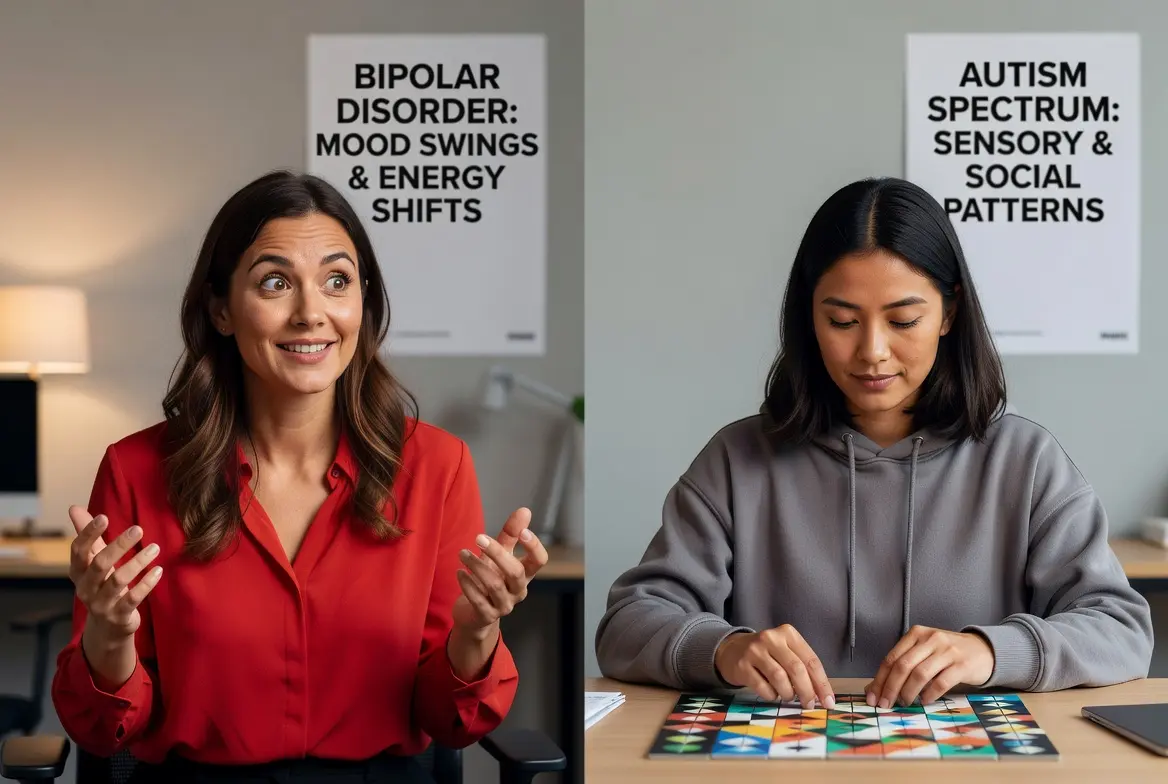
To understand why autism in female adults is so often missed, we must look at the “female phenotype” of ASD. Many women who are currently seeking a diagnosis were missed as children because they did not fit the “Little Professor” stereotype.
Masking and Social Mimicry
Undiagnosed autism in women is frequently hidden behind a “mask.” Masking involves observing neurotypical peers and consciously mimicking their body language, tone of voice, and social scripts. While this allows women to “pass” as neurotypical, it leads to:
- Burnout: The mental exhaustion of constant performance.
- Identity Confusion: Not knowing where the “mask” ends and the true self begins.
- Misdiagnosis: When the mask cracks, clinicians see the resulting anxiety or emotional collapse and label it as a mood disorder.
High Functioning Autism in Women
Women with high functioning autism (previously referred to as adult female aspergers) often excel in their careers or academics but struggle significantly with the “unspoken” parts of life—like maintaining friendships or managing sensory-heavy environments like grocery stores.
Female Autism Test vs. Checklist: Many women start their journey with a female aspergers checklist or an online female autism test. While these are excellent for self-reflection, they are screening tools, not diagnostic ones. They often highlight internalizing behaviors that traditional tests miss.
Can Autism Be Mistaken for Bipolar Disorder?
The answer is a resounding yes. Autism misdiagnosed as bipolar is one of the most common errors in adult female psychiatry.
Emotional Dysregulation vs. Mania
When an autistic woman reaches the limit of her sensory or emotional bandwidth, she may experience a meltdown. This can involve sobbing, screaming, or pacing. If a doctor sees this without the context of the sensory trigger, they may categorize it as the “agitation” of a manic episode.
Autistic Shutdown vs. Depression
Following a period of intense masking or social “demand,” an autistic woman may enter a shutdown—a state of catatonia, inability to speak, and extreme fatigue. This looks identical to the “lethargy” of bipolar depression. However, while bipolar depression might last weeks, an autistic shutdown typically resolves once the sensory and social pressure is removed.
Could You Have Bipolar Disorder? Key Symptoms to Watch For
If your mood shifts are independent of your environment—meaning you feel “high” even when things are going poorly, or “low” even when life is great—and these states last for more than four days at a time, you should pursue Signs of Bipolar Disorder testing.
In this second section, we explore the possibility of co-occurrence, the role of community lived experience, and the specific clinical steps taken during a professional evaluation to ensure an accurate diagnosis.
Can Autism Cause Manic Episodes?
A frequent point of confusion is whether can autism cause manic episodes? The clinical answer is no. Autism, as a neurodevelopmental condition, does not inherently produce the biological states of mania or hypomania.
However, the behaviors associated with hypomania autism overlap significantly. An autistic person in a state of “monotropism” (intense, single-channel focus) may exhibit:
- Pressured speech (talking rapidly about a special interest).
- Decreased sleep (forgetting to sleep because they are engaged in a project).
- High energy and “flippant” social behavior.
While these look like mania, they lack the “grandiosity” and the global mood-shifting characteristics of bipolar disorder. If an autistic woman experiences true mania—such as feeling she has literal superpowers or engaging in high-risk behavior that is out of character for her—it is likely a sign of a comorbid (co-occurring) bipolar diagnosis.
Overlap Between Autism and Bipolar Disorder
While we often discuss bipolar vs autism in females as an “either/or” situation, the reality is that they frequently coexist.
Does autism spectrum disorder overlap with bipolar disorder?
Yes. Research suggests that individuals on the autism spectrum are at a higher risk for mood disorders, including bipolar disorder, compared to the general population. This is often referred to as high-functioning autism and bipolar disorder comorbidity.
- Shared Genetic Vulnerability: Studies have identified overlapping genetic markers between ASD and bipolar disorder, specifically in areas governing synaptic plasticity and brain connectivity.
- The “Asperger’s and Bipolar Connection”: Before the DSM-5 update, many individuals with the Asperger’s profile were noted to have “cyclical” moods that eventually led to a secondary bipolar diagnosis.
Bipolar vs Autism in Females Reddit: What Online Discussions Reveal
The rise of neurodivergent communities on platforms like Reddit has provided a wealth of “lived experience” data. When searching bipolar vs autism in females reddit, several recurring themes emerge:
- The “Wrong Meds” Realization: Many women report being put on lithium or antipsychotics for years with little effect, only to find that their “mood swings” were actually sensory meltdowns that required environmental changes, not just medication.
- The Relief of Autism Diagnosis: For many, the bipolar label felt like a “brokenness,” whereas the autism label felt like a “map.”
- Identity Struggles: Many women navigate the bipolar or autism reddit threads to find others who “mask” their bipolar symptoms using their autistic need for routine, making both conditions harder to spot.
Caution: While community validation is powerful, Reddit is not a diagnostic authority. Online anecdotes should be used to gather data for your doctor, not to self-prescribe or self-diagnose.
How Can a Doctor Differentiate Between Autism and Bipolar Disorder?

Differentiating between these two is one of the most complex tasks in psychiatry. How can a doctor differentiate between autism and bipolar disorder? They look at three primary “anchors”:
1. Developmental History
Autism is present from early childhood. A doctor will ask about your behavior at age 4 or 5. Did you have sensory sensitivities then? Did you struggle with social cues before the age of 10? Bipolar disorder typically emerges in late adolescence or early adulthood. If the “traits” have been there since birth, it points toward autism.
2. The Timeline of “Episodes”
Bipolar disorder is defined by episodes—clear deviations from your “baseline” that last for days or weeks. Autism is your baseline. Doctors look to see if the symptoms are constant (Autism) or if they come and go in distinct waves (Bipolar).
3. Response to Stimuli vs. Internal Shift
As noted in our Expert Insight, doctors look for the “why.”
- If you are agitated because the lights are too bright or the plan changed, that is Autistic Overload.
- If you are agitated for three days straight regardless of the lighting or your schedule, that is likely a Bipolar Mixed State.
Bipolar and Autism in Adults
When a woman receives a dual diagnosis of bipolar and autism in adults, the treatment plan must be carefully calibrated.
- Medication Considerations: Traditional bipolar medications (like mood stabilizers) can be helpful, but autistic individuals are often hypersensitive to side effects.
- Therapy Approaches: Standard DBT (Dialectical Behavior Therapy) is often recommended for bipolar disorder, but it may need to be “Autism-Adapted” to account for sensory needs and literal processing styles.
- Executive Function Support: Both conditions impact the “CEO of the brain.” Support often includes occupational therapy to help manage daily demands without triggering burnout or a mood episode.
Social & Cultural Considerations
There are unique social dynamics at play, often searched for in terms like bipolar guy with asperger girl. While specific, these queries highlight the reality of neurodivergent relationships.
Neurodivergent Partnerships: Relationships between two neurodivergent people can be highly successful because of shared “direct” communication styles, but they require a deep understanding of each other’s specific triggers (e.g., one person’s need for noise/stimulation in a manic phase vs. the other’s need for silence/darkness in a sensory shutdown).
Frequently Asked Questions
Can autism be mistaken for bipolar disorder?
Yes, frequently. Due to the overlap in emotional dysregulation and periods of high energy, many autistic women are misdiagnosed as bipolar before their neurodivergence is recognized.
Can autism cause manic episodes?
No. Autism does not cause mania. However, “hyperfocus” or “sensory euphoria” in autistic individuals can look like mania to an observer.
Am I bipolar or do I have autism?
If your symptoms are constant and triggered by the environment, it may be autism. If your symptoms happen in distinct “waves” or “cycles” that last days or weeks regardless of the environment, it may be bipolar disorder.
Does autism spectrum disorder overlap with bipolar disorder?
Yes. It is possible to have both. This is known as comorbidity. Autistic individuals have a higher statistical likelihood of also having a mood disorder.
Are autism awareness ribbons still used?
What color are autism awareness ribbons? Traditionally, they are puzzle-piece patterns. However, many in the community now prefer the Gold or Rainbow Infinity Symbol, representing neurodiversity and acceptance over “awareness.”
Conclusion: Moving Toward the Right Support
The distinction between bipolar vs autism in females is more than just a medical nuance—it is the difference between struggling against your own brain and learning how to work with it. If you suspect you have been misdiagnosed, or if you feel you have both, the most powerful step you can take is to seek a neuro-affirming clinician who understands the “female phenotype” of autism.
You deserve a diagnosis that explains your whole life, not just your hardest days.
Authoritative Clinical & Research References
- The Lancet Psychiatry
- Autism Self Advocacy Network (ASAN) — “Know Your Rights: Diagnosis and Beyond”
- National Institutes of Health (NIH)
- Depression and Bipolar Support Alliance (DBSA) — “Bipolar Disorder and Neurodiversity”
- Journal of Autism and Developmental Disorders

Related Posts




Subscribe to Our Newsletter
Get mental health tips, updates, and resources delivered to your inbox.
MORE from Author
Read More We all have "up" days and "down" days. Perhaps you feel energized after a promotion or sluggish on a rainy…
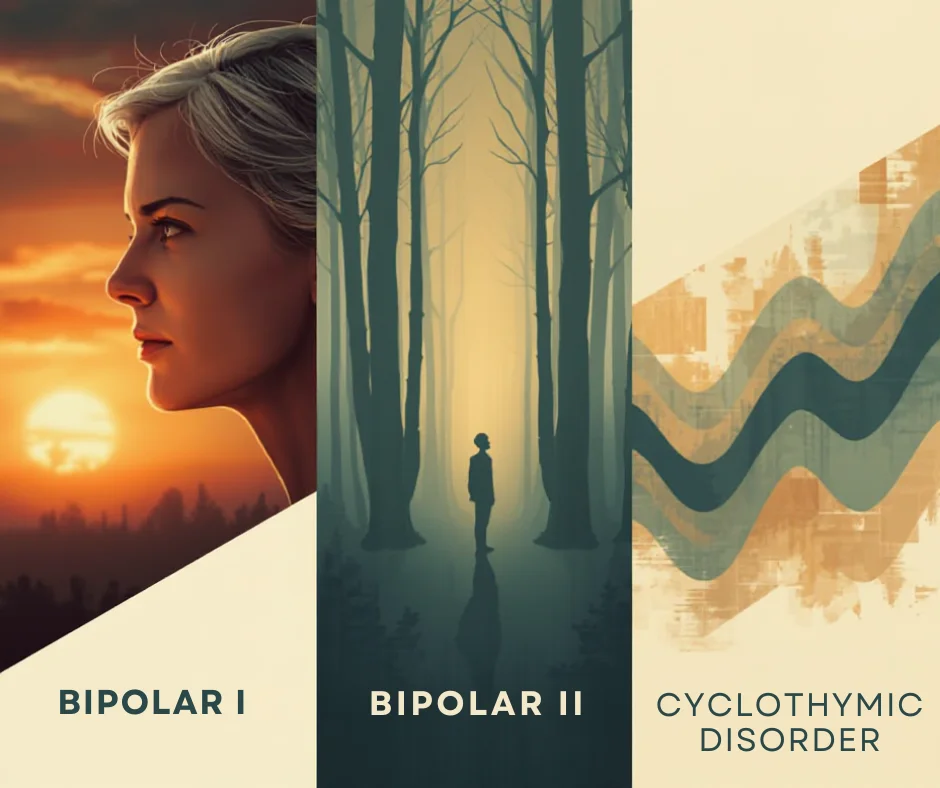 To define bipolar disorder accurately, we must look at it as a chronic mood dysregulation condition. In psychology and medicine,…
 To answer whether bipolar fits the bill, we first have to define what a neurodivergent person actually is. The term…
 Hey there. Are you looking for the truth behind the numbers? You are not alone in this search. Many people…
Are you looking for a Therapist?
Connect with qualified mental health professionals who understand
bipolar disorder, mood changes, and emotional challenges.
Private • Supportive • Confidential