
ADHD vs. Depression: Symptoms, Differences & How to Tell Them Apart

Medically reviewed by Laura Athey Updated Date: March 30, 2026

“Am I lazy, or am I depressed? Am I unmotivated, or is my brain struggling to start?” These are the questions that plague millions of adults and children currently caught in the diagnostic crossover of ADHD vs. Depression.
While ADHD is a neurodevelopmental disorder and depression is a mood disorder, the two often look strikingly similar from the outside. Both can leave an individual staring at a mounting pile of laundry for hours, unable to find the “spark” to move. Both can cause a person to struggle with focus during a conversation or withdraw from social obligations.
However, the difference between ADHD and depression is fundamental. In ADHD, the struggle is primarily one of regulation—the brain cannot effectively manage its attention, energy, or emotions. In depression, the struggle is primarily one of state—the brain is locked in a pervasive low mood, hopelessness, or numbness. Understanding this distinction is not just an academic exercise; it is the key to getting the right treatment.
What Is ADHD?
To understand the comparison, we must first define the core of Adult ADHD vs. Depression. ADHD is not a lack of attention; it is a dysregulation of attention. A person with ADHD might struggle to focus on a boring spreadsheet but can “hyperfocus” on a video game for ten hours straight.
The Core Pillars of ADHD
- Executive Dysfunction: This is the “secretary” of the brain failing at their job. It involves trouble with working memory, organization, time management, and task initiation.
- Dopability and Interest-Based Nervous System: ADHD brains are chronically low on dopamine. This creates a “stimulus-seeking” environment where the brain only engages with things that are novel, challenging, or urgent.
- Inattentive ADHD vs. Depression: Often called “Quiet ADHD,” the inattentive subtype lacks the outward “hyperactivity” most people associate with the condition. Instead, the hyperactivity is internal—racing thoughts, daydreaming, and mental fog. Because these individuals seem “slow” or “withdrawn,” they are the most likely to be misdiagnosed with depression.
Limbic ADHD
A controversial but helpful subtype to discuss is Limbic ADHD. This describes ADHD, where the primary symptoms involve moodiness, low energy, and social isolation. Unlike clinical depression, Limbic ADHD symptoms are typically present from early childhood and are constant, rather than coming in “episodes.”
What Is Depression?
When we look at depression vs. ADHD in adults, we are looking at a mood disorder that colors every aspect of a person’s existence. Major Depressive Disorder (MDD) is characterized by a persistent feeling of sadness or a “flat” affect, where nothing brings joy.
Clinical Markers of Depression:
- Anhedonia: The loss of interest in activities that were previously pleasurable.
- Hopelessness: A cognitive belief that the future is bleak and nothing will improve.
- Physical Heaviness: Often described as “walking through molasses” or “lead-pipe paralysis.”
- Sleep Disturbances: Either sleeping too much (hypersomnia) or the inability to sleep (insomnia), often accompanied by early morning waking.
ADHD vs. Depressed Child
In children, depression often looks like irritability rather than sadness. This can make the adhd vs depressed child comparison difficult, as an ADHD child may also be irritable due to frustration or sensory overload. However, a depressed child will lose interest in play, whereas an ADHD child will usually still be eager to play but may struggle to follow the rules of the game.
ADHD vs. Depression Symptoms Comparison
To help you tell them apart, we must look at the adhd depression overlapping symptoms and where they diverge.
Symptom Comparison Table
| Symptom | ADHD | Depression |
| Concentration | Struggle to direct focus; easily distracted. | Struggle to process information; mental “slowness.” |
| Motivation | Want to do things but can’t “start” (Executive Dysfunction). | Don’t want to do anything (Anhedonia). |
| Mood | Rapidly shifting; reactive to the environment. | Pervasive, heavy, and low; consistent for weeks. |
| Sleep | “Revenge bedtime procrastination”; racing mind. | Using sleep as an escape, waking up unrefreshed. |
| Energy | Cycles of high energy and “crashes.” | Consistently low energy/fatigue. |
The Motivation Distinction
This is the most critical point in adhd vs depression symptoms differences.
- In ADHD, you are lying on the couch wanting to do the dishes, thinking about the dishes, and feeling guilty that you aren’t doing the dishes, but you can’t make your body move. This is Executive Dysfunction.
- In Depression, you are lying on the couch, and you don’t care about the dishes. The dishes don’t matter. Nothing matters. This is Anhedonia.
ADHD vs. Depression in Women
The adhd vs depression in women conversation is one of the most important in modern psychiatry. For decades, girls were primarily diagnosed with depression or anxiety because their ADHD manifested as “internalized” symptoms.
The Masking Effect
Women are often socialized to be “nurturers” and “organized,” leading them to mask their ADHD symptoms at a high cost. By the time a woman reaches her 20s or 30s, the sheer effort of trying to appear neurotypical leads to chronic burnout. When she goes to a doctor and says, “I’m exhausted, and I can’t get anything done,” the doctor often sees the exhaustion (a symptom) and diagnoses depression, missing the ADHD (the cause).
Hormonal Influence
Estrogen plays a massive role in dopamine production. Many women find that their ADHD symptoms become unbearable during their luteal phase (the week before their period), leading to “PMDD” (Premenstrual Dysphoric Disorder). This cyclic “depression” is often actually an ADHD flare-up caused by dropping estrogen levels.
In my clinical work, I often see what I call “The Shadow of ADHD.” When ADHD goes undiagnosed for decades, the individual develops a core belief that they are “lazy” or “stupid.” This isn’t clinical depression at first; it is situational shame. However, over time, that shame hardens into a true depressive disorder. If we only treat the depression, we leave the “engine” of the shame (the ADHD) running. To truly heal, we have to address the neurodivergence that made the person feel “less than” in the first place.
Can ADHD Cause Depression?
A vital question for many is: Can having ADHD cause depression? The answer is a resounding yes. In clinical terms, this is often referred to as “secondary depression.”
When you have untreated ADHD, you are constantly operating in a world designed for neurotypical brains. This leads to:
- Chronic Stress: Living in a state of constant “catch-up” where you are always behind on bills, chores, or work deadlines.
- The Shame Spiral: After years of being told you have “so much potential” if you just “tried harder,” you begin to internalize these criticisms as character flaws.
- Social Isolation: ADHD-related social struggles—such as interrupting others or forgetting to reply to texts—can lead to a thinning social circle, which is a primary risk factor for depression.
Research suggests that people with ADHD are depressed at higher rates. Yes—adults with ADHD are approximately three times more likely to experience a major depressive episode than those without.
Adult ADHD vs. Depression: The Workplace Connection
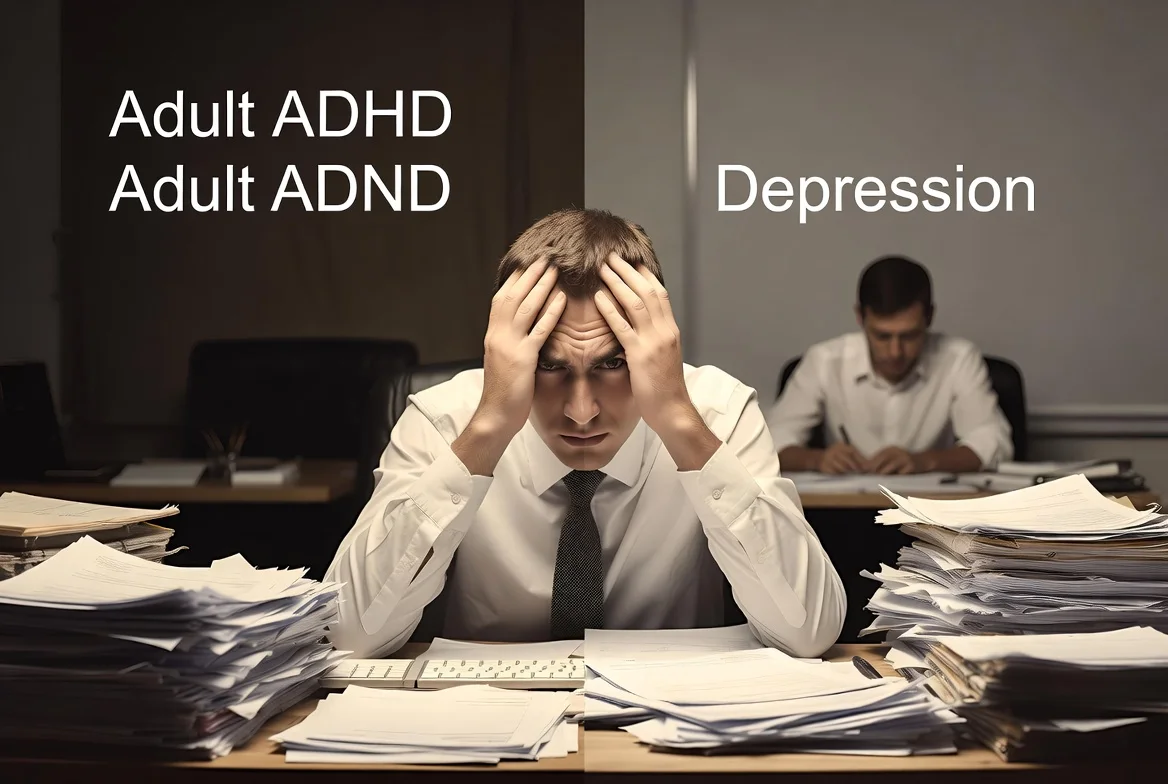
In adulthood, the difference between ADHD and depression often manifests most clearly in the workplace.
Workplace Burnout vs. Clinical Depression
Many adults seek help for “depression” when they are actually experiencing ADHD burnout.
- ADHD Burnout: You are exhausted because your executive functions (planning, starting, finishing) are overloaded. You still want to be successful, but your “cognitive battery” is at 0%.
- Clinical Depression: You are exhausted because you no longer see the point in your work. The goals themselves have lost their value.
Inattentive ADHD vs. Depression: The “Quiet” Struggle
On platforms like ADHD vs depression Reddit threads, the most common story is that of the “Inattentive” individual. Because they aren’t “bouncing off the walls,” their internal struggle is invisible.
Inattentive ADHD vs. depression is particularly tricky because both can present as:
- Slowed movement or “zoning out.”
- Forgetfulness.
- A “flat” facial expression during periods of overstimulation.
However, if you look closer, the Inattentive ADHD person is usually mentally hyperactive—their brain is a crowded room of 50 different thoughts. The depressed person is often mentally empty—their brain feels like a quiet, dark room.
What Does Depression with ADHD Feel Like?
When a person has comorbid ADHD and depression, the symptoms don’t just add up; they multiply. This creates a specific state often called “The Void.”
- Mental Paralysis: The ADHD makes it hard to choose a task, and the depression makes you feel like no task is worth choosing. You end up stuck in “waiting mode” for hours.
- Emotional Numbness vs. Dysregulation: You may feel a “storm” of ADHD emotions underneath a heavy “blanket” of depressive numbness.
- The Executive Dysfunction Stack: You forget to take your depression medication because of your ADHD, which makes your depression worse, which makes your ADHD symptoms more unmanageable.
Is It ADHD, Anxiety, or Depression?
This is the “Unholy Trinity” of mental health. It is rare to have one without at least a shadow of the other two. Anxiety vs. ADHD vs. Depression can be untangled by looking at the source of the symptom.
The Diagnostic Comparison Chart
| Feature | ADHD | Anxiety | Depression |
| Pacing/Fidgeting | Done to focus or discharge energy. | Done because of worry or fear. | Rarely occurs; movement is usually slowed. |
| Procrastination | Caused by distraction or “task blindness.” | Caused by fear of failure or perfectionism. | Caused by a lack of energy or care. |
| Insomnia | “Brain won’t shut up” about random ideas. | “Brain won’t shut up” about what might go wrong. | “Brain won’t shut up” about what already went wrong. |
ADHD vs. Depressive Mood: Temporary vs. Pervasive
It is important to distinguish adhd vs depressive mood.
- ADHD Mood Swings: These are usually “reactive.” If something good happens, the ADHD person is suddenly on top of the world. If they feel rejected (Rejection Sensitive Dysphoria), they may crash into a deep “depressive” mood for a few hours.
- Major Depression: The low mood is “autonomous.” It doesn’t matter if you win the lottery; the cloud stays. It is a pervasive state that typically lasts at least two weeks regardless of external events.
ADHD vs. Depression Medication: Finding the Right Balance
Treating ADHD vs. depression medication is not as simple as picking one pill. In fact, treating one can sometimes complicate the other. This is why a precise diagnosis is vital before starting a regimen.
ADHD Medications (Stimulants vs. Non-Stimulants)
- Stimulants (e.g., Methylphenidate, Amphetamines): These increase dopamine and norepinephrine in the prefrontal cortex. For many, this “clears the fog,” which can actually alleviate depressive symptoms caused by ADHD frustration.
- Non-Stimulants (e.g., Atomoxetine, Guanfacine): Often used when stimulants cause too much anxiety.
Depression Medications (SSRIs and SNRIs)
- SSRIs (e.g., Sertraline, Fluoxetine): These target serotonin. While excellent for low mood, they can sometimes make ADHD symptoms feel worse by causing “emotional blunting” or further decreasing motivation (apathy).
- SNRIs (e.g., Venlafaxine, Duloxetine): These target both serotonin and norepinephrine. Because they affect norepinephrine (similar to some ADHD meds), they are often more effective for people with both conditions.
The “Dual-Purpose” Med: Bupropion (Wellbutrin)
Bupropion is often cited as the best antidepressant for ADHD and depression. Unlike most antidepressants, it targets dopamine and norepinephrine. It is frequently prescribed “off-label” for ADHD because it can help with both the “dark cloud” of depression and the “brain fog” of ADHD.
Overlapping Symptoms Explained
To truly understand adhd depression overlapping symptoms, we have to look at the “hidden” biology of the brain.
Executive Dysfunction vs. Low Motivation
Both conditions look like “laziness.” However, Executive Dysfunction is a processing error. Your brain’s “operating system” is crashing because it has too many tabs open. Low motivation in depression is a power failure. The battery is simply disconnected.
Fatigue vs. Dopamine Dysregulation
ADHD fatigue often comes from “masking” and over-exertion. It is the exhaustion of a marathon runner. Depressive fatigue is “psychomotor retardation”—it is the exhaustion of someone carrying a 100-pound weight everywhere they go.
The 10-3 Rule for ADHD & Burnout
When you are struggling with both ADHD and the low mood of burnout, a standard “To-Do List” is an enemy. Instead, use the 10-3 Rule. This is designed to hack the ADHD brain’s need for novelty while respecting the Depressed brain’s low energy.
- Work for 10 Minutes: Set a timer. Pick one micro-task (e.g., just putting the silverware in the dishwasher, not the whole kitchen).
- Reset for 3 Minutes: When the timer goes off, you must stop. For 3 minutes, do something that “resets” your nervous system—splash cold water on your face, step outside, or stretch.
- Repeat or Stop: If the 10 minutes felt “okay,” do another block. If the 10 minutes felt impossible, give yourself permission to stop.
The goal of the 10-3 rule is to overcome task initiation paralysis without triggering the “hopelessness” of an unfinished mountain of work.
ADHD vs. Depression Reddit

If you look at ADHD vs depression Reddit communities, a few consistent themes emerge that aren’t always found in medical textbooks:
- “The Wall of Awful”: A term coined by the ADHD community to describe the emotional barrier that builds up around tasks you’ve failed at before. To an outsider, it looks like depression; to the person, it’s a trauma-based ADHD response.
- The “Post-Medication Sadness”: Many Redditors report that once they start ADHD medication and their life becomes “organized,” they suddenly feel more depressed. This is often the “thaw”—the brain finally has the space to process the years of grief and shame it was too busy and “scattered” to deal with before.
The Path to Integrated Healing
If you suspect you are dealing with both conditions, the goal is to create a “wraparound” treatment plan. This isn’t just about medication; it is about lifestyle adjustments that respect your neurodivergent brain.
Biological Support
Work with a provider who understands that ADHD vs. depression medication is a delicate dance. Often, the strategy is to stabilize the mood first (if the depression is severe or suicidal) and then introduce ADHD stimulants. Alternatively, if the depression is secondary to ADHD failure, treating the ADHD first can often “unlock” the patient’s ability to engage in therapy.
Cognitive Behavioral Therapy (CBT) for ADHD
Standard CBT focuses on “challenging thoughts.” However, for someone with ADHD, the problem isn’t just the thought—it’s the execution. ADHD-specific CBT focuses on “shame reduction” and “functional strategies.” It teaches you to stop saying “I’m a failure” and start saying “This task is poorly structured for my brain.”
Somatic Regulation
Because ADHD and depression both involve the nervous system, physical regulation is key.
- For ADHD: High-intensity movement or sensory input (weighted blankets, fidgets) to regulate the “seeking” brain.
- For Depression: Gentle movement (walking, stretching) to combat “psychomotor retardation” and signal safety to the body.
Frequently Asked Questions
How do I know if my symptoms are ADHD or depression?
The best way to tell is by looking at the “why” and the “history.” If your struggles with focus and organization date back to childhood and you feel “blocked” rather than “hopeless,” it is likely ADHD. If your symptoms come in waves or episodes and are accompanied by a pervasive loss of joy and a “heavy” physical feeling, it is likely depression.
What does depression with ADHD feel like?
It often feels like “The Void.” It is a state of mental paralysis where you have too many thoughts (ADHD) but no energy or desire to act on any of them (Depression). Many describe it as feeling like an engine that is revving in neutral—lots of internal noise, but no forward motion.
Is it ADHD, anxiety, or depression?
These three often overlap in a “triad.” ADHD usually provides the trigger (forgetting a task), Anxiety provides the fear (worrying about the consequence), and Depression provides the shutdown (giving up because the struggle feels endless). A specialist will look for which of the three is the “primary” driver.
Can untreated ADHD cause depression and anxiety?
Yes. Years of “failing” at neurotypical expectations lead to a condition called “Complex Trauma” or “Chronic Minority Stress.” This creates a persistent state of low self-esteem and hyper-vigilance that mirrors clinical depression and anxiety.
Are people with ADHD depressed?
Statistically, people with ADHD are significantly more likely to experience depression. This is due to both biological factors (low dopamine) and environmental factors (social rejection, workplace struggles, and academic difficulties).
What is the best antidepressant for ADHD and depression?
While everyone reacts differently, Bupropion (Wellbutrin) is frequently cited by experts. Because it targets norepinephrine and dopamine rather than serotonin, it can help improve focus and energy while simultaneously lifting the depressive cloud.
Conclusion
The intersection of ADHD and depression represents one of the most challenging landscapes in modern mental health. Because they share a biological foundation rooted in the brain’s reward and regulation systems, they often masquerade as one another, leading to years of “treatment-resistant” symptoms and unnecessary self-blame.
The path to clarity lies in understanding the fundamental “why” behind your behavior. If your struggle is born from a lifelong difficulty in managing a racing, interest-driven mind, you are likely navigating ADHD. If your struggle is a pervasive, heavy, and hopeless state that has robbed you of your “spark,” you are likely facing Major Depression. For many, the reality is a combination of both—a “shame spiral” where the frustrations of neurodivergence eventually give way to clinical despair.
Authoritative References
1. Clinical Distinction Between ADHD and Mood Disorders
2. Comorbidity and Genetic Overlap
3. ADHD in Women and Misdiagnosis
4. Pharmacology: Stimulants vs. Antidepressants
5. Executive Dysfunction vs. Anhedonia

Related Posts






Subscribe to Our Newsletter
Get mental health tips, updates, and resources delivered to your inbox.
MORE from Author
Read More Watching someone you care about struggle with bipolar depression and anxiety can be heartbreaking. You may notice that they withdraw…
 In my practice as a clinical psychologist, I often observe that the difference between a patient who crumbles under pressure…
 We all have "up" days and "down" days. Perhaps you feel energized after a promotion or sluggish on a rainy…
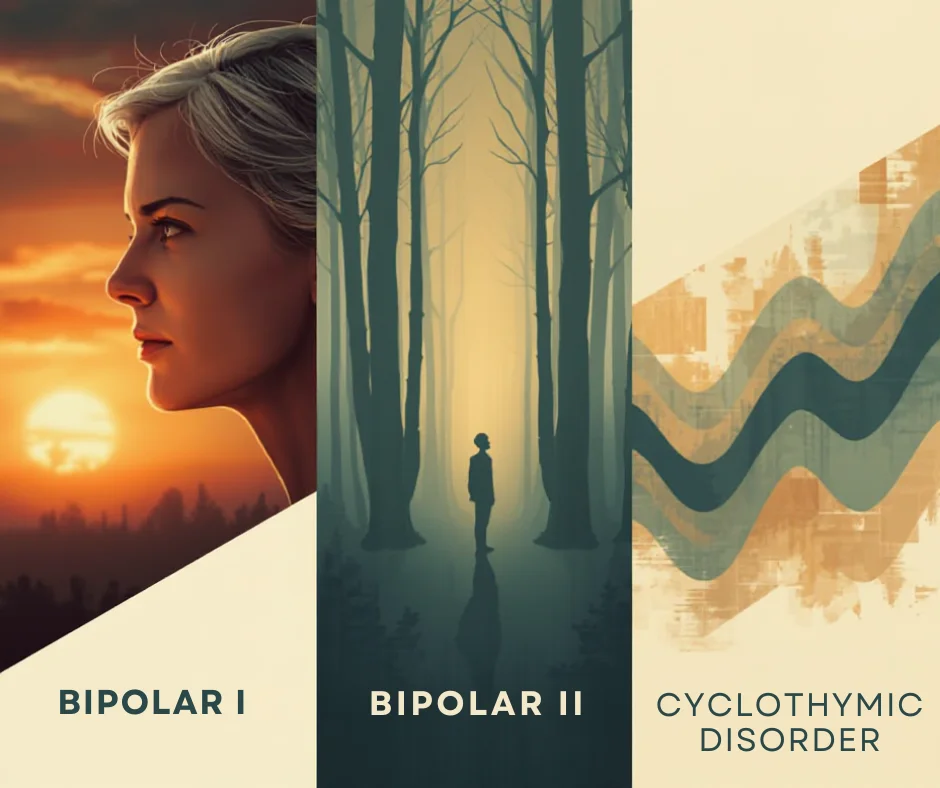 To define bipolar disorder accurately, we must look at it as a chronic mood dysregulation condition. In psychology and medicine,…
Are you looking for a Therapist?
Connect with qualified mental health professionals who understand
bipolar disorder, mood changes, and emotional challenges.
Private • Supportive • Confidential