
ADHD vs PTSD: Key Differences, Overlapping Symptoms, Trauma Links & Treatment Options

Medically reviewed by Laura Athey Updated Date: April 4, 2026
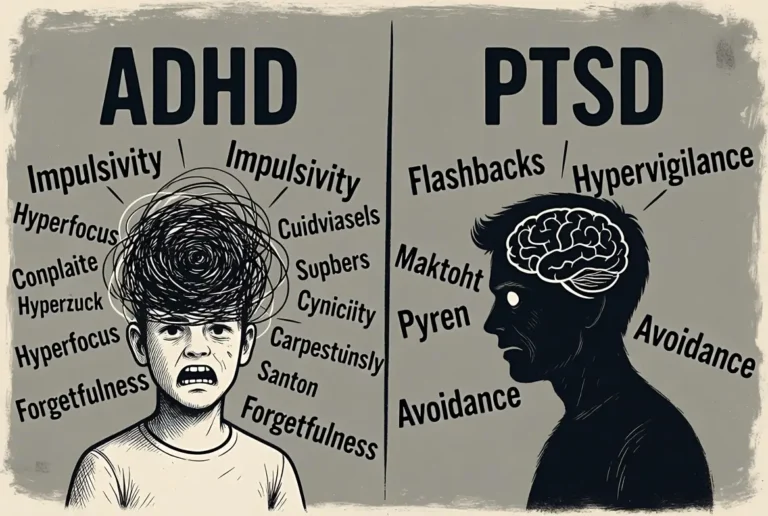
Attention-Deficit/Hyperactivity Disorder (ADHD) and Post-Traumatic Stress Disorder (PTSD) are two of the most frequently discussed conditions in modern mental health. While they originate from vastly different sources—one being a neurodevelopmental wiring difference and the other a response to psychological trauma—their outward expressions can be strikingly similar.
An adult struggling to focus at work might assume they have inattentive ADHD, unaware that their brain is actually stuck in a “freeze” state from past trauma. Conversely, a child displaying “hyperarousal” might be treated for PTSD when they are actually experiencing the baseline hyperactivity of ADHD. This confusion isn’t just a matter of semantics; it fundamentally changes the ADHD management or trauma recovery path a person takes.
In this comprehensive guide, we will break down the adhd vs ptsd distinction, explore how they overlap in women and children, and discuss the complexities of treatment—including why some ADHD medications can inadvertently make PTSD symptoms worse.
Medical Disclaimer: This article is for informational purposes only and does not constitute medical advice or a formal diagnosis. Always seek the guidance of a qualified adhd specialist or mental health professional.
What Is ADHD?
ADHD psychology defines the condition as a lifelong neurodevelopmental disorder. It isn’t something one “acquires” later in life; rather, it is a difference in brain architecture and dopamine regulation that is present from early childhood.
The DSM-5-TR Framework
Clinically, ADHD is categorized into three primary subtypes:
- Predominantly Inattentive Presentation: Characterized by “zoning out,” difficulty following complex instructions, and chronic disorganization.
- Predominantly Hyperactive-Impulsive Presentation: Characterized by physical restlessness, blurting out answers, and an inability to sit still.
- Combined Presentation: A mix of both inattentive and hyperactive symptoms.
The Neurobiological Basis
ADHD is primarily linked to dopamine dysregulation in the prefrontal cortex—the part of the brain responsible for executive functions like planning, emotional regulation, and impulse control. Because the brain’s “reward system” is under-stimulated, individuals seek out novelty or high-stimulation environments to reach a baseline level of focus.
Is there a cure for ADHD?
Short Answer: No, there is no “cure” for ADHD because it is a neurodevelopmental difference, not an illness. However, adhd treatment for adults and children—ranging from stimulants to cognitive behavioral therapy—is highly effective at managing symptoms and improving quality of life.
What Is PTSD?
Unlike ADHD, Post-Traumatic Stress Disorder (PTSD) is a trauma- and stressor-related disorder. It develops after exposure to a terrifying event—either experiencing it or witnessing it.
The Four Clusters of PTSD Symptoms
- Intrusion: Flashbacks, nightmares, and involuntary memories of the event.
- Avoidance: Staying away from places, people, or even thoughts that remind the person of the trauma.
- Negative Mood/Cognition: Persistent feelings of shame, detachment from others, or a distorted sense of blame.
- Hyperarousal: Being “on edge,” having an exaggerated startle response, and difficulty sleeping.
Complex PTSD (C-PTSD)
While standard PTSD often stems from a single event, Complex PTSD arises from prolonged, repeated trauma (such as childhood neglect or domestic abuse). C-PTSD often shares the most overlap with ADHD because it fundamentally alters a person’s baseline “window of tolerance,” making them appear chronically distracted or impulsive.
What is the 17-question PTSD test?
The PCL-17 (Post-Traumatic Check List) is a 17-item screening tool used to measure the severity of PTSD symptoms. While it is widely used by researchers and the VA, it is a screening tool, not a diagnostic instrument. A high score suggests a need for a clinical interview.
ADHD vs PTSD Symptoms: The Core Comparison

The difference between ptsd and adhd is often found in the trigger and the timeline. ADHD symptoms are chronic and pervasive across all life stages; PTSD symptoms often have a clear “before and after” point related to trauma.
Symptom Comparison Table
| Symptom | ADHD Presentation | PTSD Presentation |
| Distractibility | Chronic, internal “brain fog” or boredom. | Often triggered by environmental “reminders” or hypervigilance. |
| Hyperactivity | Physical “motor” that won’t stop; fidgeting. | “Hyperarousal”—scanning the room for threats. |
| Emotional Regulation | Quick to anger/cry, but usually recovers fast. | Intense triggers; feeling “numb” or “frozen” for long periods. |
| Sleep Issues | Brain won’t “shut off” due to racing thoughts. | Insomnia driven by nightmares or fear of vulnerability. |
| Executive Function | Working memory deficits (forgetting keys). | Difficulty concentrating due to “intrusive” thoughts. |
ADHD vs PTSD Reddit Trends
In community spaces like Reddit, a common theme is the “late-discovery” of trauma. Many users who were diagnosed with ADHD in their 20s later realize that their “distractibility” was actually a dissociative response to an unstable childhood. This highlights the vital importance of a differential diagnosis.
The most critical question I ask when distinguishing adhd vs trauma is: ‘Does your focus improve when you feel safe?’ >
An autistic or ADHD brain will struggle to organize tasks even in a perfectly calm, safe environment because the deficit is structural. A traumatized brain, however, can often ‘lock in’ and perform exceptionally well when it feels secure, only to lose all executive function the moment a perceived threat (like a critical email or a loud noise) enters the room. We aren’t just looking at what the symptom is, but what environment makes it better or worse.
ADHD vs Trauma: Is Trauma Causing ADHD?
One of the most debated topics in adhd psychology is the causal link between trauma and neurodivergence.
Can PTSD cause ADHD?
The short answer is no. You cannot “catch” genetic ADHD from trauma. However, trauma can mimic ADHD so perfectly that they are indistinguishable without a deep developmental history. This is often called “acquired executive dysfunction.”
The Feedback Loop
- Increased Vulnerability: Children with ADHD are statistically more likely to experience trauma because their impulsivity may lead to accidents, or their behaviors may trigger harsh, punitive parenting.
- Symptom Amplification: For an adult with ADHD, a traumatic event can “shatter” their already fragile coping mechanisms, making their ADHD symptoms appear much more severe than they were previously.
The ADHD vs Trauma Venn Diagram
- Overlapping Traits: Restlessness, difficulty finishing tasks, social alienation, and sleep disturbances.
- Unique ADHD Traits: A history of symptoms before age 7, high creativity/hyperfocus, and a family history of neurodivergence.
- Unique PTSD Traits: Flashbacks, avoidance of specific triggers, and a “sense of a foreshortened future” (feeling like you won’t live a long life).
ADHD and PTSD in Adults
In the adult population, adhd and ptsd overlap occurs in approximately 10% to 25% of cases. Managing this comorbidity requires a “trauma-informed” approach to neurodiversity.
The Risk of Stimulants
Standard adhd medication like Adderall or Ritalin works by increasing dopamine and norepinephrine. For a person with “pure” ADHD, this provides clarity. However, for someone with active, untreated PTSD, these stimulants can mimic the “fight or flight” response, potentially making PTSD worse by increasing heart rate, anxiety, and hypervigilance.
When Trauma Therapy Comes First
If a patient has severe C-PTSD and mild ADHD, many adhd psychologists recommend stabilizing the trauma through EMDR or trauma-focused CBT before introducing stimulants. Stabilizing the nervous system often reveals that the “ADHD” was actually a constant state of hyperarousal.
In this second section, we explore the specific ways ADHD and PTSD manifest in women and children, the complexities of combined treatment, and a specialized guide on navigating VA disability claims.
ADHD vs PTSD in Women

The intersection of adhd vs ptsd in women is particularly complex due to societal expectations and hormonal influences. Women are historically more likely to “mask” their symptoms, leading to late-stage diagnoses and a high rate of mislabeling.
The Masking and Misdiagnosis Cycle
Women with ADHD often present with the inattentive subtype, which can look like daydreaming or “spaciness.” Because they are often socialized to be people-pleasers, they may develop high levels of anxiety to compensate for their executive dysfunction. When trauma is added to the mix, a woman may be misdiagnosed with Borderline Personality Disorder (BPD) or Bipolar Disorder because her emotional dysregulation is so intense.
- Hormonal Influence: Estrogen plays a massive role in dopamine production. During menstrual cycles or menopause, a drop in estrogen can make both ADHD and PTSD symptoms feel unmanageable, leading to “meltdowns” that are often dismissed as hormonal rather than neurological.
- Trauma Prevalence: Statistics show that women experience higher rates of interpersonal trauma (such as domestic abuse or sexual assault), which can “bury” an underlying ADHD diagnosis for decades.
ADHD vs PTSD in Children
In pediatric settings, adhd vs ptsd in children is one of the most difficult differential diagnoses. A child who can’t sit still in class may be “hyperactive,” or they may be in a state of constant “threat detection” due to a stressful home environment.
Foster Care and Trauma Mimicry
Children in the foster care system are frequently diagnosed with ADHD. However, trauma-informed clinicians have found that once these children are placed in stable, permanent homes, their “ADHD” symptoms often diminish. This suggests that the brain was simply prioritizing survival over classroom learning.
- Behavioral Overlap: Both groups may show “oppositional” behavior. In ADHD, it’s usually an impulsive reaction to being told “no.” In PTSD, it’s often a defensive “fight” response to feeling out of control.
- Developmental History: A key differentiator is the age of onset. ADHD is developmental and present from early childhood. If a child was “perfectly fine” until a specific divorce, accident, or move, trauma is the more likely culprit.
Treatment for ADHD and PTSD Combined
Treating a “dual diagnosis” requires a delicate balance. If you treat the ADHD with stimulants without addressing the PTSD, you risk a panic attack. If you treat the PTSD but ignore the ADHD, the patient may lack the executive function to even show up for therapy.
1. ADHD Medication Strategy
- Stimulants: These are the gold standard for ADHD, but for trauma patients, they must be used with caution.
- Non-Stimulants: Medications like Atomoxetine or Guanfacine are often preferred for comorbid patients. Guanfacine, in particular, can help lower the “fight or flight” response while improving focus.
2. Evidence-Based PTSD Treatment
- EMDR (Eye Movement Desensitization and Reprocessing): A powerful tool that helps the brain re-process traumatic memories so they no longer trigger a physiological response.
- Trauma-Focused CBT: Helps patients challenge the “distorted” thoughts (e.g., “I am never safe”) created by trauma.
3. Complementary & Natural ADHD Treatment
- Neurofeedback for ADHD: This involves “retraining” the brain’s electrical activity. Many patients with both conditions find this helpful because it is non-invasive and doesn’t involve the jitteriness of stimulants.
- Lifestyle Scaffolding: High-protein diets, Omega-3 fatty acids, and vigorous exercise are “natural remedies” that help regulate dopamine without over-stimulating the nervous system.
Medication Concerns: Can ADHD Medication Make PTSD Worse?
The keyword here is hyperarousal. ADHD stimulants (like Adderall) act on the sympathetic nervous system. For a veteran or a trauma survivor, the “racing heart” caused by a stimulant can be misinterpreted by the brain as a sign of imminent danger. This can trigger a flashback or a spiral of anxiety.
When to switch: If you find that your medication makes you more irritable, paranoid, or unable to sleep, it is vital to speak to your psychiatrist adhd near me about non-stimulant alternatives or reducing the dosage.
PTSD, ADHD & VA Disability Claims
For veterans, the overlap between adhd and ptsd is a significant factor in VA disability claims. Many veterans joined the military with undiagnosed ADHD (as the structured environment often helps ADHD brains thrive) but exited with service-connected PTSD.
Understanding VA Ratings
The VA rates PTSD on a scale of 0%, 10%, 30%, 50%, 70%, and 100%.
- The 70% Rating: This usually indicates “deficiencies in most areas, such as work, school, family relations, judgment, thinking, or mood.”
- The 100% Rating: Indicates “total occupational and social impairment.”
ADHD as a “Secondary” Condition?
While ADHD is pre-existing and generally not service-connected, a veteran can argue that their PTSD aggravated their ADHD, making it impossible to function. This is a complex legal area.
Expert Tip: If you are navigating this, consult a VA-accredited attorney. They can help ensure your “Nexus Letter” clearly explains how your service-connected trauma has exacerbated your neurodevelopmental challenges.
Frequently Asked Questions
Are ADHD and PTSD the same?
No. ADHD is a neurodevelopmental wiring difference present from birth/childhood. PTSD is a psychological and physiological response to a traumatic event. However, they share about 50% of their outward symptoms.
Can PTSD cause ADHD?
No, but it can cause “Acquired Executive Dysfunction,” which looks identical to ADHD. If the symptoms were not present before the trauma, it is likely PTSD/Trauma and not ADHD.
What is the 10-3 rule for ADHD?
This is a behavioral productivity hack: Work for 10 minutes, then take a 3-minute break. It helps ADHD brains overcome “task paralysis” by making the “start” feel less overwhelming. It is not a medical treatment but a coping strategy.
Key Takeaways
- ADHD is about attention and regulation; PTSD is about survival and safety.
- Misdiagnosis is common, especially in women and foster children.
- Stimulants can sometimes worsen trauma-based anxiety; non-stimulants are a viable alternative.
- A “Trauma-Informed” diagnosis is the only way to ensure the treatment plan doesn’t backfire.
Authoritative Clinical & Research References
- Journal of Clinical Medicine — “The Overlap between ADHD and PTSD: A Systematic Review”
- U.S. Department of Veterans Affairs (VA) — “PTSD and ADHD”
- Frontiers in Psychiatry — “ADHD vs. PTSD in Women: The Role of Emotional Dysregulation”
- CHADD (Children and Adults with ADHD) — “Trauma and ADHD”

Related Posts






Subscribe to Our Newsletter
Get mental health tips, updates, and resources delivered to your inbox.
MORE from Author
Read More We all have "up" days and "down" days. Perhaps you feel energized after a promotion or sluggish on a rainy…
 To define bipolar disorder accurately, we must look at it as a chronic mood dysregulation condition. In psychology and medicine,…
 To answer whether bipolar fits the bill, we first have to define what a neurodivergent person actually is. The term…
 Hey there. Are you looking for the truth behind the numbers? You are not alone in this search. Many people…
Are you looking for a Therapist?
Connect with qualified mental health professionals who understand
bipolar disorder, mood changes, and emotional challenges.
Private • Supportive • Confidential