
Autism and Bipolar Disorder: Understanding the Overlap, Differences, and Comorbidity

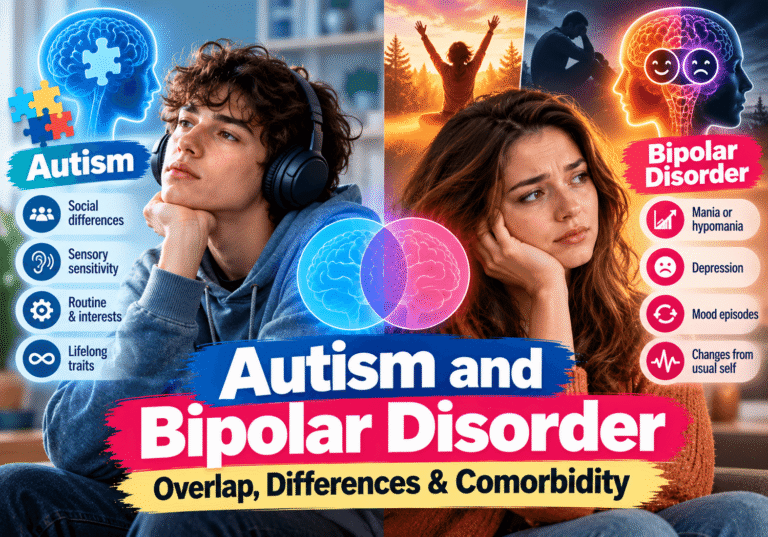
Autism and bipolar disorder are two different conditions that can look alike and can also happen together:
- Autism spectrum disorder (ASD) is a lifelong neurodevelopmental condition that shapes how a person communicates, processes sensory input and experiences the world.
- Bipolar disorder is a mood disorder marked by episodes of mania or hypomania and depression.
Research shows bipolar disorder is more common in autistic people than in the general population. The overlap in symptoms means one is often mistaken for the other. Autistic meltdowns can be misread as mood swings, intense special interests as hypomania, and autistic burnout as depression. Getting the diagnosis right matters, because the treatments are different.
This guide covers:
- how often autism and bipolar disorder co-occur
- the similarities and key differences
- what bipolar disorder looks like in autistic people
- misdiagnosis risks in women and children
- how ADHD and schizophrenia fit into the picture
- how comorbid autism and bipolar disorder are treated
Key takeaways
- Yes, you can have autism and bipolar disorder together, and you can be diagnosed with both.
- A large 2019 meta-analysis estimated that about 5% of autistic people have bipolar disorder, compared with roughly 1–3% of the general population.
- Autism traits are lifelong and consistent; bipolar symptoms come in episodes that are a change from the person’s usual self.
- Autism and bipolar disorder share some genetic risk, and bipolar or schizophrenia in a parent or sibling is linked to a higher chance of autism.
- Autistic women and children are especially at risk of misdiagnosis.
- Treatment works best when both conditions are recognized and care is adapted to autistic needs.
What Is Autism Spectrum Disorder?
Autism spectrum disorder is a neurodevelopmental condition: the brain develops differently from early childhood. The DSM-5-TR describes two core areas:
- Differences in social communication and interaction, such as reading unspoken social rules, back-and-forth conversation, or eye contact and body language.
- Restricted and repetitive patterns, such as a strong need for routine, intense focused interests, repetitive movements or speech (stimming), and sensory sensitivities (over- or under-sensitivity to sound, light, touch, taste or smell).
Autistic traits are present from early development, although they may not be recognized until later. This is especially true when someone has learned to mask (camouflage) their traits to fit in.
High-functioning autism is an informal term for autistic people without intellectual disability who may need less visible support. Clinicians increasingly use “Level 1 autism” instead, and many autistic people prefer to describe their specific support needs. People who “function well” on the outside often struggle with exhaustion, anxiety and burnout behind the scenes.
What Is Bipolar Disorder?
Bipolar disorder is a mood disorder with distinct episodes that differ clearly from a person’s usual self:
- Bipolar I: at least one manic episode, lasting 7 days or more or requiring hospitalization. Depression is common.
- Bipolar II: hypomanic episodes (at least 4 days, less severe) and major depressive episodes.
- Cyclothymia: long-lasting milder ups and downs.
Mania and hypomania involve:
- elevated or irritable mood
- increased energy
- decreased need for sleep
- racing thoughts
- pressured speech
- grandiosity
- risky behavior
Learn the signs of hypomania vs normal happiness and the early warning signs of a bipolar episode.
Can You Have Autism and Bipolar Disorder? (Comorbidity)
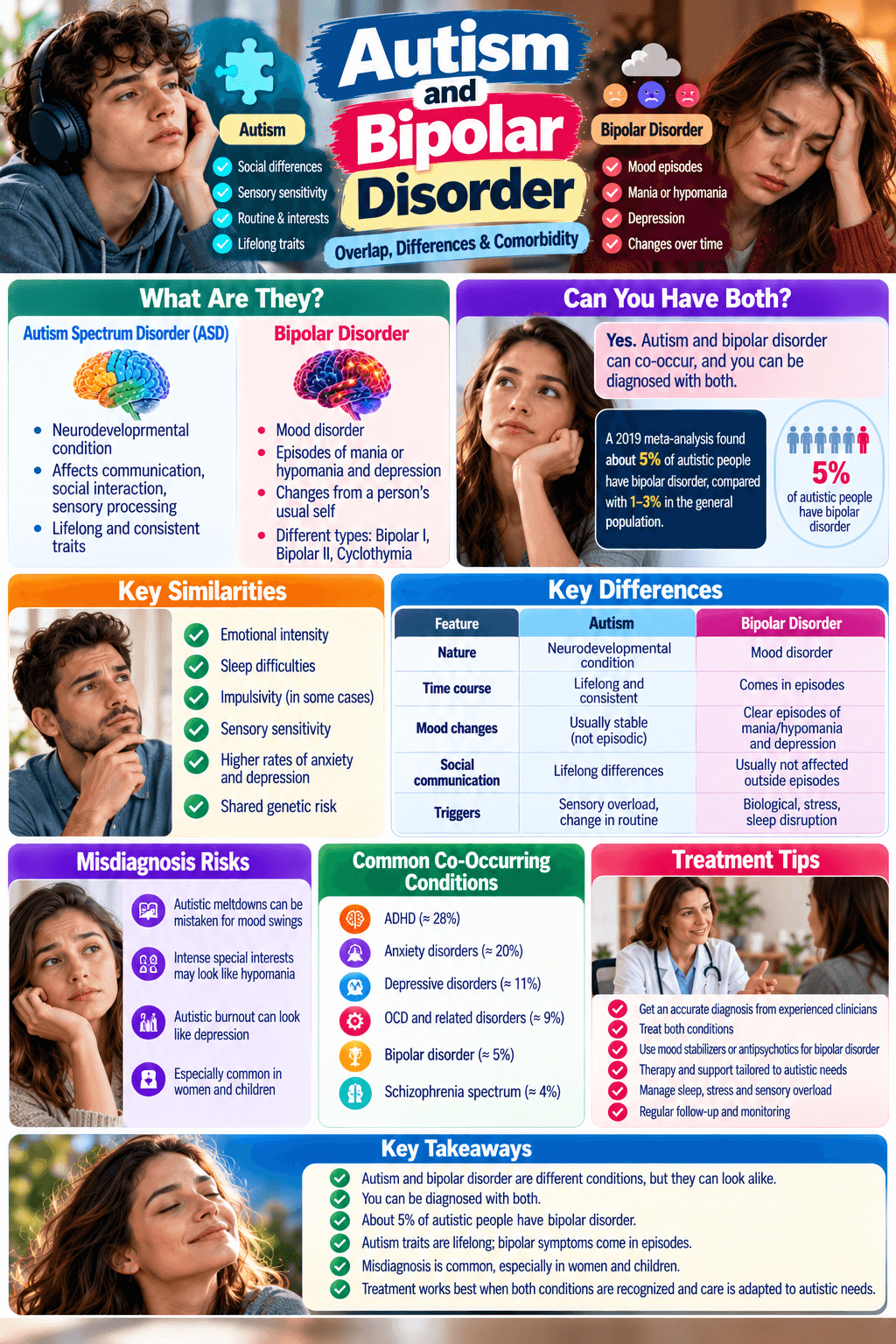
Yes. Autism and bipolar disorder can co-occur, and a person can be diagnosed with both. The DSM-5-TR allows both diagnoses when criteria for each are met.
How common is comorbid autism and bipolar disorder?
A 2019 meta-analysis in The Lancet Psychiatry (Lai et al.) pooled 96 studies and estimated these rates of co-occurring conditions in autistic people:
| Condition | Estimated prevalence in autistic people |
|---|---|
| ADHD | 28% |
| Anxiety disorders | 20% |
| Depressive disorders | 11% |
| Obsessive-compulsive and related disorders | 9% |
| Bipolar and related disorders | 5% |
| Schizophrenia spectrum and psychosis | 4% |
Rates of depression, bipolar disorder and psychosis were higher in studies of autistic adults, which fits with these conditions usually starting in adolescence or adulthood. Estimates vary widely between studies because bipolar disorder is hard to diagnose in autistic people.
Are autism and bipolar disorder related?
There does appear to be a link, although it is far from simple:
- Shared genetics. Large genetic studies show partial overlap in genetic risk between autism, bipolar disorder and schizophrenia. The overlap is stronger between bipolar disorder and schizophrenia than between autism and bipolar disorder.
- Family history. A large Swedish and Israeli study (Sullivan et al., 2012) found that having a parent or sibling with schizophrenia was linked to roughly 2.5–3 times the risk of autism. A family history of bipolar disorder showed a similar but smaller link.
- Life stress. Chronic stress, social exclusion, sleep disruption and burnout, which are common in autistic lives, can contribute to mood problems in people who are already vulnerable.
Autism does not cause bipolar disorder, and bipolar disorder is not a symptom of autism. They are separate conditions that sometimes share risk factors. See what causes bipolar disorder in the brain and is bipolar disorder neurodivergent?.
Autism and Bipolar Disorder Similarities: Why They Get Confused
The overlap between autism and bipolar disorder lies in behaviors that can look the same at a single moment in time:
| Feature | In autism | In bipolar mania/hypomania |
|---|---|---|
| Talking a lot | Long, detailed talk about special interests; a stable, lifelong style | Rapid, pressured speech that’s hard to interrupt, during an episode |
| Intense focus | Long-lasting special interests that bring joy and calm | New, grand projects that start suddenly and fade when the episode ends |
| Irritability / outbursts | Meltdowns triggered by sensory overload, change or demands; ease when the trigger is removed | Irritable mood lasting days, often without a clear trigger |
| Sleep problems | Long-standing insomnia or unusual sleep patterns; the person feels tired | Sleeping only 2–4 hours and not feeling tired |
| Social withdrawal | Baseline preference, or recovery from social overload | Mainly during depressive episodes |
| Restlessness / movement | Stimming that is soothing and regulating | Agitation that feels driven and uncomfortable |
| Low mood and exhaustion | Autistic burnout after long periods of masking or overload | A depressive episode with low mood, loss of interest and other symptoms |
| Emotional intensity | Difficulty regulating emotions, often with strong, quick reactions | Sustained mood states lasting days to weeks |
Emotional dysregulation is common in autism, ADHD, BPD and bipolar disorder, so it cannot tell them apart on its own. See bipolar vs emotional dysregulation and sudden mood swings in adults.
Difference Between Autism and Bipolar Disorder
Clinicians look at three key questions.
1. Has it always been this way, or is it a change?
- Autism is developmental. Traits are present from childhood and stay fairly stable, even if masked.
- Bipolar disorder is episodic. There is a clear “before and after”, a period when the person is noticeably different from their usual self.
2. How long does it last, and does it come in episodes?
- Autistic distress (meltdowns, shutdowns) is usually tied to a trigger and settles over minutes to hours once the person is regulated.
- Hypomania lasts at least 4 days and mania at least 7, with most of the day affected.
3. What drives the behavior?
- In autism: sensory overload, unexpected change, social demands, or a passionate interest.
- In mania: a shift in mood and energy, with grandiosity, racing thoughts and little need for sleep.
The sleep clue is often the most useful. An autistic person with insomnia usually feels exhausted. A person in mania sleeps very little but feels energized.
| Autism | Bipolar disorder | |
|---|---|---|
| Type of condition | Neurodevelopmental | Mood disorder |
| Onset | Early childhood (may be recognized later) | Usually late teens to 20s |
| Course | Lifelong, stable traits | Episodes with periods of stability between |
| Core features | Social communication differences, repetitive behaviors, sensory differences | Mania/hypomania and depression |
| Main treatments | Support, accommodations, therapy for co-occurring issues | Mood stabilizers, some antipsychotics, psychotherapy |
What Does Bipolar Disorder Look Like in Autistic People?
When someone is autistic and has bipolar disorder, mood episodes appear on top of their usual autistic baseline. Family members and the person themselves are often the best judges of what is “new”. Possible signs of a manic or hypomanic episode in an autistic person:
- Clearly less sleep without tiredness, a change from their usual pattern
- Speech that’s faster, louder or more pressured than their usual style
- Special interests becoming frantic or grandiose, such as huge spending, unrealistic plans or beliefs about special powers or importance
- More stimming or restlessness, which feels driven rather than soothing
- Unusual social disinhibition: approaching strangers, oversharing or risky behavior that’s out of character
- Irritability or aggression lasting days, not tied to sensory triggers
- Loss of usual routines in a person who normally relies on them
Depressive episodes may show up as:
- withdrawal from special interests that usually bring joy
- more shutdowns
- changes in sleep and appetite
- loss of skills
- talk of hopelessness
A mood diary tracking sleep, energy, mood and triggers over weeks to months is one of the best tools for telling bipolar episodes apart from autistic responses to overload.
Autism and Bipolar Disorder in Women
Autistic women and girls are often diagnosed later than males, partly because they are more likely to:
- mask or camouflage autistic traits
- have socially “typical-looking” interests
- turn distress inward, as anxiety, depression or eating problems
As a result, many autistic women first receive other diagnoses, such as anxiety, depression, borderline personality disorder or bipolar disorder, before autism is recognized. Some have bipolar disorder too; others were misdiagnosed. Emotional intensity, shutdowns after social events and exhaustion from masking can be mistaken for mood episodes.
If your “mood swings” are closely tied to sensory overload, social exhaustion or changes in routine, and you’ve always felt different, ask about an autism assessment. If you have clear episodes of reduced sleep need and high energy, bipolar disorder should still be assessed. See bipolar vs autism in females, bipolar symptoms in females and BPD in women.
Autism and Bipolar Disorder in Children
Diagnosing bipolar disorder in autistic children is especially difficult:
- Irritability and outbursts are common in autistic children, often from sensory overload, communication difficulty or anxiety. They usually don’t mean bipolar disorder.
- Chronic, severe irritability without distinct episodes may fit disruptive mood dysregulation disorder (DMDD) better than bipolar disorder.
- True bipolar disorder in children is relatively uncommon and requires distinct episodes of mania or hypomania.
Risperidone and aripiprazole are FDA-approved to treat irritability associated with autism in children. This is not a sign of bipolar disorder, even though the same medicines are also used for bipolar disorder.
Parents should keep a record of behavior, sleep and mood, and seek a child psychiatrist experienced in both autism and mood disorders. See emotional dysregulation in children.
Autism and Bipolar Disorder Misdiagnosis
Misdiagnosis can happen in both directions:
- Autism misdiagnosed as bipolar disorder: meltdowns read as mixed episodes, special interests as hypomania, lifelong sleep differences as mood cycling, or burnout as bipolar depression.
- Bipolar disorder missed in autistic people: mood changes put down to “just autism” (“diagnostic overshadowing”), especially in people with limited speech.
Why it matters:
- Unnecessary mood stabilizers or antipsychotics bring side effects without benefit.
- Missed bipolar disorder can mean dangerous untreated mania, or antidepressants given without mood protection.
- The right diagnosis opens the door to autism-informed support and accommodations.
ADHD, Autism and Bipolar Disorder
ADHD is the most common co-occurring condition in autism (about 28%) and also commonly occurs with bipolar disorder. All three can involve:
- distractibility
- impulsivity
- emotional dysregulation
- sleep problems
Key differences:
- ADHD symptoms are lifelong and constant, not episodic.
- Bipolar symptoms come in episodes, with a change in mood and sleep need.
Medication matters. Research suggests stimulant ADHD medication taken without a mood stabilizer may increase the risk of mania in people with bipolar disorder, while the risk appears lower when a mood stabilizer is also taken. Antidepressants alone carry a similar concern. This is why a careful assessment for bipolar disorder matters before treating ADHD or depression in autistic people.
See ADHD and depression, ADHD and anxiety and BPD vs ADHD.
Autism, Schizophrenia and Bipolar Disorder
Autism, schizophrenia and bipolar disorder share some genetic risk, and all three can involve social withdrawal or unusual thinking. Key distinctions:
- Autistic people may have literal or unusual thinking styles that are not psychosis.
- Psychosis, meaning hallucinations and fixed false beliefs, can occur in schizophrenia and in severe bipolar episodes, and occurs more often in autistic people than in the general population.
- Catatonia, unusual slowing or freezing of movement and speech, can occur in autism, bipolar disorder and schizophrenia, and needs urgent assessment.
See autism and hallucinations and schizoaffective disorder.
How Are Autism and Bipolar Disorder Diagnosed?
There is no single “autism and bipolar test”. Online quizzes can prompt a conversation, but they cannot diagnose. A thorough assessment usually includes:
- Developmental history from early childhood, often with input from parents or others who knew you then
- Autism assessment tools, such as the ADOS-2 and ADI-R, by an experienced clinician
- A detailed mood history: dates and lengths of episodes, sleep, energy, and family history of bipolar disorder
- Mood and sleep tracking over weeks to months
- Ruling out other causes: thyroid problems, substances, medication effects, trauma, ADHD, BPD
The best evaluations come from clinicians experienced in both autism and mood disorders who can look past masking.
Treatment for Autism and Bipolar Disorder Together
Effective treatment addresses bipolar disorder and respects autistic needs.
Medication
- Mood stabilizers and antipsychotics are the foundation of bipolar treatment: lithium, lamotrigine, valproate, and some atypical antipsychotics.
- “Start low, go slow.” Many autistic people report sensitivity to medications and side effects, so prescribers often begin with lower doses and adjust gradually.
- Communication about side effects. Some autistic people find it hard to describe internal sensations (interoception). Clear check-ins, written lists and caregiver input help.
- Caution with antidepressants and stimulants when bipolar disorder is present or suspected, as above.
Therapy and support
- Psychoeducation for the person and family about mood episodes and autistic traits
- Interpersonal and social rhythm therapy (IPSRT), which stabilizes daily routines (sleep, meals, activity) and often suits autistic preferences for structure. See the best therapy for bipolar disorder.
- Adapted CBT or DBT with concrete, visual and literal approaches and attention to sensory needs. See emotional dysregulation therapy.
- Sensory and environmental adjustments to reduce overload, which can lower stress and mood instability
- Burnout prevention: reducing masking where safe, building in recovery time, workplace and school accommodations
Daily stability
- Protect regular sleep, which helps both conditions. See bipolar and sleep.
- Keep a mood, sleep and sensory diary.
- Agree an early warning plan with family or supporters.
Autism and Bipolar Disorder on Reddit: Lived Experience
Online communities, including Reddit threads on “autism and bipolar disorder” and “high-functioning autism and bipolar”, are full of people sharing experiences. Common themes:
- being diagnosed with bipolar disorder first and autism years later
- learning to tell burnout from depression
- struggling with medication side effects
- relief at finally having the right explanation
These communities can reduce isolation. But self-diagnosis based on others’ stories can miss important differences. Use them for support and questions, not as a replacement for assessment.
If you are in crisis: call or text 988 (Suicide & Crisis Lifeline, US) or go to the nearest emergency department. Outside the US, contact your local emergency number.
Frequently Asked Questions About Autism and Bipolar Disorder
Can you have autism and bipolar disorder?
Yes. They can co-occur, and both can be diagnosed when criteria for each are met. About 5% of autistic people have bipolar disorder, according to a large meta-analysis.
Are autism and bipolar disorder related?
They share some genetic risk, and family history of bipolar disorder or schizophrenia is linked to higher autism risk, but one does not cause the other.
What is the difference between autism and bipolar disorder?
Autism is a lifelong neurodevelopmental condition with stable traits; bipolar disorder is a mood disorder with distinct episodes of mania or hypomania and depression.
Can autism be misdiagnosed as bipolar disorder?
Yes. Meltdowns, intense interests, sleep differences and burnout can be mistaken for bipolar symptoms, especially in women and in people diagnosed with autism as adults.
Do autistic people experience mania?
Autism itself doesn’t cause mania. If an autistic person has true manic episodes, they likely have co-occurring bipolar disorder.
Can you be diagnosed with autism and bipolar disorder as an adult?
Yes. Many people, especially women, receive an autism diagnosis in adulthood, sometimes after a bipolar diagnosis.
What medication is used for autism and bipolar disorder?
Bipolar disorder is treated with mood stabilizers and/or certain antipsychotics. There is no medication for autism itself, but some medicines treat related problems such as irritability. Doses are often started low.
The Bottom Line on Autism and Bipolar Disorder
Autism and bipolar disorder are different conditions: one a lifelong neurodevelopmental difference, the other an episodic mood disorder. But they overlap in symptoms, share some genetic risk, and co-occur more often than chance would predict. The keys to the right diagnosis are a full developmental history, careful tracking of mood and sleep over time, and a clinician who understands both. With accurate diagnosis and autism-informed treatment, people with autism, bipolar disorder or both can find real stability.
References
- Lai MC, Kassee C, Besney R, et al. Prevalence of co-occurring mental health diagnoses in the autism population: a systematic review and meta-analysis. Lancet Psychiatry. 2019;6(10):819–829.
- Sullivan PF, Magnusson C, Reichenberg A, et al. Family history of schizophrenia and bipolar disorder as risk factors for autism. Archives of General Psychiatry. 2012;69(11):1099–1103.
- National Institute of Mental Health. Autism Spectrum Disorder.
- National Institute of Mental Health. Bipolar Disorder.
- American Psychiatric Association. Diagnostic and Statistical Manual of Mental Disorders, 5th ed., Text Revision (DSM-5-TR). 2022.
Related Posts


Subscribe to Our Newsletter
Get mental health tips, updates, and resources delivered to your inbox.
MORE from Author
Read More ADHD and depression often occur together, and each makes the other harder to live with. Adults with ADHD are almost…
 We all have "up" days and "down" days. Perhaps you feel energized after a promotion or sluggish on a rainy…
 To define bipolar disorder accurately, we must look at it as a chronic mood dysregulation condition. In psychology and medicine,…
Are you looking for a Therapist?
Connect with qualified mental health professionals who understand
bipolar disorder, mood changes, and emotional challenges.
Private • Supportive • Confidential