
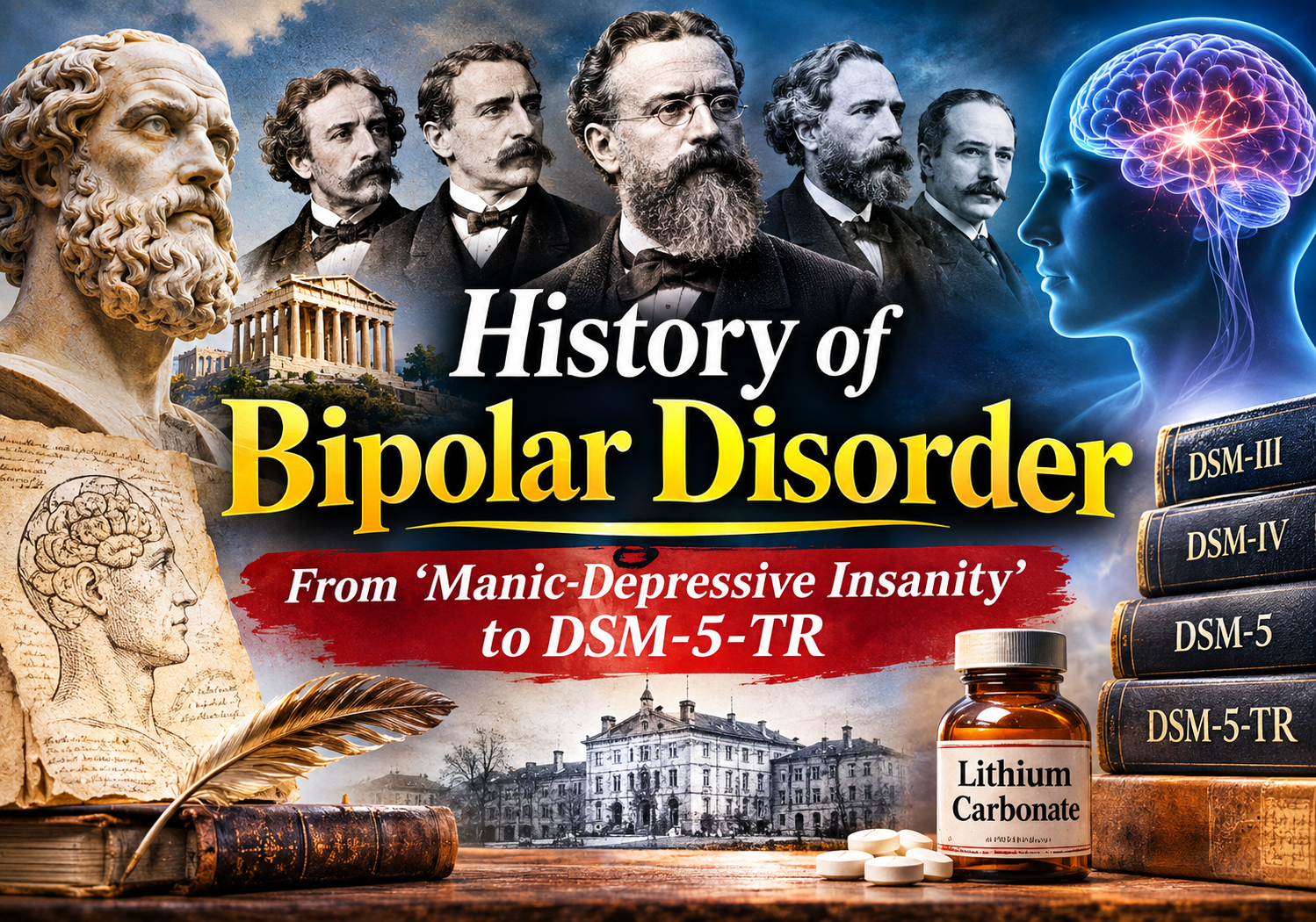
History of Bipolar Disorder: From “Manic-Depressive Insanity” to DSM-5-TR

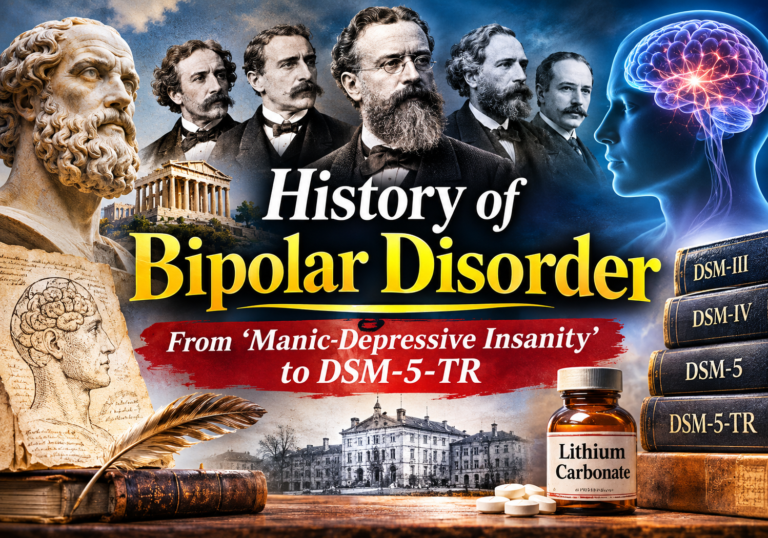
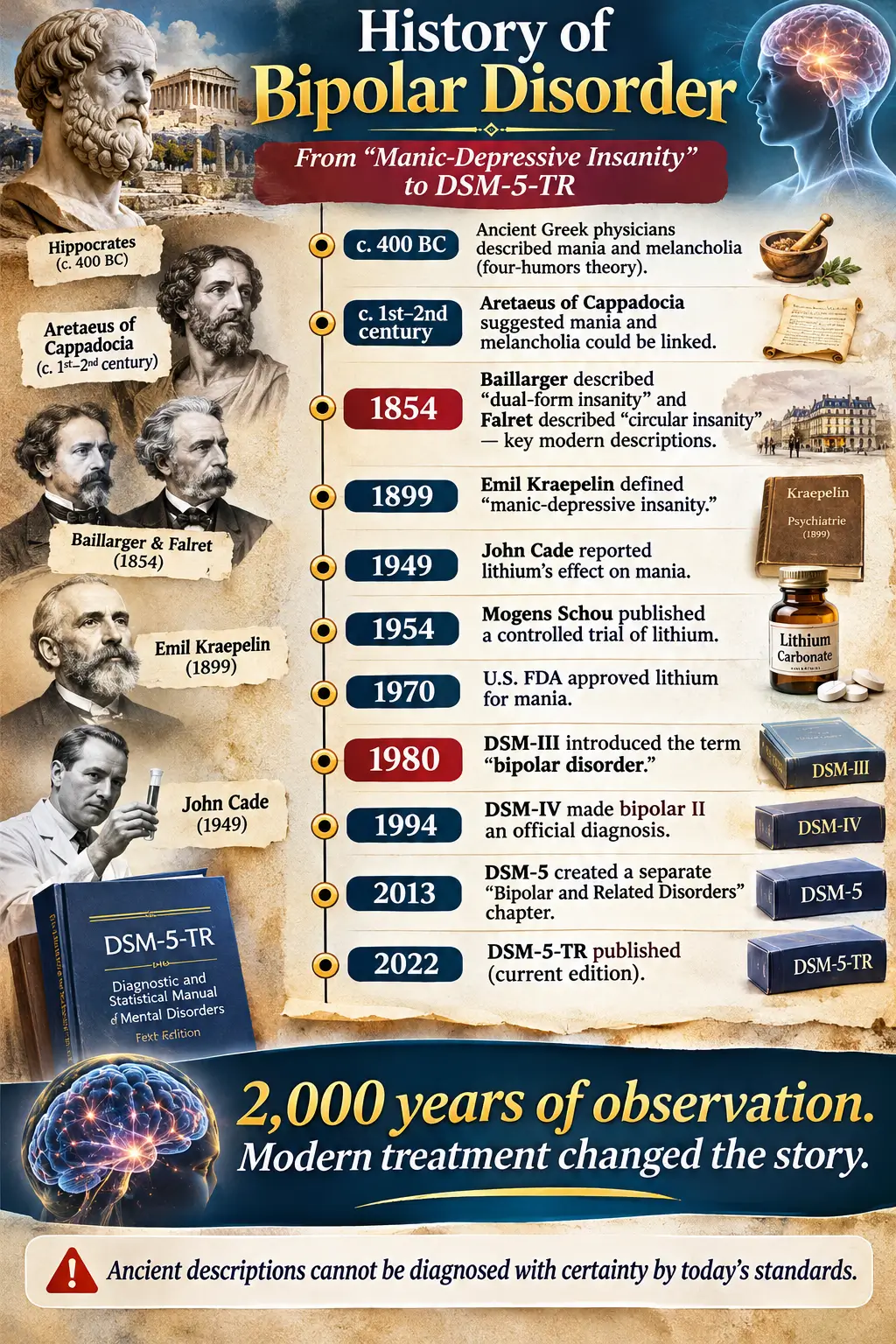
The history of bipolar disorder stretches back about 2,000 years. Ancient Greek physicians described mania and melancholia. Aretaeus of Cappadocia, writing in the 1st or 2nd century AD, was among the first to suggest they might be linked. In the 1850s, French psychiatrists Jean-Pierre Falret and Jules Baillarger described a “circular” illness of alternating moods. In 1899, German psychiatrist Emil Kraepelin named it “manic-depressive insanity.” The term “bipolar disorder” became official in the American Psychiatric Association’s DSM-III in 1980. Effective treatment arrived only in the 20th century, with lithium — first reported by John Cade in 1949 and approved in the U.S. in 1970.
This guide traces the full story: what ancient doctors believed, who discovered manic depression, why it was renamed bipolar disorder, how diagnosis and treatment changed over time, and where the field stands today.
Key takeaways
- Mania and melancholia were described in ancient Greece, but they weren’t understood as one illness until much later.
- Aretaeus of Cappadocia (c. 1st–2nd century AD) is often credited as the first to link the two.
- Falret’s “circular insanity” and Baillarger’s “dual-form insanity” (1850s) were the first modern descriptions of bipolar disorder.
- Emil Kraepelin created the concept of manic-depressive insanity in 1899.
- Karl Leonhard separated bipolar from unipolar depression in 1957. “Bipolar disorder” entered the DSM in 1980, and bipolar II became official in 1994.
- Lithium transformed treatment. Cade reported it in 1949, Schou tested it in a controlled trial in 1954, and the FDA approved it in 1970.
For today’s understanding of symptoms, causes and treatment, see our complete guide to bipolar disorder.
What Is the History of Bipolar Disorder?
The history of bipolar disorder is really three intertwined stories:
- Recognition — how physicians noticed that some people swing between extreme highs and lows
- Classification — how those observations became a named, defined illness, separate from other conditions
- Treatment — how care moved from bloodletting and asylums to lithium, modern medication and psychotherapy
One caution runs through all of it. Old terms don’t map neatly onto modern diagnoses. Ancient “mania” covered many kinds of agitation and psychosis, and “melancholia” covered many kinds of sadness and despair. Historians can see patterns that resemble bipolar disorder, but they can’t diagnose people from the distant past with certainty.
History of Bipolar Disorder Timeline
| Year | Milestone |
|---|---|
| c. 400 BC | Hippocratic writers describe melancholia and mania, explained by the “four humors” |
| c. 1st–2nd century AD | Aretaeus of Cappadocia links mania and melancholia as possibly one illness |
| c. 2nd century AD | Soranus of Ephesus treats them as separate, while noting others thought them related |
| 1621 | Robert Burton publishes The Anatomy of Melancholy |
| 1686 | Théophile Bonet is often credited with describing a mixed “manico-melancholicus” condition |
| 1854 | Jules Baillarger describes folie à double forme (Jan 31); Jean-Pierre Falret presents folie circulaire (Feb 14) |
| 1871 | William Hammond recommends lithium for mania |
| 1882 | Karl Kahlbaum describes cyclothymia |
| 1899 | Emil Kraepelin defines manic-depressive insanity in the 6th edition of his textbook |
| 1938 | Electroconvulsive therapy (ECT) is introduced in Italy |
| 1949 | John Cade reports lithium’s effect on mania in Australia |
| 1952 | DSM-I uses “manic-depressive reaction”; chlorpromazine, the first antipsychotic, is introduced |
| 1954 | Mogens Schou publishes a controlled trial of lithium in mania |
| 1957 | Karl Leonhard separates bipolar from unipolar illness |
| 1966 | Jules Angst and Carlo Perris independently confirm the bipolar–unipolar distinction |
| 1968 | DSM-II uses “manic-depressive illness” |
| 1970 | U.S. FDA approves lithium for mania |
| 1976 | Dunner and colleagues describe bipolar II |
| 1980 | DSM-III introduces the term “bipolar disorder” |
| 1994 | DSM-IV makes bipolar II an official diagnosis |
| 1995 | FDA approves divalproex (valproate) for mania |
| 2000s | Atypical antipsychotics and lamotrigine are approved for bipolar disorder |
| 2013 | DSM-5 creates a separate “Bipolar and Related Disorders” chapter |
| 2014 | First World Bipolar Day (March 30) |
| 2022 | DSM-5-TR published; ICD-11 takes effect |
Early Descriptions of Mania and Melancholia
Ancient Greece: the four humors
In the Hippocratic tradition (around the 5th–4th centuries BC), health depended on balancing four bodily fluids: blood, phlegm, yellow bile and black bile. Melancholia literally means “black bile,” which was believed to cause fear and despondency. Mania described states of frenzy, agitation or excitement, often linked to yellow bile or heat.
This was a revolutionary idea for its time. It explained mental illness through the body and the brain, not through gods, curses or spirits. The theory was wrong in its details, but it set medicine on a path toward biological explanations.
Aretaeus of Cappadocia: the first link
The Greek physician Aretaeus of Cappadocia, who lived around the 1st or 2nd century AD, wrote vivid descriptions of both states. He suggested that some people moved from melancholia to mania, and that the two might share a common origin. Many historians credit him with the earliest known description of something resembling bipolar disorder. He described patients who were cheerful, overactive and grandiose at one time, and sluggish, sad and withdrawn at another.
Soranus and the Roman world
Soranus of Ephesus (2nd century AD) treated mania and melancholia as separate diseases, while acknowledging that “many others” considered them related. Roman-era treatments included baths, diet, rest, music and — for agitation — restraint. Interestingly, he recommended alkaline mineral waters, some of which may have contained lithium, though no one knew it then.
Medieval and Renaissance views
Medieval physicians in the Islamic world and Europe largely preserved and built on Greek ideas about melancholia. In some periods and places, mental illness was also linked to sin or possession. Robert Burton’s encyclopedic The Anatomy of Melancholy (1621) explored sadness and despair from every angle. In 1686, the Swiss physician Théophile Bonet is often credited with describing a “manico-melancholicus” condition that combined the two states.
When Was Bipolar Disorder First Recognized? The 1850s
The modern origin of bipolar disorder as a distinct illness is usually dated to 1854 in Paris.
Jean-Pierre Falret and “circular insanity”
French psychiatrist Jean-Pierre Falret described folie circulaire — “circular insanity.” It was an illness in which patients cycled through depression and mania, often with symptom-free intervals between episodes. He had worked on the idea for years and formally presented it in February 1854. He also noticed that the illness tended to run in families, an observation confirmed by modern genetics.
Jules Baillarger and “dual-form insanity”
Just two weeks earlier, on January 31, 1854, Jules Baillarger described folie à double forme — “insanity in double form” — to the French Imperial Academy of Medicine. He emphasized that mania and melancholia could be two phases of one disease rather than two diseases. The two men disputed who had the idea first. Historians generally credit both with founding the modern concept.
Kahlbaum and cyclothymia
In 1882, German psychiatrist Karl Kahlbaum described cyclothymia: milder, cycling mood changes that didn’t reach the severity of full “insanity.” Today, cyclothymic disorder remains part of the bipolar spectrum.
Who Discovered Manic Depression? Emil Kraepelin
German psychiatrist Emil Kraepelin (1856–1926) is often called the father of modern psychiatric classification. Rather than classifying illnesses by symptoms alone, he followed patients over many years and grouped conditions by their course and outcome.
In 1899, in the sixth edition of his influential textbook, Kraepelin introduced “manic-depressive insanity” (manisch-depressives Irresein). He drew a sharp line between:
- Manic-depressive insanity — an episodic illness with periods of recovery between episodes, and a relatively better long-term outcome
- Dementia praecox (later renamed schizophrenia) — which he believed followed a chronic, deteriorating course
This “Kraepelinian dichotomy” shaped psychiatry for more than a century. Kraepelin’s concept was broad. It included what we would now call bipolar disorder, recurrent depression and some mixed states. In fact, he described mixed states in considerable detail. You can see his influence today in our guides to bipolar mixed episode and recurrent major depressive disorder. The boundary he drew between mood and psychotic illness is still debated — see schizoaffective disorder.
Important Pioneers in the History of Bipolar Disorder
| Pioneer | Contribution |
|---|---|
| Aretaeus of Cappadocia | Early link between mania and melancholia |
| Jean-Pierre Falret | Folie circulaire (circular insanity); noted family patterns |
| Jules Baillarger | Folie à double forme (dual-form insanity) |
| Karl Kahlbaum | Described cyclothymia |
| Emil Kraepelin | Defined manic-depressive insanity; classified by course |
| Karl Leonhard | Separated bipolar from unipolar illness (1957) |
| Jules Angst and Carlo Perris | Confirmed the bipolar–unipolar split with family and course data (1966) |
| John Cade | Discovered lithium’s effect on mania (1949) |
| Mogens Schou | Proved lithium’s effectiveness in controlled trials |
| David Dunner and colleagues | Described bipolar II (1976) |
| Kay Redfield Jamison | Research and memoir (An Unquiet Mind) that transformed public understanding |
Why Was Bipolar Disorder Previously Called Manic Depression?
Historical names for bipolar disorder
| Name | Era |
|---|---|
| Mania and melancholia | Ancient Greece and Rome |
| Folie circulaire (circular insanity) | 1850s, France |
| Folie à double forme (dual-form insanity) | 1850s, France |
| Manic-depressive insanity / psychosis | 1899 (Kraepelin) |
| Manic-depressive reaction | 1952 (DSM-I) |
| Manic-depressive illness | 1968 (DSM-II, ICD-8) |
| Bipolar affective disorder | ICD-9 and ICD-10 era |
| Bipolar disorder | 1980 onward (DSM-III and later) |
From “manic depression” to “bipolar disorder”
The term bipolar comes from Karl Leonhard. In 1957 he divided mood disorders into bipolar (people who experience mania as well as depression) and monopolar or unipolar (depression only). In 1966, Jules Angst in Switzerland and Carlo Perris in Sweden independently confirmed that the two groups differed in family history, age of onset and course. This was strong evidence that they were distinct conditions.
When the American Psychiatric Association published DSM-III in 1980, “manic-depressive illness” was replaced by “bipolar disorder.” The change reflected several goals:
- Precision — the new term separated bipolar illness from unipolar depression, which Kraepelin’s broad “manic-depressive” concept had included
- Description — it named the two mood “poles” rather than implying constant psychosis
- Less stigma — many people found “manic” and “insanity” frightening labels
Some people, including some clinicians and people with lived experience, still prefer the older term “manic depression.” They feel it captures the reality of the illness better. See is manic depression the same as bipolar?
How Bipolar Disorder Diagnosis Has Evolved
DSM-I to DSM-II (1952–1968)
The first two editions of the DSM were shaped by psychoanalytic ideas. DSM-I described a “manic-depressive reaction”, framing mental illness as a reaction to life stresses. DSM-II used “manic-depressive illness.” Diagnoses were loosely defined, and agreement between psychiatrists was poor. In the U.S., many people who would now be diagnosed with bipolar disorder were labeled with schizophrenia.
DSM-III (1980): a turning point
DSM-III introduced explicit diagnostic criteria, separated bipolar disorder from major depression, and required a history of mania for a bipolar diagnosis. It made psychiatric diagnosis far more reliable and paved the way for modern research.
Bipolar II and DSM-IV (1994)
In 1976, researchers led by David Dunner described patients who had depression plus hypomania — milder highs without full mania. DSM-IV (1994) made bipolar II an official diagnosis, alongside bipolar I and cyclothymia. This recognized that many people with recurrent depression actually had a bipolar illness. See bipolar type 2, what is bipolar 1? and is bipolar 1 or bipolar 2 worse?
DSM-5 (2013) and DSM-5-TR (2022)
DSM-5 moved bipolar disorder into its own chapter, “Bipolar and Related Disorders,” placed between psychotic disorders and depressive disorders. Key changes included:
- Increased energy or activity became a core criterion for mania and hypomania, not just mood change
- The “mixed episode” was replaced by a “with mixed features” specifier, which can apply to any episode
- Mania emerging during antidepressant treatment, and persisting beyond the drug’s effect, can count toward a bipolar diagnosis
- New categories for other specified and unspecified bipolar disorders
DSM-5-TR (2022) updated the text while keeping the criteria largely the same. See what are the 7 types of bipolar disorder?, bipolar 2 criteria, manic switch and is bipolar disorder a personality disorder?
ICD classification
The World Health Organization’s International Classification of Diseases followed a similar path. ICD-10 (1990s) used F31 bipolar affective disorder. ICD-11, which took effect in 2022, uses codes 6A60–6A62 for bipolar type I, bipolar type II and cyclothymic disorder. See bipolar disorder and ICD-10.
The pediatric bipolar controversy
In the 2000s, U.S. diagnoses of bipolar disorder in children rose dramatically. A 2007 study in Archives of General Psychiatry found that office visits for youth with a bipolar diagnosis rose about 40-fold between 1994–95 and 2002–03. The jump fueled debate about overdiagnosis and how mania presents in children. Partly in response, DSM-5 introduced disruptive mood dysregulation disorder (DMDD) for children with chronic, severe irritability but not episodic mania. See emotional dysregulation in children.
History of Bipolar Disorder Treatment
How was bipolar disorder treated in the past?
For most of history, treatments were limited and often harsh:
- Ancient and medieval: diet, baths, bloodletting, purging, rest, music and herbal remedies, guided by humoral theory
- 17th–18th centuries: confinement, restraint and “moral” or religious explanations
- 19th century: the rise of asylums and “moral treatment,” which emphasized calm, routine and humane care, along with sedatives such as bromides and chloral hydrate
- Early 20th century: prolonged sleep therapy, insulin coma therapy, fever therapy and other experimental treatments, plus long hospital stays
None of these reliably prevented episodes. Kraepelin documented the natural course of untreated manic-depressive illness, with recurring episodes over a lifetime, because effective treatment didn’t yet exist.
Electroconvulsive therapy (1938)
ECT was introduced in Italy in 1938 by Ugo Cerletti and Lucio Bini. It proved highly effective for severe depression and mania. Early ECT was given without anesthesia and was sometimes misused, which gave it a frightening reputation. Modern ECT is performed under anesthesia with muscle relaxants and remains one of the most effective treatments for severe or treatment-resistant mood episodes.
The lithium revolution
Lithium’s story is one of the most remarkable in medicine:
- 1800s: Lithium was used for gout and “uric acid” conditions. In 1871, American physician William Hammond recommended lithium bromide for mania. In Denmark, the Lange brothers used lithium for recurrent depression. These early uses were largely forgotten.
- 1949: Australian psychiatrist John Cade reported that lithium calmed patients with mania in the Medical Journal of Australia. Interest was muted, partly because of safety concerns after lithium chloride salt substitutes caused poisonings around the same time.
- 1954: Danish psychiatrist Mogens Schou published a controlled trial confirming lithium’s effect in mania. He spent decades proving it could also prevent episodes.
- 1958: New lab equipment made it practical to measure lithium blood levels, making treatment safer.
- 1970: The U.S. FDA approved lithium for mania, followed by approval to prevent mania in 1975.
Lithium transformed manic-depressive illness from a condition that often meant years in hospital into one that many people could manage in the community. It remains the gold-standard maintenance treatment today and the medication with the best evidence for reducing suicide risk. See lithium, lithium side effects and lithium toxicity symptoms.
How was bipolar disorder treated in the 1960s?
In the 1960s, treatment for manic depression depended heavily on where you lived:
- Lithium was used in parts of Europe, but in the U.S. it wasn’t FDA-approved until 1970. Many American psychiatrists were still skeptical.
- Chlorpromazine (introduced in 1952) and other early antipsychotics were widely used to control mania, often at high doses with significant side effects.
- ECT was common for severe depression and mania.
- Psychoanalytic therapy dominated American psychiatry, even though it did little to prevent manic episodes.
- Long hospital stays were common, though the 1963 Community Mental Health Act began shifting care from large state hospitals toward community services.
- Many people were misdiagnosed with schizophrenia, especially in the U.S.
From mood stabilizers to modern treatment
- 1960s–1970s: Researchers in France and Japan explored the anticonvulsants valproate and carbamazepine for mood disorders.
- 1995: The FDA approved divalproex (valproate) for mania — see valproate.
- 2000s: Atypical antipsychotics such as olanzapine, quetiapine and aripiprazole were approved for bipolar disorder. In 2003, lamotrigine was approved to prevent mood episodes.
- 2010s–2020s: Lurasidone, cariprazine and lumateperone (Caplyta) expanded options for bipolar depression. In 2026, the FDA approved milsaperidone (Bysanti) for bipolar I mania.
Learn more in bipolar disorder medications and mood stabilizers vs antipsychotics.
The rise of psychotherapy and self-management
From the 1980s onward, research showed that psychotherapy alongside medication improves outcomes. Approaches developed specifically for bipolar disorder include:
- psychoeducation
- family-focused therapy
- interpersonal and social rhythm therapy (IPSRT)
- CBT
The large NIMH-funded STEP-BD study in the 2000s showed that intensive psychotherapy sped recovery from bipolar depression. Mood charts and, later, digital mood tracking gave people new tools to manage their illness. See bipolar disorder treatment, what is the best therapy for bipolar disorder?, bipolar mood chart and mood tracking apps for bipolar.
Modern Understanding of Bipolar Disorder
Today, bipolar disorder is understood as a lifelong, highly heritable brain-based mood disorder, shaped by both genes and environment. Key modern insights include:
- Genetics: Falret noticed family patterns in the 1850s. Today, twin studies estimate heritability at around 60–85%, and large genetic studies have identified many contributing gene variants.
- Circadian rhythms: Sleep and body-clock disruption play a central role — see bipolar sleep.
- Brain science: Imaging and biological research point to differences in emotion-regulation circuits, cell signaling and energy metabolism — see what causes bipolar disorder in the brain.
- A spectrum view: Many researchers see a spectrum ranging from cyclothymia to bipolar II and bipolar I — see is bipolar disorder neurodivergent?
- Physical health: People with bipolar disorder face higher rates of heart disease and other conditions, making whole-person care essential.
- Public awareness: Memoirs, celebrity disclosures and advocacy have reduced stigma. World Bipolar Day, held each year on March 30 (Vincent van Gogh’s birthday), began in 2014. See famous people with bipolar disorder and bipolar disorder statistics.
Retrospective diagnoses: a word of caution
Historical figures such as Vincent van Gogh, Virginia Woolf and Robert Schumann are often said to have had bipolar disorder. These are retrospective theories based on letters and biographies, not diagnoses made in their lifetimes. They’re interesting, but they should be treated with caution.
History vs Natural History of Bipolar Disorder
People searching for the “history of bipolar disorder” sometimes mean something different:
- The history of the diagnosis (this article) — how medicine discovered, named and learned to treat the illness
- The natural history of bipolar disorder — how the illness typically unfolds in a person over a lifetime. It usually begins in the late teens or twenties, with recurring episodes; without treatment, episodes may become more frequent. See does bipolar get worse with age? and how long do bipolar episodes last?
- A personal or family history of bipolar disorder — whether you or your relatives have had it. A family history is the strongest known risk factor. See am I bipolar? and our bipolar test.
“History of bipolar disorder” in ICD-10 coding
In medical coding, “history of bipolar disorder” has a specific meaning. In ICD-10-CM:
- F31 codes cover bipolar disorder, including F31.7x for bipolar disorder in remission. Because bipolar disorder is usually lifelong, a person with past episodes is often coded under F31.
- A family history of mental and behavioral disorders is generally coded with Z81.8.
- Z86.59 covers a personal history of other mental and behavioral disorders, but it’s typically used only for conditions that are no longer present.
Coding depends on the clinician’s documentation and official guidelines, so check with a certified coder. See bipolar disorder and ICD-10.
Frequently Asked Questions About the History of Bipolar Disorder
When was bipolar disorder first recognized?
Ancient Greek physicians described mania and melancholia, and Aretaeus of Cappadocia (1st–2nd century AD) suggested they were linked. Bipolar disorder was first recognized as a distinct illness in 1854, when French psychiatrists Jules Baillarger and Jean-Pierre Falret described “dual-form” and “circular” insanity. Emil Kraepelin defined manic-depressive insanity in 1899, and “bipolar disorder” became official in 1980.
Who discovered bipolar disorder?
No single person discovered it. Aretaeus of Cappadocia first linked mania and melancholia in ancient times. Jean-Pierre Falret and Jules Baillarger described the modern illness in 1854, and Emil Kraepelin defined “manic-depressive insanity” in 1899. Karl Leonhard coined the bipolar–unipolar distinction in 1957, which led to the name “bipolar disorder” in DSM-III in 1980.
What was bipolar disorder originally called?
Over the centuries, bipolar disorder has been called mania and melancholia, circular insanity (folie circulaire), dual-form insanity (folie à double forme), manic-depressive insanity, manic-depressive reaction and manic-depressive illness. The name “bipolar disorder” was introduced in the American Psychiatric Association’s DSM-III in 1980, though many people still use the older term “manic depression.”
Why was the name changed from manic depression to bipolar disorder?
The name changed in 1980 with DSM-III. “Bipolar” came from Karl Leonhard’s 1957 distinction between bipolar illness (mania plus depression) and unipolar depression. The new term was more precise, because the older “manic-depressive” concept also included recurrent depression. It described the two mood poles, and it was seen as less stigmatizing than “manic” or “insanity.”
When was lithium first used for bipolar disorder?
Lithium was recommended for mania as early as 1871 by William Hammond, but its modern use began in 1949, when Australian psychiatrist John Cade reported that it calmed manic patients. Mogens Schou confirmed its effect in a controlled trial published in 1954, and the U.S. FDA approved lithium for mania in 1970 and for preventing mania in 1975.
How was bipolar disorder treated in the 1960s?
In the 1960s, treatment included early antipsychotics like chlorpromazine, electroconvulsive therapy, long hospital stays and psychoanalytic therapy. Lithium was used in parts of Europe but wasn’t approved in the U.S. until 1970. Many Americans with manic depression were misdiagnosed with schizophrenia, and community mental health services were only beginning to replace large state hospitals.
How has the understanding of bipolar disorder evolved over time?
Understanding has moved from ancient humoral theories, to 19th-century descriptions of circular insanity, to Kraepelin’s manic-depressive insanity. Leonhard’s bipolar–unipolar split came next, followed by modern criteria in DSM-III, DSM-IV and DSM-5. Today, bipolar disorder is seen as a heritable, brain-based spectrum condition involving circadian rhythms, treated with medication, psychotherapy and self-management.
What are the risk factors for developing bipolar disorder?
The strongest risk factor is a family history of bipolar disorder, since heritability is estimated at around 60–85%. Other factors include major stress, sleep disruption, substance use, childhood adversity, and antidepressant use without a mood stabilizer in people who are vulnerable. Onset is most common in the late teens and twenties. Having risk factors doesn’t mean someone will develop the condition.
The Bottom Line on the History of Bipolar Disorder
The history of bipolar disorder runs from ancient descriptions of mania and melancholia, through Falret’s and Baillarger’s “circular” insanity and Kraepelin’s manic-depressive insanity, to today’s DSM-5-TR and ICD-11. The biggest turning points were:
- Leonhard’s bipolar–unipolar split
- the 1980 renaming to bipolar disorder
- the recognition of bipolar II
- above all, the discovery of lithium, which turned a once-devastating illness into a treatable one
Today’s mix of medication, psychotherapy and self-management is the product of 2,000 years of observation and 70 years of modern science. To learn about the condition as it’s understood now, read our guides to bipolar disorder, bipolar symptoms and bipolar disorder treatment.
References
- Mason BL, Brown ES, Croarkin PE. Historical underpinnings of bipolar disorder diagnostic criteria. Behavioral Sciences. 2016;6(3):14.
- Angst J, Marneros A. Bipolarity from ancient to modern times: conception, birth and rebirth. Journal of Affective Disorders. 2001;67(1–3):3–19.
- Shorter E. The history of lithium therapy. Bipolar Disorders. 2009;11(Suppl 2):4–9.
- Psychiatrist.com / Primary Care Companion for CNS Disorders. History of lithium treatment in psychiatry.
- NIH Intramural Research Program. A sense of calm in bipolar disorder: the clinical trials of lithium.
- National Institute of Mental Health. Rates of bipolar diagnosis in youth rapidly climbing. 2007 (Moreno C, et al. Archives of General Psychiatry. 2007;64(9):1032–1039).
- Psychology Today. A short history of bipolar disorder.
- Wikipedia. History of bipolar disorder (overview; primary sources above).
- American Psychiatric Association. Diagnostic and Statistical Manual of Mental Disorders, 5th ed., Text Revision (DSM-5-TR). 2022.
- National Institute of Mental Health. Bipolar Disorder.

Subscribe to Our Newsletter
Get mental health tips, updates, and resources delivered to your inbox.
MORE from Author
Read More Bipolar mania treatment aims to bring a manic episode under control quickly and safely, then prevent the next one. For…
 The history of bipolar disorder stretches back about 2,000 years. Ancient Greek physicians described mania and melancholia. Aretaeus of Cappadocia,…
 Bipolar daylight saving time questions come up twice a year for good reason. When the clocks change, your sleep, body…
 Bipolar disorder treatment works best as a combination of medication (usually a mood stabilizer such as lithium, or an atypical…
Are you looking for a Therapist?
Connect with qualified mental health professionals who understand
bipolar disorder, mood changes, and emotional challenges.
Private • Supportive • Confidential